
Top 15 Talogy Alternatives and Competitors
Discover 15 powerful Talogy alternatives to streamline your hiring process and assess candidates with confidence.
The best Talogy alternatives are the ones that match how your team actually hires. Talogy is a consulting-led psychometric house built for large, structured programmes. If you need faster setup, published pricing, technical and role-specific testing, or AI interviewing in the same tool, a different platform will fit better.
Talogy is a real institution in this category. It traces its assessment lineage to 1946, and by its own account it runs on more than 75 years of practice, 150 in-house psychologists and psychometricians, and delivery in 160 countries for over 10,000 organizations. That depth is the product. It is also the reason teams outgrow it: the buying motion is consultative, the pricing is quote-only, and the catalogue leans toward personality, cognitive and situational-judgement work rather than coding tests or work samples.
TL;DR
- Talogy suits organizations that want validated psychometrics plus consulting support, and that can absorb a sales-led buying cycle.
- Teams usually leave for one of four reasons: no published pricing, slow setup, thin technical and work-sample coverage, or no built-in AI interviewing.
- Testlify is the closest fit for teams under about 200 people who want breadth, self-serve pricing and interviewing in one place.
- Judge any replacement on validity evidence, coverage, integrity controls, pricing transparency and legal defensibility, in that order.
- Whatever you pick, the selection tool has to be job-related and auditable. That obligation does not transfer to the vendor.
 ChatGPT
 Gemini
 Claude
 Grok
Grok Perplexity
What is Talogy?
Talogy is a global talent assessment and development company. It measures cognitive ability, personality, leadership potential and job-relevant behaviour, then wraps consulting around the results: assessment centres, development centres, coaching and leadership programmes. Its assessment portfolio includes long-established instruments such as PAPI, Caliper, Logiks, EIP3 and SafetyDNA.
The name is newer than the science. Talogy is the identity PSI Talent Management adopted in 2021 after consolidating a series of acquisitions, which is why buyers still run into the old brand names in RFPs and legacy contracts.
Its core products today are Talogy InView Leadership for leadership hiring and development, Talogy Spotlight for early-career talent, and TalogyTech, the online assessment platform that carries the delivery and the ATS integration. Pricing is not published anywhere on the company site, so every deal starts with a conversation.

Who are Talogy's main competitors?
Talogy competitors split into three groups, and knowing which group you are shopping in saves a lot of demo time.
Psychometric and consulting houses compete with Talogy on its own ground: validated instruments, norm groups, published research and human interpretation. They win on scientific defensibility for senior and safety-critical roles. They tend to price by assessment and sell through people.
Skills-assessment platforms compete on breadth and speed. They cover role-specific skills, software, language and coding alongside cognitive and personality testing, they set up in an afternoon, and most publish their prices. Testlify, TestGorilla, Vervoe, iMocha, eSkill, TestDome and Canditech sit here.
Technical hiring tools such as Codility, HackerRank, HackerEarth and Coderbyte only overlap with Talogy for engineering roles, but for those roles the overlap is total and the depth is far greater.
A fourth group, video-first interviewing tools, shows up in the same searches. That capability is now table stakes inside assessment platforms rather than a separate purchase.
If you have already narrowed the field to one head-to-head decision, the Testlify and Talogy feature comparison goes deeper on that specific pairing, and the wider assessment tool comparison hub covers the rest of the category.
How did we evaluate these Talogy alternatives?
Feature checklists are easy to game, so the order below reflects what actually decides whether a switch works.
- Evidence of validity. Does the tool measure something that predicts performance in the role you are hiring for, and can the vendor show you why?
- Coverage against your roles. A personality battery is useless for a backend engineer. A coding platform is useless for a warehouse supervisor.
- Assessment integrity. Remote testing without proctoring produces scores you cannot defend.
- Pricing transparency. Published tiers let you model cost per hire before a demo. Quote-only pricing does not.
- Time to first assessment. Some platforms are live the same day. Consulting-led programmes take weeks.
- Integration. The assessment layer should feed the system of record you already run, not compete with it.
- Defensibility. The EEOC expects any employment test to be job-related and consistent with business necessity, and to be monitored for adverse impact. That is the employer's duty, not the vendor's.
One number is worth holding on to while you compare. A 2022 meta-analysis in the Journal of Applied Psychology put structured interviews at .42 and general cognitive ability at .31 for predicting job performance, correcting decades of inflated estimates. Structure beats raw ability testing. So a platform that helps you run structured, scored interviews is doing more for hire quality than one that only sells you a cognitive battery.
Talogy alternatives at a glance
Tool | Built for | Best fit |
|---|---|---|
Testlify | Broad skills, cognitive and personality testing plus AI interviewing | Teams that want one platform and published pricing |
TestGorilla | Ready-made skills tests at volume | High-volume screening for generalist roles |
Vervoe | Job simulations with automated grading | Roles where output matters more than traits |
Codility | Engineering assessment and live coding | Enterprise software hiring |
Mercer Mettl | Broad testing with heavy proctoring | Campus and certification programmes |
iMocha | Skills testing plus workforce skills analytics | Teams measuring internal skill gaps too |
Hirevue | Video interviewing with assessment modules | Very high-volume hourly hiring |
TestDome | Work-sample tasks | Practical screening on a small budget |
Coderbyte | Coding challenges and take-home projects | Startups hiring developers |
HireMojo | Recruitment automation and pre-screening | Teams automating job posting and triage |
HackerEarth | Coding assessment with hackathons | Campus technical hiring at scale |
HackerRank | Developer assessment and technical interviews | Established engineering organizations |
TestInvite | Highly configurable exams | Certification and controlled testing |
eSkill | Customisable subject-level testing | Diverse non-technical role families |
Canditech | Immersive job simulations | Teams replacing the first interview |
1. Testlify
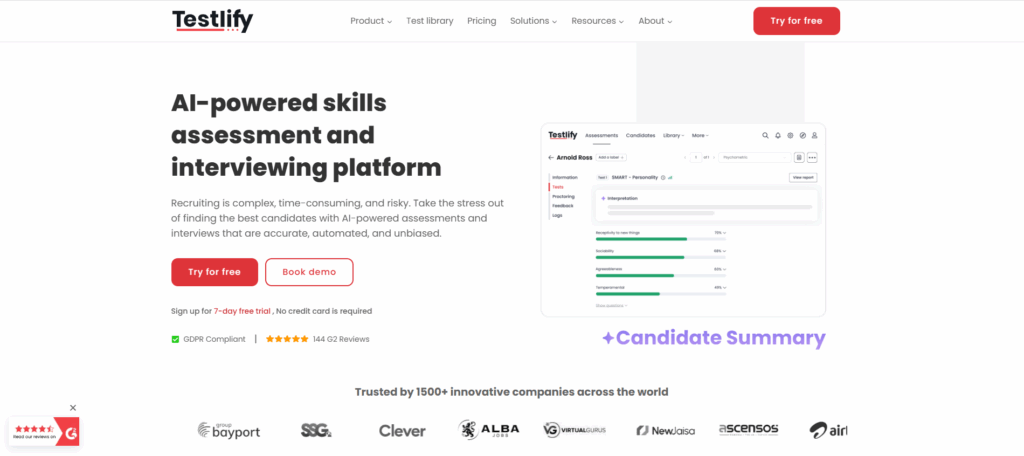
Testlify is an AI-assisted skills assessment and interviewing platform. Where Talogy sells psychometrics with consulting attached, Testlify puts the testing, the interviewing and the integrity controls in one self-serve product, and publishes what it costs.
It is the closest thing in this list to a like-for-like replacement, because it covers the psychometric ground Talogy owns (cognitive ability, personality and culture, situational judgement, psychometric batteries) and then adds the coverage Talogy does not: coding, software skills, language, typing, blue-collar and simulation testing across more than 3,000 ready-made tests.
Assessment depth
- More than 25 question types, including single and multiple select, ranking, fill in the blank, practical tasks submitted by file or URL, and live work in Google Docs, Sheets, Slides, Microsoft Word, PowerPoint and Excel.
- Real coding, not a code box. An embedded VS Code editor, single-file or multi-file project questions, up to 20 visible or hidden test cases with per-case scoring, and SQLite database test cases.
- Vibe coding, which lets candidates direct AI tools to reach a working solution instead of writing syntax by hand. Almost nothing else in this category has an answer to how engineers now actually work.
- Item-level psychometrics surfaced to recruiters: difficulty index, discrimination index, a quality-risk flag for questions with very low accuracy or high skip rates, plus answer, score and time distributions. This is test-publisher instrumentation, and it is the part that speaks Talogy's language.
Interviewing
Testlify runs one-way asynchronous video, two-way conversational AI video, audio and voice questions, and outbound AI phone interviews billed at $0.18 per minute. The AI interviewer is configurable: selectable avatar and voice, a defined persona and context, custom prompts, and more than 150 interview templates. Recording controls cover attempt limits, preparation time before auto-start, recording language and a 5 minute maximum per video answer.
Transcripts are automatic and multilingual, with the spoken language auto-detected on any recording of at least 30 seconds. AI scoring is advisory by design: the product ships the line "AI scores and insights are for guidance only. Use human judgment for final decisions", and both "Display AI scores to the reviewer" and "Include AI score in the final average" are toggles. The honest limit is that Testlify does not schedule live human interview panels.
Integrity
Three proctoring presets (Standard, Strict, Custom) sit over more than 20 measures: full-screen enforcement, tab-switch detection, face detection and photo ID verification with face match, periodic webcam snapshots, copy-paste tracking, multi-monitor restriction and AI-tool detection. The standout is dual-device proctoring, where the candidate's phone becomes a second camera positioned to capture both the candidate and the laptop screen, and the session will not start until mobile monitoring is active.
Results come back as a three-tier flag rather than an automatic verdict. Yellow reads "Some behavior during the session wasn't ideal. A quick manual review is recommended." Auto-termination is a separate opt-in setting with a recruiter-defined violation threshold, so evidence and rejection stay decoupled. Face verification data is deleted after 30 days and consent can be withdrawn at any time.
Where it sits in your stack
If you already run Greenhouse, Workday or Lever, Testlify plugs in as the screening and interviewing layer through 100+ ATS integrations and leaves your ATS as the system of record. If you have no ATS, it also ships a simple built-in hiring pipeline: job requisitions, an application form, job-board publishing and an applied to reviewed to shortlisted to rejected flow. It is deliberately basic, and it is not positioned against an incumbent system of record.
Testlify pricing
Pricing is a credit selector crossed with a monthly or annual toggle. One credit covers one started assessment by a qualified candidate. Annual figures, from the Testlify pricing page:
Plan | Credits per year | Price | Per credit | Seats |
|---|---|---|---|---|
Starter | 100 | $139/mo, billed $1,668/year | $16.68 | 3 |
Basic | 300 | $279/mo, billed $3,348/year | $11.16 | 5 |
Business | 1,000 | $699/mo, billed $8,388/year | $8.39 | 10 |
Premium | 3,000 | Contact sales | Volume-based | 20 |
Enterprise | 10,000 | Contact sales | Volume-based | 30 |
Custom | 25,000+ | Contact sales | Volume-based | 40 |
There is a 7-day free trial with no card, a 30-day money-back guarantee, and prices lock for 24 months. Extra seats are $15 per seat per month. Non-profits get 25% off. Be aware that white labeling, SAML SSO and the 100+ ATS integrations are paid add-ons on the self-serve tiers at $2,388 per year each, and are included only on Custom. Budget for them rather than assuming they are bundled.
Best for: teams under roughly 200 people that want psychometric coverage, technical testing and interviewing in one tool, with a price they can model before a call.
2. TestGorilla
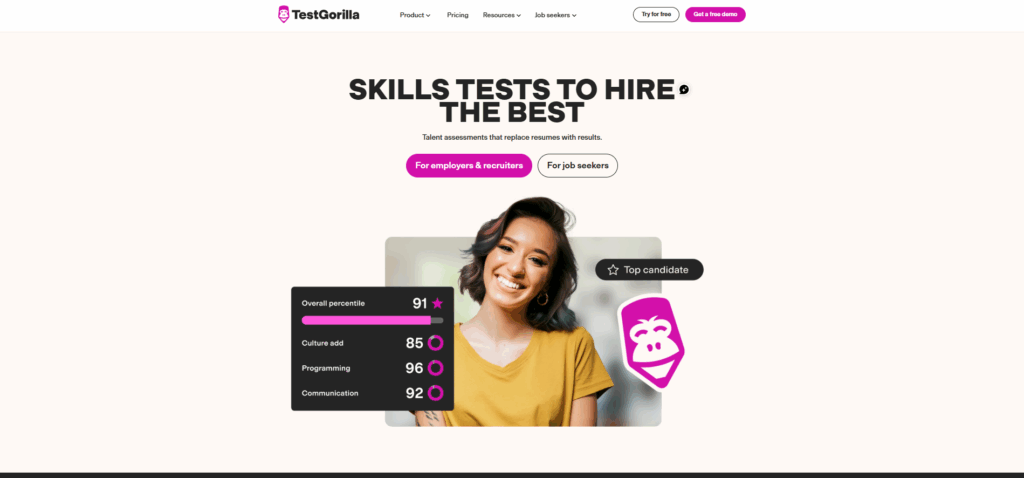
TestGorilla is a pre-employment testing platform built around a large library of ready-made tests. It optimises for speed and self-service rather than the validation-and-consulting model Talogy runs, which makes it a straightforward switch for teams that want to start screening this week.
Features
- Ready-made test library: coding and IT, cognitive ability, personality and role-specific skills.
- Video responses: one-way video questions can be added inside an assessment to judge communication.
- Anti-cheating measures: IP tracking, webcam snapshots, plagiarism detection and full-screen monitoring.
- ATS integrations: native connectors plus Zapier, so it drops into an existing workflow.
Best for: high-volume screening of generalist and support roles where the bottleneck is applicant count, not assessment science.
3. Vervoe
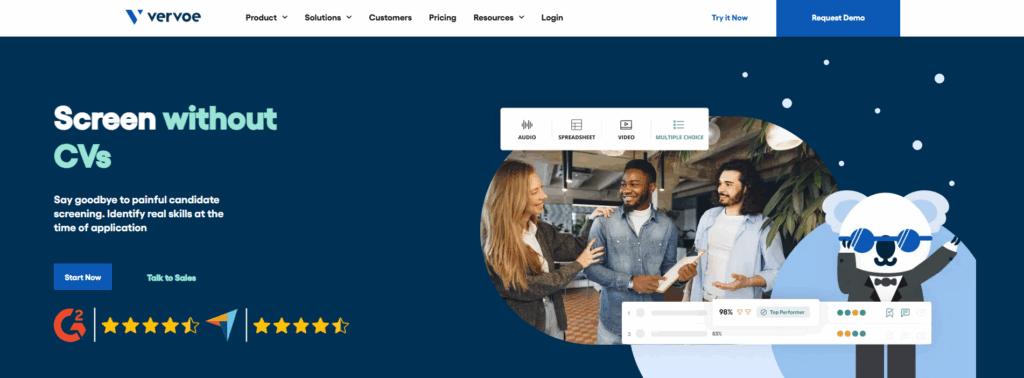
Vervoe's argument is merit over resumes: let candidates do the job, then grade the output. Its assessments lean on realistic tasks rather than abstract questions, and AI grades and ranks the responses automatically.
Features
- Job simulations: pre-built assessments that mirror job-specific tasks across a range of roles and industries.
- Mixed question formats: multiple choice, free text, video prompts and custom questions.
- Automated grading: responses are scored and candidates ranked, surfacing strong performers without manual review.
- Integrity controls: plagiarism detection, timed questions and proctoring.
Best for: roles where demonstrated output predicts better than a trait profile, such as support, sales and marketing execution.
4. Codility
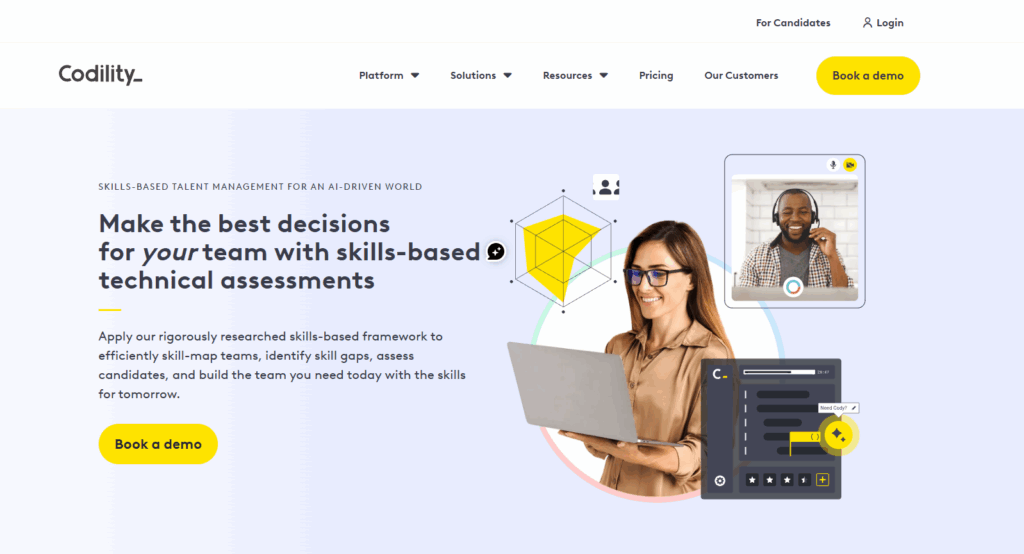
Codility is an engineering assessment platform for coding tests and live technical interviews. It has no meaningful overlap with Talogy outside software roles, but inside them it goes far deeper than any general psychometric catalogue.
Features
- Coding task library spanning many programming languages and difficulty levels.
- Live technical interviews with a shared pair-programming interface and in-session evaluation.
- Plagiarism and integrity tooling aimed at enterprise volume, with detailed performance reporting.
- Standardised scoring so engineers are compared on the same task rather than on interviewer impressions.
Best for: established engineering organizations that hire developers continuously.
5. Mercer Mettl
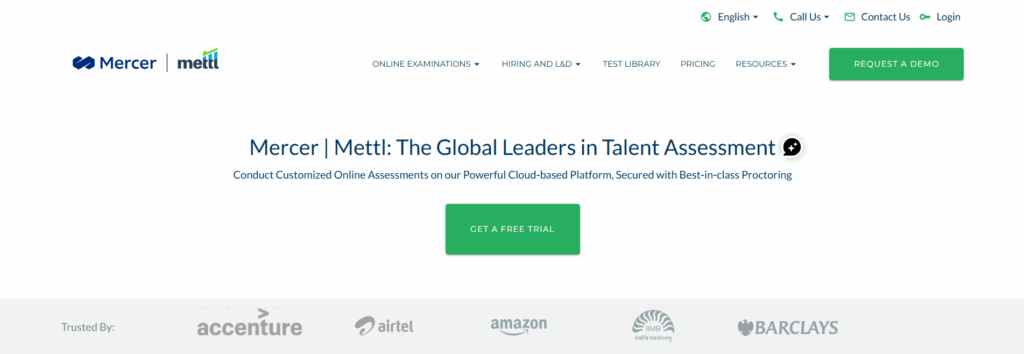
Mercer Mettl is a broad online assessment platform covering technical, cognitive, behavioural and psychometric testing, backed by a global HR consultancy. Of everything in this list it is the closest structural match to Talogy: research-led content, consultative sales, quote-based pricing.
Features
- Wide role coverage across domain tests, coding exams and psychometric batteries.
- Heavy proctoring: AI monitoring, lockdown browser and live human proctors.
- Branding controls including custom logos, colours and a branded test subdomain.
- Competency reporting with percentile benchmarks and recommendation logic.
Best for: campus recruitment, certification programmes and regulated testing at scale.
6. iMocha
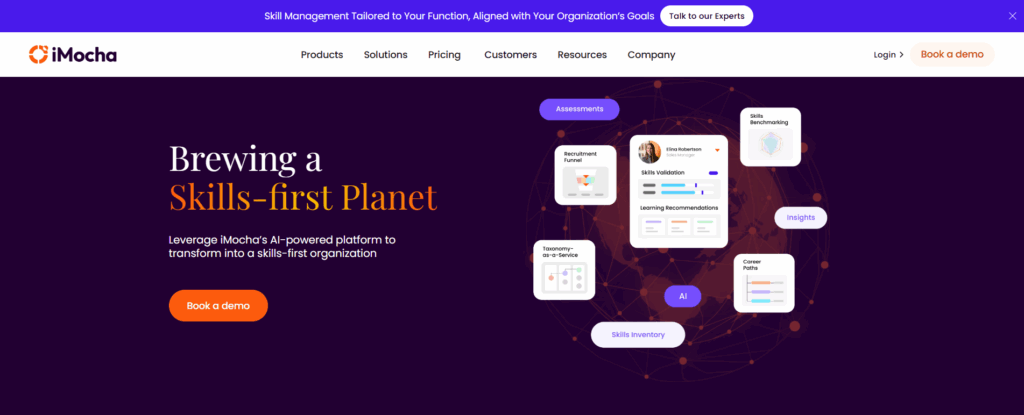
iMocha covers pre-hire testing and then keeps going into the workforce, mapping skills across an existing employee base. That second half is the reason to look at it: if your problem is partly internal mobility, a pure hiring tool answers only half the question.
Features
- Large assessment catalogue spanning technical, functional and soft skills.
- Custom test creation from scratch or by mixing questions from the existing bank.
- Conversational AI interviewing with an automated report on strengths and gaps.
- Skills analytics that benchmark candidates and map skill coverage across teams.
Best for: organizations running skills-gap analysis and internal mobility alongside external hiring.
7. Hirevue
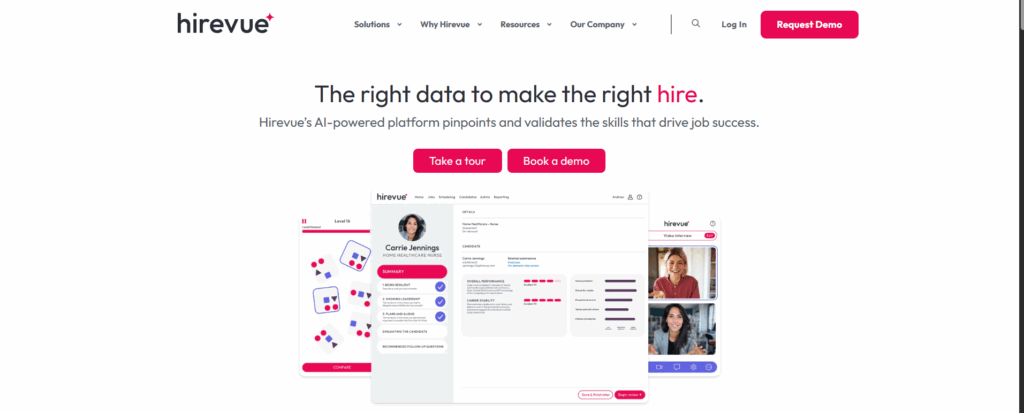
Hirevue came out of digital interviewing and moved into assessment. It pairs on-demand and live video interviewing with game-based and AI-scored modules, and it is built for the kind of hiring volume where a few seconds per candidate matters.
Features
- Validated interview content developed by industrial and organisational psychologists.
- On-demand and live video interviewing with AI assistance in scoring responses against set criteria.
- Game-based assessments measuring problem solving and related cognitive traits.
- Scheduling and workflow automation connected to the ATS.
Best for: very high-volume hourly and frontline hiring programmes.
8. TestDome
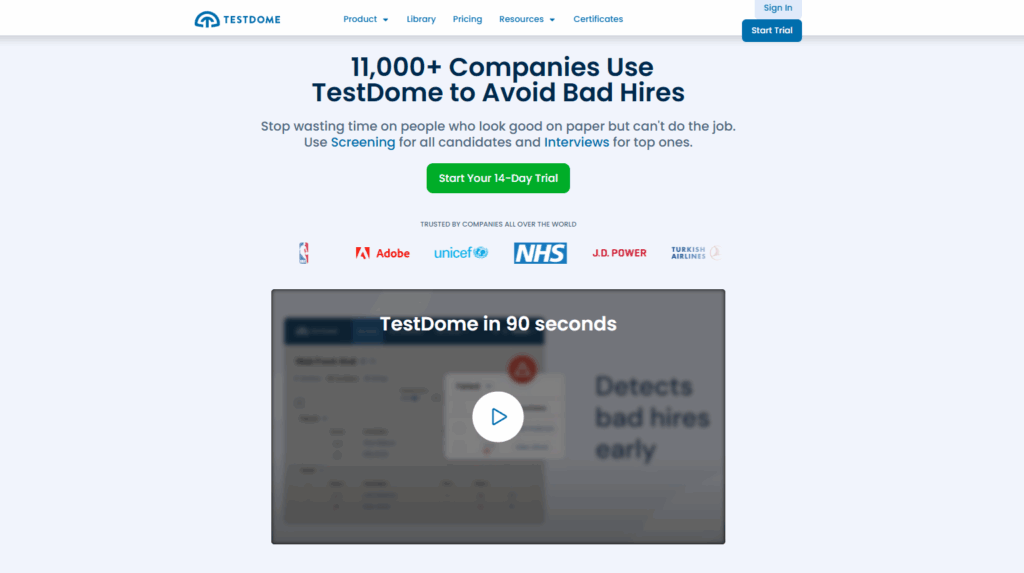
TestDome takes a narrow, practical position: test people on tasks that look like the job. Its assessments favour short work samples over abstract quizzes, which makes it a quick filter rather than a full evaluation programme.
Features
- Work-sample tasks such as coding challenges, data exercises and support scenarios.
- Role coverage across software, accounting, customer service and administrative work.
- Basic proctoring with optional webcam monitoring and screen recording.
- Score comparison so candidates can be benchmarked side by side.
Best for: small teams that want a fast practical filter before the first interview.
9. Coderbyte
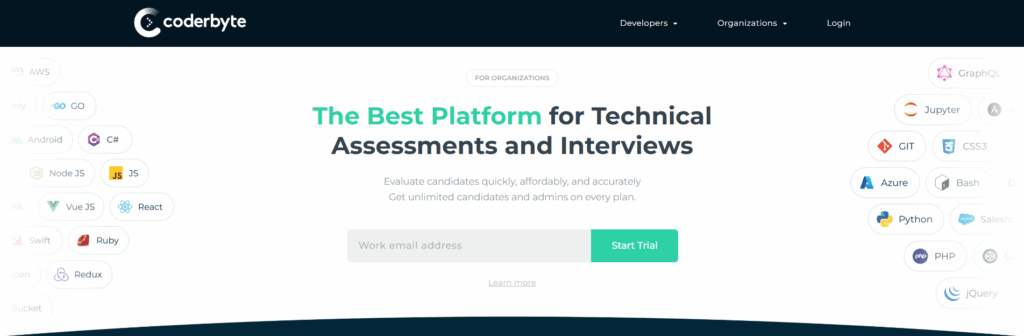
Coderbyte is a technical assessment tool aimed at startups and mid-sized companies hiring developers and data scientists, with coding challenges and take-home projects on a subscription rather than per-candidate basis.
Features
- Coding challenges and projects across many languages and technical skill areas.
- Mixed question types including multiple choice, algorithmic problems and SQL queries.
- Live interview tooling: collaborative editor, spreadsheets, notebooks and a whiteboard.
- Code playback so reviewers can watch how a solution was built, not just the final answer.
Best for: startups that need technical depth without enterprise pricing.
10. HireMojo
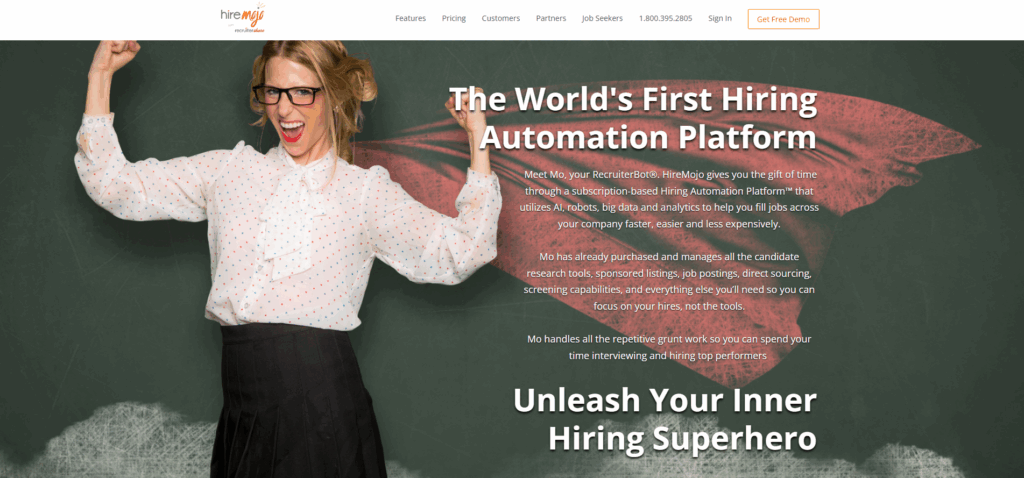
HireMojo is a hiring automation platform rather than an assessment vendor. It sits earlier in the funnel than Talogy does, handling job posting, applicant pre-screening and scheduling.
Features
- Automated job distribution across multiple boards and channels.
- Pre-screening and scoring to rank applicants before a human reads a resume.
- Job and interview content templates for teams starting from nothing.
- Candidate tracking with notes, status and automated rejection messaging.
Best for: lean teams whose bottleneck is process overhead rather than evaluation quality.
11. HackerEarth
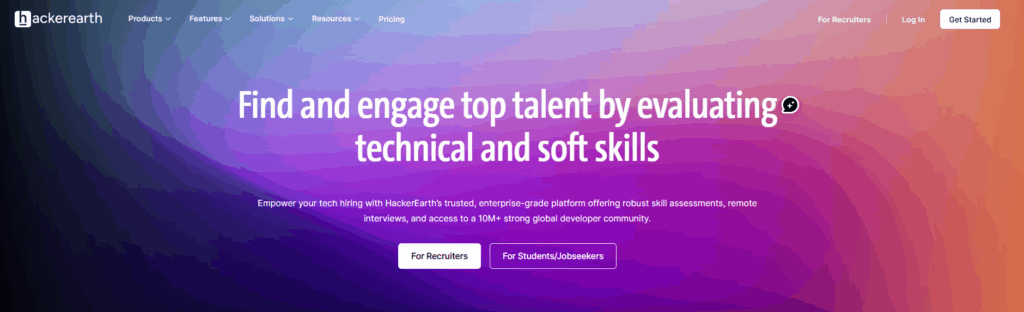
HackerEarth pairs developer assessment with hackathons and remote pair-programming interviews, which gives it an employer-branding angle most assessment tools do not have.
Features
- Large technical question bank covering multiple choice, coding problems and data science scenarios.
- Proctoring with webcam monitoring, keystroke analysis and plagiarism detection.
- Live coding interviews with a collaborative editor, video and a whiteboard.
- Skill reporting broken down competency by competency.
Best for: campus technical hiring and engineering brand-building programmes.
12. HackerRank
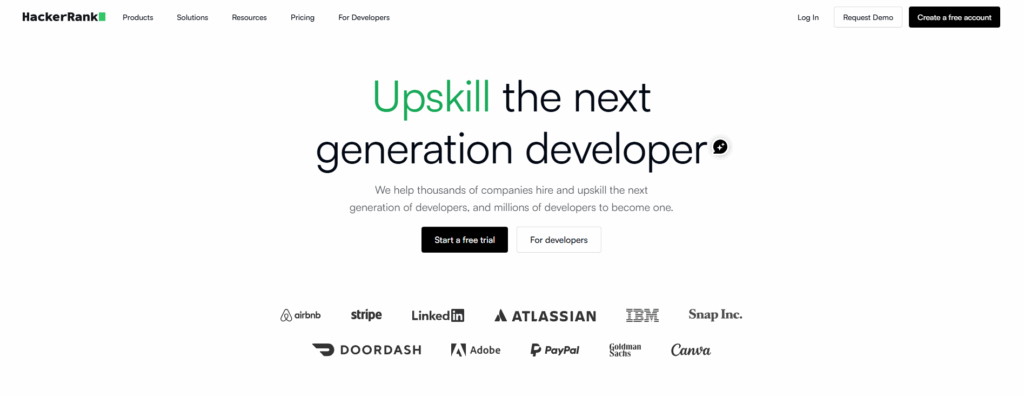
HackerRank is the long-standing developer assessment platform in this group, running skill-based coding tests and live technical interviews for enterprise engineering teams.
Features
- Deep question library weighted toward coding challenges across many languages.
- Screening through to interview in one place, from automated tests to pair programming.
- Integrity tooling including plagiarism checks and webcam monitoring.
- Enterprise integrations with common ATS and HR systems.
Best for: large engineering organizations with an established technical bar.
13. TestInvite
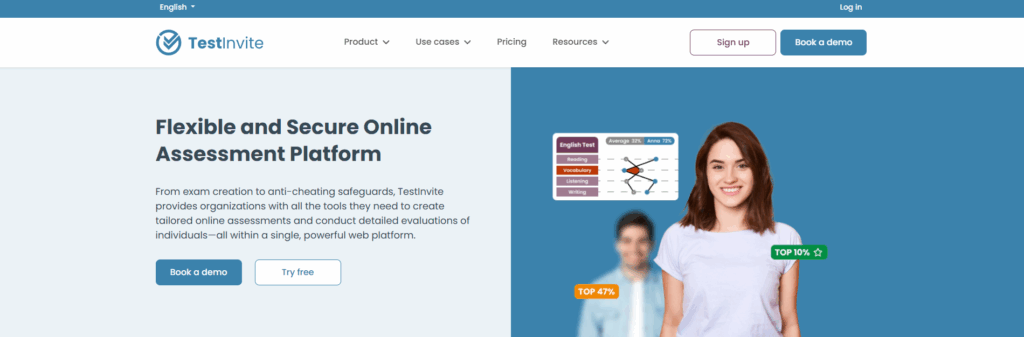
TestInvite is exam software before it is hiring software. Its appeal is control: if you have your own validated items and want to run them your way, it gives you more configuration than most hiring platforms will.
Features
- Configurable test builder with a wide range of question types.
- Ready-made assessments for general abilities, usable as a starting point.
- Custom scoring and reporting, including derived metrics and written interpretations by score band.
- Lockdown and cheat detection with question randomisation.
Best for: certification bodies and teams bringing their own item bank.
14. eSkill
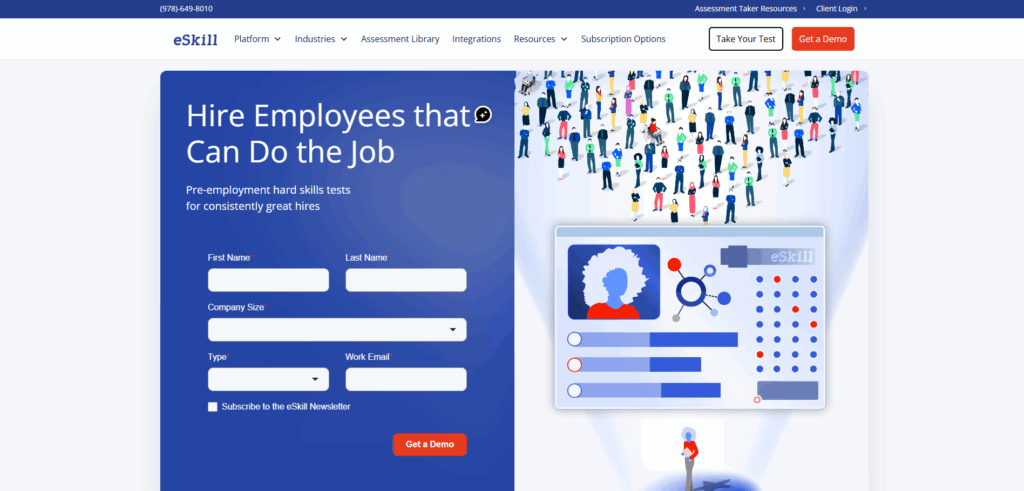
eSkill has been in pre-employment testing a long time and its strength is subject-level customisation: build a test by picking topics rather than taking a fixed battery off the shelf.
Features
- Large ready-made catalogue plus test assembly from a topic-level question bank.
- Job simulations such as typing exercises and customer interaction scenarios.
- Proctoring that flags copy-paste and tab-switching in real time.
- Detailed reporting with breakdowns by subject and question type.
Best for: employers testing across many unrelated non-technical role families.
15. Canditech
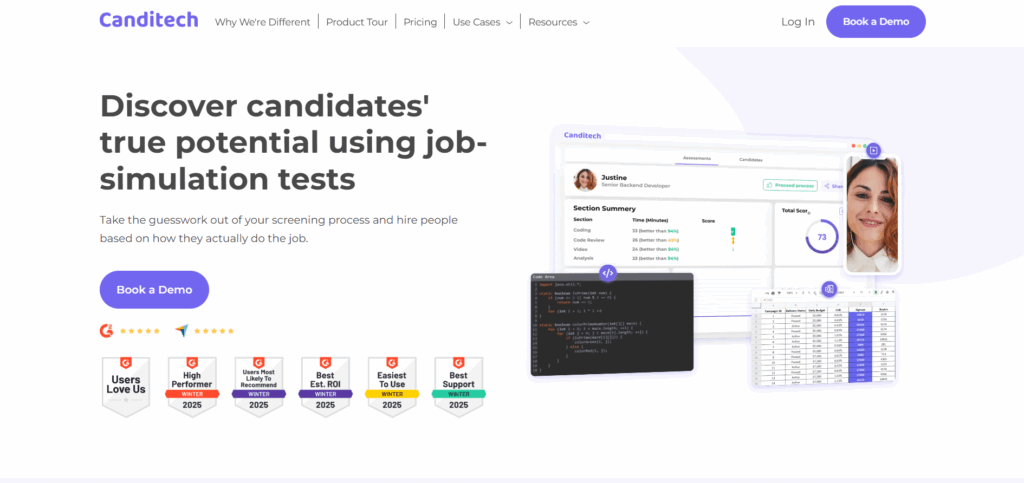
Canditech is the newest name here and it is built around one idea: a job simulation that is realistic enough to replace the screening interview outright.
Features
- Expert-built and custom tests assembled into a single simulated work session.
- Job simulations covering coding, spreadsheet exercises and written responses.
- Automatic scoring and ranking against objective performance rather than impressions.
- Benchmarking against job-specific or industry reference points.
Best for: teams trying to cut a screening round out of the process entirely.
How do you choose the right Talogy alternative?
Start from the roles, not the vendor. List the five roles you will hire most in the next year, write down what actually predicts success in each, then check which platforms measure that. Most switching regret traces back to buying a catalogue that did not cover the jobs.
Then apply the Testlify Multi-Signal Talent Evaluation Model. It says one signal is never enough: combine role-relevant assessments, structured interviews, work samples, reviewer feedback and references, and weight them by what the role demands. A sales hire and a backend engineer should not be judged on the same evidence mix. The point is not more testing, it is fewer blind spots in the evidence you already collect.
Two practical filters cut the list fast. If you cannot see a price, expect a sales cycle measured in weeks. If the tool cannot show you why a question predicts performance, it will not survive a challenge.
That last point is getting sharper. New York City now requires an annual independent bias audit for automated employment decision tools, with published results and candidate notice. Similar rules are spreading. Any vendor you shortlist should already know what its audit position is.
Pro tip: run your new shortlist against candidates you have already hired. If the tool scores your strong performers low, the problem is the tool, not the candidates. It costs a week and it is the only honest validation most teams can run before committing budget.
One more thing worth planning for. The World Economic Forum's Future of Jobs Report 2025 found that employers expect 39% of workers' core skills to change by 2030. A fixed battery bought once will drift. Pick a platform where you can add and retire tests yourself, without a services engagement each time.
Start assessing candidates this week
Pick two roles you are hiring now, build an assessment for each, and send it to your next ten applicants. You will learn more from that than from three more comparison pages. Testlify has a 7-day free trial with no card required, and you can book a demo if you would rather be walked through it. Already know the shape of what you need? Browse the test library or check which of your tools it already connects to on the integrations page.
Key takeaways
- Talogy is a consulting product, not just software. Its 150 in-house psychologists and 160-country footprint are what you are paying for. If you are not using the consulting, you are carrying its cost in your contract, and a self-serve platform will deliver the same screening outcome for less.
- Coverage is the switching risk, not features. Psychometric houses are thin on coding, software and work-sample testing. Map your next year of roles against the catalogue before you sign, because a battery that misses half your hiring creates a second purchase.
- Structure beats raw ability testing. Structured interviews predict performance better than general cognitive ability (.42 against .31). Weight your budget toward tools that make interviews consistent and scored, not only toward test libraries.
- Published pricing changes the buying cycle. Self-serve tiers let you model cost per hire in an afternoon. Quote-only pricing means weeks of calls before you know whether the tool is affordable, and that delay is a real cost.
- Integrity controls decide whether remote scores mean anything. Proctoring depth, AI-assistance detection and identity verification are what separate a defensible score from a number a candidate could have outsourced.
- Defensibility stays with you. The EEOC expects employment tests to be job-related and monitored for adverse impact, and NYC now requires an annual bias audit for automated selection tools. Buying from a reputable vendor does not discharge that duty.
- Validate before you commit. Run the shortlist against people you have already hired. It is the cheapest validity check available and it settles most vendor arguments in a week.
FAQs

Director of Marketing
Akash Patange is the Director of Marketing at Testlify, where he works closely with HR leaders and recruiters to help organizations improve hiring outcomes. He writes about talent assessment, recruitment technology, and data-driven hiring practices.
LinkedInRelated resources
View all
Alternatives
Top 15 Hire Success Alternatives and Competitors
Alternatives
Top 15 Testgrid Alternatives and Competitors
Alternatives
Top 15 Testello Alternatives and Competitors
Alternatives
Top 15 TalentLyft Alternatives and Competitors
Alternatives
Top 15 Skillmeter Alternatives and Competitors
Alternatives
Top 15 Talentate Alternatives and Competitors
Get started.
Hire on proof, not resumes.
Run your first skills-based assessment free — no credit card required.