
Top 15 TalentLyft Alternatives and Competitors
Discover 15 powerful TalentLyft alternatives to streamline your hiring process and assess candidates with confidence.
If you are shopping for TalentLyft alternatives, the first thing to get straight is what you are actually replacing. TalentLyft is an applicant tracking system with recruitment marketing bolted on: job posting, a branded careers page, sourcing, and a candidate pipeline. It is not a testing platform. So the right replacement depends on which half of the job is failing you.
Most teams who leave do so for one of two reasons. Either the workflow is wrong (they want a different pipeline, better job-board reach, cheaper seats), or the workflow is fine and the decisions coming out of it are not. Those need different tools. Swapping one ATS for another fixes the first problem and does nothing at all for the second.
This page covers both. It walks through what TalentLyft does, what it costs today, how it stacks up against Hireology (the head-to-head people search for most often), and fifteen platforms worth a look, with honest notes on where each one fits and where it does not.
 ChatGPT
 Gemini
 Claude
 Grok
Grok Perplexity
TL;DR
- TalentLyft is an ATS plus recruitment marketing tool. Its Essential plan lists at $100 a month, or $1,000 a year paid annually, with unlimited job slots and unlimited users.
- Replacing it with another ATS makes sense when your problem is workflow: pipeline stages, careers-page branding, job-board reach, or per-seat cost.
- If your problem is that too many wrong people reach the interview stage, an ATS swap will not touch it. That is a screening problem, and it needs evidence, not a new pipeline.
- Hireology is the closer comparison for multi-location and hourly hiring. TalentLyft is the better fit for a single-site team that cares about employer brand.
- Skills assessments and structured interviews sit upstream of whichever ATS you land on, and most of them plug straight into it.
- Shortlist on three things: does it fit how you actually hire, what does it cost per user at your headcount, and does it connect to the rest of your stack.

What is TalentLyft?
TalentLyft is recruitment software that combines an applicant tracking system with recruitment marketing. You post a job, syndicate it to job boards, run a branded careers page, collect applications into a pipeline, and move candidates through stages with interview kits and scorecards. Sourcing tools and an employee referral program sit alongside it.
The product leans harder on the front of the funnel than most small-team ATS products do. Careers-page branding, referral campaigns and a Chrome sourcing extension are all first-class features. That tells you who it was built for: a company that needs to attract applicants, not one drowning in them.
What it does not do is evaluate anyone. There is no test library, no coding environment, no proctoring. Interview kits and scorecards help you record a judgment consistently, which is genuinely useful, but they do not produce independent evidence about whether a candidate can do the work. Keep that distinction in mind while you read the rest of this page, because it decides which tool on the list is right for you.
Why do teams look for TalentLyft alternatives?
Four reasons come up again and again, and only two of them are solved by buying a different ATS.
Pricing shape. TalentLyft charges a flat platform fee rather than per user or per job slot. That is generous if you have ten people in the system and awkward if you have two, because a very small team pays the same as a much larger one.
Reporting depth. Teams that outgrow basic funnel counts and want real source-of-hire analysis or cost-per-channel reporting tend to hit a ceiling.
Industry fit. Hourly, shift-based and multi-location hiring has its own shape (texting candidates, high volume, fast turnaround) and general-purpose ATS products handle it awkwardly.
Screening quality. This is the big one, and it is not an ATS problem. Applications arrive, the pipeline moves them along, and interviewers still cannot tell who is worth an hour. The U.S. Bureau of Labor Statistics counted 7.3 million job openings and 5.1 million hires in July 2026, which means roughly three in five open roles did not get filled that month. Pipelines are not usually the bottleneck. Deciding is.
There is a cost attached to guessing. SHRM's benchmarking put the average cost per hire at nearly $4,700, and that figure counts the hire you made, not the two you had to redo. And the ground keeps moving underneath the criteria you screen on: the World Economic Forum's Future of Jobs Report 2025 found employers expect 39% of key skills to change by 2030, with 63% naming skills gaps as their biggest barrier to transformation. A resume filter tuned to 2023 job titles ages badly.
How much does TalentLyft cost?
TalentLyft's own pricing page lists Essential at $100 per month, or $1,000 a year billed annually, with unlimited job slots and unlimited users. Growth adds multiple branded careers pages, multiple pipelines, workflow automation, custom fields, a custom careers domain, and requisition and offer management. Enterprise adds SSO, custom reporting, data migration and a dedicated support channel, priced on request. There is a 14-day trial, though you cannot post to job boards during it without a verified account or an active plan.
One honest caveat: at the time of writing, that page renders the same $100 figure for both Essential and Growth, and third-party directories still quote older numbers ($49 and $99 tiers, or $73.50 and $148.50). Confirm the current Growth price with TalentLyft directly rather than trusting a comparison site, this one included.
Where the flat fee is a genuine advantage: unlimited users. Most ATS products in this bracket charge per seat, so a hiring team of twelve pays TalentLyft once and pays a per-seat rival twelve times. Run that math for your own headcount before you switch on price alone.
TalentLyft vs Hireology: what is different?
TalentLyft vs Hireology is the comparison people search for most, and the honest answer is that they are built for different companies. TalentLyft is a general-purpose ATS with strong employer-branding and sourcing tools, priced for a small or mid-size team hiring salaried roles. Hireology is built for multi-location and hourly hiring, in industries like healthcare, retail, hospitality, automotive and home care.
That difference shows up in the feature list. Hireology puts two-way texting, interview scheduling, background checks and payroll or HRIS handoffs at the centre, because a restaurant group hiring 40 shift workers a month lives or dies on response speed. TalentLyft puts careers-page branding, job-board syndication and referral campaigns at the centre, because a 60-person software company hiring six engineers a year lives or dies on attracting the right applicants in the first place.
Price follows the same split. TalentLyft starts at $100 a month for the whole platform. Hireology is quoted per location and lands substantially higher, which is normal for tools sold to franchise and multi-site operators.
Pick Hireology if you hire hourly staff across several sites and speed of contact is your constraint. Pick TalentLyft if you hire salaried staff at one or two sites and applicant quality and brand are your constraint. If neither describes you, that is a signal that the ATS is not where your problem lives.
Do you need a new ATS or better screening?
Answer this before you look at a single demo. Write down the last five hires you regret. Then ask what would have caught them.
If the answer is "we lost them because we were slow" or "they never saw the job", that is a workflow and sourcing problem, and a different ATS may genuinely fix it. If the answer is "they interviewed well and could not do the work", no ATS on this list will help, because none of them measure anything.
That second failure is well studied. A meta-analysis by Kuncel and colleagues found that mechanically combining assessment information predicts outcomes as well as or better than experts recombining the same information by judgment. Put plainly: when you already have the evidence, letting a gut feeling overrule the numbers at the end makes decisions worse, not better. The catch is that you need evidence in the first place, and a pipeline stage is not evidence.
Pro Tip: run the two purchases in the right order. Add screening first, on top of whatever ATS you already have, and give it one hiring cycle. If your shortlists get better, you never needed a new ATS. If they do not, you have learned something cheap, and you can go shop for a pipeline with a clear head.
This is what the Testlify Hiring Workflow Method describes: run evidence-based hiring end to end, from screening and assessment through interview, review, ATS sync and the final decision, so the workflow and the evidence are one process rather than two disconnected purchases. Assessment is not a substitute for the pipeline you already run. The two just have to talk to each other, or you end up copying scores into a spreadsheet by hand.
How did we evaluate these alternatives?
Every tool below was checked against the same five questions:
- What job does it actually do? Pipeline and workflow, candidate evaluation, or both. Mixing these up is the most common buying mistake on this list.
- Breadth of evaluation. How many kinds of evidence can it collect, and are they relevant to the roles you hire?
- Integration reach. Whether it connects to the ATS, HRIS and calendar you already run, or expects to become your system of record.
- Cost at your size. Flat fee, per seat, per candidate or per location, and what that works out to at 5, 20 and 100 hires a year.
- Candidate experience. Time demanded of applicants, accessibility, and whether people finish what you send them.
Pricing below is what each vendor published at the time of writing. Verify it before you buy, because these move.
TalentLyft alternatives compared at a glance
Platform | Primary job | Best for | Published entry price |
|---|---|---|---|
TalentLyft | ATS plus recruitment marketing | Single-site teams hiring salaried roles | $100/month (Essential) |
Testlify | Assessment and AI interviewing, with a simple built-in pipeline | Teams who need better shortlists, with or without an ATS | $139/month annual (Starter) |
Hireology | ATS for hourly, multi-location hiring | Franchise, retail, healthcare, automotive | Quoted per location |
TestGorilla | Skills assessment | Broad multi-measure screening | Free tier, paid on request |
Adaface | Conversational technical assessment | Developer screening at volume | Published per plan |
Vervoe | Skills assessment with AI grading | Task-based, role-specific testing | Published per plan |
Codility | Developer assessment | Engineering hiring teams | Quoted |
iMocha | Skills assessment and skills intelligence | Enterprise skills mapping | Quoted |
HireVue | Video interviewing and assessment | High-volume enterprise interviewing | Quoted |
TestDome | Skills and coding tests | Small teams wanting pay-as-you-go tests | Published per plan |
Coderbyte | Technical assessment | Developer screening and take-homes | Published per plan |
HireMojo | Recruiting automation | Teams outsourcing sourcing workflow | Quoted |
HackerEarth | Developer assessment and hackathons | Engineering hiring plus employer branding | Published per plan |
HackerRank | Developer assessment | Large engineering organizations | Published per plan |
TestInvite | Secure online exams | Certification and proctored testing | Published per plan |
eSkill | Job-specific test library | Customized role-based testing | Quoted |
Canditech | Job simulations | Work-sample style screening | Published per plan |
1. Testlify
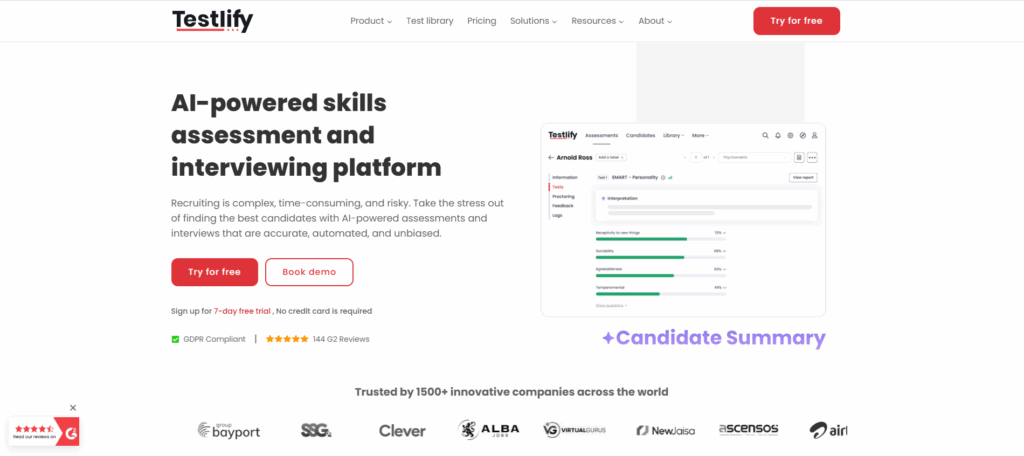
Testlify is a pre-hire assessment and interviewing platform. It sits upstream of the pipeline: candidates apply, Testlify produces evidence about what they can do, and the shortlist that reaches your interviewers is already scored. For teams that do not run an ATS at all, it also ships a simple built-in hiring pipeline, which is the part that overlaps with TalentLyft.
It is worth being precise about that overlap, because it is narrow. Testlify does not set out to replace an applicant tracking system you already trust. If you run Greenhouse, Workday or Lever, Testlify plugs into it and leaves it as the system of record. If you run nothing, the built-in pipeline is deliberately basic: post a job, take applications, screen with evidence, move people through applied, reviewed, shortlisted and rejected. It is one tool instead of buying two, not a full ATS. For a direct feature-by-feature read, there is a separate Testlify and TalentLyft comparison.
Key features
- Test library and question depth: a library of 3,500+ tests across coding, cognitive ability, personality and culture, language, software skills, situational judgement, simulation and gamified categories, with 25+ question types and three difficulty levels.
- Coding that reflects real work: an embedded VS Code editor, single-file or multi-file projects, up to 20 visible or hidden test cases with per-case scoring, SQLite database test cases, and vibe coding, which asks candidates to direct AI tools to a working solution instead of writing every line by hand.
- Video, voice and AI interviewing: one-way async video, two-way conversational AI video, voice and audio questions, and outbound AI phone interviews billed at $0.18 per minute. You pick the AI avatar, voice, persona and prompts, set attempt limits and recording time, and get automatic multilingual transcripts. 150+ interview templates ship with it.
- Scoring you control: question, test and assessment-level scoring, score-based or weighted (x0 to x5 per test), two explicit negative-marking modes, and percentile benchmarking against other candidates and other reviewers.
- Proctoring, including dual-device: the candidate's phone becomes a second camera positioned to capture both them and their screen, and the assessment will not start until that monitoring is active. Three presets (Standard, Strict, Custom) cover everything from tab-switch detection to photo ID face matching.
- Item-level analytics: difficulty index, discrimination index and a quality-risk flag per question, so you can tell whether a test is broken rather than whether a candidate is.
- Integrations: 100+ ATS integrations, plus Zapier, webhooks, custom SMTP, SAML SSO and SCIM provisioning.
Pros
- AI scoring stays advisory by design. The product ships the line "AI scores and insights are for guidance only. Use human judgment for final decisions," and both "Display AI scores to the reviewer" and "Include AI score in the final average" are toggles you can switch off.
- Dual-device proctoring is unusual at this price point.
- Office-app tasks bound to the real products (Google Docs, Sheets, Slides, Word, PowerPoint, Excel) test tool fluency for non-technical roles, which most assessment tools skip.
- A structured, candidate-initiated accommodation request routes to an administrator, rather than leaving candidates to email someone and hope.
Cons
- It does not schedule live human interview panels. Video and AI interviewing are covered; calendar coordination for a panel of people is not.
- Chromium desktop only. Candidates on Chrome or Edge are fine, others are not, and the mobile app is a fallback for recording audio and video rather than a way to sit a whole assessment on a phone.
- The built-in pipeline is basic on purpose. Where an established applicant tracking system is already the system of record, Testlify is the screening layer in front of it.
- AI resume scoring is currently limited to Greenhouse integrations.
Best for
Teams under a few hundred people who are losing time to interviews that should never have been booked, and either have no ATS or have one they intend to keep.
Testlify pricing
Testlify prices on candidate credits, not seats. One credit is consumed when a qualified candidate starts an assessment, and credits do not roll over. Published annual plans are:
- Starter: $139/month, billed $1,668/year, 100 credits ($16.68 each), 3 seats.
- Basic: $279/month, billed $3,348/year, 300 credits ($11.16 each), 5 seats.
- Business: $699/month, billed $8,388/year, 1,000 credits ($8.39 each), 10 seats.
- Premium, Enterprise and Custom: 3,000, 10,000 and 25,000+ credits respectively, priced on contact with sales.
Monthly billing uses the same tier names with different credit counts and prices (Starter $198/month for 10 credits, Basic $398 for 30, Business $998 for 100). Extra seats are $15 each per month on every tier. There is a 7-day free trial with no card required, a 30-day money-back guarantee, and pricing locked for 24 months. White labeling, the 100+ ATS integration pack and SAML SSO with 2FA are paid add-ons at $2,388 a year each on the self-serve tiers, included on Custom, so add those in if you need them.
2. TestGorilla
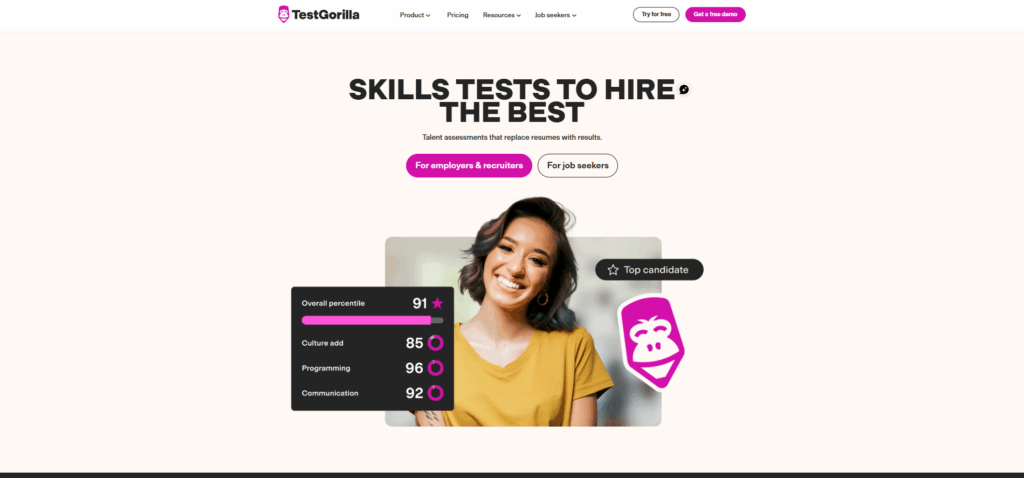
TestGorilla is a pre-employment testing platform built around combining several short tests into one assessment. Its library covers technical skills, cognitive ability, personality, language and role-specific knowledge, and it is aimed at teams moving away from resume-first screening.
Key features
- A test library spanning cognitive ability, programming, software skills, language and personality measures.
- Custom questions in multiple-choice, essay, file-upload and video-response formats.
- Anti-cheating measures including webcam snapshots and full-screen detection.
- ATS integrations and candidate reporting.
Best for
Teams that want to stack several short measures into a single screening step, across both technical and non-technical roles.
3. Adaface
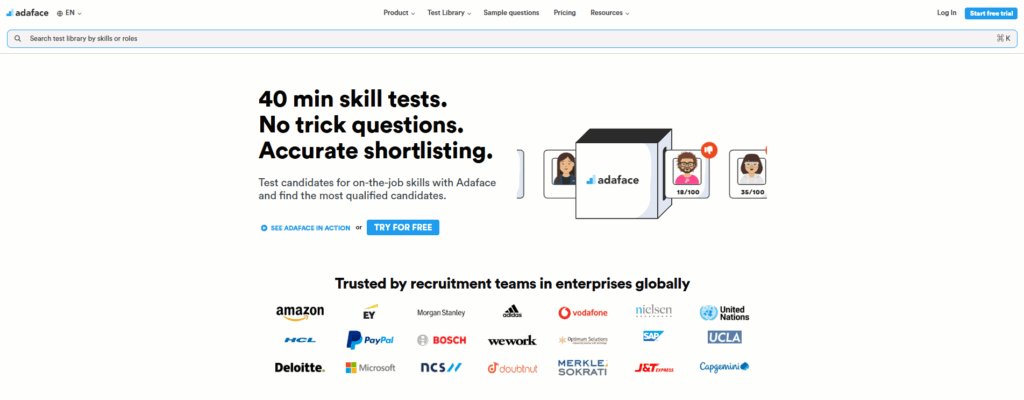
Adaface runs technical screening as a conversation rather than a timed exam, which is a deliberate bet that candidates finish more assessments when the format feels less hostile. Its library skews heavily technical.
Key features
- Conversational assessment flow instead of a standard test interface.
- Coding, data and role-specific technical tests.
- Custom question support and role-based test templates.
- ATS integrations and candidate scorecards.
Best for
Engineering teams screening a lot of developers who care about completion rates.
4. Vervoe
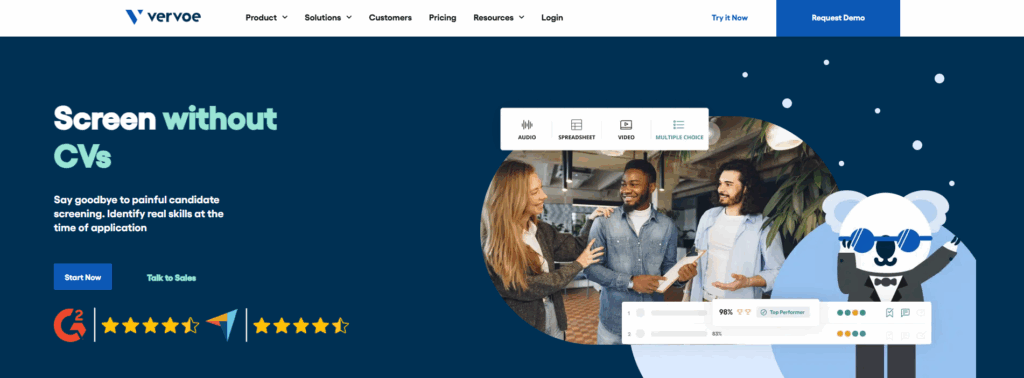
Vervoe builds assessments around tasks rather than questions, and grades the output with AI. The idea is to watch someone do a simplified version of the job instead of asking them about it.
Key features
- Task-based and simulation-style assessments.
- AI grading of open-ended responses.
- Role-specific assessment templates.
- Candidate ranking and reporting.
Best for
Roles where the work product is easy to sample, such as support, sales, marketing and operations.
5. Codility
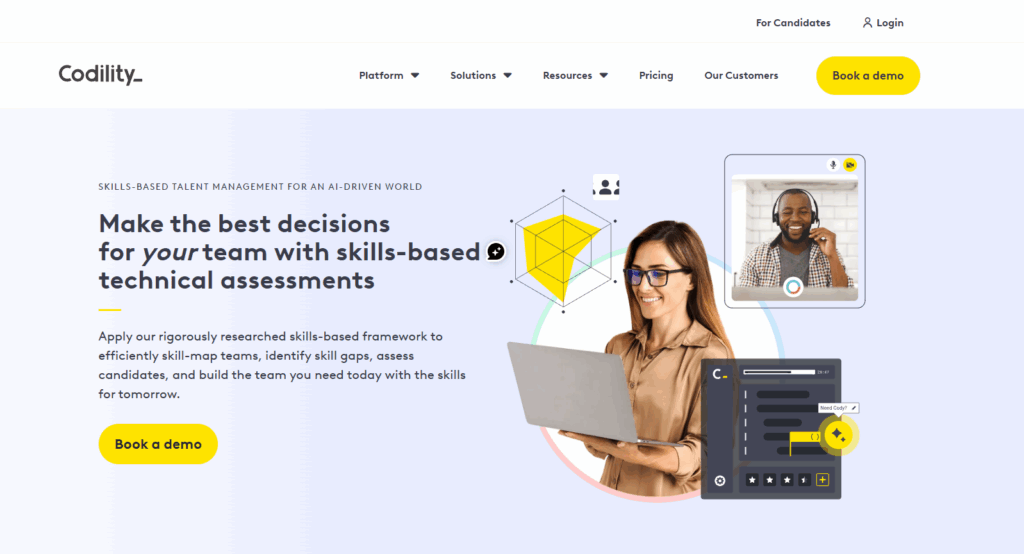
Codility is a developer assessment platform covering take-home tasks and live technical interviews. It is squarely an engineering tool and does nothing for non-technical hiring.
Key features
- Coding tasks with automated evaluation.
- A live pair-programming interview environment.
- Plagiarism and similarity checks.
- Engineering-focused reporting.
Best for
Engineering organizations standardizing how they assess developers.
6. iMocha
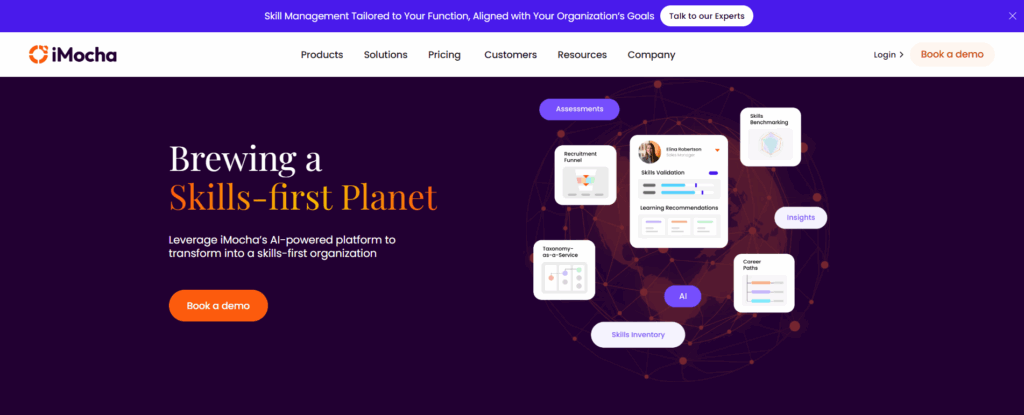
iMocha runs a large skills library and has moved toward skills intelligence, meaning mapping the skills a workforce already has as well as testing the ones candidates claim.
Key features
- A wide catalogue of technical and business skill tests.
- Custom assessment creation.
- Skills taxonomy and internal skills mapping.
- Enterprise reporting.
Best for
Larger organizations that want one skills framework covering hiring and internal mobility.
7. HireVue
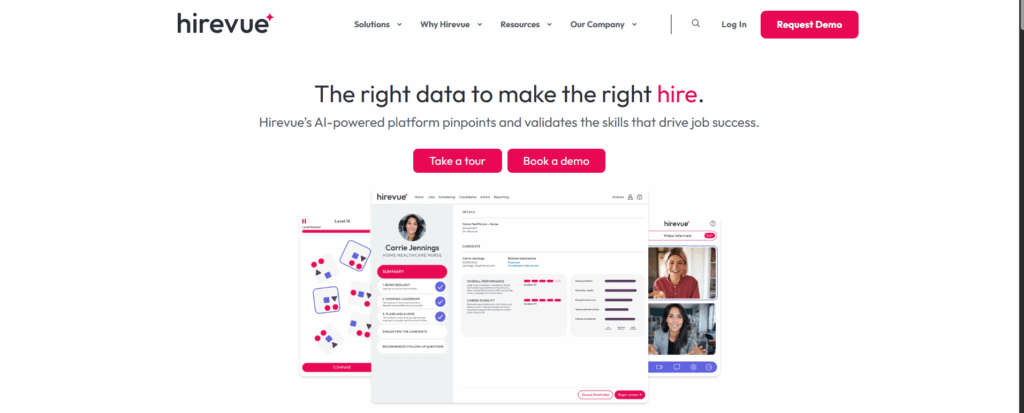
HireVue is a video interviewing and assessment platform aimed at high-volume enterprise hiring, with scheduling and conversational tools alongside the interview product.
Key features
- On-demand and live video interviewing.
- Game-based and structured assessments.
- Interview scheduling and candidate messaging.
- Integrations with the major enterprise applicant tracking systems.
Best for
Enterprises running thousands of interviews a year where scheduling load is the constraint.
8. TestDome
TestDome offers pre-made skills and coding tests with straightforward per-candidate pricing, which suits teams that hire occasionally and do not want an annual contract.
Key features
- Ready-made tests across programming, data and office skills.
- Automatic scoring with anti-cheating checks.
- Custom question support.
- Simple candidate invitation flow.
Best for
Small teams that need a handful of tests a quarter rather than a platform.
9. Coderbyte
Coderbyte provides technical challenges and take-home projects, with a large public challenge library that doubles as practice material for candidates.
Key features
- A large library of coding challenges across languages.
- Take-home project assessments.
- Automated scoring and code playback.
- Candidate reporting for technical reviewers.
Best for
Technical teams that want a quick coding filter before a human review.
10. HireMojo
HireMojo automates recruiting workflow: writing and posting the job, sourcing candidates and managing responses. It is the closest tool on this list to TalentLyft's recruitment marketing side.
Key features
- Automated job posting and distribution.
- Candidate sourcing and outreach automation.
- Screening question workflows.
- Recruiting analytics.
Best for
Small teams with no recruiter who want the sourcing motion handled for them.
11. HackerEarth
HackerEarth pairs developer assessment with hackathons and coding contests, so it works as an employer-branding channel as much as a screening tool.
Key features
- Coding assessments across many languages.
- Hackathon and contest hosting.
- Live technical interview tooling.
- Developer community reach.
Best for
Engineering teams that want assessment and developer-community visibility from one vendor.
12. HackerRank
HackerRank is a widely adopted developer assessment platform with a large question bank and interview tooling, common in larger engineering organizations.
Key features
- Extensive coding question library.
- Live collaborative interview environment.
- Plagiarism detection.
- Benchmarking and engineering analytics.
Best for
Large engineering organizations standardizing developer screening across teams.
13. TestInvite
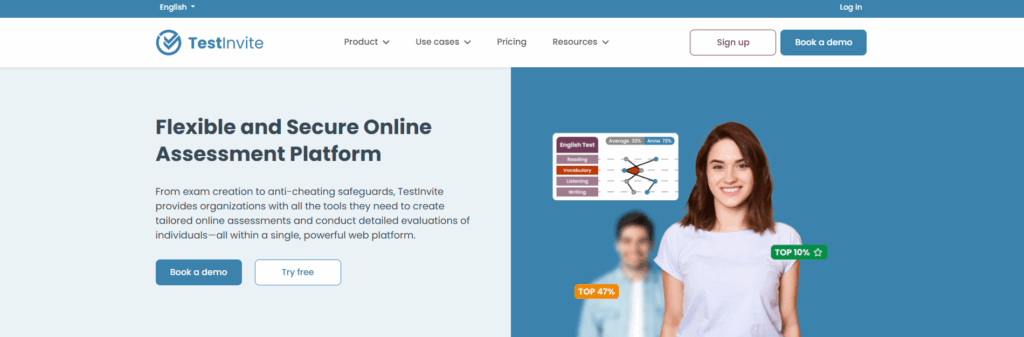
TestInvite is an online exam platform used for hiring, certification and education, with a strong emphasis on secure, proctored delivery.
Key features
- Exam authoring with question banks and sections.
- Proctoring and browser lockdown.
- Detailed exam analytics.
- Certification workflows.
Best for
Organizations running formal certification exams as well as hiring tests.
14. eSkill
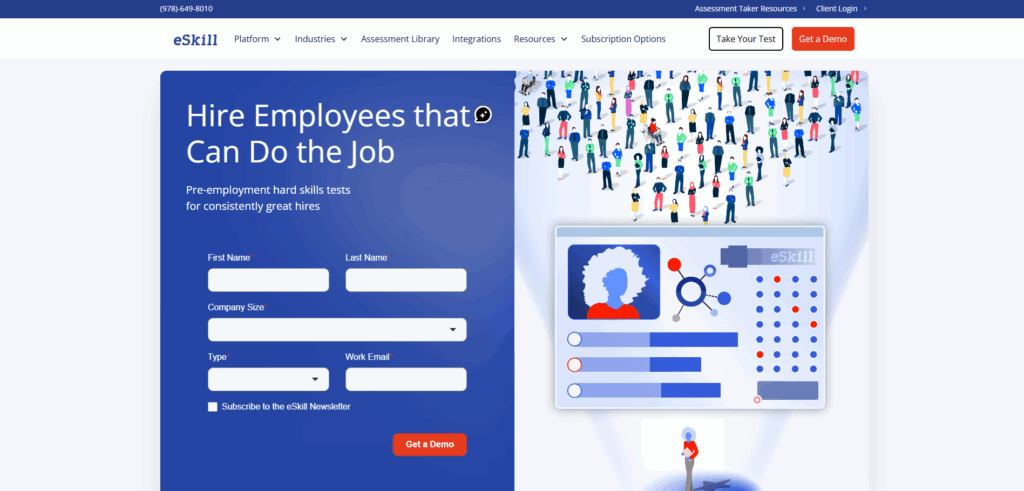
eSkill focuses on customizable, job-specific test batteries, letting employers assemble a test from subject areas that match a particular role rather than picking an off-the-shelf one.
Key features
- Modular test building from a large subject catalogue.
- Job-specific and industry-specific test batteries.
- Video response questions.
- Reporting and candidate comparison.
Best for
Employers with unusual role definitions that off-the-shelf tests do not match.
15. Canditech
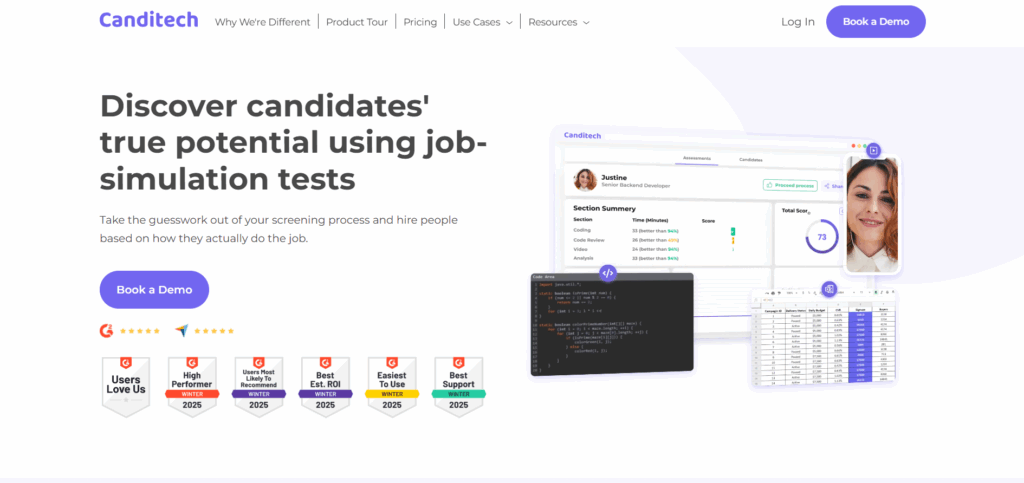
Canditech builds job simulations that combine technical tasks, video responses and work samples into a single sitting, aiming to compress several interview stages into one.
Key features
- Job simulation assessments mixing task and video formats.
- Automated scoring with reviewer input.
- Role templates across technical and business functions.
- Candidate experience reporting.
Best for
Teams trying to cut a multi-stage interview loop down to one evidence-rich step.
Which TalentLyft alternative should you pick?
Start with the diagnosis, not the shortlist. If applications are thin or slow to move, you want an ATS, and the choice comes down to whether you hire hourly across sites (Hireology and its peers) or salaried at one site (TalentLyft itself is decent at this, which is worth saying on a page about replacing it).
If applications are plentiful and the problem is that you cannot tell them apart, the ATS is not your bottleneck and switching it will cost you a migration for nothing. Add evidence to the top of the funnel instead, keep the pipeline you have, and let the two systems talk.
Testlify's 7-day free trial needs no card, so you can run one real role through it before committing to anything. If you would rather see it against your own hiring workflow first, book a demo and bring a job description you are actually hiring for.
Key Takeaways
- TalentLyft is an ATS, not an assessment tool. It runs job posting, careers-page branding, sourcing and a candidate pipeline. It does not measure whether anyone can do the job. Getting this wrong is why teams switch ATS products twice and still complain about hire quality.
- Diagnose before you shop. Slow or thin pipelines are a workflow problem an ATS can fix. Interviews with people who cannot do the work are a screening problem that no ATS on this list addresses. The two failures need different budgets.
- Price the whole seat count, not the sticker. TalentLyft charges a flat $100 a month at Essential with unlimited users, so a per-seat rival that looks cheaper at three users can cost far more at fifteen. Run your own headcount through both models.
- Hireology and TalentLyft are not really competitors. Hireology is built for hourly, multi-location hiring with texting and scheduling at the centre. TalentLyft is built for single-site salaried hiring with employer brand at the centre. Pick by how you hire, not by feature count.
- Evidence beats intuition once you have it. Mechanically combining assessment data predicts performance at least as well as experts re-judging the same data, so the value is in collecting the evidence and then not overriding it on a hunch.
- Skills criteria go stale faster than they used to. With 39% of key skills expected to shift by 2030, a screening filter built on job titles and years of experience ages badly. Test for what the role needs now and revisit it.
- Sequence the purchases. Add screening on top of your current ATS for one hiring cycle. If shortlists improve, you saved yourself a migration. If they do not, you have a clear reason to go ATS shopping.
FAQs

Director of Marketing
Akash Patange is the Director of Marketing at Testlify, where he works closely with HR leaders and recruiters to help organizations improve hiring outcomes. He writes about talent assessment, recruitment technology, and data-driven hiring practices.
LinkedInRelated resources
View allAlternatives
Top 15 Skillmeter Alternatives and Competitors
Alternatives
Top 15 Talentate Alternatives and Competitors
Alternatives
Top 15 TalentLens Alternatives and Competitors
Alternatives
Top 15 TalentMesh Alternatives and Competitors
Alternatives
Top 15 Maki People Alternatives and Competitors
Alternatives
Top 15 TestGenius Alternatives and Competitors
Get started.
Hire on proof, not resumes.
Run your first skills-based assessment free — no credit card required.