
Testlify vs. Saville Assessment: Which Platform is Best for HR Teams?
Testlify vs. Saville: Discover which skills assessment platform best suits your hiring needs
Testlify and Saville Assessment both put evidence in front of a hiring decision, but they were built for two different buyers. Saville Assessment is a British psychometric publisher: validated aptitude and personality questionnaires, delivered through its Oasys platform, normally interpreted by someone your team has sent on an accreditation course. Testlify is a self-serve skills assessment and interviewing platform: 3,500+ ready-made tests, 25+ question types, AI video, voice and phone interviews, and proctoring, with no course between you and your first assessment.
So the short answer depends on who is doing the hiring. A talent team screening hundreds of applicants a month, with nobody on staff who holds a psychometric qualification, will get further with Testlify. A leadership assessment that needs a British Psychological Society accredited personality instrument, read by a trained occupational psychologist, is exactly what Saville was built for. Most teams comparing the two are somewhere in between, and this page is written to help you work out which side of that line you sit on.
TL;DR
- Saville sells validated psychometrics (Wave personality, Swift aptitude, situational judgement) delivered through Oasys, and its model assumes an accredited user. Training runs 8 to 12 hours of e-learning plus about 2.5 days of virtual sessions.
- Testlify sells breadth and speed: 3,500+ tests across 12 categories, work-sample formats like coding and Microsoft Office tasks, and AI interviews in the same tool.
- Neither publishes a like-for-like price. Testlify does publish list pricing (Starter is $1,668 a year for 100 candidate credits). Saville quotes on request.
- For volume sifting, the practical difference is not test quality. It is how many people can act on a result without help, and how fast a shortlist gets scored.
- Saville is the better answer for regulated leadership assessment and for teams that already run a BPS-qualified assessment function.
 ChatGPT
 Gemini
 Claude
 Grok
Grok Perplexity
What is Testlify?
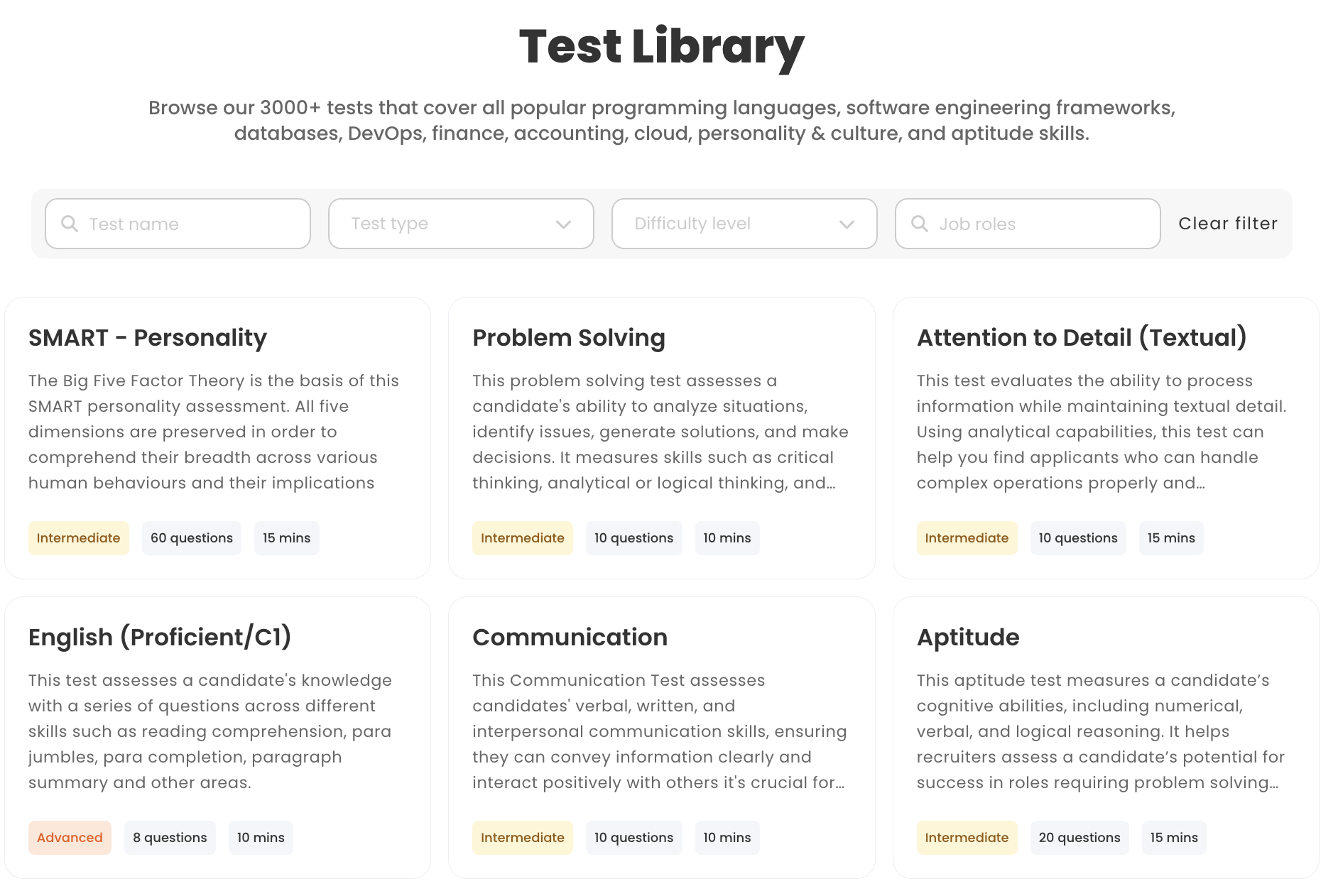
Testlify is an AI-assisted talent assessment and interviewing platform. You build an assessment from a library of 3,500+ validated tests across 12 categories, invite candidates, and get a scored shortlist before anyone sits down for a first call. It covers role-specific skills, cognitive ability testing, personality and culture, situational judgement scenarios, coding, software skills, language and typing, plus gamified and simulation formats.
The part buyers usually miss is the question layer underneath the library. Testlify ships 25+ question types, and several of them are work samples rather than multiple choice: coding questions in an embedded VS Code editor with up to 20 test cases, hands-on tasks submitted by file or URL, and live tasks inside Google Docs, Sheets, Slides, Microsoft Word, Excel and PowerPoint. There is also a vibe coding format, where a candidate directs AI tools toward a working solution instead of writing every line by hand. That is a fair reflection of how a lot of engineering work now happens.
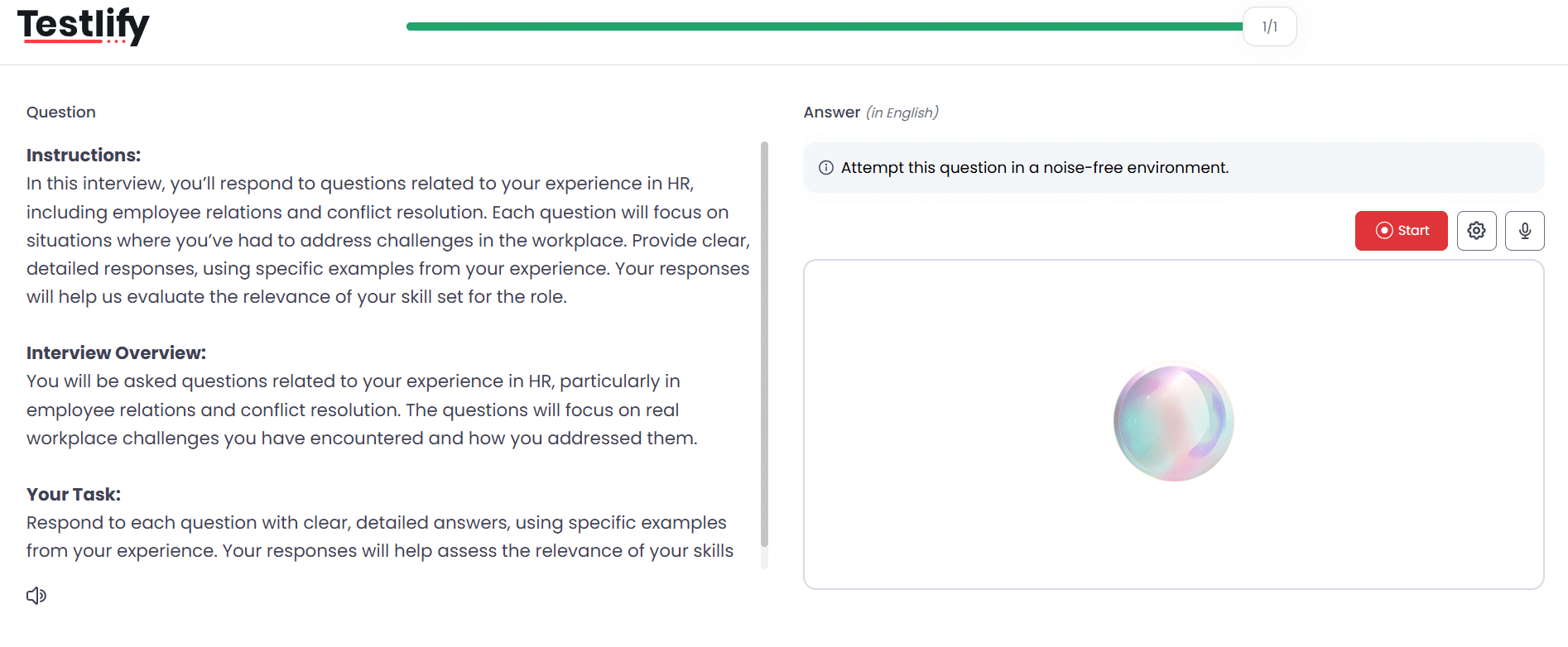
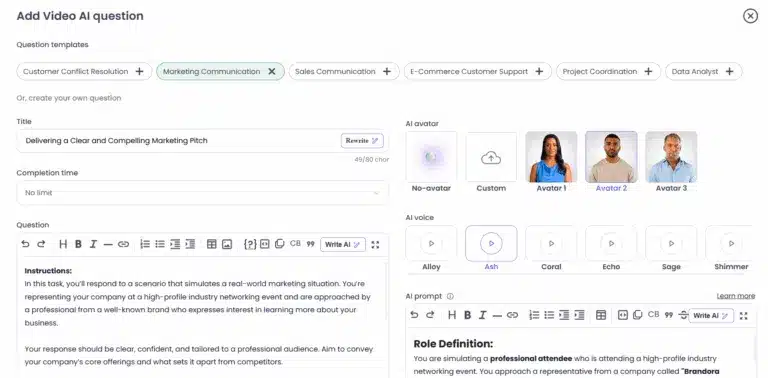
Interviewing sits in the same product. Testlify runs one-way video, two-way conversational AI video, voice and audio questions, and outbound AI phone interviews billed at $0.18 per minute, with 150+ interview templates to start from. You choose the AI avatar and voice, write the prompts, cap attempts and recording time, and get automatic multilingual transcripts. AI scores the open answers, a human can override every score, and the product says so out loud: "AI scores and insights are for guidance only. Use human judgment for final decisions."

What is Saville Assessment?
Saville Assessment is a psychometric test publisher founded as Saville Consulting by Professor Peter Saville, one of the better-known figures in British occupational psychology. Towers Watson bought the business for GBP 42 million in 2015, which is how it ended up inside WTW, and it returned to independence in 2023 when Tenzing backed a management buyout. The catalog is narrower than a skills-assessment platform's on purpose: this is a publisher, and its product is measurement.
Three families do most of the work. Wave is the personality questionnaire, built around styles, motives and talents, and it is untimed. Swift is the aptitude range, packaging verbal, numerical, diagrammatic, abstract, error checking and spatial reasoning into short combined batteries. There is a situational judgement range as well, plus Wave Connect, the newer platform layer the company positions for role profiling and workforce dashboards.
Their client list is the kind you would expect from a publisher with that heritage: Ricoh, Jaguar Land Rover, EY and Baker McKenzie all appear on the company's own site. Graduate schemes and leadership pipelines at large employers are the natural home for these tools.
Saville Assessment partnerships and accreditation
Here is the thing most comparison pages skip. Saville's model runs on accreditation. To administer and interpret the aptitude range and the Wave Styles questionnaire, someone on your side takes a Test User: Occupational Ability or Test User: Occupational Personality course, which confers eligibility for the BPS and EFPA qualifications, commonly called Level A and Level B. Saville's own training combines roughly 8 to 12 hours of e-learning with about 2.5 days of virtual sessions, and Wave course bookings include a one-hour consultation where the delegate is fed back on their own report.
That is a strength and a cost at the same time. Accreditation is why a Wave report can be defended in a promotion panel. It is also why a five-person talent team without a qualified user cannot simply buy the tool on a Tuesday and sift with it on a Wednesday. Saville also works through a partner and distributor network in several markets, so what you are quoted, and who supports you, can depend on which entity you buy through.
Who are Saville Assessment and who uses them?
Saville Assessment is an occupational psychology publisher whose tools are used mainly by large employers running graduate schemes, high-stakes leadership assessment and structured development programs. Typical users are in-house assessment specialists, occupational psychologists and consultancies, not generalist recruiters. The buying committee usually includes someone who already holds a BPS test-user qualification.
Look at who is not on that list, though. Fast-growing companies under 200 people, agencies, professional services firms and non-tech businesses hiring across mixed roles rarely have a qualified test user in the building. They are the companies most likely to land on a comparison page like this one, and they are the ones for whom the accreditation requirement, not the test science, is the deciding factor.
Saville online aptitude tests for high-volume hiring
Saville online aptitude tests are short, well-validated reasoning assessments delivered through Oasys, and they are a reasonable sifting instrument at volume. Swift batteries combine several reasoning types into a single sitting of roughly 10 to 20 minutes. Single aptitude tests, taken one reasoning type at a time, run about 24 to 30 minutes each. Wave, being a personality questionnaire, is untimed.
Swift aptitude tests and single aptitude tests
The Swift range exists precisely because volume hiring punishes long assessments. Swift Analysis Aptitude covers verbal, numerical and diagrammatic reasoning in one sitting. Swift Comprehension covers verbal and numerical comprehension plus error checking. Swift Executive and Swift Technical target senior and technical populations respectively. If your only requirement is a defensible reasoning sift for a graduate intake, this is a strong, boring, dependable answer, and boring is a compliment in selection science. Worth knowing how the families differ before you pick one: our breakdown of the main types of aptitude test lays out what each format actually measures.
Where volume sifting breaks down
Reasoning ability is one signal. The problem is treating it as the whole picture. The most recent large meta-analysis of selection methods, from Sackett and colleagues in 2022, put structured interviews at an operational validity of .42, ahead of job knowledge tests at .40, work sample tests at .33 and cognitive ability at .31. That reordering matters for anyone designing a sift. General reasoning is useful and it is not the strongest single predictor available, which is the argument for combining signals rather than ranking candidates on one.
The second constraint is throughput. U.S. employers made 5.1 million hires in July 2026 against 7.3 million open roles, so most talent teams are working a funnel that is wide at the top and thin on recruiter hours. Every extra step that needs a qualified interpreter is a step that queues. A 25-minute single aptitude test per reasoning type, read by the one accredited person in the business, is a different operational proposition from a 40-minute blended assessment that scores itself and pushes a ranked shortlist into the ATS overnight.
Pro tip: before you compare feature lists, count the people in your organization who are allowed to interpret a result today. If that number is one, or zero, the tool that needs accreditation will slow you down no matter how good its norms are.
What is the Saville Assessment Oasys platform?
Oasys is Saville Assessment's online delivery platform: the system that sends invitations, administers the Swift and Wave assessments, holds candidate records and generates reports. Candidates log in to Oasys to update their details, read guidelines, sit the assessment and access reports. It connects to applicant tracking systems including Taleo, iCIMS and SAP SuccessFactors, and the company reports 99.96% platform uptime.
Treat Oasys as an administration layer rather than a hiring workflow. It is good at what a publisher needs it to be good at: correct delivery, correct norms, correct reports. What it is not is a place where a hiring manager reviews interview recordings, a reviewer panel scores candidates side by side, or a job requisition moves through stages. Those live somewhere else in a Saville-based stack, usually your ATS.
Testlify vs. Saville Assessment: feature comparison
The table below compares the two on the dimensions buyers actually raise on calls. Where a row says "not published", it means the company does not state it publicly, not that the capability is absent.
Dimension | Testlify | Saville Assessment |
|---|---|---|
Category | Skills assessment and interviewing platform | Psychometric test publisher |
Library | 3,500+ tests across 12 categories | Wave personality, Swift and single aptitude tests, situational judgement |
Question formats | 25+ types, including coding, Office and Google Workspace tasks, file upload, typing | Standardized psychometric item formats |
Custom assessments | Yes, built from the library or generated from a job description | Configured from the published catalog |
Interviews | One-way video, two-way conversational AI video, voice, AI phone at $0.18 per minute | Not part of the published product range |
Proctoring | Standard, Strict and Custom presets, plus dual-device monitoring | Not published |
Scoring | Question, test and assessment level, weights x0 to x5, AI scoring with human override | Norm-referenced psychometric scoring |
Who can interpret results | Any reviewer with access | Accredited users for the aptitude and Wave ranges |
Delivery platform | Testlify, with a built-in hiring pipeline | Oasys, plus Wave Connect |
ATS integrations | 100+, sold as a $2,388 a year add-on on the self-serve plan | Taleo, iCIMS, SAP SuccessFactors and others |
Languages | Real-time translation of tests and custom questions | Multiple published language versions |
Published pricing | Yes, from $1,668 a year | No, quote on request |
Free trial | 7 days, no card required | Not published |
Test library and question types
Breadth is the clearest gap between the two. Testlify's library spans blue collar, coding, cognitive ability, engineering, language, personality and culture, programming, psychometric, role-specific, situational judgement, software skills, simulation and gamified categories, and you can mix several in one assessment. Question banks can be fixed, so every candidate sees the same items, or variable, drawing unused questions at random from a larger pool.
Saville's catalog is deliberately narrower and deeper. You get fewer instruments, each with published norms and a research base behind it. If your requirement is "measure numerical reasoning against a graduate norm group", that depth is worth more than breadth. If your requirement is "screen a warehouse supervisor, a payroll clerk and a React developer this month", breadth wins, and it is not close.
Breadth is also getting harder to buy once and forget. Employers surveyed for the World Economic Forum expect 39% of the key skills a job requires to change by 2030, down from 44% in the previous edition but still a large chunk of any role profile. A library you can add to, and questions you can rewrite yourself, age better than a fixed catalog when the job description keeps moving.
Interviews: video, voice and phone
This is the dimension where the two products stop overlapping. Testlify runs the interview itself. One-way async video for early screening, two-way conversational AI video where the candidate is muted while the AI is speaking (genuine turn-taking, not recorded prompts), voice and audio questions, and outbound AI phone interviews. You configure the avatar, the voice, the persona, the prompts, the number of attempts and the preparation time before recording starts. Transcripts are automatic and multilingual, generated for any recording of at least 30 seconds.
Reviewers can watch or download the video, download the audio, replay the screen, regenerate the interview report and export the transcript. Video violation detection runs alongside it, flagging a webcam that goes dark, a face that disappears or a second face appearing mid-answer.
The honest boundary: Testlify does not schedule live human interview panels. If you need calendar coordination for four partners and a candidate across three time zones, that is your ATS or a scheduling tool, not this.
Proctoring and assessment integrity
Testlify ships three proctoring presets, Standard, Strict and Custom, and the measures underneath them include full-screen enforcement, tab-switch detection, face detection and single-presence checks, photo ID verification with face match, periodic webcam snapshots, copy-paste tracking, multi-monitor restriction, AI-tool and browser-extension detection, and IP or location checks.
The one worth calling out is dual-device proctoring. The candidate's phone becomes a second camera, positioned so it captures both the candidate and the laptop screen, and the assessment will not start until mobile monitoring is active. Very few assessment products offer it.
Just as important is what the product refuses to do with those signals. Flags are three-tier and evidence-first: green means nothing was observed, yellow says "a quick manual review is recommended", red means cheating was confirmed. Auto-termination is a separate opt-in setting with a threshold the recruiter chooses, not something a flag triggers by itself. Face verification data is deleted after 30 days and consent can be withdrawn at any time. That distinction, evidence over automatic rejection, is what makes the whole thing defensible when a rejected candidate asks why.
Reporting and benchmarking
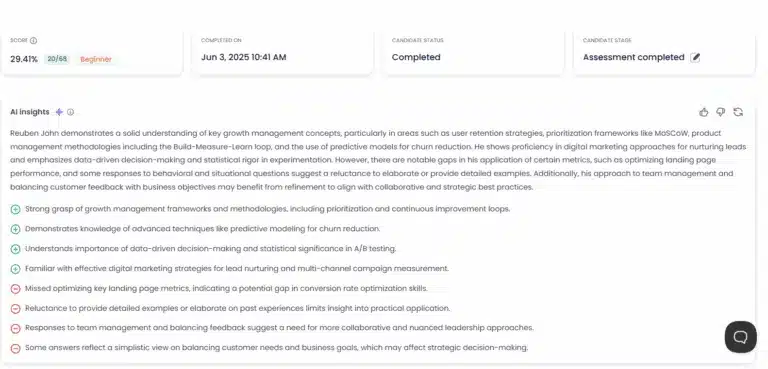
Both products report well, in different currencies. Saville gives you norm-referenced psychometric profiles with a research base behind the interpretation. Testlify gives you item-level psychometrics that most assessment platforms keep hidden: difficulty index, discrimination index, a quality-risk flag for questions with very low accuracy or high skip rates, answer distributions, and score and time distributions per question. Percentile rank, candidate rank and "better than" comparisons sit on top.
Report types run from development and DISC to CEFR language, cultural fit, conflict management, 360 feedback and reviewer score reports, exportable as PDF, ZIP or CSV through the reporting and analytics view. Shareable reports have granular toggles, so you can show a hiring manager the score and hide the AI insights, or show proctoring flags without the underlying detail.
Integrations and the ATS question
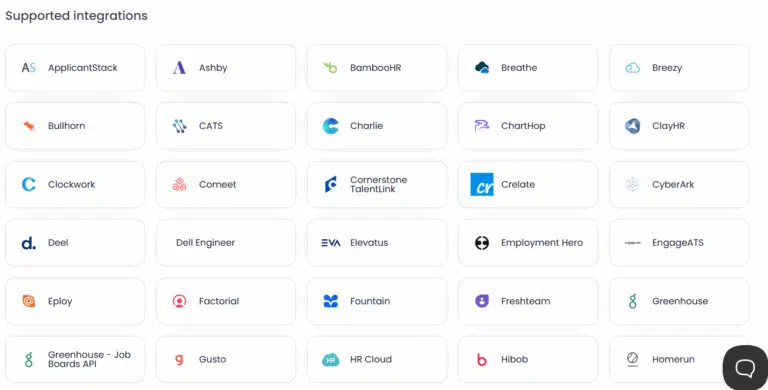
Most teams comparing these two already run an applicant tracking system and are not looking to replace it. Testlify integrates with 100+ ATS products and leaves your ATS as the system of record, which is the normal deployment. On the self-serve plan those integrations are a $2,388 a year add-on, and they are included on the Custom plan. AI resume screening is free with a Greenhouse integration and is limited to Greenhouse today.
If you do not run an ATS at all, Testlify also ships a simple built-in hiring pipeline: job requisitions, an application form, publishing to job boards, a public job listing and an applied to reviewed to shortlisted to rejected flow. It is deliberately basic. It exists so a 30-person company can hire without buying two products, not to compete with an enterprise system of record.
Saville connects to major ATS platforms through Oasys, including Taleo, iCIMS and SAP SuccessFactors, which covers the large-employer stack its customers tend to run.
Is Testlify a better alternative to Saville Assessment?
For most teams landing on this page, yes, and the reason is operational rather than scientific. Testlify covers more of the hiring job in one place: tests, work samples, interviews, proctoring, scoring and a shortlist, with published pricing and a 7-day trial that needs no card. Saville covers one part of that job with more measurement depth and a gate in front of it.
The Testlify Multi-Signal Talent Evaluation Model is how we frame this. One signal is fragile; several role-relevant signals pointing the same way create confidence. A candidate should not advance because of one strong test score or one polished interview, but because assessment evidence, work-sample evidence, interview evidence and reviewer feedback agree. A publisher sells you one high-quality signal. A platform lets you combine four and see where they disagree, which is usually the most interesting thing on the page.
Candidate trust is the other half. Gartner found that just 26% of job applicants trust AI to evaluate them fairly, which is a warning to anyone automating a sift. It is also the argument for the human-override design: show the AI score to the reviewer or hide it, include it in the final average or leave it out, and route any question that matters to a named human. The tooling should make a human decision better, not replace it.
That tension is not going away. 88% of organizations now report regular AI use in at least one business function, on McKinsey's most recent count, so the realistic question for a hiring team is no longer whether AI touches the process. It is whether a candidate can be told what the AI did, and whether a human can overturn it. Both answers should be yes before you automate a single sift.
Where Saville Assessment is the better choice
Three cases, stated plainly. First, regulated or high-stakes leadership assessment where a BPS-accredited personality instrument and a qualified interpreter are effectively required. Second, an existing assessment function with trained users, historical norm data and validation studies already built on Wave, where switching costs more than it returns. Third, a research-grade requirement, such as a bespoke norm group or a published validity study for a specific role family, which is publisher work rather than platform work.
If you are in one of those three, the honest recommendation is to keep Saville for that work and, if breadth is the gap, run a skills platform alongside it for volume roles. Nobody says you have to pick one tool for every hire.
Saville vs SHL and other psychometric publishers
Saville is one of several established publishers in the same tradition, and buyers comparing it usually have SHL on the list too. The useful distinction is not brand, it is what each category optimizes for.
Type of provider | Optimized for | Typical buyer | Main trade-off |
|---|---|---|---|
Psychometric publishers (Saville, SHL and peers) | Measurement depth, norms, defensibility | In-house assessment teams, occupational psychologists | Accreditation and cost per candidate; narrow role coverage |
Skills assessment platforms | Role coverage, speed, self-serve use | Talent teams and founders hiring across mixed roles | Fewer published norm groups than a publisher |
Video interview tools | Async and AI interviewing | High-volume and distributed hiring teams | Little or no underlying skills measurement |
ATS-native assessments | Convenience inside an existing workflow | Teams already committed to one ATS | Shallow test content, weak proctoring |
Saville and SHL sit in the same box, and choosing between them is mostly a question of which norms, which report format and which relationship your assessment lead already trusts. Choosing between that box and a skills platform is the bigger decision, and it turns on who needs to read the result. Our own roundup of Saville Assessment alternatives goes wider if you are still building a shortlist, and there is a separate breakdown of options for teams moving off SHL.
How much do Testlify and Saville Assessment cost?
Testlify publishes list prices. Saville does not. On annual billing, Testlify's Starter plan is $1,668 a year for 100 candidate credits, which works out at $16.68 per credit, with 3 seats included. Basic is $279 a month for 300 credits, Business is $699 a month for 1,000, and Premium, Enterprise and Custom tiers are quoted by sales. A credit is consumed when a qualified candidate starts an assessment, credits do not roll over, and extra seats are $15 a month each. The trial is 7 days with no card, there is a 30-day money-back guarantee, and prices are locked for 24 months.
Read the add-ons before you budget. White labeling and 100+ ATS integrations are each $2,388 a year on the self-serve plan and included on Custom, and SAML SSO with 2FA is also an add-on there. Metered items sit on top: AI phone interviews at $0.18 a minute, face verification at $0.50 an attempt.
Saville quotes on request, and pricing typically depends on the instruments you license, candidate volume, and the accreditation training your team needs first. Budget for the training, not just the tests, because a Level A and Level B course for one or two users is a real line item and a real calendar commitment.
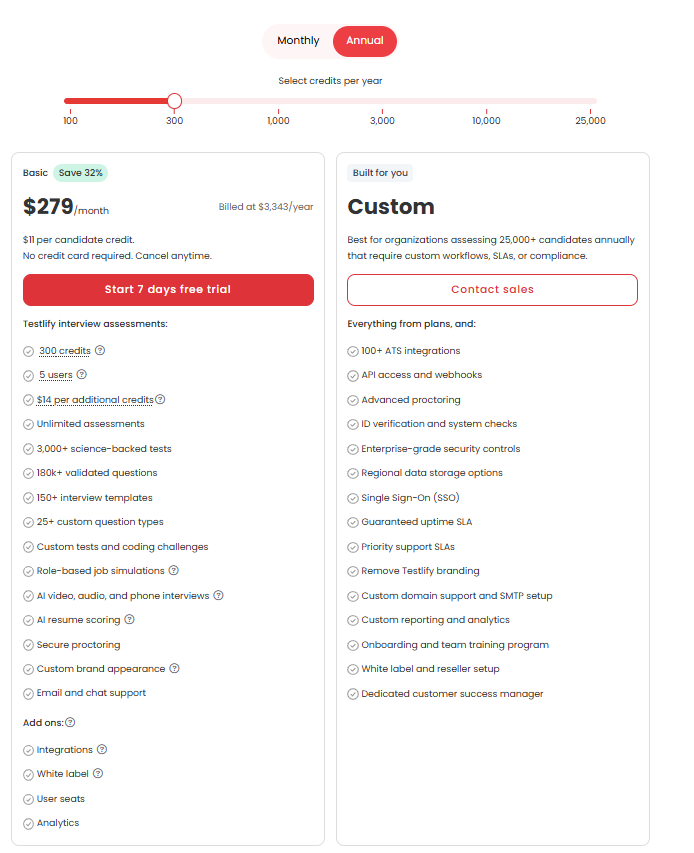
A worked example, kept deliberately simple. A 90-person recruitment agency hiring 40 people a year across sales, operations and one or two technical roles needs breadth, not depth: four or five different assessment types, results anyone on the team can read, and a shortlist ready before the first call. On published Testlify pricing that is comfortably inside the Basic tier. The same agency buying from a publisher pays per candidate, plus a course for whoever will be allowed to interpret the reports, and still needs somewhere else to run the interviews.
Hire on evidence, not on a hunch
If you are replacing or supplementing a psychometric publisher, the fastest way to see the difference is to build the assessment you would actually send. Pick three role-relevant tests from the test library, add a work-sample question, turn on the proctoring preset that matches the stakes, and send it to two people on your own team. You will know within a day whether the reports tell you something your current process does not. Start with the 7-day free trial or book a demo and have someone walk you through the interview builder.
Key takeaways
- The deciding factor is usually access, not accuracy. Saville's instruments are well validated, but its aptitude and Wave ranges assume an accredited user. If nobody in your business holds that qualification, every result queues behind the one person who does, and your time-to-shortlist is set by their calendar.
- Breadth and depth are different purchases. A publisher gives you a small number of instruments with published norms. A platform gives you 3,500+ tests across 12 categories plus work samples. Buy depth for leadership assessment and validation work; buy breadth when you hire across mixed roles every month.
- One signal is fragile. Structured interviews outpredict cognitive ability tests in the 2022 Sackett meta-analysis, .42 against .31, which is the case for combining assessment, work sample, interview and reviewer evidence rather than ranking on a single reasoning score.
- Interviewing is where the products stop overlapping. Testlify runs one-way, conversational AI video, voice and phone interviews with transcripts and human-override scoring in the same tool. Saville does not publish an interviewing product, so a Saville stack needs a second vendor for that step.
- Published pricing is itself a feature. You can budget Testlify from the pricing page, add-ons included, before you talk to anyone. Quote-on-request pricing is not a red flag, but it does mean your evaluation timeline starts with a sales call rather than a trial.
- Candidate trust is a design constraint. With only 26% of applicants trusting AI to evaluate them fairly, disclose what is automated, keep a human override on every score, and make the proctoring evidence reviewable rather than automatically disqualifying.
- Keep both where it makes sense. Running a publisher for senior and regulated hiring while a skills platform handles volume roles is a legitimate answer, and often cheaper than forcing one tool to do both jobs badly.
FAQs

Director of Marketing
Akash Patange is the Director of Marketing at Testlify, where he works closely with HR leaders and recruiters to help organizations improve hiring outcomes. He writes about talent assessment, recruitment technology, and data-driven hiring practices.
LinkedInRelated resources
View all
Competitor Comparisons
Testlify vs. Talogy: Skills Assessment Platform Comparison
Competitor Comparisons
Testlify vs. Hire Success: Which Skills Assessment Platform is Best for HR Teams?
Competitor Comparisons
Testlify vs. Testgrid: Which Skills Assessment Platform is Best for HR Teams?
Competitor Comparisons
Testlify vs. Testello: Which Skills Assessment Platform is Best for HR Teams?
Competitor Comparisons
Testlify vs. TalentLyft: Which Skills Assessment Platform is Best for HR Teams?
Competitor Comparisons
Testlify vs. Skillmeter: Which Skills Assessment Platform is Best for HR Teams?
Get started.
Hire on proof, not resumes.
Run your first skills-based assessment free — no credit card required.