
Recruitment vs Executive Search: 7 Key Differences (2026 Guide)
Learn how recruitment vs executive search differ on cost, timeline, fee model, and candidate type — and which approach protects quality of hire at every level.

Recruitment and executive search both fill open roles, but they solve different problems. Recruitment brings in active applicants for mid-level and high-volume jobs through postings and inbound screening. Executive search hunts down senior leaders who are not looking, reaches out directly, and builds interest one conversation at a time.
Pick the wrong approach and either the process is overkill for a mid-level seat, or a critical leadership decision gets rushed through a model designed for speed over fit. The choice comes down to the level of the role, how fast it needs to be filled, and what a wrong hire would cost.
 ChatGPT
 Gemini
 Claude
 Grok
Grok Perplexity
TL;DR
- Recruitment vs executive search is a role-level decision, not a budget decision. The wrong tool at the wrong level costs more than the fee difference.
- 77% of organizations report difficulty filling senior leadership roles, according to Korn Ferry talent research. Executive search exists for exactly this problem.
- Standard job postings reach only 30-40% of the talent pool. Passive candidates make up the remaining 60%, and executive search is the only structured way to reach them.
- The cost gap is 6.5x: SHRM 2025 benchmarks put the average non-executive hire at $5,475 vs $35,879 for executives. Gallup research shows a leadership mis-hire costs up to 200% of that person’s annual salary.
- Retainer vs contingency is the fee model split that explains how each approach works and what level of commitment each side brings to the process.
- Pre-hire assessment protects quality of hire in both models. It is the step most teams skip and the one most likely to prevent a costly re-hire.

What is recruitment?
Recruitment is the process of finding and hiring candidates for open roles by attracting people who are actively looking. It runs on job postings, sourcing, resume screening, and interviews, and it is built for speed and volume. Most entry-level and mid-level hiring lives here.
The model is inbound-heavy: candidates come to you. One recruiter can manage multiple open roles simultaneously because the flow is repeatable. Confirm the need, post the role, screen applicants, shortlist, interview, offer, and onboard the new hire. For positions with a healthy candidate pool, nothing beats this approach on cost and time efficiency.
When recruitment fits best
- Roles at entry-level through mid-management with a clearly defined skills brief.
- Positions where competencies can be verified through structured assessment early in the funnel.
- Volume hiring across multiple departments where speed and consistency matter most.
- Budgets and timelines that cannot support a 3-6 month process.
What is executive search — and is it the same as headhunting?
Executive search and headhunting are the same practice. The terms are used interchangeably across the industry. An executive search firm sends consultants — sometimes called headhunters — to identify, approach, and convince senior leaders to consider a move, regardless of whether those leaders are actively looking.
The defining characteristic is proactive, confidential outreach to passive candidates. LinkedIn’s talent research found that 45% of professionals are only open to a new role when a recruiter approaches them directly. Executive search is built entirely for this group. Passive candidates and those open to approaches — but not actively applying — make up approximately 60% of the total talent pool.
How an executive search actually runs
- Leadership discovery: define the role profile with the hiring team.
- Market mapping: identify target companies and potential candidates.
- Confidential outreach: direct approach to passive targets.
- Deep vetting: structured interviews, psychometric assessments, reference checks.
- Shortlist delivery: 3-5 fully assessed candidates presented to the client.
- Offer support and onboarding: extended support through the first 90 days.
When executive search fits best
- C-suite, VP, or Director roles with strategic scope over a team or division.
- Situations requiring confidentiality, such as replacing a sitting executive.
- Decisions where leadership judgment and culture fit weigh as heavily as credentials.
- Roles where a mis-hire would set the business back by quarters, not weeks.
Recruitment vs executive search: what are the 7 key differences?
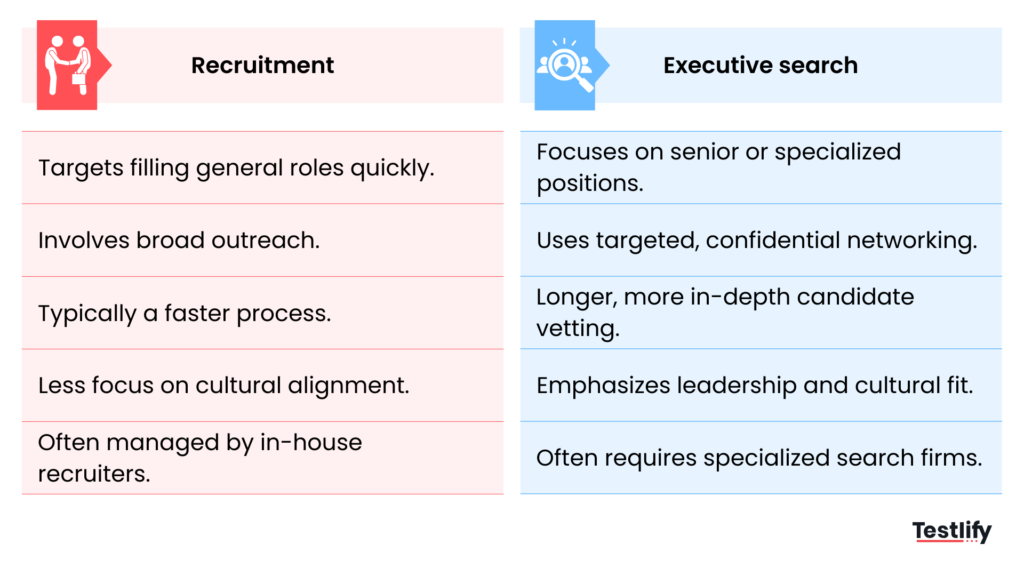
The short version: recruitment is broad, fast, and applicant-driven. Executive search is narrow, slow, and recruiter-driven. The table below covers the 7 differences that actually change how the process runs.
Factor | Recruitment | Executive Search |
|---|---|---|
Target roles | Entry-level to mid-management | Senior leadership, C-suite, VP, Director |
Candidate type | Active job seekers (30-40% of talent pool) | Passive leaders (60% of talent pool) |
Approach | Job postings, inbound screening, volume sourcing | Confidential outreach, market mapping, direct approach |
Fee model | Contingency: 15-25% of salary, paid on placement | Retainer: 25-35% of salary, paid in 3 milestones |
Typical timeline | 2-8 weeks | 3-6 months |
Average cost per hire (SHRM 2025) | $5,475 | $35,879 |
Primary success metric | Time-to-fill, offer acceptance rate | Quality of hire, leadership retention at 12 months |
What does executive search actually cost — and what is retainer vs contingency?
SHRM’s 2025 Talent Acquisition Benchmarking Report puts the average non-executive hire at $5,475 and the average executive hire at $35,879 — a 6.5x gap. SHRM also notes executive hiring costs jumped 21% since 2022, reflecting both the tighter senior talent market and the depth of process required.
Contingency recruiting is the standard recruitment model. The agency earns a fee — typically 15-25% of first-year compensation — only when a candidate is successfully placed. No placement, no fee. This aligns incentives well for volume roles but limits how much time a recruiter can invest in any single search. Multiple agencies may work the same role simultaneously with no committed mandate from either side.
Retainer-based executive search means the client pays in stages — typically at search initiation, shortlist delivery, and placement. Fees run 25-35% of first-year compensation. The upfront commitment funds a deeper, exclusive, and confidential process with the firm’s full resources behind the engagement.
Pro Tip: Never evaluate executive search on cost per hire alone. Price the downside instead. Gallup research shows a single leadership mis-hire can cost up to 200% of that leader’s annual salary once lost productivity, team disruption, and replacement costs are counted. A $35,879 search fee is inexpensive insurance against a six-figure mistake.
How long does executive search take — and why?
A well-run executive search closes in 3-6 months. That timeline breaks across five phases:
- Weeks 1-3: Leadership discovery, role profile, market mapping.
- Weeks 4-8: Confidential outreach, initial conversations with passive targets.
- Weeks 9-14: Deep vetting, assessments, shortlist preparation.
- Weeks 15-20: Client interviews, reference checks, offer, acceptance.
- Post-hire: Extended onboarding support through day 90.
Standard recruitment moves faster because the model is inbound and volume-driven. A well-executed job posting can generate a qualified shortlist in days. Executive search is slower by design — it requires building relationships with people who were not looking, running discreet outreach, and evaluating leadership judgment alongside credentials.
Key Takeaway: The 3-6 month executive search timeline is a feature, not a delay. Cutting that process to save 6 weeks typically introduces the kind of risk that costs far more than the time saved.
When should you use executive search?
Use executive search when the role is senior, the right candidates are passive, and a mis-hire would hurt the business for quarters rather than weeks. Korn Ferry’s talent research documents a persistent leadership shortage, with 77% of organizations reporting difficulty filling senior leadership roles with qualified candidates. That gap is not a pipeline problem — it is a visibility problem. The leaders who could fill those seats are employed, performing well, and not monitoring job boards.
Gallup’s manager engagement research also shows that managers account for at least 70% of the variance in employee engagement across their teams. One leadership hire ripples across headcount, culture, and output in ways a mid-level replacement simply does not.
- The role is C-suite, VP, or Director with strategic scope over a team or division.
- Confidentiality is required, for example replacing a sitting executive.
- The right candidates need to be convinced, not just recruited.
- Team performance, product direction, or revenue is directly tied to who fills this seat.
- A 12-month quality of hire metric matters more than a 4-week time-to-fill.
When is standard recruitment the better choice?
For the majority of open roles, standard recruitment wins on speed, cost, and scale. When there is a deep active candidate pool, a clearly defined skills brief, and a timeline measured in weeks, a well-run recruitment process delivers better ROI than a retained executive search.
Standard recruitment also guards against over-engineering a hire. Not every manager-level role needs a 6-month search. If a wrong hire at this level would cost 1-2x annual salary to fix and the ramp time is under 3 months, standard recruitment is the right tool. The goal is to keep quality high while moving quickly, which is where structured pre-hire assessment earns its keep.
- Hiring for entry-level through mid-management positions with a strong active talent pool.
- Volume and consistency are higher priorities than exhaustive vetting.
- Budget and timelines are constrained.
- Skills can be verified early in the funnel through structured testing before the first interview.
Internal recruiting vs external executive search firm: how do you choose?
Some organizations run leadership hiring through an in-house talent acquisition team. Others outsource every senior search to an external firm. Most high-growth teams do both, depending on the role. Three factors determine the right split:
Factor | In-House Team Wins | External Firm Wins |
|---|---|---|
Market access | Deep networks in the specific talent pool already exist | The role requires mapping competitors or entering a new market |
Confidentiality | Internal hire; current team is aware of the vacancy | Replacing a sitting executive; strict discretion required |
Bandwidth | TA team has capacity and expertise at this seniority level | In-house team is stretched across 20+ open roles |
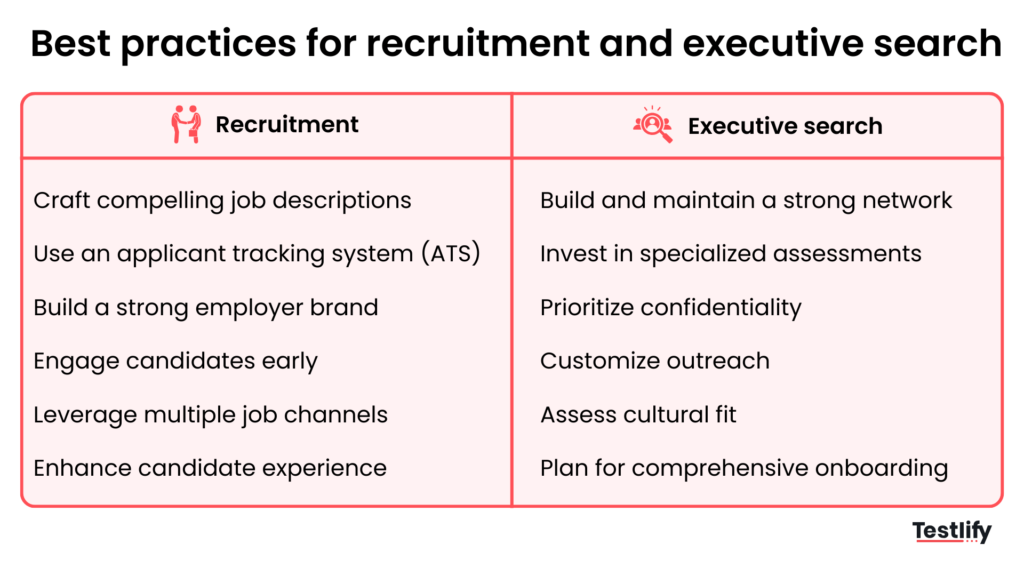
The two approaches are complementary, not competing. A common pattern: in-house handles the search brief, role definition, and first-round screening; the external firm runs passive outreach and deep vetting. Neither track is wasted when the scope is clearly defined upfront.
How does Testlify protect quality of hire in both models?
Recruitment and executive search differ on cost, timeline, and candidate type. They share one failure point: a hire who performs well in the process and underperforms in the role. Testlify’s talent assessment platform addresses this before the final decision is made.
The Testlify 3-Stage Hire-Right Scorecard applies across both hiring models:
Stage | Assessment | What it measures |
|---|---|---|
1 | Problem-solving, learning speed, pattern recognition | |
2 | Working style, collaboration, stress response | |
3 | Values alignment, decision-making patterns |
For volume recruitment, the Scorecard runs early in the funnel, before first-round interviews. Screening stays fast, consistent, and bias-reduced at scale. For executive search, the same Scorecard adds objective data to a decision that otherwise rests on interview performance and a handful of references. LinkedIn’s Future of Recruiting report found 93% of talent teams say accurately assessing candidate skills is the single factor most likely to improve quality of hire — yet only 25% feel confident they can measure it well.
Testlify connects to 100+ ATS integrations, runs across 3,000+ tests covering 4,500+ job roles, and returns a 94% candidate satisfaction score. The platform puts structured measurement at the point where it matters most: before the offer, not after.
Key Takeaway: Teams using Testlify report a 55% reduction in time-to-hire. That number comes from moving screening upstream in both models — fewer surprises at the offer stage means faster closes and fewer searches re-opened.
Frequently asked questions (FAQs)
Hire right at every level with Testlify
Whether filling 10 mid-level seats or one critical VP role, quality of hire lives or dies before the offer is made. Score every shortlisted candidate on the skills that predict success. Book a demo to see Testlify’s full assessment library, or start free and run your first Hire-Right Scorecard today.

Content Writer
Yashika Khandelwal is a Content Writer with 3+ years of experience creating research-backed content on hiring, talent assessment, and HR technology. She is a registered Organizational Psychologist and subject matter expert who combines behavioral science with practical recruitment insights to produce accurate, evidence-based content.
LinkedInRelated resources
View all
HR & recruitment
What is recruitment process outsourcing and how much does it cost?

HR & recruitment
Recruitment sources: Types, advantages and disadvantages

HR & recruitment
How to improve recruitment diversity: enterprise HR guide

HR & recruitment
The cost of a bad hire in the age of AI: What every company should know

HR & recruitment
How AI is changing the game for job applicants: Navigating the risks in hiring

HR & recruitment
Top 7 recruitment KPIs and how to effectively track them in 2026
Get started.
Hire on proof, not resumes.
Run your first skills-based assessment free — no credit card required.