
9/80 work schedule: A definitive guide for 2026
Discover the benefits, challenges, and key details of the 9/80 work schedule in this comprehensive 2025 guide to boost productivity and work-life balance.

Most people are familiar with the standard 9-to-6 job schedule and may be unaware that there are other ways to structure the working week. Companies such as Chevron already offer alternative schedules, including the popular 9/80 compressed workweek, which gives employees an extra day off every other week.
The shift toward greater flexible work arrangements is becoming more visible across the workplace. According to the US Bureau of Labor Statistics, 57% of wage and salary workers had a flexible schedule, allowing them to vary when they started and ended work.
So, what exactly is a 9/80 schedule, how does it work, and what are its benefits and drawbacks for employees and employers? This blog explores everything you need to know about the 9/80 work schedule.
 ChatGPT
 Gemini
 Claude
 Grok
Grok Perplexity
TL;DR
- A 9/80 work schedule allows employees to work 80 hours over nine days instead of the traditional 10, giving them an extra day off every other week.
- The schedule can improve work-life balance, rest, employee satisfaction, and flexibility while maintaining full-time hours.
- Longer workdays may also create challenges, including fatigue, burnout, lower productivity, and difficulties managing personal responsibilities. pasted text
- Employers must consider overtime, payroll, scheduling, and wage-and-hour compliance before implementing a 9/80 schedule.
- Compared with a 4-day workweek, the 9/80 model maintains traditional working hours while still providing additional time off. pasted text
- HR teams should run a pilot, establish clear payroll policies, adjust workloads, monitor burnout, train managers, and track employee feedback before rolling it out company-wide. pasted text
- Ultimately, the right schedule depends on the organization's business needs, workforce preferences, and ability to manage longer workdays.

What is a 9/80 work schedule?
A 9/80 work schedule is an alternative work arrangement where employees work 80 hours over nine days instead of the typical 10 days in two weeks. In this schedule, employees work eight 9-hour days and one 8-hour day, followed by a day off every other week.
Employees may sometimes enjoy a full day off or get a four-hour day every other week. Ultimately, the main objective is to boost productivity and engagement by providing a good work-life balance.
How does a 9/80 work schedule operate?
A 9/80 work schedule is a way of structuring your work hours to give you more time off. Here’s how it works:
- Over two weeks (80 hours), you work eight 9-hour days and one 8-hour day instead of the traditional 10 days of 8-hour shifts.
- As a result, you get one extra day off every two weeks.
In a typical setup, you might work longer hours Monday through Thursday (9 hours each day) and only 8 hours on one Friday. The next Friday, you’d get the entire day off. This schedule is popular because it gives employees an extra day of rest every other week while maintaining full-time work hours.
It’s a flexible schedule often used to help balance work and personal time without reducing overall hours or pay.
For payroll purposes, employers divide the day: the first four hours worked count toward the first week, and the remaining four hours count toward the second week.
9/80 work schedule advantages
Opting for such alternating work like 9/80 work week offers numerous benefits, some of which include:
Improved productivity
Providing a day off might encourage employees to work harder since they see it as a reward for their hard work. It might also boost productivity, though no research supports this claim. It might also improve employee morale as they tend to look at their duties in a positive light.
Due to the 9/80 work schedule, companies may even witness fewer vacation requests and sick leave. About 54% of employees are in favor of such alternative work schedules.
Employees feel a sense of ownership and responsibility, leading to a happier work environment.
Work-life balance
An extra day off allows employees to take care of their personal needs and improve their work-life balance. One day off also means less commute time since they don’t have to battle through traffic.
Longer work travel is often associated with lower work satisfaction, increased stress, and deteriorated mental health. Survey results show that about 50% of professionals find traveling to work stressful.
Hence, having a 9/80 work schedule delicately balances this issue, boosting employee satisfaction and promoting the working environment.
For businesses, this means reducing absenteeism and turnover due to a happy and healthy workplace culture. This reduces the physical and mental strain often caused by long commutes.
Increased focus and rest
With more time to handle personal commitments outside of work, employees are less likely to face interruptions during the day, improving focus.
The additional hour of work each day also boosts task completion, allowing employees to finish what they start more efficiently.
Plus, the extra two days off each month provide ample time for rest and recovery, ensuring they return refreshed and ready for the week ahead.
Better qualified talents
Studies reveal that 71% of employees prefer flexible work schedules. Hence, implementing a 9/80 work schedule may attract better-qualified employees since many workers value flexible work policies and greater control over their schedules.
A recent Gallup survey found that about 61% of professionals rated greater work-life balance as “very important.” A 9/80 schedule might lead to a better retention rate, as employees who thrive in a good work-life balance are less likely to look for other job opportunities.
9/80 work schedule disadvantages
Though it may seem like a 9/80 work schedule is better, the cons of it outweigh the pros. But that doesn’t mean you have to disregard the entire concept. The final decision to implement it or not is subjective to your company and its policy.
Some of the disadvantages of 9/80 work schedule include:
Risk of burnout
Though there is an additional day off as a benefit, following a 9/80 work schedule means working an extra hour every four days, which increases the risk of accidents and stress. SHRM released reports linking a 9/80 work week to severe risks like burnout, health issues, etc.
Longer workdays lead to personal challenges
One key downside of a 9/80 schedule is the more extended workdays. Working 9 hours daily can make it harder for employees to manage personal responsibilities outside of work. With less time available in the evenings, balancing errands, family time, or appointments may become more difficult for employees.
Decreased productivity in the last hour
Another disadvantage is that employees may experience a drop in productivity during the final hour of the longer workdays. Many employees are used to an 8-hour workday and may start losing focus or energy beyond that point, leading to less effective work and potential fatigue.
Legal and compliance risks with wage and hour laws
Implementing a 9/80 schedule for employers presents legal challenges, especially with nonexempt employees.
Strict compliance with wage and hour laws, such as the Fair Labor Standards Act (FLSA), is crucial to avoid overtime pay issues.
In states like California, where daily overtime laws apply, this schedule can create additional complexities, requiring careful attention to workweek definitions and overtime calculations.
Abuse and overtime
Employees may struggle to adjust to the extra hour of work in a 9/80 schedule. For example, if someone is used to finishing work at 5 p.m., they might start a new task in the extra hour, leading to them working late, sometimes past 6 p.m.
While this isn’t a problem if it happens occasionally, some employees might take advantage by staying clocked in unnecessarily, leading to overtime pay that costs the company more money.
Not profitable for small businesses
Implementing a 9/80 work schedule might not work out for every company, especially small businesses with limited resources. There might not be enough employees to split the day off or to handle the work through shifts.
9/80 schedule versus 4-day workweek: Which is better?
The choice between a 9/80 schedule and a 4-day workweek depends on the business’s and its employees’ needs.
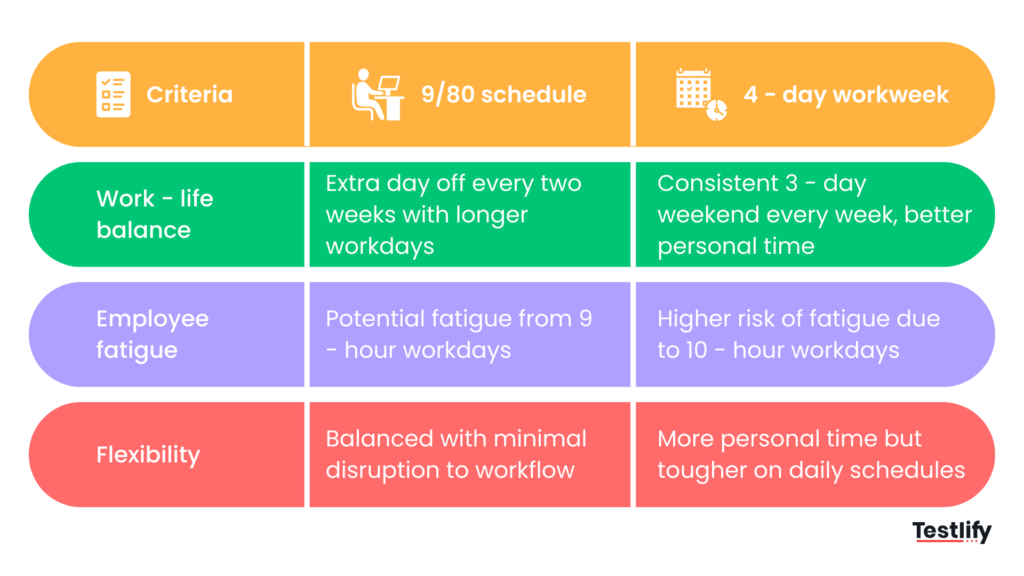
A 9/80 work schedule offers an extra day off every two weeks without reducing total work hours, which can enhance work-life balance. However, it can result in longer workdays, which may be challenging for some employees.
On the other hand, a 4-day workweek provides a consistent three-day weekend, promoting better rest and employee satisfaction. Still, businesses must rethink how to maintain output within fewer hours.
Ultimately, the 4-day workweek may be better suited for organizations focused on employee well-being and flexibility, while the 9/80 schedule offers a balanced approach with minimal disruption to overall work hours.
Note: The 4-day workweek would be better from a payroll and scheduling perspective.
How HR can help implement the 9/80 schedule?
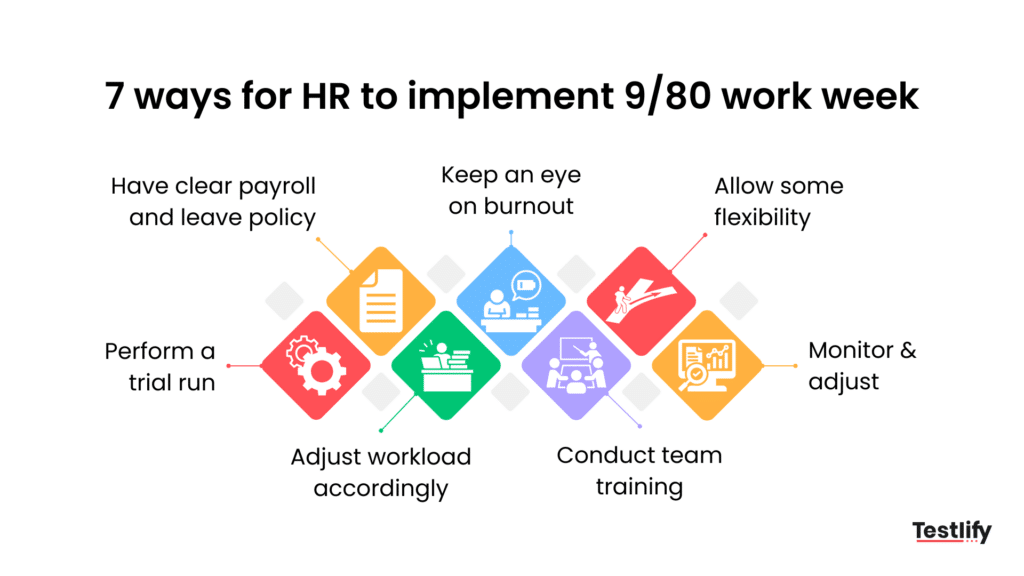
Below are some pointers every HR professional should know for smoother implementation of the 9/80 work schedule.
Perform a trial run
Consider running a pilot program for a 9/80 work schedule to understand how your employees react to it. How well can they cope with this new work week? Identify any potential scheduling challenges and track productivity.
Once you find the perfect balance, you can roll out the entire schedule.
Have a clear payroll and leave policy
Since the 9/80 schedule is not a standard process, there might be complications in leave and payroll processes. Before going full-fledged with it, have clear and transparent policies regarding payroll. Anticipate a rough sick leave and vacation request that might come your way.
Adjust workload accordingly
Communicate with managers to adjust workloads according to the new schedule. Prioritize tasks, delegate effectively, and ensure everyone feels comfortable and productive during their workdays.
Keep an eye on burnout
Though there is an additional day off as a benefit, following a 9/80 work schedule means working an extra hour every four days, which can increase fatigue and stress. HR teams should also understand the causes and warning signs of employee burnout when evaluating alternative schedules.
Conduct team training
Before launching a 9/80 schedule, provide brief training sessions for managers on scheduling their teams and handling common employee concerns effectively. Employees should also be trained on time management strategies to handle the longer workdays.
Allow some flexibility
Consider adding flexibility within the 9/80 schedule, like letting employees choose their “off” Friday or making occasional adjustments for personal needs. This flexibility can significantly boost morale and keep employees satisfied.
Monitor and adjust
Track key metrics such as productivity, absenteeism, and employee satisfaction during the pilot and beyond. Be ready to make changes as needed to maximize the benefits of the 9/80 schedule.
Over to you
A 9/80 work schedule might sound fancy, but the answer to whether you should adopt it or not lies in your company’s objective and what your employees want.
This structure provides employees more personal time and helps organizations attract and retain talent by promoting flexibility and job satisfaction.
Frequently asked questions (FAQs)

Human Resources Lead
Snehi Parmar leads People at Testlify, owning hiring, culture, performance, and retention for a 90-person team. She writes on practical HR strategy and building people processes that scale.
Related resources
View all
HR & recruitment
What is job enlargement and how to implement it? Pros & Cons

HR & recruitment
Corporate Recruiting: Definition, Process, and Best Practices

HR & recruitment
Skills vs competencies: What’s the difference?

HR & recruitment
How to create talent sourcing strategies in 6 easy steps?

HR & recruitment
Are boomerang employees the next big hiring trend?

HR & recruitment
What is skills mapping: Frameworks and tools
Get started.
Hire on proof, not resumes.
Run your first skills-based assessment free — no credit card required.