
Testlify vs Pulsifi: A detailed comparison
Discover the perfect solution for evaluating your candidates’ skills with Testlify. Dive into our comprehensive Testlify vs Pulsifi…
Testlify vs Pulsifi comes down to one question: do you need a skills assessment platform or a personality and culture-fit engine? Testlify is a pre-hire assessment platform with 3,500+ role-specific, cognitive, coding and personality tests, one-way video and AI interviews, and proctoring, priced from $139 a month. Pulsifi is a talent intelligence platform built around psychometric and cognitive assessments plus pre-recorded video responses, sold on a quote basis to enterprise teams. This comparison walks through what each product does, how their video interview questions work, what they cost in 2026, and when the other one is the better pick.
 ChatGPT
 Gemini
 Claude
 Grok
Grok Perplexity
TL;DR: Testlify vs Pulsifi in 60 seconds
- Scope. Testlify tests what a candidate can do (skills, coding, cognitive ability, software tasks) and who they are (personality, culture). Pulsifi focuses on who they are and how they think, through psychometric and cognitive assessments, and adds video responses on top.
- Video interviews. Both support one-way video. Pulsifi has candidates pre-record answers to trait-based questions. Testlify adds AI-led conversational interviews over video, audio, chat and phone, scored on communication and reasoning.
- Cheating controls. Testlify ships webcam snapshots, tab-switch detection, copy-paste monitoring and AI-assistance detection. Pulsifi's public materials don't describe proctoring, and its assessments stay valid for a year across applications.
- Pricing. Testlify publishes its prices: Standard is $139 a month ($1,668 a year for 100 candidate credits). Pulsifi does not publish prices; you request a quote.
- Bottom line. Pick Testlify when you hire for skills across many roles and want proctored, published-price testing. Pick Pulsifi when your program is built around psychometric fit and you already have skills evidence from elsewhere.

What is Pulsifi and who is it built for?
Pulsifi is a talent intelligence platform that scores candidates on personality, work interests, culture preferences and cognitive ability, then predicts role fit and culture fit from that data. It sells to enterprise talent acquisition teams, with packaged programs for hiring automation, psychometric assessment, graduate hiring and lateral hiring, and it describes itself as a "People Data Platform" rather than a test library.
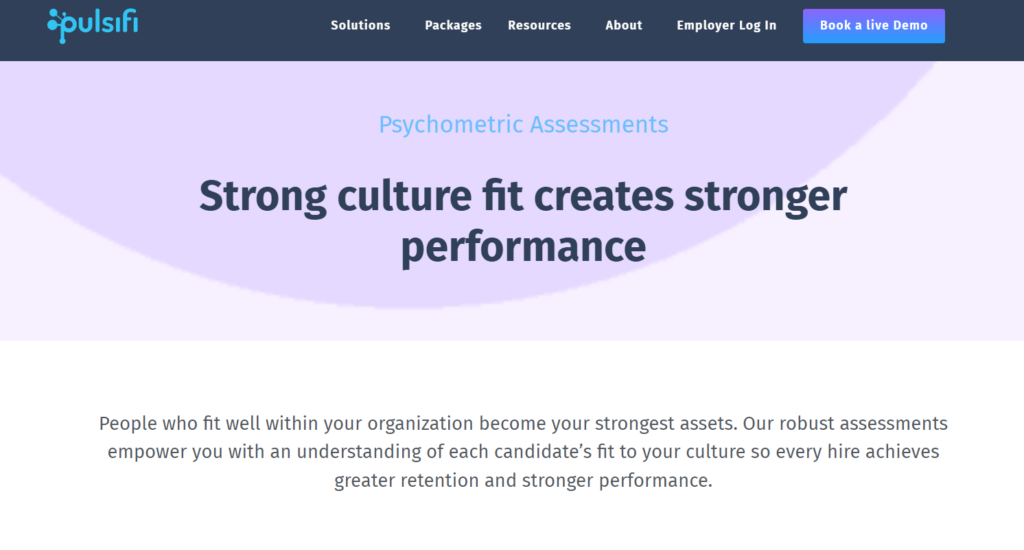
That positioning matters more than any single feature. Pulsifi's job is to tell you whether someone will fit and thrive, using the same kind of trait science that sits behind Big Five personality tools. It's a reasonable bet for graduate programs, where every applicant has roughly the same thin resume and personality plus reasoning are the only signals you have. It's a weaker bet when the role has a hard skill you can test directly. A payroll analyst either reconciles the ledger or doesn't, and no culture-fit score changes that.
Testlify starts from the opposite end. It's a skills-first assessment platform: pick a role, assemble a test from a library of 3,500+ validated tests and 180,000+ questions, add custom questions or a video prompt, and proctor the whole thing. Personality and culture tests are in the library too (see Testlify's psychometric tests), but they sit next to the skills evidence rather than replacing it.
What is a Pulsifi assessment?
A Pulsifi assessment is a short online questionnaire, typically 5 to 15 minutes, drawn from two families: psychometric assessments that map personality, work interests and preferred work culture, and cognitive ability assessments that cover verbal, numerical and logical reasoning. Results feed a fit prediction and stay valid for one year, so a candidate who applies again inside that window isn't asked to retake them.
Two details from Pulsifi's own candidate documentation are worth knowing before you buy. First, Pulsifi states that each assessment takes 5 to 15 minutes, which keeps drop-off low but limits how much any single test can measure. Second, completed assessments are valid for one year, which is candidate-friendly but means a hiring manager may be reading a personality profile that's eleven months old.
What a Pulsifi assessment does not include: coding tests, software skills tasks (Excel, Google Sheets), typing tests, situational judgment tests or role-specific knowledge tests. If the role needs any of those, you'd run them in another tool and stitch the results together yourself.
Bottom line: Pulsifi answers "will this person fit?" well and "can this person do the job?" barely at all. Decide which question your hiring bottleneck is before you compare feature lists.
Pulsifi video interview questions vs Testlify
Pulsifi's video interview is a one-way, pre-recorded format: the recruiter picks questions (Pulsifi recommends a set based on the traits it considers important for the role) and candidates record their answers in the Pulsifi candidate app. Testlify also offers one-way video questions inside any assessment, and adds AI-led conversational interviews across video, audio, chat and phone that are scored on communication, reasoning and role knowledge.
What to expect in a Pulsifi video interview
If you're the candidate, Pulsifi's own guidance is practical: use Google Chrome, check your camera and microphone, sit on a stable connection, and do a few practice rounds before you record. The questions themselves are trait-led rather than technical, because that's what the platform is built to measure. Expect prompts in the shape of "Describe a time you had to adapt to a change you didn't choose" or "How do you decide what to prioritize when everything is urgent?", each answered in a short recorded clip.
If you're the recruiter, the trade-off is that trait-led questions are easy to rehearse. A candidate who has done three one-way interviews this month has polished answers for adaptability and teamwork ready to go. That's not a Pulsifi flaw; it's a one-way video flaw, and it's why the format works best as one signal among several rather than the deciding one.
How Testlify's video and AI interviews differ
Testlify treats a video question as one item type among 25+ inside an assessment, so a support-engineer test can mix a coding task, a Sheets exercise and a two-minute video answer in one sitting. You set how many recording attempts a candidate gets per question. Its AI interviews for candidate screening go further: the AI interviewer asks structured follow-ups over video, audio or chat (it can even phone the candidate), and every candidate gets the same question path, which is what makes the scores comparable.
How to write video interview questions that predict performance
Whichever platform you use, the research on interviews is consistent about one thing: structure beats charm. The 2022 reanalysis of selection-method validity by Sackett and colleagues in the Journal of Applied Psychology puts structured interviews among the strongest predictors of job performance, while years of education and general years of experience land among the weakest. So write questions the same way for every candidate, tie each to a specific competency, and score against a written rubric before you watch the next clip. For more on formats, see the guide to types of interviews.
Pulsifi test library vs Testlify test library
The library is where the two products diverge most. Testlify's catalog covers role-specific skills, coding, cognitive ability, software tools, language, typing, situational judgment and personality. Pulsifi's covers psychometric and cognitive ability, with video on top. The table below compares the capabilities that come up most in buying conversations, based on each vendor's published materials as of September 2026.
Capability | Testlify | Pulsifi |
|---|---|---|
Test library | ||
Role-specific skills tests | Yes | No |
Cognitive ability tests | Yes | Yes (verbal, numerical, logical) |
Coding tests | Yes | No |
Situational judgment tests | Yes | No |
Typing and software skills tests (Excel, Sheets) | Yes | No |
Personality and culture tests | Yes | Yes |
Motivation and work-interest tests | Yes | Yes |
Custom assessment builder | Yes | No |
Role-based templates | Yes (150+ interview templates) | No |
Question types | ||
Multiple choice | Yes | Yes |
Descriptive (open text) | Yes | Not listed |
Video questions | Yes | Yes |
Audio questions | Yes | Not listed |
File upload and Google Docs, Sheets, Slides tasks | Yes | No |
Qualifier (knockout) questions | Yes | Not listed |
Interviews | ||
One-way video interview | Yes | Yes |
AI conversational interview (video, audio, chat, phone) | Yes | No |
Recording attempts per question configurable | Yes | Not listed |
Live video interview | No | No |
Assessment integrity | ||
Webcam snapshots and session recording | Yes | Not listed |
Tab-switch, copy-paste and full-screen monitoring | Yes | Not listed |
AI-assistance detection | Yes | Not listed |
ID verification | Yes (Custom plan) | Not listed |
Reporting and workflow | ||
Skill-level candidate reports | Yes | Fit and benchmark reports |
Exportable reports | Yes | Yes |
Multiple reviewer scoring | Yes | Not listed |
ATS integrations | Yes (add-on on Standard) | Yes |
White-label and custom branding | Yes | Custom branding |
Commercial | ||
Published pricing | Yes, from $139 a month | No, quote only |
Free trial | 7 days, no card | Not published |
Money-back guarantee | 30 days | Not listed |
Two honest notes on the table. "Not listed" means we couldn't find the capability in Pulsifi's public documentation as of September 2026, not that it definitely doesn't exist; ask for it on a demo. And Testlify's ATS connectors and white-label are add-ons on the Standard plan, so budget for them if you need them on day one.
How do Testlify and Pulsifi handle cheating?
Testlify runs a full proctoring stack: webcam snapshots, tab-switch and copy-paste detection, full-screen enforcement, AI-assistance detection and session recording, with ID verification on the Custom plan. Pulsifi's public materials don't describe proctoring controls, and its one-year assessment validity means a stored result is reused rather than re-tested. For most skills-testing programs that gap decides the comparison.
Fraud is no longer an edge case. In a 2Q25 Gartner survey of 3,000 candidates, 6% admitted to interview fraud, either posing as someone else or having someone else pose as them, and Gartner now predicts that one in four candidate profiles worldwide will be fake by 2028. Gartner's talent acquisition trends for 2026 name candidate fraud and candidates' use of generative AI as direct threats to candidate quality. Six percent sounds small until you run 2,000 applicants through a funnel and realize 120 of them may not be who they say they are.
Testlify's approach follows the Testlify Assessment Integrity Framework: identity checks, environment control, behavior monitoring, AI-assistance detection and reviewable evidence, with the final call staying human. The last part matters. A tab switch is a flag, not a verdict; someone's child walked in, or a calendar reminder popped up. The framework gives the reviewer the clip and the timeline and lets them decide.
Where does that leave a Pulsifi buyer? Personality questionnaires are less exposed to impersonation than a coding test, because there's no right answer to look up, so the lower proctoring intensity is partly by design. But a psychometric result that's up to a year old, gathered in an unproctored session, is thin evidence for a role where the person will handle money, patients or production systems. Pair it with a proctored skills test or a structured live interview before you decide.
Which platform reports and integrates better?
Testlify gives you skill-by-skill scores, benchmarks against other candidates, multiple-reviewer scoring, and PDF or CSV exports, with ATS integrations for Greenhouse, Workday, Lever, SAP SuccessFactors, SmartRecruiters and Zoho Recruit available as an add-on. Pulsifi's reporting centers on fit predictions and candidate benchmarking, with exportable reports and ATS connectors listed on its website. Testlify wins on depth; Pulsifi's report is simpler to read for a non-technical hiring manager.
How you use the report matters as much as what's in it. A 2013 meta-analysis by Kuncel and colleagues in the Journal of Applied Psychology found that combining assessment data mechanically (fixed weights, same formula for everyone) predicts outcomes as well as or better than experts re-weighting the same information case by case. In plain terms: decide your weights before you see the candidates, then don't fiddle. Testlify's weighted section scoring lets you set those weights once per role. If you use Pulsifi, write the weights down somewhere the hiring committee can see them, because the platform's fit score is doing that combination for you and you should know how.
Bottom line: a prettier report doesn't help if reviewers override it on gut feel. Whichever platform you choose, fix the scoring rules before the first candidate lands.
Testlify vs Pulsifi pricing: what does each cost?
Testlify publishes its prices; Pulsifi doesn't. Testlify's Standard plan is $139 a month, billed at $1,668 a year, and includes 100 candidate credits (about $16.68 per candidate), 3 user seats, the full test library, AI interviews, proctoring and custom branding. Pulsifi sells packaged programs and asks you to request a quote, so the only way to compare total cost is to price your own volume with both vendors.
Testlify pricing
Beyond the Standard plan, extra seats are $15 per seat a month and extra candidate credits are $21 each. There's a 7-day free trial with no credit card, a 30-day money-back guarantee, and a 25% discount for non-profits with the code TESTLIFYCARES25. Teams assessing 25,000+ candidates a year move to a Custom plan that adds ID verification, SSO, regional data storage and an uptime SLA. Full detail is on the Testlify pricing page.
Pulsifi pricing
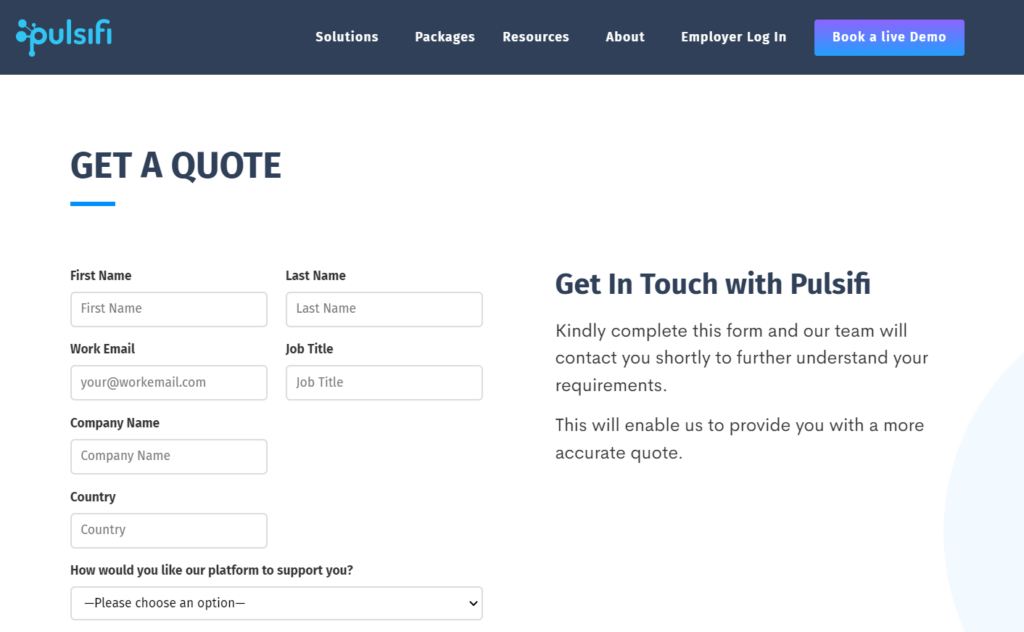
Pulsifi packages its platform by use case (hiring automation, psychometric assessment, graduate hiring and lateral hiring) and quotes each deal individually. That's normal for enterprise psychometric vendors, and it usually means an annual contract sized to expected volume rather than a per-candidate price. Ask three things on the call: what happens to the price if volume runs 30% over plan, whether video assessments are metered separately, and what the one-year assessment validity does to your billable count when candidates re-apply.
A worked cost example
Take a 400-person company hiring 60 people this year and screening about 250 candidates to do it. On Testlify Standard that's $1,668 for the first 100 credits plus 150 extra credits at $21, or $3,150, for a total of $4,818, roughly $19 per screened candidate with proctoring and reporting included. For Pulsifi, you'd put that same 250-candidate volume in the quote request and compare the number that comes back. If it's within a few hundred dollars, decide on library fit and integrity controls, not price.
When is Pulsifi the better pick?
Pulsifi is the better pick when your hiring decision is mostly about fit and potential rather than a testable skill: large graduate intakes where every resume looks the same, internal mobility programs that need a common personality baseline, or roles where a structured live interview already covers competence. Its one-year assessment validity and short 5-to-15-minute tests also suit programs where candidates apply to several roles in a season.
- Graduate and early-career hiring. With 800 applicants and no work history to test, personality, work interests and reasoning are the available signals, and that's Pulsifi's home ground.
- Culture and team-fit programs. If your people team already runs a fit model and wants a vendor built around it, Pulsifi's prediction layer is closer to that need than a skills library is.
- Repeat applicants. A candidate who applies to three roles in ten months completes the assessments once. That's a better candidate experience and less admin.
Testlify is the better pick when the role has a skill you can test (which is most roles), when you want published pricing and a trial before a contract, when proctoring is non-negotiable, or when you want one platform for coding, software, language and personality testing instead of two. Teams weighing a wider set of options can compare other Pulsifi alternatives side by side.
How should you choose between Testlify and Pulsifi?
Choose by counting signals, not features. The Testlify Multi-Signal Talent Evaluation Model combines multiple role-relevant signals, including assessments, interviews, simulations, references and reviewer feedback, so that no candidate advances on one polished interview or one test score. Map your open roles against that list, then ask which platform supplies the signals you're missing.
- List the competencies per role. Write down the 4 to 6 things a great hire must be able to do or be. Mark each as "skill" or "trait".
- Match each to a signal. Skills need a work-sample or knowledge test; traits need a psychometric instrument or a structured interview. If more than half your list is "skill", a psychometric-only platform leaves you blind on the half that matters most.
- Check the integrity requirement. Remote, high-stakes or regulated roles need proctoring and identity checks. Put that in the RFP before pricing.
- Price your real volume. Use last year's screened-candidate count, not headcount. Run it through Testlify's published pricing and Pulsifi's quote form.
- Pilot with one role for 30 days. Testlify's 7-day trial and 30-day guarantee make this cheap. Score the pilot on time-to-shortlist and hiring-manager confidence, not on which dashboard looked nicer.
Pro tip: run the pilot on the role you struggle to fill, not the easy one. A platform that only looks good on your simplest hire hasn't told you anything.
Across the teams we work with, the pattern is that assessment programs fail on adoption, not on validity. Hiring managers stop reading reports they don't trust. So whichever vendor you pick, the second decision (who scores what, with which rubric, before the interview) is the one that decides whether the tool pays for itself. See why teams pick Testlify for how customers set that up.
Hire on evidence with a Testlify demo
If the roles on your list are mostly skills, start a free 7-day Testlify trial (no card needed) and run one real role through a proctored assessment with a video question attached. Or book a Testlify demo and bring your candidate volume, and the team will price it against the quote you got from Pulsifi.
Key takeaways
- Testlify and Pulsifi solve different problems. Testlify measures skills plus traits; Pulsifi measures traits plus reasoning. Buying the wrong one leaves your biggest hiring risk unmeasured, so classify your roles before you compare features.
- Video interviews are a signal, not a verdict. Both platforms support one-way video, and Testlify adds AI-led conversational interviews. Trait-led video questions are easy to rehearse, so score them with a rubric and combine them with a skills test.
- Structure is what makes an interview predictive. The 2022 Sackett reanalysis ranks structured interviews among the strongest predictors and education and years of experience among the weakest. Same questions, same order, written scoring, every time.
- Cheating controls now decide enterprise deals. With 6% of surveyed candidates admitting interview fraud and Gartner predicting one in four fake profiles by 2028, unproctored results carry real risk. Testlify's proctoring stack is a material advantage for high-stakes roles.
- Published pricing changes the buying conversation. Testlify's $139-a-month Standard plan and 7-day trial let you pilot before you commit; Pulsifi's quote-only model means you negotiate first and test later. Price both against your real screened-candidate volume.
- Decide the scoring rules before the first candidate. Mechanical combination of assessment data predicts as well as or better than expert re-weighting. Fix your weights per role and hold reviewers to them, on either platform.
FAQs
Related resources
View all
Competitor Comparisons
Testlify vs Prevue: A detailed comparison
Competitor Comparisons
Testlify vs Ducknowl: A detailed comparison
Competitor Comparisons
Testlify vs letsremotify: A detailed comparison
Competitor Comparisons
Testlify vs Topgrading: A detailed comparison
Competitor Comparisons
Testlify vs Recruiter: A detailed comparison
Competitor Comparisons
Testlify vs Otomeyt: A detailed comparison
Get started.
Hire on proof, not resumes.
Run your first skills-based assessment free — no credit card required.