
Job Specialization: Benefits, Risks, and Examples (2026)
Discover the definition, examples, pros & cons of job specialization. Learn how it boosts efficiency, its challenges, and best practices for businesses.

Job specialization is the practice of narrowing a role down to a few closely related tasks so one person can get very good at them. Instead of asking someone to do a bit of everything, you give them one lane and let them master it. Done well, it raises output and quality. Done badly, it bores people and leaves you exposed the day a key specialist walks out the door.
This guide explains what job specialization means, where it pays off, where it backfires, real examples across industries, the alternatives when a role gets too narrow, and how AI is changing the whole calculus. You will also get a simple way to decide which roles truly need a specialist, and how to measure whether the split actually worked.
TL;DR
- Job specialization gives one person a narrow, focused role so they build deep skill, work faster, and make fewer mistakes.
- The upside is real: higher productivity, faster training, and easier hiring for a clear skill set.
- The downside is just as real: boredom, low flexibility when work changes, and risk when a hard-to-replace specialist leaves.
- When a role gets too tight, job enlargement, enrichment, rotation, and cross-training open it back up without losing the gains.
- Specialize the roles that reward depth, keep the rest broad, and hire for each on real evidence rather than a resume.
 ChatGPT
 Gemini
 Claude
 Grok
Grok Perplexity
What is job specialization?
Job specialization is the process of breaking a broad job into a smaller set of related tasks so an employee can focus on one area and build deep skill in it. A surgeon operates. An anesthesiologist manages sedation. A billing clerk handles claims. Each person owns a narrow slice of the work and gets faster and more accurate the longer they do it.
The idea is old. Ancient Egypt and Mesopotamia split work into specialized roles for building, farming, writing, and irrigation, and those societies grew faster because of it. The modern version runs on the same logic: divide the work, deepen the skill, raise the output. What changed is how quickly roles now shift, which is exactly why specialization needs guardrails today.

How does job specialization differ from work?
Job specialization is about the individual: one person mastering a specific role. Work specialization, or division of labor, is about the organization: splitting a large process into separate tasks handed to different people or teams. One is a personal skill focus. The other is a structural design choice. Most companies run both at the same time without ever naming the difference.
What are the advantages of job specialization?
Job specialization raises productivity, speeds up training, deepens expertise, and lowers the cost of each unit of work. When people repeat a focused set of tasks, they make fewer mistakes and move faster. It also lets you hire for one clear skill set instead of hunting for rare all-rounders, which shortens the search and sharpens the screen.
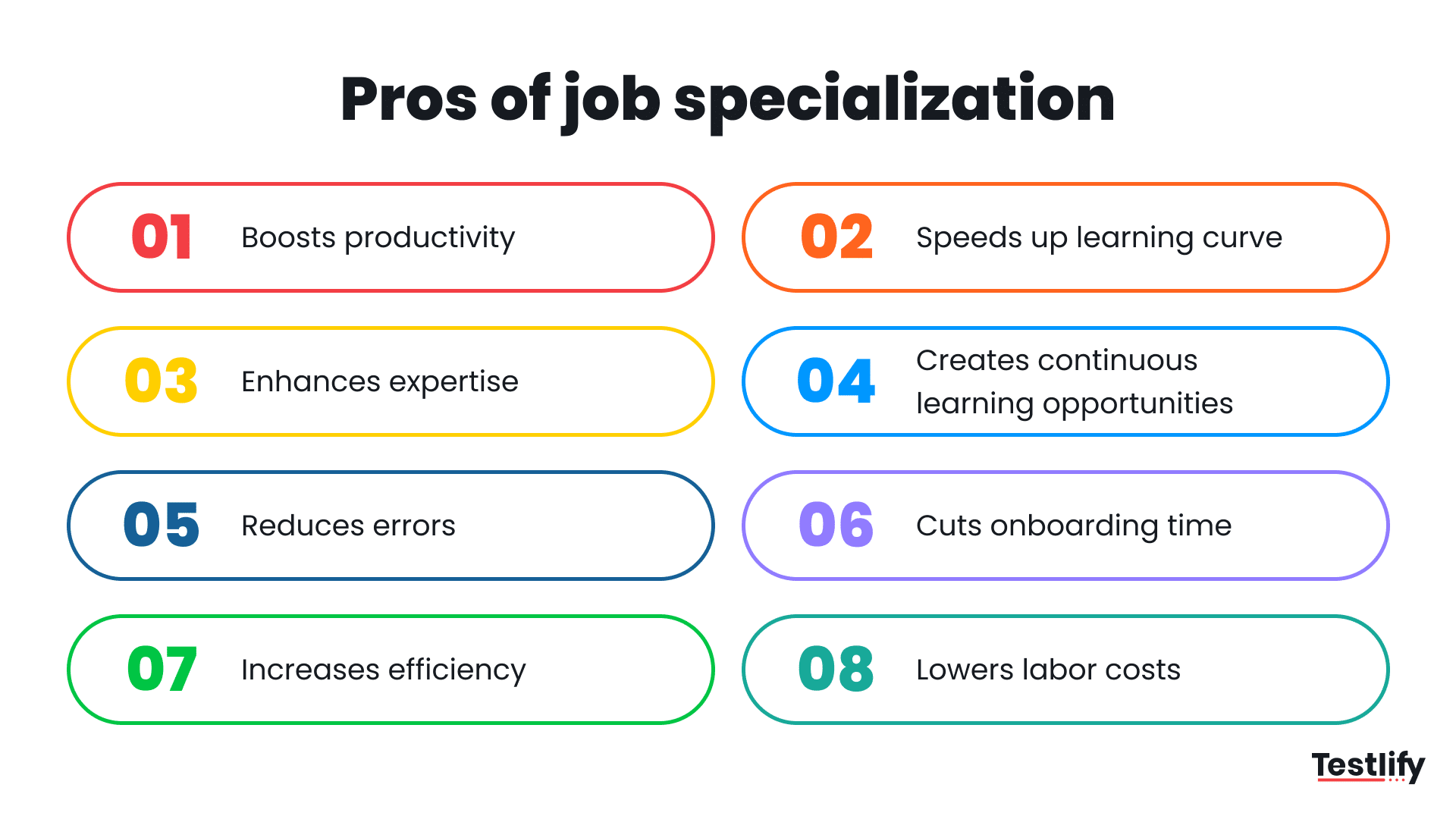
Higher productivity and fewer errors
Focus compounds. The more a person repeats a defined task, the faster and cleaner the work gets, and the fewer mistakes slip through. That is why an assembly line beats one person building a whole car, and why a coder who only writes back-end services ships faster than a true generalist juggling six things at once.
Faster, cheaper training
Teaching one skill set is quicker than teaching ten. New hires reach full output sooner because onboarding targets a narrow scope, so the role gets productive in weeks, not months. Smaller training load also means lower cost per hire and less downtime while someone gets up to speed.
Deeper expertise and engagement
Specialists build mastery that is hard to copy, which makes them more valuable and, often, more engaged. Gallup found that people who get to use their strengths every day are 6 times more likely to be engaged, 8% more productive, and 15% less likely to quit. A well-matched specialist is playing to a strength, not just filling a seat.
Lower cost per task
Specialized people produce more in less time, so the cost of each finished task drops. A focused team can handle more volume without adding headcount, which is why high-throughput functions like manufacturing, claims processing, and customer support lean so hard on specialization.
What are the disadvantages of job specialization?
The big risks are boredom, fragility, and rigidity. Repeating one narrow task drains motivation. Leaning on a few specialists leaves you exposed when one resigns. And highly specialized people can struggle to adapt when the work itself changes. Specialization that is pulled too tight quietly raises turnover and slows how fast your team can respond.

Monotony that hurts engagement
Doing the same thing all day gets dull, and dull is expensive. Gallup estimates that low engagement costs the global economy 8.9 trillion dollars, or 9% of global GDP, with 62% of employees not engaged at work. Repetitive specialized roles are a common trigger, especially when there is no variety or path forward. This is where employee satisfaction quietly erodes.
Over-reliance on a few specialists
When only one or two people can do a critical job, their exit becomes a crisis. Replacing a deep specialist takes time, and the work can stall while you search and train. The narrower the role, the smaller the pool of people who can step in, so a single resignation can hold up a whole process.
Low flexibility and resistance to change
Specialists can find it hard to move sideways or pick up new tools, which is a problem when roles are changing fast. The World Economic Forum projects that 39% of core skills will change by 2030, and that 59 of every 100 workers will need reskilling. People locked into one narrow task are the hardest to move when that shift hits, and a skills mismatch can open up quickly.
Job specialization examples across industries
Job specialization shows up in every sector. Here is how it looks in practice:
- Healthcare: a general practitioner handles a wide range of concerns, while a cardiac surgeon does only heart procedures and an anesthesiologist manages sedation.
- Information technology: a cybersecurity analyst focuses on threat detection, while a back-end developer focuses on building and scaling services.
- Manufacturing: one worker fits a single part, another runs quality checks. Splitting the line this way cuts errors and speeds up output.
- Marketing: an SEO specialist optimizes for search, while a content marketer writes the articles. Together they cover what neither could alone.
- Customer support: technical support handles troubleshooting, while account managers own retention and renewals.
What are the alternatives to job specialization?
When a role gets too narrow and starts to bore people or box them in, four job-design methods open it back up without throwing away the efficiency you gained: job enlargement, job enrichment, job rotation, and cross-training. Each adds variety or ownership in a different way, and most teams use them in combination, matched to what a specific role actually needs.
- Job enlargement: widen the role sideways by adding more tasks at the same level, so a claims clerk also handles intake and follow-up. It fights monotony, though it adds breadth rather than depth. See our guide to job enlargement for how to do it without overloading people.
- Job enrichment: deepen the role by handing over more ownership, like letting a support specialist resolve a case end to end instead of passing it up a level. More control usually means more motivation.
- Job rotation: move people between specialized roles on a set schedule so they keep a second and third skill. A warehouse that rotates picking, packing, and quality checks every quarter never loses coverage when one person is out.
- Cross-training: teach a specialist a neighboring role part-time so no critical task rests on a single person. Cross-training is the cheapest insurance against the single-point-of-failure risk, and it gives people the variety that keeps them around.
How is AI changing job specialization?
AI is absorbing the most repetitive specialized tasks first, which shifts where human specialization still pays off. The narrow, rules-based slices that once justified a dedicated seat are increasingly automated, so the specialties that hold their value now cluster around judgment, exception handling, and knowing when the tool is wrong. A specialist who only did the routine part of the job is exposed; one who owns the hard calls is not.
That reshapes how you design a specialized role in 2026. Audit each one for how much of it is routine versus judgment. Where the routine share is high and climbing, expect automation to take it, and point the human toward the review, the edge cases, and the customer trust that software cannot carry alone. With core skills shifting fast, the durable move is to hire for the underlying capability and comfort working alongside AI, not just today’s task list.
None of this means specialization is dead. It means the boundary moved. The winning setup pairs a focused human specialty with the tools that handle the grunt work, so the person spends their time on what actually needs a person. Design the role around that split and it ages far better than a role defined by a single manual task.
How do you apply job specialization effectively?
Start with the role, not the job title. Decide which roles genuinely reward deep specialization (often healthcare, IT, finance, and legal) and which run better broad, like early-stage startups and small teams. Map the must-have competencies for each specialized role, then check candidates against real evidence instead of a resume. And pair every narrow role with cross-training, so depth never becomes a trap.

This is where the Testlify Competency-to-Evidence Matrix helps. It maps every role to the competencies that matter, then connects each competency to measurable evidence through assessments, simulations, structured interviews, and reviewer feedback. Instead of guessing whether someone fits a specialized role, you score them against the exact skills the role needs, and a human still makes the final call.
The data backs the skills-first approach. Deloitte reports that skills-based organizations are 107% more likely to place talent effectively and 98% more likely to keep high performers, because they match people to work by proven skill rather than job title alone. Specialize the role, but hire and move people on evidence.
- Identify which roles need a narrow scope and which need range. Not every job benefits from a tight box.
- Define the core competencies for each specialized role, then map them to evidence you can actually measure.
- Run a job analysis before you write the job ad, so the role is built on real tasks. A clear job analysis keeps the scope honest.
- Build in cross-training and job rotation so specialists keep a second skill and the work has backup.
- Review roles every few quarters. Rigid structures go stale fast, so check whether each specialized role still fits the work.
How do you measure whether specialization is working?
Track four numbers before and after you narrow a role, not just a gut feeling. If output and quality rise while coverage stays healthy, the split earned its place. If quality is flat and coverage drops, you traded resilience for nothing.
- Output per hour on the core task, so you can see whether focus actually raised throughput.
- First-pass quality: the share of work that ships with no rework. Specialization should push this up.
- Time to full productivity for a new hire in the role, which a tighter scope should shorten.
- Coverage ratio: how many people could do the job if one left. If the answer is one, you have a fragility problem to fix with cross-training.
Here is how that looks in practice. Picture a 45-person online furniture retailer where a single customer operations team handled everything: pre-sale chat, order changes, returns, and damage claims. As volume grew, response times slipped because people switched between a refund policy and a product question every few minutes. Splitting the team into a returns-and-claims group and a live-chat sales group gave each a single lane, and first-contact resolution on claims climbed while chat wait times fell. The catch showed up fast: when the lead claims specialist took two weeks off, the backlog spiked, which is exactly why the company then cross-trained two chat agents on claims basics. Depth first, backup right behind it.
Dimension | Specialized role | Generalist role |
|---|---|---|
Primary focus | Deep expertise in a specific function or domain | Broad responsibilities across multiple functions |
Productivity | High efficiency and expertise in core responsibilities | Balanced performance across a wider range of tasks |
Training & onboarding | Faster to onboard due to a narrower scope | Longer onboarding as multiple skills and processes must be learned |
Adaptability | Less flexible when priorities or business needs change | Highly adaptable and able to switch between different responsibilities |
Knowledge continuity | Greater risk if the employee leaves because expertise is concentrated | Lower risk as responsibilities can be shared across team members |
Best suited for | Healthcare, IT, finance, legal, engineering, and other specialized professions | Startups, small businesses, operations, and fast-changing environments |
Pro Tip: Before you split a generalist role into two specialized ones, run a 90-day trial with clear task boundaries and track output and error rates. Across the teams Testlify works with, the roles that gain the most from specialization are the high-volume, high-repetition ones. If the numbers do not move, the role probably wanted range, not a narrower box.
Key takeaways
- Specialization trades range for depth. A narrow role builds mastery and speed, which is why output rises and errors fall, but you give up flexibility to get it. Know what you are trading before you split a role.
- The cost shows up later, not on day one. Boredom, turnover, and over-reliance on a few experts build slowly. With low engagement already costing the global economy 9% of GDP, a monotonous specialized role is a quiet drain you should design against.
- Match the structure to the work. Specialize roles that reward repetition and deep skill, such as healthcare, IT, finance, and legal. Keep roles broad where the work changes fast, so the team can adapt without a reorg.
- Keep a way out when a role gets too narrow. Job enlargement, enrichment, rotation, and cross-training add variety and backup, so depth never turns into monotony or a single point of failure.
- Hire and move people on evidence. With 39% of core skills set to change by 2030 and AI absorbing the routine work, screen for proven competencies, aim humans at the judgment, and recheck the fit often.
Frequently asked questions (FAQs)

B2B SaaS Content Writer
Rishav Kumar is a B2B SaaS content writer with 4 years of experience. He loves crafting engaging content. Always exploring fresh ideas, he's passionate about helping businesses grow through impactful writing.
LinkedInRelated resources
View all
HR & recruitment
What is a LMS and why do businesses need one?

HR & recruitment
Moonlighting: How can HR detect & prevent it? (Top methods)

HR & recruitment
Employee onboarding checklist: Steps, templates and best practices (2026)

HR & recruitment
On-demand recruitment: what it is, how it works, and when to use it (2026)
![Employee evaluation forms: How to create one [Free templates]](/api/media/file/Employee-evaluation-forms-2.png?dpl=dpl_6Z8Gzi5dgny5ePrnCfPbRPCRYCA7)
HR & recruitment
Employee evaluation forms: How to create one [Free templates]

HR & recruitment
Writing Assessments for Hiring: Identify Top Talent
Get started.
Hire on proof, not resumes.
Run your first skills-based assessment free — no credit card required.