
On-demand recruitment: what it is, how it works, and when to use it (2026)
On-demand recruitment helps businesses hire faster, reduce costs, and stay flexible by bringing in the right talent exactly when they need it.

Most organizations we work with arrive at on-demand recruitment the same way: a key hire falls through, the internal team is already managing 3 other open requisitions, and someone needs to fill the gap fast. On-demand recruitment exists for exactly that moment, but the companies using it well have built it into their hiring plan long before the crisis starts.
On-demand recruitment is a flexible model that gives companies access to external recruiters and hiring specialists on a project or time-limited basis. Companies activate the service when hiring volume spikes or internal capacity runs short, then disengage once the roles are filled.
The global Recruitment Process Outsourcing market, which includes on-demand hiring services, was valued at $7.33 billion in 2022 and is projected to grow at a 16.1% CAGR through 2030 (Grand View Research). The growth reflects a structural shift: organizations are choosing hiring flexibility over fixed recruitment headcount.
TL;DR
- Most companies activate on-demand recruitment only after a hiring crisis has started; the teams that treat it as a standing capacity layer fill roles faster and spend less per hire than teams that use it reactively.
- On-demand recruitment and RPO are not the same thing: on-demand is project-scoped and fast-start, while RPO transfers ownership of a larger portion of your hiring process under a multi-year contract.
- The average time-to-fill in the US is 44 days; on-demand programs built around pre-vetted talent pools routinely deliver a first candidate slate in under 7 business days.
- Cost-per-hire averages $4,700 across industries; on-demand models using pay-per-qualified-applicant pricing typically cost less per filled role than retained agency fees on volume hiring.
- The SCALE Protocol (Scope, Calibrate, Activate, Learn, Extend) gives HR teams a repeatable structure for deploying on-demand recruitment without losing institutional knowledge between engagements.
- AI does not replace on-demand recruiters in 2026; it multiplies their output by handling sourcing, outreach sequencing, and pipeline tracking so specialist recruiters can focus on assessment and candidate close.
 ChatGPT
 Gemini
 Claude
 Grok
Grok Perplexity
What is on-demand recruitment?
On-demand recruitment is a hiring model where companies engage external recruiting professionals on a time-limited, project-specific basis. The company defines the scope (roles, timeline, volume), the on-demand provider sources and screens candidates, and the engagement ends once the hiring goal is met, with no ongoing retainer required.
The model differs from traditional recruitment agencies in one key way: there is no placement fee tied to a specific hire. On-demand providers charge for time, access, or qualified applicant volume, which changes the incentive structure and typically reduces cost-per-hire for companies filling multiple roles at once.
A pattern I keep observing in enterprise HR teams is that on-demand recruitment gets conflated with RPO. They are related but distinct. RPO transfers ownership of part or all of your hiring process to an external provider, often under a multi-year contract, while on-demand recruitment is modular: you define a scope, activate a team, and close the engagement when the work is done.

How does on-demand recruitment work?
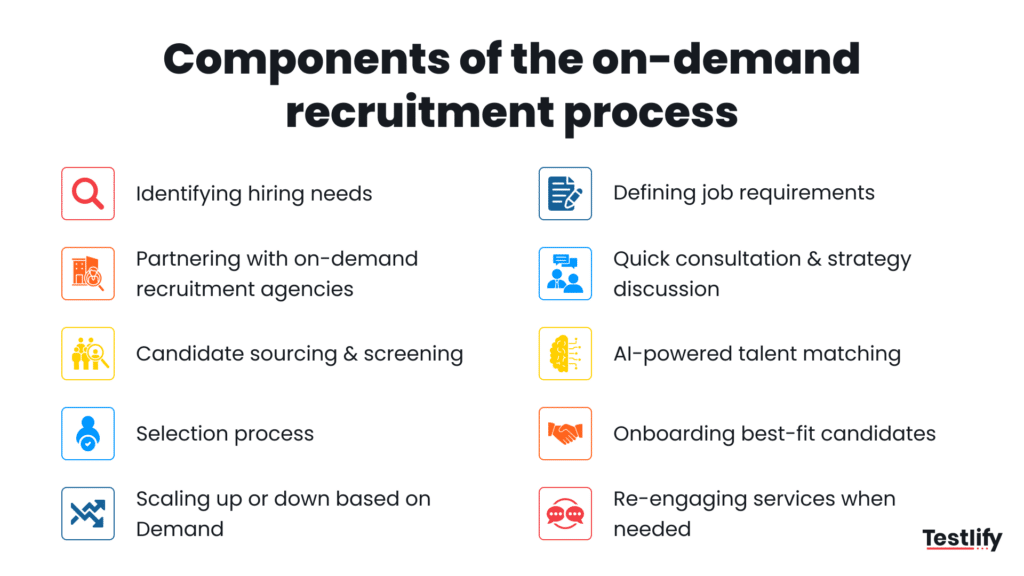
On-demand recruitment operates in 5 stages: define the hiring scope, select and brief the recruiting team, source and screen candidates, conduct structured assessments, then hire and disengage. The process typically starts within 24 to 72 hours of contract signing, making it one of the fastest hiring models available to enterprise teams.
Step 1: Define the scope
The company documents the open roles, required competencies, timeline, and acceptable cost-per-hire. A 15 to 20-minute intake call with the on-demand provider covers these requirements upfront. The clearer the brief, the faster the sourcing begins.
Step 2: Match the recruiting team
The on-demand provider assigns recruiters with sector-specific experience. For technical roles, this means recruiters who have filled similar positions before, not generalists working from a job description for the first time.
Step 3: Source and screen candidates
The recruiting team works the provider’s existing talent pools, job boards, and direct outreach channels. Pre-vetted candidate pipelines mean screening begins faster than a cold search, with most providers delivering a first shortlist within 5 to 7 business days.
Step 4: Run structured assessments
Shortlisted candidates complete role-relevant assessments before reaching the interview stage. Competency-based assessments give on-demand teams a consistent evaluation layer without requiring a custom process to be built for each engagement.
Step 5: Hire and disengage
Once roles are filled, the engagement closes and the company retains all candidate data, assessment scores, and sourcing records. When another hiring need arises, the engagement can restart within hours rather than days because the infrastructure is already in place.
When should you use on-demand recruiting?
On-demand recruiting works best in 5 situations: sudden hiring volume spikes, internal HR capacity shortfalls, specialist or niche role requirements, short-term project staffing, and post-layoff rehiring cycles. If any of these describe your current situation, on-demand recruiting will typically outperform a traditional job posting approach on both speed and quality of candidates.
- When hiring demand surges suddenly: Unexpected business growth, new product launches, or a competitor’s exit from the market can create sudden hiring demand, making on-demand recruitment an effective way to scale hiring capacity.
- When internal HR lacks bandwidth: When HR teams frequently manage workforce planning, compliance, employee engagement, and active recruiting simultaneously, on-demand support prevents candidate experience from degrading while keeping existing processes intact.
- When specialist roles need fast fills: For hard-to-fill roles in fields such as data science, compliance, and supply chain, on-demand recruitment provides access to pre-vetted specialist talent pools
- When staffing short-term projects: Contract and project-based roles rarely justify permanent recruitment infrastructure or agency retainers, making on-demand recruitment a cost-effective way to meet hiring needs without long-term overhead.
- After a layoff and rehiring cycle. After a downsizing event, on-demand recruiters can rebuild talent pipelines faster than lean internal teams while helping organizations meet urgent hiring needs.
What problems does on-demand recruiting solve?
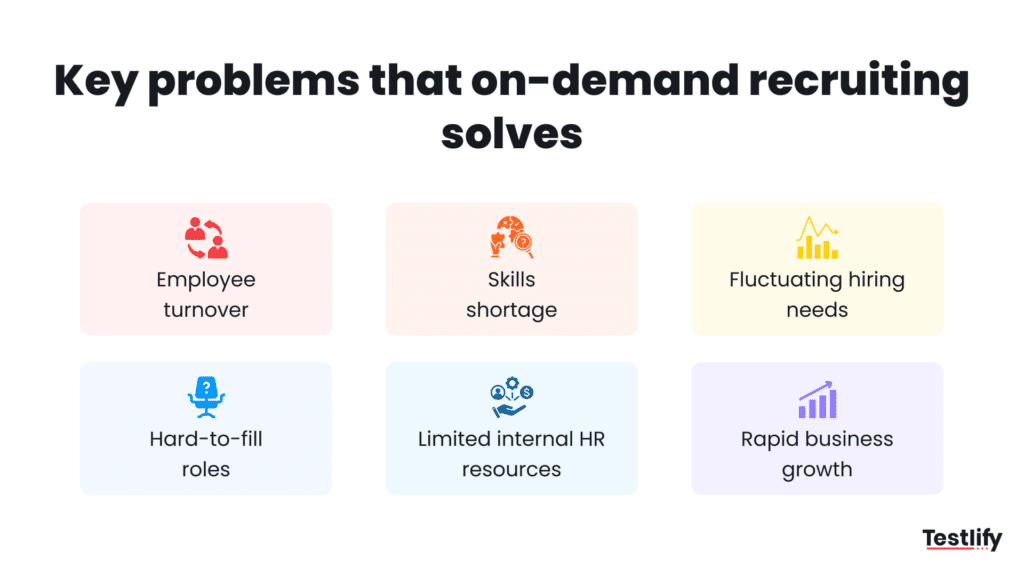
On-demand recruiting directly addresses 4 hiring problems that affect most enterprise organizations: extended time-to-fill, high cost-per-hire, internal bandwidth gaps, and skills shortages in specialist functions. Each of these problems compounds the others; on-demand recruitment breaks the cycle by adding external capacity without adding permanent headcount.
Problem | Impact | How on-demand recruitment addresses it |
|---|---|---|
Employee turnover | Sudden departures leave critical roles vacant during transition periods | Pre-vetted replacement pipelines activate within 24 to 72 hours of engagement start |
Skills shortage | 9 in 10 executives report significant skills gaps | Specialist providers maintain warm pipelines of niche and technical talent already screened |
Fluctuating hiring needs | Volume spikes don’t justify permanent TA headcount year-round | Activate when volume surges, disengage when demand subsides, pay only for what you use |
Hard-to-fill roles | Senior or specialist positions can sit vacant for 60 to 90 days | Domain-expert recruiters tap networks and pipelines that standard HR teams cannot access |
Limited internal HR resources | HR teams managing 5+ concurrent priorities lose sourcing focus | External recruiters add capacity without adding permanent headcount or overhead |
Rapid business growth | Post-funding or expansion hiring ramps require filling 20 to 50+ roles fast | On-demand teams scale to volume requirements quickly while maintaining consistent candidate quality |
Employee turnover
When a key team member exits unexpectedly, the pressure on internal HR is immediate. The hiring team is already managing active pipelines, and a cold replacement search adds weeks of delay while the business absorbs the productivity gap.
On-demand recruitment solves this by activating an external recruiting team within 24 to 72 hours of engagement start. Because the provider maintains pre-vetted talent pools, the first candidate slate arrives in days rather than weeks. Specific ways it helps:
- Immediate sourcing activation without waiting for internal capacity to free up
- Pre-screened replacement candidates for common role types already in the pipeline
- Engagement closes once the replacement is hired, with no ongoing cost
Skills shortage
On-demand providers address skills shortage by maintaining warm pipelines of pre-screened specialists across functions like data science, compliance, supply chain, and engineering. How this plays out in practice:
- Recruiters with domain expertise know where specialist talent concentrates and how to reach it
- Pre-vetted pipelines mean the first shortlist reflects the actual market, not just applicants who responded to a job post
- Passive candidates who would not apply directly are reachable through a specialist recruiter’s existing network
Fluctuating hiring needs
Retail, logistics, hospitality, and project-driven industries all face hiring cycles that spike sharply and then drop. Building a permanent TA team sized for peak demand means carrying significant overhead during quiet periods.
On-demand recruitment matches hiring capacity to actual demand. The model works because you only pay for active engagement:
- Activate the on-demand team when hiring volume spikes seasonally or due to a new project
- Disengage when the surge passes, with no retainer or notice period required
- Reactivate quickly when the next cycle begins, because the provider already knows your requirements
Hard-to-fill roles
Senior leadership positions, cross-functional specialists, and roles requiring rare certification combinations routinely sit open for 60 to 90 days under standard sourcing. Every additional week of vacancy carries a direct productivity cost and risks losing shortlisted candidates to competing offers.
On-demand recruitment narrows this window by assigning recruiters who have placed similar roles before. Key advantages:
- Domain-expert recruiters know the talent pool for the specific function and seniority level
- Direct outreach to passive candidates who are not visible on job boards
- Faster time-to-first-slate because the recruiter is not learning the market from scratch on your requisition
Limited internal HR resources
Smaller HR teams and lean People Operations functions face a constant bandwidth problem: the same team managing onboarding, compliance, performance reviews, and employee relations cannot also run a high-quality recruiting process across multiple open roles simultaneously.
On-demand recruitment adds external sourcing capacity without adding permanent headcount. This means:
- Internal HR focuses on the decisions that require institutional knowledge: final interviews, offer negotiation, and onboarding
- The on-demand team handles sourcing, initial screening, and pipeline management
- No additional salary, benefits, or office overhead associated with the added capacity
Rapid business growth
Post-funding rounds, market expansions, and product launches often require hiring 20 to 50 roles in a compressed window. Internal teams cannot scale recruiting this quickly without compromising either the candidate experience or the quality of the assessment process.
On-demand recruitment is purpose-built for this scenario. The structure that makes it work at scale:
- Multiple specialist recruiters can be activated simultaneously across different role families
- Structured assessment layers via Testlify’s talent assessment library keep evaluation quality consistent across high-volume hiring
- Weekly pipeline reporting gives HR leadership visibility into progress across all open roles in one place
Key Takeaway: The biggest ROI from on-demand recruitment comes not from the first engagement but from the second. Companies that retain sourcing data, assessment scores, and candidate notes between engagements reduce time-to-fill on repeat roles by 30 to 50%, because the pipeline is already built rather than rebuilt from zero.
What are the benefits of on-demand recruitment?
The 4 core benefits of on-demand recruitment are faster time-to-fill, lower cost-per-hire on volume roles, access to specialist talent pools, and the ability to scale hiring capacity without increasing permanent headcount.
For enterprise teams managing variable hiring cycles, the combination of speed and cost control is the primary driver of adoption.
Access to specialist recruiters
When you partner with an on-demand recruitment service, you get recruiters with domain expertise in the specific function you are hiring for. In my work with HR teams filling technical roles, the difference between a recruiter who knows the talent market for a function and one who is learning it in real time is typically 2 to 3 weeks of sourcing time.
AI-augmented screening
Modern on-demand platforms integrate AI screening tools that reduce manual resume review significantly. Combined with structured talent assessments, this allows hiring teams to focus on the top 10 to 15% of applicants rather than triaging an unscreened stack of applications.
No long-term cost commitment
Permanent recruitment agencies typically charge 15 to 25% of first-year salary per placement. On-demand models price on time or applicant volume, which delivers better unit economics when filling multiple roles simultaneously.
Real-time hiring data
On-demand providers deliver candidate pipeline reports, source-of-hire tracking, and time-to-stage metrics throughout the engagement. This gives HR leaders visibility into hiring health without building a separate analytics function from scratch.
Pro Tip: Before signing an on-demand contract, ask the provider for their median time-to-first-slate for your specific role category. Providers who cannot answer that question from their own historical data are likely to underperform against providers who can cite benchmarks by function and seniority level.
What are the best practices for on-demand recruiting?
The best practices for on-demand recruiting come down to 5 behaviors: define role requirements before the engagement starts, run structured assessments at every stage, retain all candidate data between engagements, measure time-to-fill and cost-per-hire at the role level, and maintain a standing vendor relationship even during quiet hiring periods.
The SCALE Protocol
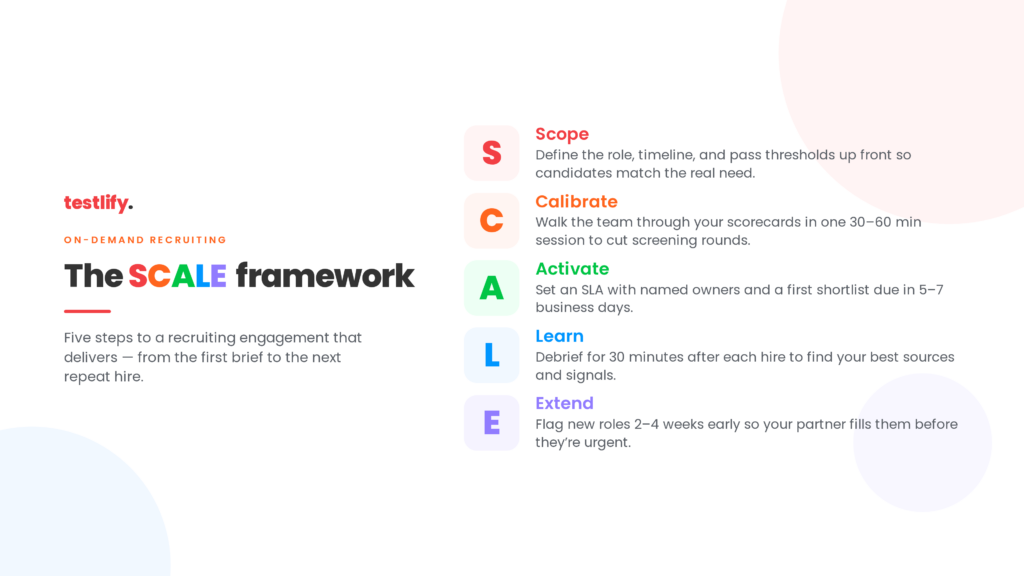
In our experience, the teams that get the most from on-demand recruitment follow a repeatable structure. We call this the SCALE Protocol: 5 stages that govern how enterprise HR teams deploy on-demand recruitment from initial scoping through re-engagement.
Scope (S)
Define role requirements, hiring timeline, assessment criteria, and pass thresholds before the engagement starts. Ambiguous briefs produce candidate slates that do not match the actual hiring need, which wastes the first 2 to 3 weeks of the engagement.
Calibrate (C)
Brief the on-demand recruiting team on your assessment rubrics and scoring benchmarks. Calibration sessions of 30 to 60 minutes before sourcing begins reduce the number of screening rounds required and improve the quality of the talent pool.
Activate (A)
Deploy the recruiting team with a defined SLA: first slate within 5 to 7 business days, weekly pipeline updates, and a named point of contact on both sides. SLAs without named accountability points produce slow engagements regardless of provider quality.
Learn (L)
After each hire, conduct a 30-minute post-engagement debrief: which sources performed best, which assessment stage produced the most useful signal, and where candidate experience gaps appeared. This data shapes the next engagement.
Extend (E)
Maintain the vendor relationship between active engagements by sharing new role requirements 2 to 4 weeks before they become urgent. Teams that brief their on-demand partner ahead of time consistently see faster time-to-fill than teams that activate the relationship only after the crisis has already started.
Key Takeaway: Apply the SCALE Protocol as a standing operating procedure rather than a one-off checklist. The teams that document each stage maintain institutional hiring knowledge even when internal HR team members change or when the on-demand provider rotates personnel between engagements.
How does AI change on-demand recruiting in 2026?
AI is making on-demand recruitment faster, more scalable, and more data-driven. Rather than replacing recruiters, it automates repetitive tasks and allows recruiting teams to focus on candidate evaluation, stakeholder alignment, and hiring decisions.
- Automated candidate sourcing: AI can search job boards, talent databases, and professional networks simultaneously, helping recruiters identify qualified candidates faster than manual sourcing methods.
- Smarter candidate matching: Modern AI tools rank candidates based on skills, experience, and role-fit signals rather than simple keyword matches, improving shortlist quality and reducing screening time.
- Continuous candidate engagement: AI-powered messaging and scheduling tools keep candidates informed throughout the hiring process, reducing drop-off rates without increasing recruiter workload.
- Faster first-slate delivery: By leveraging existing talent pools and automated sourcing workflows, on-demand recruitment providers can deliver qualified candidate shortlists significantly faster than traditional search processes.
- Greater recruiter productivity: Tasks such as resume screening, outreach sequencing, interview coordination, and pipeline tracking can be automated, allowing recruiters to spend more time on high-value activities that require human judgment.
- Better hiring insights: AI helps recruiters identify patterns in sourcing, screening, and hiring outcomes, enabling more informed talent decisions and continuous process improvement.
The key challenge is avoiding over-automation. AI can accelerate sourcing and screening, but it cannot reliably assess motivation, judgment, communication style, or long-term role fit.
Final thoughts
The most successful teams do not wait for a hiring crisis before engaging external recruiting support. They treat on-demand recruitment as a strategic extension of their talent acquisition function, combining recruiter expertise, automation, and structured assessments to improve hiring outcomes at every stage.
Ready to make on-demand hiring more efficient and data-driven?
Book a demo with Testlify to see how skills assessments can help you identify qualified candidates faster, improve shortlist quality, and make more confident hiring decisions.
Frequently asked questions (FAQs)

Related resources
View all![Employee evaluation forms: How to create one [Free templates]](/api/media/file/Employee-evaluation-forms-2.png?dpl=dpl_AgGGfmY7o9TUxEGdRawpCce7m7MW)
HR & recruitment
Employee evaluation forms: How to create one [Free templates]

HR & recruitment
Writing Assessments for Hiring: Identify Top Talent

HR & recruitment
Affiliative leadership: Importance, tips and benefits

HR & recruitment
HR hiring cycle: steps, tools, and best practices

HR & recruitment
Understanding Key Responsibility Areas in recruitment

HR & recruitment
Employee appreciation day 2026: Why it matters (10 ideas)
Get started.
Hire on proof, not resumes.
Run your first skills-based assessment free — no credit card required.