
Hiring Funnel Bottlenecks: How to Stop Candidate Ghosting
Candidate ghosting and other hiring funnel bottlenecks is a growing issue for enterprise. This blog uncovers the key reasons behind it and offers actionable fixes to optimize your hiring funnel.

61% of job seekers say they have been ghosted after a job interview, up nine points in a single year, according to Greenhouse’s 2024 State of Job Hunting report. For an enterprise running dozens of open roles at once, that silence is not a candidate problem. It is a funnel problem.
To fix hiring funnel bottlenecks, find the exact stage where candidates go quiet, cut the delay and confusion at that stage, and keep people informed at every step. Ghosting and drop-off are symptoms. A slow, unclear funnel is the cause, and it is the part you control. This guide shows you where enterprise funnels leak, why candidates disappear, and the fixes that hold up at scale.
 ChatGPT
 Gemini
 Claude
 Grok
Grok Perplexity
TL;DR
- A hiring funnel bottleneck is any stage where qualified candidates stall or leave: slow screening, silent gaps, or assessments that feel irrelevant.
- Ghosting and drop-off are the visible result. Most of it traces back to slow response and unclear next steps, both of which you own.
- Five stages leak the most: application, assessment, interview scheduling, post-interview, and offer-to-onboarding.
- The fix is a shorter, clearer, evidence-based funnel: screen with role-relevant assessments early, decide faster, and automate honest updates at every stage.
- Enterprises that measure drop-off by stage, then fix the worst one first, recover far more candidates than teams chasing every leak at once.

What are hiring funnel bottlenecks?
A hiring funnel bottleneck is any point in your recruiting process where qualified candidates slow down, stall, or leave before the next step. It shows up as long screening queues, silence after an interview, or an assessment that takes too long. Ghosting and drop-off are the two clearest signs a bottleneck exists.
Ghosting is when a candidate stops responding without notice. It can happen anywhere, from a half-finished application to a signed offer. Drop-off is the broader pattern: people abandon the process because it is too long, too vague, or too disconnected from the job they actually want. Both drain the same thing, your shortlist of people who were genuinely a fit.
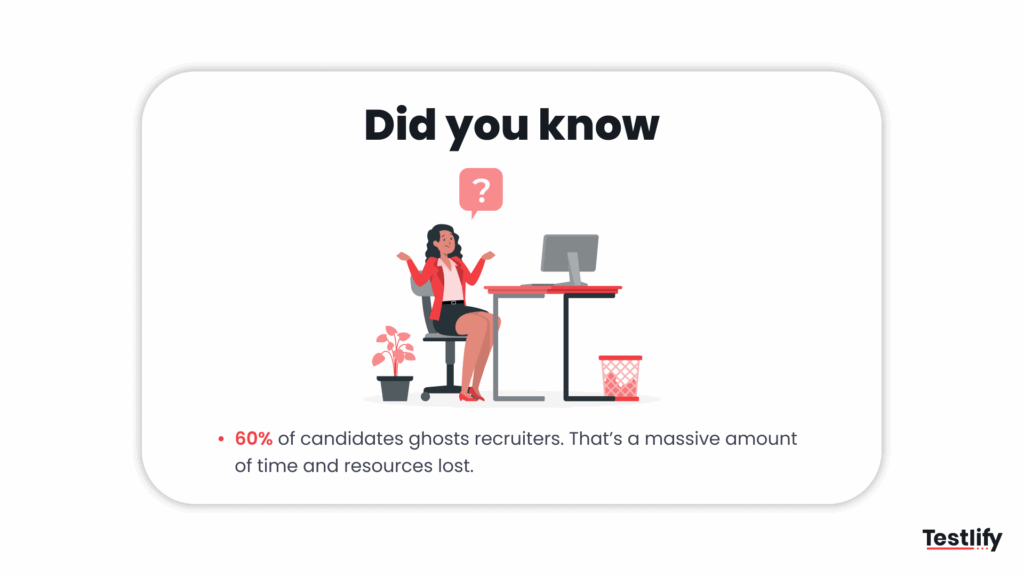
The cost is not abstract. When a good candidate walks and the role sits open, you pay twice: once in the recruiting spend already sunk, and again to start over. SHRM’s benchmarking report puts the average cost per hire at $5475, and that clock resets every time a funnel leak forces a re-hire. Across dozens of open requisitions, small leaks add up to real money and slower teams.
Why do candidates ghost and drop off?
Candidates ghost when the process makes disappearing easier than staying. The main triggers are slow or silent communication, a long or confusing application, assessments that feel irrelevant, and better offers moving faster elsewhere. Ghosting rarely means someone is unprofessional. More often it points to a flaw in how the funnel was built.
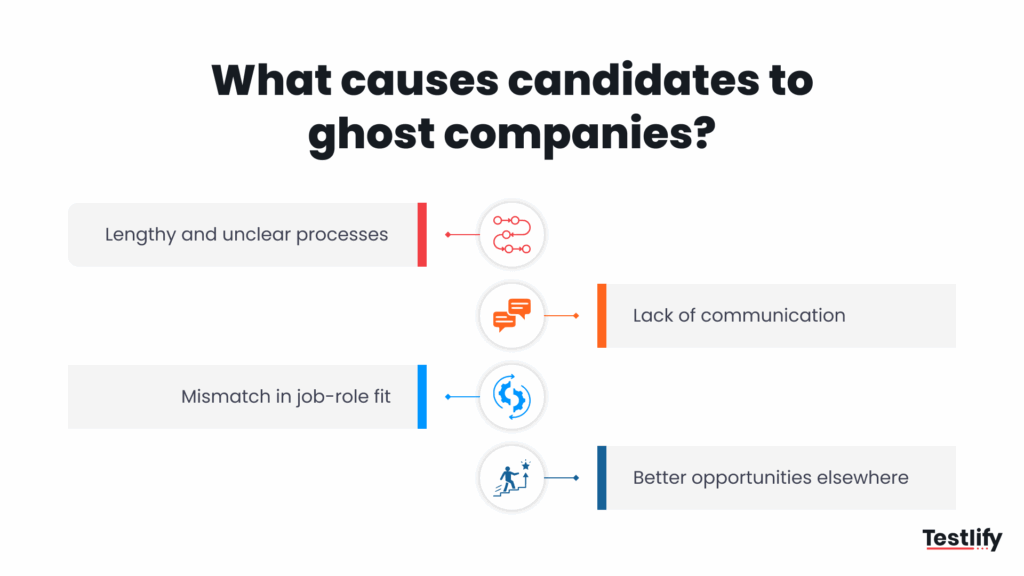
Slow and silent communication
Silence after an application or interview reads as a no. Candidates fill the gap with the offer that answered them first. When a reply takes days, high-intent people have already moved on, and the ones who stay start to doubt the role. How fast you respond in the early stages tells a candidate more about your company than any careers page.
Long or unclear processes
When people cannot see what comes next or how long it will take, they disengage. Multi-step applications that ask for a resume and then the same details by hand are a common culprit. Trust also erodes when candidates suspect a role is not real. The same Greenhouse report found that in any given quarter, 18 to 22 percent of postings on its platform look like ghost jobs, and that suspicion makes real applicants quicker to quit.
Irrelevant assessments and job mismatch
If a test feels disconnected from the actual role, candidates decide their time is being wasted. A skills mismatch often hides here, unmeasured until it shows up later as a bad hire. Assessments that mirror real job tasks do the opposite: they respect the candidate’s time and give your team evidence worth acting on.
Better and faster offers elsewhere
Strong candidates usually hold more than one offer. There are more passive candidates being courted now than active applicants, so a delay or a clumsy step at your company is all a competitor needs. For enterprises hiring globally, that competition is constant. Speed and clarity are how you win the people who had a choice.
Turnover from these leaks is expensive on its own. Gallup estimates that replacing an employee costs one-half to two times their annual salary. Every candidate you lose to a preventable bottleneck pushes you back toward that bill.
(For a deeper look at the ghosting side of this, see our guide on candidate ghosting in recruitment.)
Where in the hiring funnel do candidates drop off?
Candidates drop off most at five stages: the application, the assessment, interview scheduling, the post-interview wait, and the gap between offer and onboarding. There is no single point where everyone quits. Each stage leaks for its own reason, so the fix starts with knowing which one is costing you the most.
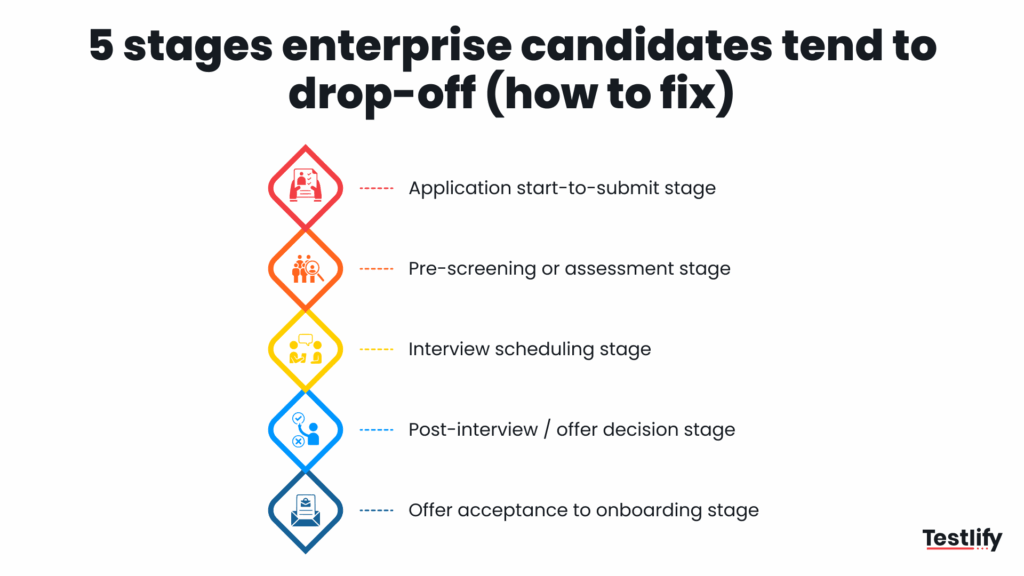
Two stages deserve extra attention in enterprise hiring. The assessment stage is a high-volume checkpoint where a poorly matched test bleeds good people fast. The post-interview wait is where in-demand candidates, already holding offers, quietly withdraw. Fix those two first and the whole funnel steadies.
Funnel stage | Why candidates drop off | What fixes it |
|---|---|---|
Application | Long, repetitive forms; poor mobile experience; account creation required | One-click or mobile-first applications; autofill resumes; ask only essential questions |
Screening | Slow response times; unclear eligibility criteria | Fast screening, transparent requirements, automated acknowledgments |
Assessment | Tests feel irrelevant, too long, or repetitive | Short, job-relevant, validated assessments with clear time limits |
Interview scheduling | Delays, limited availability, multiple reschedules | Self-service scheduling, calendar integration, flexible interview slots |
Interview | Unstructured interviews, repetitive questions, poor interviewer experience | Structured interviews, trained interviewers, consistent evaluation rubrics |
Communication | Long periods of silence; unclear next steps | Regular status updates, realistic timelines, automated follow-up emails |
Offer stage | Slow approvals, low compensation, competing offers | Faster approvals, transparent compensation, personalized offer discussions |
Offer to onboarding | Candidate disengagement, counteroffers, lack of communication | Preboarding check-ins, welcome kits, manager introductions, onboarding plans |
Onboarding | Confusing paperwork, poor first-day experience | Digital onboarding, clear schedules, buddy or mentor programs |
Entire hiring journey | Process feels impersonal or disrespectful | Consistent communication, feedback where possible, and a candidate-first experience |
How do you fix & prevent hiring funnel bottlenecks?
You fix hiring funnel bottlenecks by shortening the process, screening with evidence early, and communicating on a schedule instead of when someone remembers. Reactive follow-ups are not enough at enterprise scale. The funnel itself has to be redesigned so the default behavior keeps candidates informed and moving.
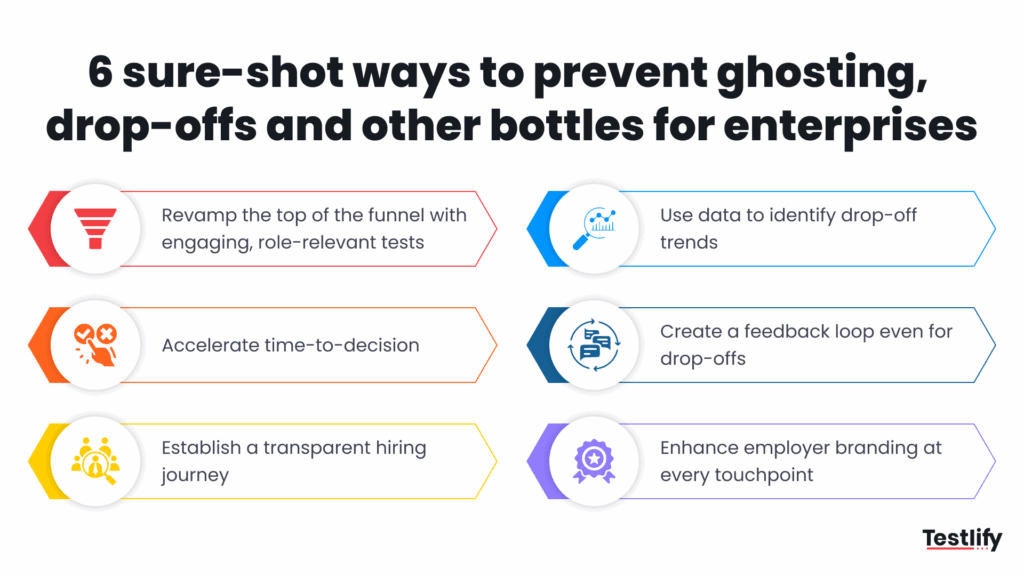
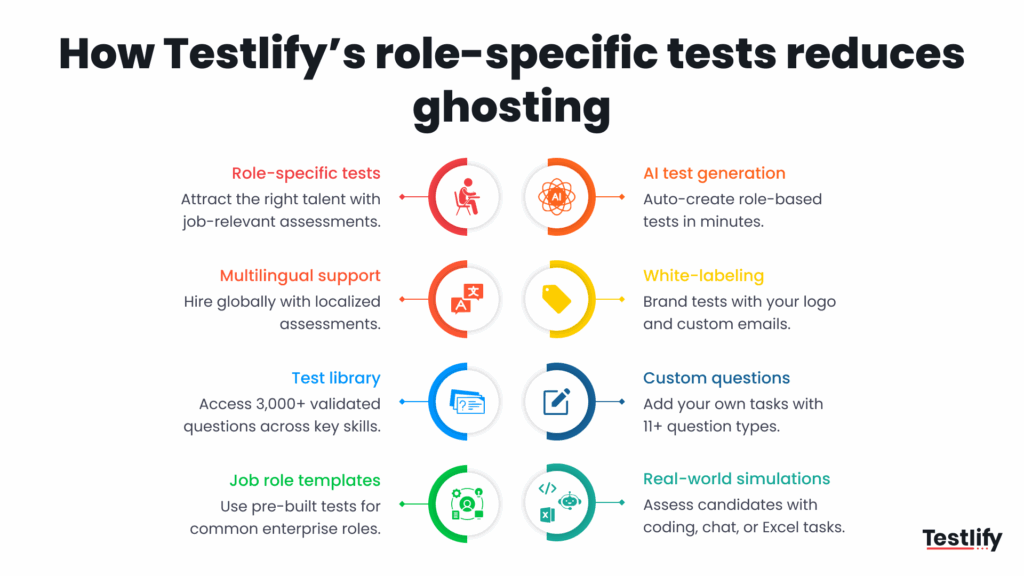
Screen with role-relevant assessments at the top
Put a short, job-relevant skills test at the application stage. It filters for genuine intent and gives serious candidates a way to show what they can do instead of guessing whether their resume will be read. People who invest ten minutes in a relevant assessment tend to stay engaged, because they have already put skin in the game.
This is where Testlify‘s pre-hire assessments fit. When a test reflects real job tasks, candidates feel respected rather than processed, and your team gets evidence for the shortlist on day one. That single move trims the assessment-stage leak and raises match quality at the same time.
Shrink the time-to-decision
Enterprise hiring stalls between stages, sometimes for two or three weeks, and that gap is exactly when top candidates accept something else. Candidates left waiting 10 business days routinely lose interest, so aim to score assessment results within 24 hours and skip rounds of manual resume screening. AI-assisted candidate insights, plus video and audio responses, help hiring managers reach a confident call sooner without another calendar-clogging interview. Capping the process at three interview stages keeps momentum without cutting rigor.
Related: How to use video and audio interviews to assess candidates
Communicate on a schedule, not on a whim
Most ghosting starts with uncertainty. A candidate applies, tests, maybe interviews, then waits with no idea where they stand. Set expectations at the first touchpoint: the stages, the timeline, and when they will hear back. Then automate the updates so a plain message like “Your results are under review, expect an update within three business days” goes out every time, not just when someone has a free moment.
Use drop-off data to find the real leak
Ghosting follows patterns. Maybe drop-off spikes after round one, or a certain role or location loses more people. Track completion rates, time spent on assessments, and the exact points where candidates exit, then fix the worst stage first. An analytics view of the funnel turns a vague “we lose people” into a specific, solvable problem.
- Completion rates by stage and role
- Time spent on each assessment
- Exact drop-off points in the funnel
- Candidate engagement and benchmark comparisons
Keep the candidate experience branded and consistent
Sometimes ghosting is about perception, not process. If your careers page, job descriptions, and assessment portal feel disjointed, candidates disconnect from the brand. A consistent, branded candidate experience at every touchpoint keeps people committed. Testlify’s white-label option lets enterprises deliver assessments and emails under their own identity, so the process feels like one company, not five disconnected tools.
Run the funnel with the hiring workflow method
Testlify helps teams run evidence-based hiring across the full journey, from screening and assessment through interview, review, ATS sync, and a final human decision. It treats the funnel as one connected system rather than a set of handoffs, which is where enterprise leaks usually hide. Applied here, it means every stage has a defined owner, a clear timeline, and an automated update, so no candidate falls into a silent gap between two teams.
Put concretely: a 2,000-person retailer hiring 40 store managers a quarter could send a 12-minute role-based assessment at apply, auto-shortlist on the scores within a day, and trigger a status email at each step. The recruiter spends their time on the ten strongest candidates instead of screening 400 resumes by hand, and those candidates never sit in silence long enough to take another offer. The workflow supports the decision; the hiring manager still makes it.
Pro Tip: Before you redesign anything, map your last 90 days of hiring and count how many candidates cross each stage transition. The single biggest drop, not the loudest complaint, is where you fix first. Most teams are surprised it is the assessment or the post-interview wait, not the application.
A quick checklist to mitigate ghosting and drop-offs
There is no single fix. A mix of process cleanup, the right tools, and candidate-first habits is what moves the numbers. Start with these four:
- Simplify the application. Cut fields you will not use, make it mobile-first, and let people apply in under five minutes.
- Automate honest updates. Trigger a message at each stage: application received, assessment submitted, interview scheduled, decision coming. Testlify connects with 100+ ATS and HRIS systems so those updates fire automatically.
- Make every step role-relevant. Swap generic tests for assessments tied to the actual job and level, so candidates see the point of finishing.
- Set expectations early. Name the stages and timelines up front. A clear process builds the trust that keeps people from ghosting.
Key takeaways
- Ghosting is a funnel signal, not a character flaw. When 61 percent of job seekers report being ghosted, the pattern is structural. That matters because you can only fix what you own, so treat every drop-off as a process defect to diagnose, not a candidate to blame.
- Speed is the strongest lever. High-intent candidates leave first when a reply takes days. Because competing offers move fast, cutting your time-to-decision from weeks to hours protects the exact people you most want to keep.
- Diagnose by stage before you fix. Five stages leak for different reasons, and spreading effort across all of them wastes it. Measuring drop-off at each transition tells you the one stage to fix first, usually the assessment or the post-interview wait.
- Relevant assessments cut leaks and raise quality together. A test that mirrors the real job filters for intent and gives you shortlist evidence on day one. That means you lose fewer serious candidates and surface stronger ones in the same step.
- Automated, honest communication scales trust. Manual follow-ups break down across dozens of requisitions. Scheduled status updates at every stage keep candidates engaged without depending on any one recruiter’s memory.
- The math justifies the work. With average cost per hire near $4,129 and turnover costing up to twice a salary, every recovered candidate has a hard dollar value. Fixing the funnel is a cost-control project, not just a candidate-experience nicety.
Frequently asked questions (FAQs)

Related resources
View all
HR & recruitment
Global hiring challenges and how enterprises are solving them

HR & recruitment
When candidates show their true colors: interview red flags to look out for

HR & recruitment
Tips for conducting your first job interview as an HR intern

HR & recruitment
Optimizing Talent Acquisition: Integrating AI and PPC Strategies

HR & recruitment
Top reasons to study human resource management in 2026

HR & recruitment
How gameplay reveals professional skills beyond resumes
Get started.
Hire on proof, not resumes.
Run your first skills-based assessment free — no credit card required.