
10 game-changing HR innovation examples you need to know
Discover the top ten HR innovations transforming workplaces, boosting employee engagement, and driving business success.

With just 36% of employees engaged at work, HR professionals constantly look for fresh ways to boost employee engagement. This is where HR innovations come in. These unique strategies and tools are designed to improve employee experience and increase productivity.
In this blog, we have discussed the top 10 innovations in the HR industry that you can implement for a happy workforce.
 ChatGPT
 Gemini
 Claude
 Grok
Grok Perplexity
What are HR innovations?
HR innovation refers to the process of developing new ideas, practices, and technologies to improve HR functions. It enhances processes like recruitment, employee engagement, performance management, and talent growth.
Innovation in HR focuses on anticipating evolving workplace dynamics and crafting effective responses to meet future needs.
Some of the key activities of HR personnel include:
- Managing operational costs
- Promoting diversity and inclusion
- Driving value through partnerships
- Planning for leadership succession
- Upskilling and reskilling the workforce
- Managing phased retirement processes
- Recruiting talent aligned with company strategy
- Creating clear and effective communication networks
- Building a high-performance, customer-focused culture
- Balancing employee expectations and business needs
- Using technology to enhance processes and productivity

Top 10 examples of HR innovations for 2025
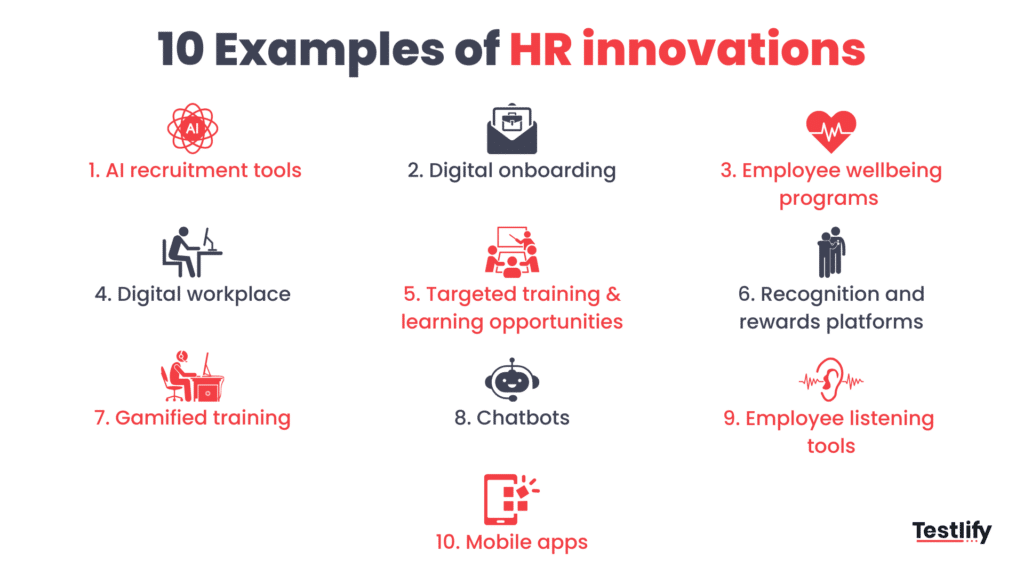
Now that we understand HR innovations, let’s explore some impactful examples of how they will shape the workplace in 2025. These innovations are driving change and improving employee experiences.
AI recruitment tools
Implementing AI enables HR teams to gain valuable insights while controlling headcount and costs. One of the most common applications of AI in recruitment is using software to identify the best-fit candidates for specific roles.
AI-driven tools have revolutionized recruitment by automating processes like screening resumes, cover letters, and other application materials. These tools analyze job requirements to efficiently shortlist the most qualified candidates.
Additionally, AI helps filter out applicants who do not meet the minimum qualifications, streamlining the hiring process and ensuring HR focuses on the most promising talent.
Also read: 10 Steps to streamline your hiring process.
Apart from the above, one of the most standout applications of AI-powered tools is conducting skill tests.
Companies like Testlify use AI to create customized, data-driven assessments that accurately evaluate candidates’ technical and soft skills. These tools provide objective insights, helping organizations identify top talent efficiently and ensure candidates are the right fit for the role.
Digital onboarding
Onboarding begins after a candidate secures the job. Still, it is a critical step in ensuring the retention of top talent. A poor onboarding experience can lead to turnover, with 64% of new hires leaving within their first year due to negative onboarding.
HR technology now streamlines the onboarding process, often starting when a candidate signs their contract. These tools ensure new hires stay engaged and don’t feel overlooked.
Digital onboarding uses technology to guide employees through their initial days, automating tasks like paperwork, emails, training, and other repetitive activities.
Also read: Employee onboarding process: A complete guide.
Employee wellbeing programs
Wellbeing programs are essential not only in our personal lives but also increasingly in our professional lives. Employers are realizing its impact on workplace performance and employee satisfaction.
Challenges like burnout and absenteeism are rising, pushing employers to rethink how they support employees beyond traditional benefits. Burnout, in particular, is costing businesses billions annually.
In fact, 76% of employees report experiencing burnout at least occasionally. Those who frequently face burnout are 63% more likely to take sick days and 23% more likely to visit the emergency room. They’re also 2.6 times more likely to actively seek a new job.
Absenteeism is also a significant concern, costing businesses heavily. The Centers for Disease Control and Prevention Foundation estimates that workplace illness-related absences cost U.S. employers $225.8 billion annually or $1,685 per employee.
With such high costs, business leaders turn to HR teams for solutions that address employee well-being inside and outside the office. According to a new report from Workhuman and Gallup, investing in employee wellness has reduced burnout, improved social well-being, and created a stronger sense of belonging.
Also read: What is the importance of managing employee absences?
Digital workplace
A digital workplace is a cloud-based virtual environment that enables employees to work, collaborate, and access information and tools digitally rather than relying solely on physical office space.
In many cases, employees use a mix of physical and digital workplaces. For instance, you’re already part of the digital workplace transformation if you are using tools like Slack, Zoom, or Microsoft Teams.
The digital workplace is another key example of HR innovation. It involves transforming the physical workplace into a more digital, connected environment.
Digitalizing the workplace means equipping employees with the technology to work remotely or in a distributed team setup.
Various tools, such as communication platforms, video-conferencing, project management software, and enterprise resource planning (ERP) systems, support the digital workplace.
Targeted training and learning opportunities
Learning and development (L&D) is another area in which HR innovation is making a significant impact. Organizations can offer employees on-demand, real-time learning experiences.
These training and L&D programs are tailored to each individual’s preferences, allowing employees to access content on any device and focus on skills aligned with their career goals.
With a more diverse and mobile workforce, this shift is crucial for organizations aiming to attract and retain top talent.
Also read: Types of learning and development activities in a company
Recognition and rewards platforms
Humans are creatures of habit and naturally seek recognition and rewards, especially in the workplace. 41% of employees prefer peer recognition, while 37% want it from their managers.
Annual rewards and recognition programs can boost employee motivation, engagement, and job satisfaction.
In recent times, there has been a new term in the workplace called peer-to-peer recognition. Peer-to-peer recognition is a workplace program where employees at all levels can acknowledge and appreciate each other’s efforts. It’s often informal and encourages colleagues to highlight each other’s achievements, skills, or contributions.
This can be done through a handwritten note, a social media shoutout, a simple “thank you” on Slack, or a recognition platform like Bucketlist or or even a thoughtfully designed custom awards program to celebrate meaningful contributions.
The goal of peer-to-peer recognition is to make employees feel valued and appreciated, which can lead to increased happiness, motivation, and job satisfaction.
Gamified training
HR innovation also includes creative approaches like gamification in training programs. By adding game-like features, training becomes more engaging and encourages greater participation.
Common gamification methods in HR include:
- Badges and rewards for completing training modules or mastering specific skills.
- Interactive simulations that mimic real-world scenarios offer a safe space for learners to practice new skills.
- Social elements that promote collaboration and motivate learners to work together to meet training goals.
Studies show that gamification increases employee engagement by 48% and productivity by 50%.
Incorporate gamification into your mobile app to boost employee engagement, encouraging them to interact with recommended training materials regularly.
Chatbots
AI chatbots are one of the most impactful innovations in HR. They answer common questions quickly and help resolve simple issues when HR teams are unavailable.
Chatbots can address queries about policies, benefits, and processes and even assist with onboarding new employees or managing annual leave.
In fact, 62% of employees prefer using chatbots for their personal HR needs.
These innovations are not meant to replace HR teams but to support them by handling routine tasks. By automating these common issues, chatbots save HR teams valuable time, allowing them to focus on more strategic tasks.
According to Gartner, 75% of HR inquiries will soon be managed by chatbots or other AI-driven platforms. Since chatbots are available 24/7, employees can access information anytime, without waiting for business hours.
Employee listening tools
Employee survey tools are another form of HR innovation that supports employee well-being and engagement.
Such tools are crucial because they help companies understand what employees need and expect, leading to better engagement, productivity, and retention. In fact, 74% of employees work more effectively when they feel heard. Running frequent pulse surveys helps HR professionals analyze workplace trends and identify potential issues early, allowing them to address problems before they escalate.
Also read: How to implement effective employee satisfaction surveys.
Mobile apps
There are about 8.93 million mobile apps worldwide, so why not create one for employees? A mobile app can save time by eliminating the need to log into different sites for tasks like checking leave status or reimbursements.
With just a few taps, employees can access their payslips or see a list of benefits and perks they’re eligible for. You can also add features that let employees swap shifts, recognize achievements, or track performance in real-time.
Whether you build a custom app or use an off-the-shelf platform, mobile apps are a simple HR innovation that can significantly impact employers.
Why is HR innovation important?
HR innovation is important because it helps create a culture of growth, creativity, and collaboration. HR has evolved beyond basic tasks like recruitment and payroll to focus on enhancing the overall employee experience.
HR plays a key role in driving innovation by fostering a culture that encourages creativity, risk-taking, and open communication. This includes providing opportunities for training and development, offering competitive compensation packages, and recognizing employees’ achievements.
By promoting diversity and inclusion, HR empowers employees to share new ideas and perspectives, which leads to a more innovative workplace.
Additionally, HR can collaborate with other departments to identify challenges and develop innovative solutions, ultimately improving business performance.
Frequently asked questions (FAQs)

Related resources
View all
HR & recruitment
Upskilling and reskilling differences: Which fits your needs?

HR & recruitment
A recruiter’s guide to Employee Net Promoter Score (eNPS)
HR & recruitment
Spans and Layers: How to Right-Size Your Org Structure
HR & recruitment
Workforce Reduction: Steps, Alternatives, and Best Practices

HR & recruitment
7 ways to start your talent search and sourcing strategy

HR & recruitment
HR Benchmarking: Types, benefits and challenges
Get started.
Hire on proof, not resumes.
Run your first skills-based assessment free — no credit card required.