
How to write an HR audit report: format, template and example
A practical guide to the HR audit report: what to include, how to write each finding, a copy-ready template and a worked hiring example.

An HR audit report is the written record of an HR audit. It shows what was reviewed, what the auditor found, how serious each gap is, and who will fix it by when. A good report turns interview notes, file checks and policy reviews into a short list of ranked findings that leadership can approve and act on.
This guide shows TA leaders, recruiters and HR teams how to write one. You will get the sections to include, a five-part format for each finding, a copy-ready template, a worked hiring example and tips for presenting results.
TL;DR / Key takeaways
- An HR audit report records the scope, method, findings, risk ratings and action plan of an HR audit, so leaders can decide what to fix first.
- Every report needs eight parts: summary, scope, method, findings, risk ratings, recommendations, action plan and appendix.
- Write each finding in five parts: what you found, the rule it breaks, why it happened, what it could cost, and the fix.
- Rate findings High, Medium or Low and put legal exposure first. The EEOC received 88,201 new discrimination charges in FY 2025.
- Give the hiring process its own section: job ads, interview consistency, test records, AI tools and record retention.
- Keep the summary to one page and assign every action an owner and a deadline.
 ChatGPT
 Gemini
 Claude
 Grok
 Perplexity
What is an HR audit report?
An HR audit report is the formal document that closes an HR audit. It explains which HR areas were reviewed, sets each finding against the law, policy or good practice it was tested against, rates the risk, and lists the actions agreed with the people who own each process.
The audit is the work; the report is what the business keeps. For the definition of the audit itself and its main types, see the HR audit glossary entry. This guide is about the next step: turning your audit work into a report people will read and act on.
An HR audit report usually goes to the CHRO or head of people, the leadership team and, when legal exposure is found, to legal counsel. A shorter version may go to the managers who own the processes that need fixing.

Why does an HR audit report matter?
An HR audit report matters because findings that are not written down, rated and assigned rarely get fixed. The report is the evidence that the company looked for problems, ranked them and acted, which counts if a regulator, a court or an acquirer later asks how HR risk was managed.
The legal stakes are real. According to EEOC enforcement statistics, the agency received 88,531 new discrimination charges in FY 2024 and 88,201 in FY 2025, up from 81,055 in FY 2023. Many of those charges start with hiring, promotion or termination decisions that were poorly documented.
A clear report also helps HR win budget. When a finding shows that interview notes are missing for 4 in 10 hires, the fix (structured interview guides, a scoring tool, training) is easier to approve than a general request to "improve hiring".
What should an HR audit report include?
An HR audit report should include an executive summary, the audit scope and objectives, the method used, detailed findings, a risk rating for each finding, recommendations, an action plan with owners and deadlines, and an appendix with the evidence. Those eight sections let any reader see what was checked, what was wrong and what happens next.
Section | What to write | Typical length |
|---|---|---|
Executive summary | Overall verdict, top 3 to 5 findings, the decisions you need | 1 page |
Scope and objectives | HR areas covered, period reviewed, sites, what was out of scope | Half a page |
Method | Documents reviewed, sample sizes, interviews held, checklists used | Half a page |
Findings | One block per finding, written in the five-part format below | 1 to 2 pages per area |
Risk ratings | High, Medium or Low for each finding, with the rating rules | Table |
Recommendations | The specific fix for each finding | Inside each finding |
Action plan | Owner, deadline and status for every action | Table |
Appendix | Checklists, sample lists, policy extracts, data tables | As needed |
Most audits group findings by HR area: hiring and recruitment, employee records and onboarding, pay and classification, benefits and leave, performance and termination, policies and training, health and safety, and HR data and systems. Use the same areas in the report so readers can find their part fast.
How do you write an HR audit report?
You write an HR audit report in seven steps: confirm the audience and purpose, restate the scope, organize the evidence by HR area, write each finding, rate the risk, agree actions with process owners, and then write the summary last. Writing the summary last keeps it honest, because it reflects the findings you actually have.
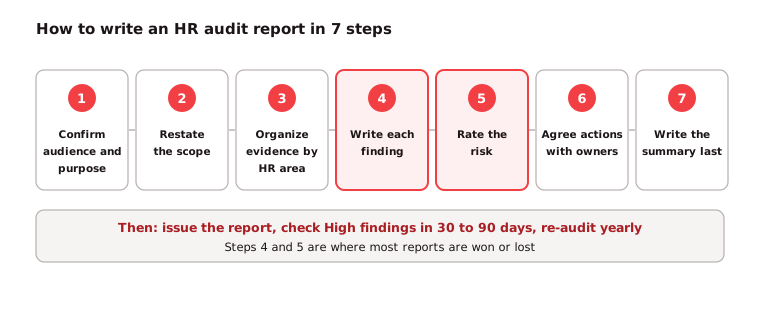
- Confirm the audience and purpose: A board wants risk and cost. HR managers want the detail. Decide who the main reader is and write for them; put extra detail in the appendix.
- Restate the scope: List the HR areas, sites, period and sample sizes. Say clearly what was not reviewed, so nobody assumes a clean bill of health for it.
- Organize the evidence by HR area: Sort your checklists, file reviews and interview notes into the areas from the table above. Drop anything that does not tie back to an audit objective.
- Write each finding: Use the five-part structure in the next section. One finding per gap; do not merge unrelated issues.
- Rate the risk: Apply the same rating rules to every finding, and put legal exposure first.
- Agree actions with owners: Share draft findings with each process owner before the report goes up. Record their response and the deadline they commit to.
- Write the executive summary: One page: the overall verdict, the top findings, and the decisions or budget you need from leadership.
If you are still planning what to check, start with this list of common HR compliance gaps and how to avoid them, then use the steps above to write up what you find.
Pro tip: Share each finding with its owner before the final report. Owners who have already agreed to a fix and a date rarely push back in the leadership meeting.
How should you write each audit finding?
Each audit finding should be written in five parts: the condition (what you found), the criteria (the law, policy or standard it is measured against), the cause (why it happened), the effect (the risk or cost) and the recommendation (the fix). This is the standard structure auditors use, and it stops findings from reading like opinions.
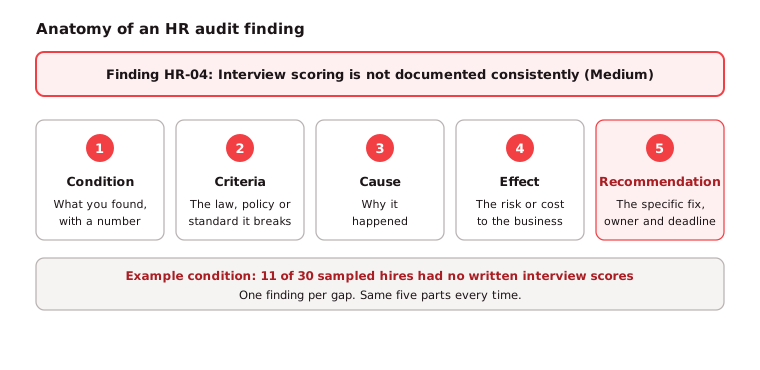
- Condition: State the fact with a number. "Interview notes were missing for 9 of 25 hires sampled."
- Criteria: Name the rule. "Company policy requires written interview notes for every hire. EEOC rules require employment records to be kept for at least one year."
- Cause: Explain why. "Hiring managers use their own question lists and there is no shared scorecard."
- Effect: Describe the risk. "The company could not show why one candidate was chosen over another if a hiring decision were challenged."
- Recommendation: Give a specific, doable fix. "Introduce structured interview guides and a shared scorecard for all open roles by Q2."
Then rate each finding on a simple scale so readers know what to fix first.
Rating | Meaning | Example | Fix within |
|---|---|---|---|
High | Breaks a law or creates direct legal or financial exposure | Missing I-9 forms, misclassified employees, AI screening tool with no bias audit | 30 days |
Medium | Breaks internal policy or weakens a key control | Missing interview notes, inconsistent offer approvals | 90 days |
Low | Good practice gap with low direct risk | Outdated job descriptions, slow candidate feedback | Next audit cycle |
What does an HR audit report template look like?
An HR audit report template is a fixed outline you copy for every audit, so reports are consistent from year to year and easy to compare. Copy the outline below into your document tool and fill in each part.
1. Cover page: Report title, company, audit period, auditor names, date issued, distribution list and confidentiality note.
2. Executive summary: Overall rating (for example Satisfactory, Needs improvement or Unsatisfactory), number of findings by rating, top 3 to 5 findings in one line each, decisions or budget requested.
3. Scope and objectives: HR areas reviewed, sites and entities, period covered, what was out of scope, and the questions the audit set out to answer.
4. Method: Documents and systems reviewed, sample sizes and how samples were picked, people interviewed, checklists used and any limits on access to data.
5. Findings by HR area: For each finding: ID, title, rating, condition, criteria, cause, effect, recommendation, management response, owner and deadline.
6. Action plan: One table with finding ID, action, owner, deadline, status and evidence of completion.
7. Positive observations: What is working well and should be kept. This builds trust with process owners.
8. Appendix: Checklists, sample lists, policy extracts, data tables and a glossary of terms.
Number each finding (for example HR-01, HR-02) so the action plan, follow-up emails and the next audit can refer to it without confusion.
What should the hiring section of an HR audit report cover?
The hiring section of an HR audit report should cover job ads and descriptions, how candidates are screened, how interviews are run and scored, how tests and AI tools are used, how decisions are documented, and how long records are kept. Hiring creates more legal exposure than most HR areas, yet many audit reports give it a single line.
Use this checklist to build the hiring section:
- Job ads and descriptions: Requirements are tied to the job, wording is neutral, and pay ranges appear where local law requires them.
- Screening criteria: Every candidate for a role is screened on the same written criteria, set before the role opens.
- Interview consistency: Interviewers use a shared question set and scorecard, and notes are kept for every candidate. See structured vs unstructured interviews for why this matters.
- Assessments and tests: Each test measures a skill the job needs, scoring is the same for everyone, and results are stored with the candidate record.
- Adverse impact checks: Pass rates at each stage are compared across groups to spot adverse impact early.
- AI and automated tools: The report lists every tool that screens or scores candidates, who checked it for bias, and what candidates are told.
- Decision records and retention: The reason for each hire or rejection is written down, and records are kept for the required period.
AI tools deserve their own line in 2026. In New York City, Local Law 144 on automated employment decision tools requires a bias audit within one year before an AI hiring tool is used, a public summary of the results, and notice to candidates 10 business days before use. If your company hires in New York City and uses such a tool, the hiring section should say whether those three steps are in place.
What does an HR audit report example look like?
An HR audit report example shows how the template reads once it is filled in. The example below is a hiring finding from a fictional 600-person SaaS company, written in the five-part format with a management response, owner and deadline.
Finding HR-04: Interview scoring is not documented consistently (Rating: Medium)
- Condition: In a sample of 30 hires made between January and June, 11 had no written interview scores and 6 had notes from only one of three interviewers.
- Criteria: The company's hiring policy requires a completed scorecard from every interviewer. The EEOC recordkeeping rules require employers to keep personnel and employment records for one year.
- Cause: Engineering and sales teams use their own question lists, the ATS does not require a scorecard before a candidate moves stage, and new hiring managers have not been trained.
- Effect: The company cannot show the job-related reason for 37% of sampled hiring decisions. If a rejected candidate filed a charge, HR would have little evidence to defend the decision.
- Recommendation: Make the scorecard a required step in the ATS, roll out structured interview guides for the 10 most-hired roles, and add a skills test before the first interview so every candidate has a scored, stored result.
- Management response: Agreed. Head of TA to set up required scorecards and guides; HR Ops to update the hiring policy.
- Owner and deadline: Head of Talent Acquisition, 90 days. Follow-up sample of 20 hires at the next quarterly review.
Key takeaway: A finding is only useful when someone outside HR can read it, see the evidence, understand the risk and know exactly who will fix it.
How should you present HR audit findings to leadership?
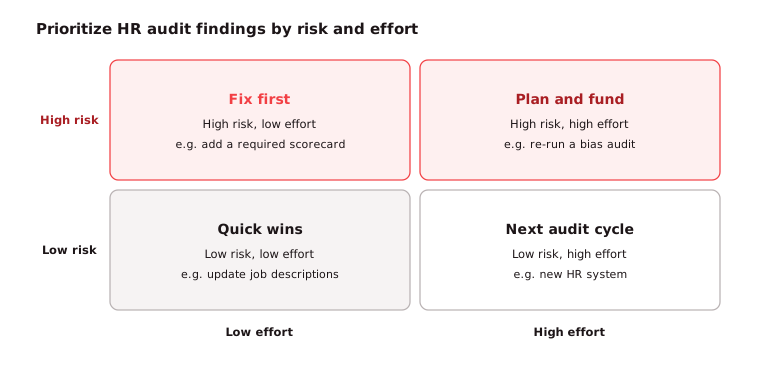
HR audit findings should be presented to leadership as a one-page summary with the top risks, a simple chart of findings by rating and area, and the decisions you need from them. Walk through the High findings in the meeting and leave the detail in the report for those who want it.
- Lead with the verdict: Open with the overall rating and how many High, Medium and Low findings there are.
- Show priority, not volume: Use a risk and effort grid. High-risk, low-effort fixes go first; high-risk, high-effort fixes need a plan and budget.
- Use traffic-light colors: Red, amber and green ratings make a 30-row action plan readable in seconds.
- Ask for decisions: End with the approvals you need, such as a policy change, a tool, training time or headcount.
- Bring legal in early: When a finding points to likely legal exposure, share it with counsel before the wider meeting.
Pick the format by audience: slides for the leadership meeting, a PDF or document for the full record, and a short email to each owner with their actions.
What mistakes weaken an HR audit report?
The mistakes that weaken an HR audit report are vague findings, no risk ratings, recommendations without owners, too much detail up front, and no follow-up date. Each one makes it easier for leaders to agree with the report and then do nothing.
- Vague findings: "Some files were incomplete" gives no scale. Say "14 of 60 personnel files had no signed offer letter".
- No rating rules: If ratings are not defined, every owner will argue their finding down to Low.
- Fixes with no owner: An action without a named person and date is a wish. Put both in the action plan.
- Burying the lead: Leaders read the first page. If the top risk is on page 12, it will not get funded.
- Ignoring what works: A report with only problems makes owners defensive. Note the controls that are working.
- No follow-up: Schedule the check on High findings when you issue the report, not later.
How often should you update an HR audit report?
HR audit reports are usually updated once a year, with a full audit across all areas every two to three years and smaller audits after big changes such as a merger, rapid hiring, new locations or a new law. High findings should get their own follow-up check within 30 to 90 days.
New rules are a common reason to re-audit one area. In the EU, the Pay Transparency Directive had to be written into national law by 7 June 2026, and employers with 100 or more employees must report on pay gaps between women and men. Companies hiring in the EU should check pay, job grading and pay range disclosure in job ads.
AI in HR is another trigger. The SHRM 2025 Talent Trends report found that 43% of HR professionals used AI for HR tasks in 2025, up from 26% in 2024. Each new AI tool in hiring or performance reviews should be added to the next audit scope.
How can Testlify support the hiring section of your audit?
Testlify supports the hiring section of an HR audit by giving every candidate the same scored, stored skills assessment, so the job-related reason behind each decision is on record. It does not replace your audit; it fixes several of the hiring findings audits often raise.
- Same test, same scoring: Pick from 3,500+ tests or build one from your job description, and score every candidate on the same criteria. Browse the Testlify test library.
- Records you can show: Per-skill score breakdowns, timestamped logs, and CSV or PDF export give you evidence for each decision. See reporting and analytics.
- Fair, checked process: 20+ proctoring checks protect test integrity, and Testlify's matching model completed a third-party bias audit under NYC Local Law 144 on June 16, 2023. Read the NYC bias audit summary.
- Fits your stack: Results sync with 100+ ATS and HRIS tools, so scores sit with the candidate record your auditors will sample.
To track the numbers your audit will ask for, such as time to hire and quality of hire, see this list of key HR metrics.
Ready to close the gaps in your hiring section?
If your last HR audit report flagged inconsistent interviews or missing hiring records, start with one role. Start a 7-day free trial of Testlify, no credit card required, build a skills assessment from your job description and see every candidate's scored result in one place.
Frequently asked questions

Content Writer
Yashika Khandelwal is a Content Writer with 3+ years of experience creating research-backed content on hiring, talent assessment, and HR technology. She is a registered Organizational Psychologist and subject matter expert who combines behavioral science with practical recruitment insights to produce accurate, evidence-based content.
LinkedInRelated resources
View all
HR compliance
I-9 verification: a step-by-step guide for employers

HR compliance
Employee monitoring policy template: free sample and guide

HR compliance
What is Personally Identifiable Information (PII) and how’s it protected?

Interview questions
30 Selenium interview questions to ask and what strong answers sound like

Hiring Guide
Startup hiring: a guide to your first 20 hires

Hiring Guide
How to hire your first engineer as a founder: a step-by-step guide
Get started.
Hire on proof, not resumes.
Run your first skills-based assessment free — no credit card required.