
AI bias audit: what it is and how to run one in 2027
What an AI bias audit is, which hiring laws require one, how impact ratios work, the audit steps, and what to ask AI hiring vendors.

Your resume screener may be rejecting one group far more often than another, and you might never know. If it is, the legal risk sits with you, not the vendor.
An AI bias audit gives you the evidence by comparing how often each group is advanced or scored highly. This guide covers the laws, the impact ratio math, the audit steps and the questions to ask vendors.
TL;DR:
- An AI bias audit compares selection or scoring rates across groups to see whether a hiring tool disadvantages any of them.
- New York City's Local Law 144 requires an independent bias audit within one year before an automated hiring tool is used, a published summary and candidate notice 10 business days ahead.
- The core number is the impact ratio: a group's selection rate divided by the top group's rate. A ratio under 0.80 is a warning sign, not a verdict.
- A vendor's audit is a starting point. Employers stay responsible, so test the tool on your own applicant data too.
- Audit every stage that scores people: resume screening, skills tests, AI interviews and ranking.
- Audit at least once a year and again after any change to the model, the roles or the scoring criteria.
 ChatGPT
 Gemini
 Claude
 Grok
 Perplexity
What is an AI bias audit?
An AI bias audit is an impartial review of an automated hiring tool's outcomes, broken down by sex, race or ethnicity and their combinations, to find out whether any group is advanced or scored lower than others. The audit looks at what the tool actually did with real candidates, not what its designers intended.
The term comes mostly from hiring law. New York City defines a bias audit for automated employment decision tools (AEDTs).
AEDTs are software that uses machine learning, statistics or AI to substantially assist or replace a hiring or promotion decision. The city's AEDT page sets out the audit, publication and notice duties.
An AI bias audit checks outcomes. Where a skew comes from, such as biased training data or a proxy like zip code, is the separate question of algorithmic bias.
A good audit points you toward the cause. For the human side of the problem, see the common types of hiring bias.

Why do AI bias audits matter for hiring teams?
AI bias audits matter because AI now touches most early hiring decisions, and the employer, not the vendor, carries the legal risk when a tool screens out a protected group. An audit is the only way to know whether the tool is fair on your candidates before a regulator or a rejected applicant asks.
SHRM's 2024 survey of 2,366 HR professionals found that about 1 in 4 employers use AI for HR work, and 64% of those use it in talent acquisition. HR teams not yet using AI named a lack of resources to audit the algorithms as one reason.
A December 2025 audit by the New York State Comptroller found that the city's consumer agency received only two complaints about automated hiring tools between July 2023 and June 2025. When the agency reviewed 32 companies it found one case of non-compliance.
The Comptroller's auditors reviewed the same companies and found at least 17 potential issues. Penalties run from $500 to $1,500 per violation per day.
For TA leaders, the lesson is to audit before someone else does.
Which laws require an AI bias audit?
AI bias audit rules differ by place. New York City is the only US jurisdiction that requires an independent bias audit before a hiring tool is used. Colorado, California and Illinois rely on notice, record keeping and anti-discrimination rules, and the EU treats hiring AI as high-risk from December 2027.
Jurisdiction | Rule | What it asks of employers | In force |
|---|---|---|---|
New York City | Local Law 144 | Independent bias audit within one year before use, public summary, notice 10 business days before use | July 5, 2023 |
California | Civil Rights Council rules on automated decision systems | Existing anti-discrimination law applies to AI tools; keep automated-decision data for at least four years | October 1, 2025 |
Illinois | HB 3773 (Human Rights Act change) | Notice when AI is used in hiring and other job decisions; discriminatory AI is a civil rights violation | January 1, 2026 |
Colorado | SB 26-189 (replaces SB 24-205) | Notice before use, an explanation of adverse outcomes, record keeping; no audit mandate | January 1, 2027 |
European Union | AI Act, as amended by the AI Omnibus | Hiring AI is high-risk: risk assessment, good-quality data, logging, human oversight | December 2, 2027 |
US federal | Title VII and the Uniform Guidelines | Selection procedures with adverse impact must be job-related | In force |
In the EU, the AI Act lists CV-sorting software as high-risk and says training data must limit discriminatory outcomes. If you hire in Colorado, see Colorado employment and labor laws.
Even where no AI rule exists, a tool that causes adverse impact can expose the employer to a discrimination claim whoever built it.
What does an AI bias audit measure?
An AI bias audit measures selection rates or scoring rates for each group, then compares them as impact ratios. New York City requires these figures for sex, race or ethnicity and intersectional groups such as Hispanic women, plus a count of candidates whose category is unknown.
- Selection rate: the share of a group the tool advances. 120 of 300 candidates advanced is a 40% selection rate.
- Scoring rate: for tools that give a score, the share of a group scoring above the median score.
- Impact ratio: a group's selection or scoring rate divided by the rate of the highest group.
- Four-fifths rule: under the federal Uniform Guidelines, 29 CFR 1607.4(D), a selection rate below four-fifths (80%) of the top group's rate is generally treated as evidence of adverse impact.
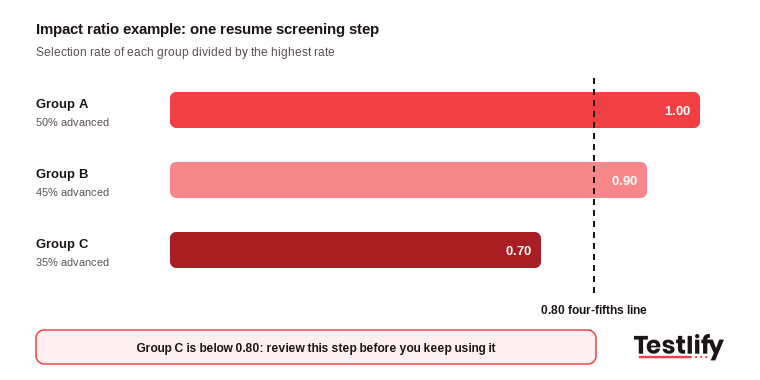
Group C falls below the four-fifths line, so the step needs a closer look. Two cautions apply.
Small groups swing widely, so check whether a gap is statistically meaningful before acting. And a ratio above 0.80 is not a clean bill of health: the Uniform Guidelines say smaller gaps can still count when they are significant.
New York City lets auditors leave out categories under 2% of the data.
How do you conduct an AI bias audit?
Running an AI bias audit is a practical project that HR and TA teams can own with the right data. You need outcome counts by group, a clear list of the tools in use and an independent auditor where the law requires one. The six steps below take you from mapping decisions to publishing results. A single tool with clean data can be audited in a few weeks.
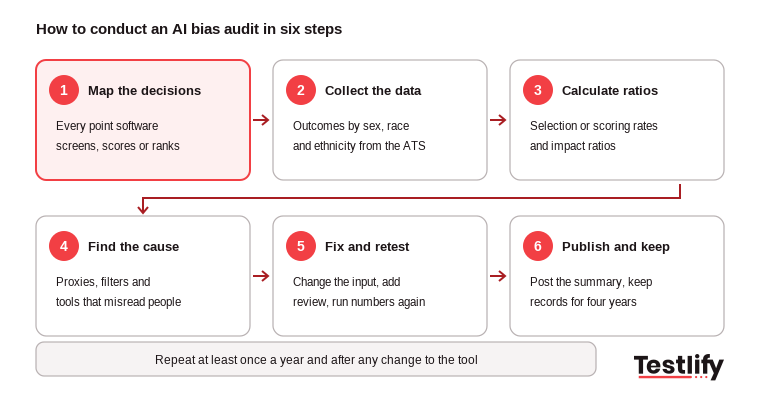
Step 1: Map the decisions
List every point where software screens, scores, ranks or rejects candidates, and what "advanced" means at each one.
Step 2: Collect the data
Pull applicant and outcome counts by sex and race or ethnicity from your ATS. Use real historical data where you have enough; New York City allows test data only when it does not. Never guess or infer a candidate's demographics.
Step 3: Calculate the ratios
Work out selection or scoring rates and impact ratios for each group and each intersectional group, at every stage.
Step 4: Find the cause
Where a ratio is low, check the inputs. Common culprits are proxies such as zip code or graduation year, degree filters the job does not need, and speech tools that struggle with accents.
Step 5: Fix and retest
Remove or reweight the problem input, adjust criteria, or add a human review step. Then run the numbers again.
Step 6: Publish and keep records
In New York City, post the audit summary and the tool's distribution date on your careers page. Keep the data either way. California's Civil Rights Council requires employers to keep automated-decision data for at least four years.
Pro tip: Set up demographic self-identification in your ATS before the tool goes live. An audit is only as good as the share of candidates who answer, and you cannot rebuild that data later.
Which hiring stages should an AI bias audit cover?
An AI bias audit should cover every hiring stage where software scores, ranks or filters candidates, not just the one product a vendor calls AI. A fair final interview cannot fix a resume screen that removed a group at the start.
Stage | What to check | Common source of skew |
|---|---|---|
Resume screening | Pass rate by group | Keyword matching, school or degree filters, employment gaps |
Skills tests | Scoring rate by group | Questions that test culture or language rather than the job |
AI interviews | Scoring rate by group and by format (chat, voice, video) | Speech recognition errors, camera and lighting, accents |
Ranking and shortlists | Share of each group in the top of the list | Weighting that favors one input |
Structured, job-related questions make every stage easier to defend. See how structured interviews work and how to use AI for bias-free candidate screening.
Is a vendor's bias audit enough?
A vendor's bias audit is a useful start but rarely enough on its own. Vendor audits often use pooled data from many customers, which shows how the tool behaves on average, not on your roles, your locations or your applicant pool.
New York City's FAQ says the vendor is not responsible for the audit, although a vendor can hire an independent auditor and share the results. The employer remains responsible for making sure an audit was done before use.
Pooled data from other employers can only be relied on if you also contributed your own data, or if you are using the tool for the first time.
The auditor must be independent of both you and the vendor, and the city keeps no approved list, so check this yourself.
What should you do when a tool fails the audit?
A tool that fails an AI bias audit should be paused for the affected step or put under human review until the cause is found and fixed. New York City's law does not require any specific action after an audit, but federal and state anti-discrimination laws still apply.
- Check the numbers first: Confirm the group sizes are large enough and the data is complete.
- Find the input that drives the gap: Remove proxies and filters that are not needed for the job.
- Look for a fairer option: If another method tests the same skill with less adverse impact, switch to it.
- Retest and record: Rerun the ratios after every fix and keep the before and after results with an owner and a date.
Key takeaway: A failed ratio is a signal to investigate, not proof of discrimination. Ignoring it, though, turns a fixable problem into a legal one.
How much does an AI bias audit cost and how often should you run one?
An AI bias audit costs more as the number of tools, stages and groups grows, and it should run at least once a year. Local Law 144 sets the one-year minimum, and a new audit is wise whenever the model, the roles or the scoring criteria change.
As one example, SHRM reported a recruiting technology vendor quote of $20,000 to $75,000 for an audit. The price depended on product complexity and the depth of analysis.
High-volume teams often check impact ratios every quarter between formal audits, because drift between yearly checks is easy to miss.
What should you ask AI hiring vendors about bias?
AI hiring vendors should be able to answer six questions about bias before you sign. Keep the written answers with your audit records.
- Has an independent auditor tested this tool, when, and can we see the full report and the published summary?
- Which groups, stages and data were covered, and was it historical or test data?
- Can we export candidate-level scores and outcomes to run our own impact ratios?
- Can a reviewer see why each candidate got their score?
- What changes when you update the model, and will you tell us before it ships?
- Does a person make the final decision, and can our team override the tool?
How does Testlify support fair, auditable hiring?
Testlify supports fair, auditable hiring by scoring candidates on job-related skills with explainable results and leaving the decision with people. Testlify published a third-party bias audit of its Matching Model, completed on June 16, 2023.
Read Testlify's NYC bias audit to see how it lines up with Local Law 144.
- Job-related tests: 3,500+ tests and 25+ question types measure the skills a role needs, not proxies such as school or past employers. using skills assessments to reduce bias
- Explainable scores: every report shows a per-skill breakdown, so a reviewer can see what drove a result.
- Audit-ready data: question analytics, timestamped logs and CSV or PDF exports give your team the raw data for its own impact ratios.
- Same test for everyone: structured AI interviews ask every candidate the same questions, and 20+ proctoring checks keep results honest.
- Accessible to more candidates: assessments run in 15+ languages.
Ready to run fairer, audit-ready hiring?
A fair hiring process starts with assessments built on job-related skills, scored the same way for every candidate. Testlify gives your team 3,500+ validated tests, 25+ question types and Video AI, Voice AI and Chat AI interviews, so you can assess skills at each stage and keep clear records.
Browse the Testlify test library to find tests for the roles you hire. You can also book a demo to see how reports and exports support your own audit, or start a 7-day free trial with no credit card required.
Frequently asked questions (FAQs)

Co-Founder and CTO
Jiten Modi is Testlify's CTO and leads a 50-person engineering organization. He writes on technical hiring, evaluating developers with real-world assessments, and building engineering teams.
LinkedInRelated resources
View all
HR compliance
Payroll audit: a step-by-step checklist for HR and finance teams
HR compliance
How to write an HR audit report: format, template and example
HR compliance
I-9 verification: a step-by-step guide for employers

HR compliance
Employee monitoring policy template: free sample and guide

HR compliance
What is Personally Identifiable Information (PII) and how’s it protected?

AI in recruitment
Autonomous AI hiring agents for enterprise: a 2027 guide
Get started.
Hire on proof, not resumes.
Run your first skills-based assessment free — no credit card required.