
Payroll audit: a step-by-step checklist for HR and finance teams
A payroll audit checks pay, classification and tax withholding against the law. See the step-by-step checklist and what audits usually find.

A payroll audit is a structured review of a company's pay records, worker classifications, tax withholdings and recordkeeping to confirm they match the law and the company's own policy. It can be run internally by HR and finance, or externally by a tax authority or outside auditor. Either way, the goal is the same: catch errors, missed classifications or compliance gaps before they turn into back pay, penalties or an employee complaint.
TL;DR :
- A payroll audit checks pay rates, calculations, worker classification, tax withholdings and recordkeeping against the law and company policy, usually once a year or before a known risk event.
- Start by setting the scope and the time period before pulling any documents. An audit with no defined period runs long and still misses things.
- Reconcile HR and payroll data first. Mismatches between who HR has on file and who payroll is actually paying are where most errors start.
- Worker classification is a frequent finding: confirm exempt versus non-exempt status and employee versus contractor status, since misclassification carries the largest penalty exposure.
- Watch state exempt-salary thresholds every year, not just the federal one. California's exempt-employee salary floor rose to $70,304 a year on January 1, 2026, while the federal threshold was rolled back in May 2026 to the lower pre-2024 level of $684 a week, so a role that is exempt federally may still fail a state's higher bar.
- Document every finding with evidence, not just a note that something looked off. An auditor or regulator will ask what you checked and what you found.
 ChatGPT
 Gemini
 Claude
 Grok
 Perplexity
What is a payroll audit?
A payroll audit is a review of payroll records, calculations and processes to confirm employees are paid correctly, classified correctly, and taxed correctly, and that the company can show its work if asked.
Payroll covers the full cycle a payroll audit checks: gross pay, deductions, tax withholding, and net pay, plus the records behind each step. An audit can be a routine internal check, a pre-acquisition review, or a response to a specific red flag like an employee complaint or a spike in overtime.

What does a payroll audit actually check?
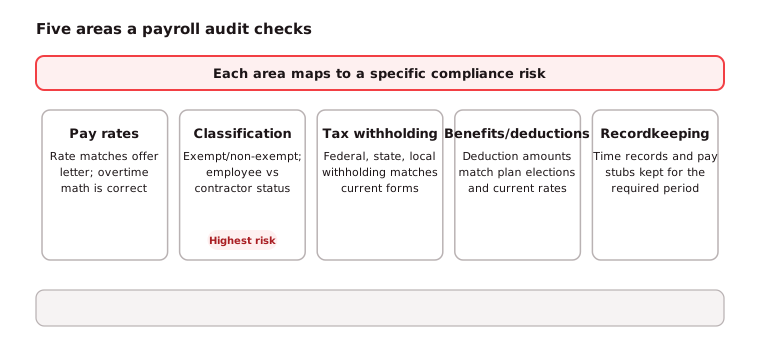
A payroll audit checks five things in most frameworks: pay rates and wage calculations, worker classification (exempt or non-exempt, employee or contractor), tax withholdings, benefits and deduction accuracy, and recordkeeping.
Industry guidance from payroll and HR compliance teams reports that mismatches between the HR system's employee list and what payroll is actually processing are where most errors start, which is why the step-by-step process below puts reconciliation before any detailed verification.
Each of these five areas maps to a real risk: a wrong pay rate underpays or overpays someone, a misclassified worker can trigger years of back overtime, and missing records make any later dispute harder to defend.
Pro tip: pull the worker classification list before anything else. If a role was reclassified by duties this year but payroll still runs it under the old status, every downstream number in that record is suspect until it is fixed.
How do you run a payroll audit step by step?
A payroll audit works best as five steps run in order, not all at once.
- Set the scope and period: decide which pay periods, locations and employee groups the audit covers before pulling a single document. An undefined scope is the most common reason audits run long.
- Reconcile HR and payroll data: compare the HR system's active employee list against who payroll is actually paying. New hires, terminations and leave statuses that have not synced are where mismatches cluster.
- Verify pay rates and calculations: spot-check a sample of pay stubs against approved rates, raises and overtime rules for the period in scope.
- Check worker classification: confirm exempt and non-exempt status against actual job duties, and confirm anyone paid as a contractor meets the legal test for that status.
- Document every finding: write down what was checked, what was found, and the fix, with evidence attached. A finding with no evidence is hard to act on later and harder to defend if questioned.
Key takeaway: the audit is only as useful as the documentation behind it. Write down what you checked and what you found, not just a final pass or fail.
Why does worker classification cause so many payroll audit findings?
Worker classification causes a disproportionate share of findings because the cost of getting it wrong compounds over time. An employee misclassified as exempt who should have been paid overtime can be owed back pay for every week of the misclassification, not just from the date the error is caught.
A worker treated as a contractor who meets the legal test for employee status can trigger back payroll taxes, benefits exposure and penalties on top of back wages.
The federal and state rules moved in different directions in 2026, which makes this a good year to re-check every exempt role. The US Department of Labor's salary-basis rules set the federal exempt-employee salary floor at $684 a week after the DOL rescinded a higher proposed threshold in May 2026.
California moved the other way: the state's 2026 minimum wage notice set the state's exempt-employee salary floor at $70,304 a year, effective January 1, 2026. A role that clears the federal bar can still fail a state's higher one, and the salary test is only half of the exemption; the duties test still has to hold up too.
How often should a company run a payroll audit?
In the audits I have seen HR and finance teams run, the ones that stay clean year over year treat the audit as a standing calendar item, not a reaction to a problem.
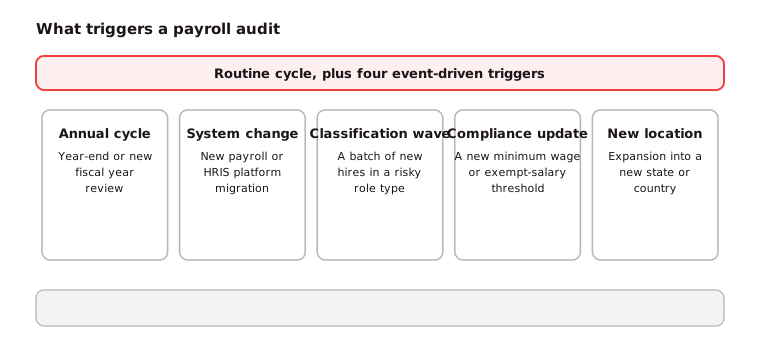
Most companies run a full payroll audit once a year, often tied to year-end or the start of a new fiscal year, with smaller spot-checks after any payroll system change, a wave of new hires in a high-risk classification, or a known compliance update such as a minimum wage or exempt-salary threshold change.
A company expanding into a new state should also run a focused audit on that location's rules before, not after, the first few pay cycles go out; California's 2026 minimum wage notice is a useful example of how specific these state-level checks need to be, since it sets a higher exempt-salary floor than the federal rule covered above.
Testlify does not run payroll, but the same discipline that keeps an audit clean, clear job duties mapped to the right classification, and a documented, repeatable process, starts with hiring the role correctly in the first place.
A structured job description and skills assessment for payroll and finance roles gives HR a clean paper trail from the job posting through to how the role is actually classified and paid.
Want a clear, structured process for assessing the people who will run your next payroll cycle correctly? Browse the Testlify test library or start a free trial.
Frequently sked questions (FAQs)

People and Talent Partner
Arushi Shah runs day-to-day talent acquisition and candidate experience at Testlify. She writes on interviewing, structured hiring, and giving candidates a fair, fast process.
LinkedInRelated resources
View all
HR compliance
How to write an HR audit report: format, template and example

HR compliance
I-9 verification: a step-by-step guide for employers

HR compliance
Employee monitoring policy template: free sample and guide

HR compliance
What is Personally Identifiable Information (PII) and how’s it protected?

Talent assessment
Enneagram type 8: the challenger at work and how to manage one

Workplace culture
Enneagram type 6: the Loyalist at work and in life
Get started.
Hire on proof, not resumes.
Run your first skills-based assessment free — no credit card required.