
How to read an Enneagram chart: wings, arrows and the triangle explained
A plain guide to reading an Enneagram chart: the nine points, wings, growth and stress arrows, and what the inner triangle shows.

An Enneagram chart can look like a puzzle at first: nine numbers on a circle, crossed by a web of lines. Each part has a clear job, and the lines are easier to read than they look.
Below, you will learn what the points, wings, arrows and inner triangle mean, and how to find your own type in five steps.
TL;DR:
- The nine points on the outer circle are the nine Enneagram types; your "wings" are the two types on either side of your core number.
- The lines crossing the circle are arrows that show where a type tends to move under stress (disintegration) and under growth (integration), not a fixed description of behavior.
- The inner triangle connects types 3, 6 and 9; the rest of the points form a six-sided shape connecting the other six types.
- Centers group the nine types into three sets of three: the Gut (8, 9, 1), the Heart (2, 3, 4) and the Head (5, 6, 7).
- A number alone is not the whole picture. Most people read their type with its dominant wing, written as "9w1" or "4w5."
- Use the chart for self-awareness and team conversations. It is not a validated tool for hiring decisions.
 ChatGPT
 Gemini
 Claude
 Grok
 Perplexity
What are the nine points on an Enneagram chart?
The nine points on an Enneagram chart are the nine personality types, each built around a core motivation and a core fear rather than a simple trait label.
Type | Core motivation | Common label |
|---|---|---|
1 | Wants to be right and good | The Reformer |
2 | Wants to be needed and loved | The Helper |
3 | Wants to be successful and admired | The Achiever |
4 | Wants to be unique and understood | The Individualist |
5 | Wants to understand and be self-sufficient | The Investigator |
6 | Wants security and support | The Loyalist |
7 | Wants to stay happy and avoid pain | The Enthusiast |
8 | Wants to be strong and in control | The Challenger |
9 | Wants peace and to avoid conflict | The Peacemaker |
Each number is a type in its own right, not a ranking: 9 is not "better" than 1, and the numbers simply mark positions around the circle.

How do wings work on an Enneagram chart?
Wings are the two types that sit directly next to your core type on the circle, and they shade how that core type typically shows up. A Nine's wings are Eight and One, and a Four's wings are Three and Five. Most people lean toward one wing more than the other, written as "9w1" (a Nine with a One wing) or "4w5" (a Four with a Five wing).
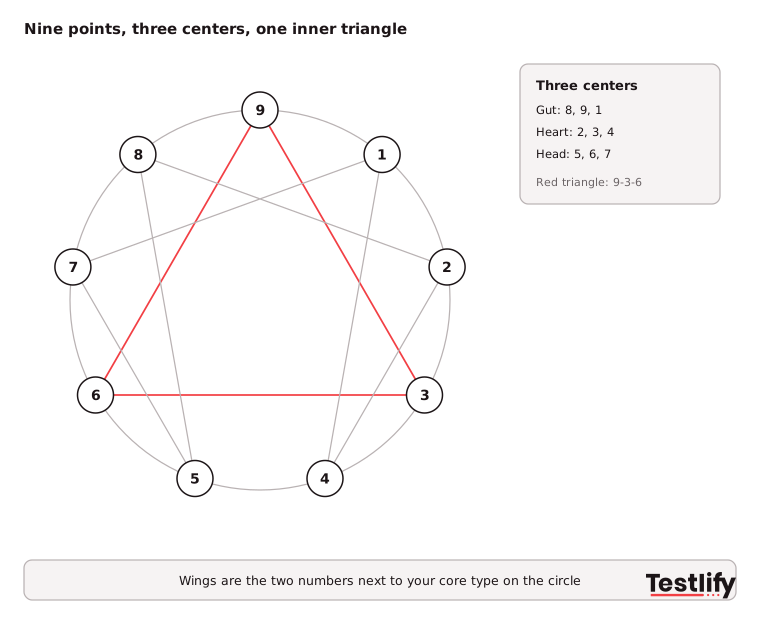
The wing does not change your core number's motivation, but it does add a flavor: a 9w1 tends to bring more structure and a sharper sense of right and wrong to the Peacemaker's core desire for calm, while a 9w8 tends to bring more assertiveness and directness to that same core desire.
What do the arrows on an Enneagram chart mean?
The lines connecting non-adjacent points on the chart are usually called arrows, and they describe two different directions of movement: a stress (or disintegration) direction and a growth (or integration) direction. Sources differ on which arrow points which way on a given chart, so it is worth checking the convention a specific chart uses before reading too much into the direction.
- Stress direction: under pressure, a type tends to pick up some of the less healthy traits of the type at the other end of its stress arrow.
- Growth direction: when a type is doing well and intentionally working on itself, it tends to pick up some of the healthier traits of the type at the other end of its growth arrow.
Pro tip: treat the arrows as a tendency to watch for, not a prediction. A person's actual behavior under stress depends heavily on the specific situation, not just their number.
What is the triangle inside an Enneagram chart?
The inner triangle connects types 3, 6 and 9, running in the sequence 9 to 3 to 6 and back to 9. Some interpretations treat these three types as the most central points in the system.
The remaining six types (1, 2, 4, 5, 7, 8) connect to each other in a six-sided shape, usually drawn as a hexagram, inside the same circle.
What are the three centers on an Enneagram chart?
The nine types also group into three centers of three types each, sometimes called triads, based on the dominant way each group tends to process the world.
Center | Types | Dominant focus |
|---|---|---|
Gut (Body) | 8, 9, 1 | Control, autonomy and instinct |
Heart | 2, 3, 4 | Feelings, image and connection to others |
Head | 5, 6, 7 | Thinking, security and anticipating problems |
Knowing a person's center can be a faster, broader read than memorizing all nine types: it tells you roughly where their attention tends to go before you know the specific number.
How to read an Enneagram chart to find your own type
Reading a type chart is the easy part; working out which type is actually yours takes a bit more care. Most people recognize themselves in two or three descriptions at once, and the type that looks right on the surface is often not the one driving the behavior.
The steps below move from a rough shortlist to a type you can trust, checking each guess against your wings, your center and how you act in real situations.
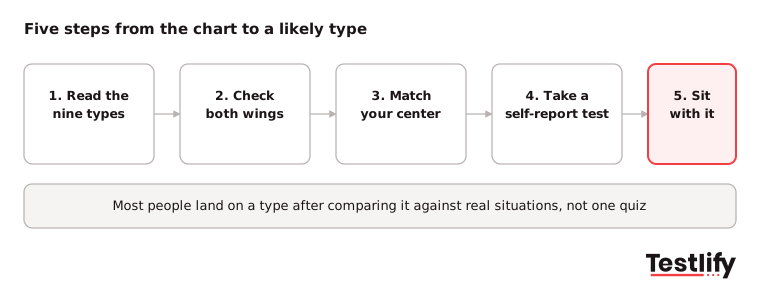
- Read the nine type summaries above and identify the one or two that sound closest to your core motivation, not just surface behavior.
- Check both wings of your likely core type to see which one sounds more familiar day to day.
- Look at your center (Gut, Heart or Head) as a sanity check: does your likely type's center match where your attention naturally goes?
- Take a validated self-report test rather than guessing from the chart alone; Testlify's Enneagram personality test gives a structured starting point.
- Sit with it for a week or two as Enneagram typing is self-reported and easy to get wrong on a first read; most people land on a type after comparing it against real situations, not a single quiz result. In my work with teams on personality frameworks, the type people pick on day one is wrong about as often as it is right.
Can you use an Enneagram chart at work?
Many teams use the Enneagram informally for self-awareness, communication and team-building conversations. Used this way, understanding the chart helps a manager or teammate read a result without over-interpreting it: knowing that a person's wing and center matter as much as their core number keeps the conversation from flattening someone into one label.
In team-building, the chart works best as a conversation starter, not a verdict on anyone's ability to do the job. Gallup's workplace research makes a similar point about self-report frameworks: they help with reflection and coaching, not with sorting candidates.
The chart should not be used as a hiring filter.
The Enneagram is self-reported, was not built as a predictive hiring instrument, and has far less validity evidence behind it than structured skills assessments and work-sample tests. Testlify's guide to the Enneagram test in hiring goes deeper on where the Enneagram fits and does not fit in a hiring process.
Key takeaway: use the chart to understand people already on your team, and use a validated test, such as Testlify's DISC and Big Five personality assessments, when a personality signal actually needs to inform a hiring decision.
Ready to add a validated personality assessment to your hiring process alongside informal tools like the Enneagram? Book a demo or start a 7-day free trial, no credit card required.
Frequently asked questions (FAQs)

Human Resources Lead
Snehi Parmar leads People at Testlify, owning hiring, culture, performance, and retention for a 90-person team. She writes on practical HR strategy and building people processes that scale.
Related resources
View all
Workplace culture
12 employee motivation strategies that actually work

Workplace culture
How to boost employee morale: 9 ways that work

Workplace culture
Organizational change management in 2026: why change stalls and what HR should do

Workplace culture
How to reduce employee absenteeism: 10 steps that work

Workplace culture
External recognition programs: what they are and how to run one

Workplace culture
Employee communication best practices for 2026
Get started.
Hire on proof, not resumes.
Run your first skills-based assessment free — no credit card required.