
How to boost employee morale: 9 ways that work
Nine practical ways to boost employee morale, what kills it in the first place, and how to tell if your team's morale is actually improving.

Employee morale is how positive, motivated and committed a team feels about their work and their workplace at a given time. It shows up in small things before it shows up in the numbers: people volunteer for extra work or they do not, meetings feel energetic or flat, and small frustrations get raised early or left to fester. Boosting it rarely needs a budget; it needs attention to what is actually lowering it.
TL;DR / Key takeaways
- Employee morale is how positive and motivated a team feels right now, distinct from engagement, which is the longer-term commitment to the job and the company.
- Global employee engagement fell to 20% in 2025, its lowest point since 2020, and low engagement cost the world economy about $10 trillion in lost productivity.
- The fastest morale killers are unfair or unexplained decisions, no recognition, and unclear expectations, not low pay on its own.
- The highest-impact boosts are mostly free: specific recognition, clear expectations, manager check-ins, and transparency about decisions that affect people.
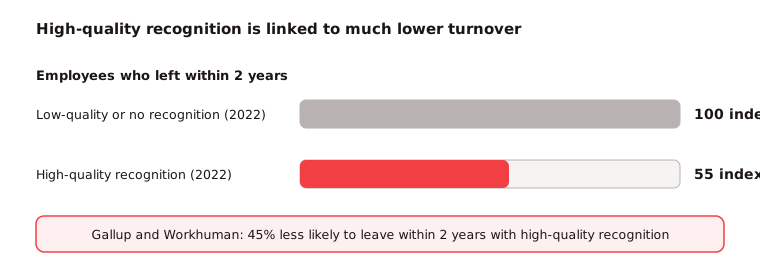
- Recognition works: employees who got high-quality recognition were 45% less likely to have left their job two years later, per Gallup and Workhuman.
- Measure morale with short pulse surveys and manager observations, not only an annual engagement survey.
 ChatGPT
 Gemini
 Claude
 Grok
 Perplexity
What is employee morale?
Employee morale is the overall mood, confidence and motivation of a team or individual at a given point in time. It is shaped by day-to-day experience: how a manager treats people, whether effort gets noticed, whether workload feels fair, and whether people trust where the company is headed.
Morale is related to but different from employee engagement. Morale is the shorter-term, more emotional read on "how do I feel about work right now," while engagement is the longer-term measure of how committed someone is to their role and the company's goals. A team can be engaged (they care about the mission) while morale dips for a quarter because of a reorg, and a team with good morale this month can still be at risk of leaving if engagement with the actual work is low. Both matter, and boosting morale is usually the faster lever.

Why does employee morale matter for the business?
Employee morale matters because it drives retention, productivity and discretionary effort, and the data shows most companies are losing ground on all three. Gallup's State of the Global Workplace found that global employee engagement fell to 20% in 2025, the lowest level since 2020 and the second straight annual drop from a 23% peak in 2022, and estimates low engagement cost the world economy about $10 trillion in lost productivity in 2025, roughly 9% of global GDP.
Recognition, one of the strongest and cheapest morale boosts, has a measurable retention effect. A Gallup and Workhuman study that followed about 3,400 employees from 2022 to 2024 found that employees who received high-quality recognition in 2022 were 45% less likely to have left their job by 2024, and 65% less likely to be actively watching for another job. Gallup separately estimates that 42% of employee turnover is preventable, which puts a number on how much morale and recognition work can realistically move.
What kills employee morale?
The fastest ways to kill employee morale are unfair or unexplained decisions, going unnoticed, unclear expectations, and a toxic or uncivil environment, more than low pay on its own. People tolerate hard problems and busy periods when they feel respected and informed; they disengage fast when they feel disposable.
- Unfair or unexplained decisions: A promotion, layoff or project assignment that is not clearly explained reads as arbitrary even when the underlying decision was reasonable.
- Going unnoticed: Consistently good work that gets no acknowledgment teaches people that effort beyond the minimum does not matter.
- Unclear expectations: Not knowing what "good" looks like, or having goals that shift without explanation, is exhausting in a way that is hard to name.
- Micromanagement: Constant check-ins and approval steps signal distrust, even when the manager's intent is support.
- A toxic or uncivil environment: SHRM's Civility Index put the US workplace civility score at 39.9 for the third straight quarter in Q4 2025, below the 40-point threshold SHRM treats as the line into "incivility is common." A workplace that tolerates rudeness or exclusion drains morale faster than almost anything else on this list.
- Chronic overwork with no acknowledgment: Sustained overtime or understaffing is tolerable short term; it is not tolerable as the unspoken default.
How do you boost employee morale?
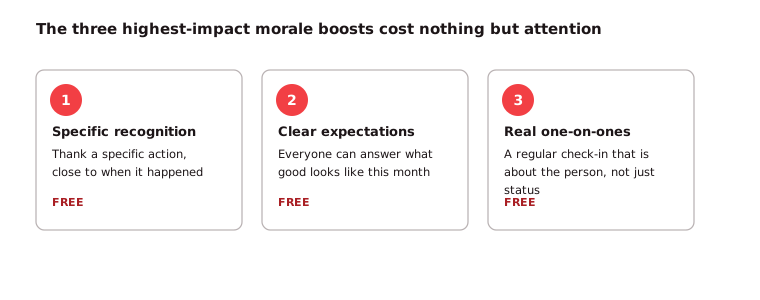
The highest-impact ways to boost employee morale are specific recognition, clear expectations, regular manager check-ins, transparency about decisions, flexibility, growth opportunities, fair workload, celebrating wins, and protecting time off, and most of them cost nothing but attention.
- Give specific, timely recognition: Thank people for a specific action close to when it happened ("the way you handled that escalation on Tuesday") rather than a generic end-of-quarter shoutout. Specific recognition is remembered; generic recognition is forgotten.
- Set clear expectations: Make sure every person can answer "what does good look like in my role this month" without asking. Ambiguity is one of the most common, least visible morale drains.
- Run real one-on-ones: A weekly or biweekly check-in that is about the person, not just status updates, catches frustration before it becomes resignation.
- Explain decisions, even hard ones: When a promotion, reorg or layoff happens, explain the reasoning to the people affected and to the team. Silence gets filled with worse assumptions than the truth usually is.
- Offer real flexibility: Where the work allows it, let people choose how and when they do focused work. Flexibility over small things builds trust that pays off on bigger asks later.
- Invest in growth: A clear path to a new skill, a stretch project or a promotion signals the company sees a future for someone, which low pay alone cannot fully offset.
- Keep workload visibly fair: Review who is carrying the heaviest load every quarter, not only when someone complains. Unequal workload that goes unaddressed is read as favoritism even when it is not.
- Celebrate team wins, not just individual ones: A quick, genuine acknowledgment when a team hits a milestone builds shared identity that outlasts any single project.
- Protect time off: Actively encourage people to use their vacation and do not reward those who never take it. A culture that quietly punishes time off erodes morale for everyone watching.
Pro tip: Pick the one or two morale killers from the list above that are most present in your team right now and fix those first. A single well-run one-on-one habit does more for morale than five generic perks rolled out at once.
Which morale boosters are free and which cost money?
Most of the highest-impact morale boosters cost time and attention, not budget; the paid options work best as a layer on top of those habits, not a replacement for them.
Morale booster | Cost | Best for |
|---|---|---|
Specific recognition | Free | Every team, every week |
Clear expectations and goals | Free | New hires, role changes, reorgs |
Regular one-on-ones | Free (time) | Catching problems early |
Transparent communication on decisions | Free | Layoffs, reorgs, policy changes |
Flexible schedules or remote days | Low cost | Roles where output matters more than hours |
Growth and stretch projects | Low cost | Retention of high performers |
Team celebrations or lunches | Moderate cost | Milestones, project wins |
Formal recognition or rewards programs | Moderate to high cost | Scaling recognition past a small team |
Extra paid time off or wellness stipends | Higher cost | Burnout-prone teams, post-crunch periods |
See employee perks that boost engagement and morale and employee reward ideas to boost morale for more on the paid end of this table, and the Testlify HR glossary entry on morale for a shorter definition and related terms.
How do you measure employee morale?
Employee morale is measurable with short, frequent signals rather than waiting for an annual engagement survey to catch a problem that started months earlier. A quick pulse survey, manager observation and a few behavioral signals together give an early warning an annual survey cannot.
- Pulse surveys: A short, recurring question such as "how are you feeling about work this week" tracked over time, not a long annual form.
- One-on-one notes: Managers tracking mood and energy informally in regular check-ins, reviewed as a pattern, not a single data point.
- Participation signals: Meeting energy, volunteering for extra work, and use of optional social or team events.
- Absence and turnover patterns: A rise in unplanned absence or early resignations in one team is often a morale signal before it becomes an exit interview.
- Recognition frequency: How often people are recognized, and by whom, tracked at the team level to catch managers who recognize no one.
Tools built for this are covered in ways to boost employee engagement, and recognition platforms specifically in top employee recognition tools.
How does fair, skills-based hiring protect morale?
Morale drops fastest inside a team when a hiring or promotion decision looks unfair, even when the outcome was reasonable, so the fairness of the process matters as much as the result. A promotion, internal transfer or new hire that the team cannot see the reasoning behind reads as favoritism, whether or not that is true.
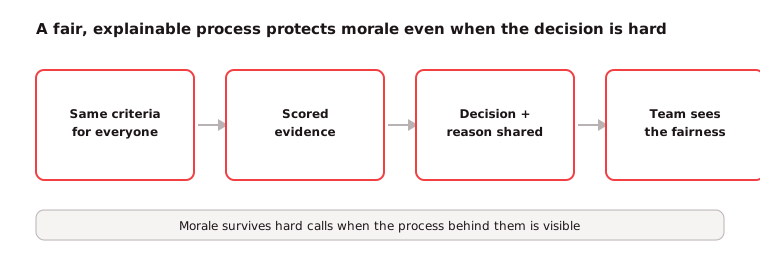
Testlify's skills tests and AI interviews score every candidate for a role, internal or external, against the same criteria, with a report a manager can point to when explaining a decision. That does not remove the difficulty of a hard call; it gives the team evidence instead of a guess about why it was made. what are AI interviews and do they really work
Ready to make hiring decisions your team can see the fairness in?
See how consistent, skills-based scoring gives every hiring and internal-mobility decision a clear, explainable basis. Start a 7-day free trial of Testlify, no credit card required, or browse the test library to see the criteria behind the scores.
Frequently asked questions

Content Writer
Yashika Khandelwal is a Content Writer with 3+ years of experience creating research-backed content on hiring, talent assessment, and HR technology. She is a registered Organizational Psychologist and subject matter expert who combines behavioral science with practical recruitment insights to produce accurate, evidence-based content.
LinkedInRelated resources
View all
Workplace culture
Organizational change management in 2026: why change stalls and what HR should do

Workplace culture
How to reduce employee absenteeism: 10 steps that work

Workplace culture
External recognition programs: what they are and how to run one

Workplace culture
Employee communication best practices for 2026

Workplace culture
What is an upskilling strategy? A practical guide for HR teams

Workplace culture
Employee engagement metrics: 12 to track and how to measure them
Get started.
Hire on proof, not resumes.
Run your first skills-based assessment free — no credit card required.