
12 employee motivation strategies that actually work
Twelve employee motivation strategies that work in 2026, from autonomy and recognition to fair pay, plus how to measure what sticks.

Employee motivation strategies work when they target what actually drives people at work: a sense of control over how they do the job, visible progress, specific recognition and pay that feels fair. Generic perks move the needle far less than most managers assume. Below are 12 strategies, grouped by what they target, plus how to tell if any of them are actually working.
TL;DR / Key takeaways
- The strategies that move employee motivation most reliably target autonomy, mastery, recognition and fair pay, not generic perks.
- Gallup has found that highly engaged teams show meaningfully lower turnover and absenteeism than teams with low engagement.
- Specific, timely recognition from a manager moves motivation more than a generic end-of-year bonus.
- Giving people real choice over how they do their work, not just what they must deliver, raises motivation more than closer supervision.
- Pay that is below market undoes almost any other motivation strategy; fix the floor before adding extras.
- Measure a leading signal (pulse scores, participation) against a baseline, not just gut feel, before deciding a strategy worked.
- Run any new strategy for at least one full review cycle before judging it.
 ChatGPT
 Gemini
 Claude
 Grok
 Perplexity
What is employee motivation?
Employee motivation is the combination of reasons a person puts effort into their work: wanting to do well at the task itself, wanting to be seen doing well, and needing the pay and security that make the job worth keeping. Researchers usually split these into intrinsic motivation (the work itself is satisfying) and extrinsic motivation (external rewards like pay, recognition or promotion).
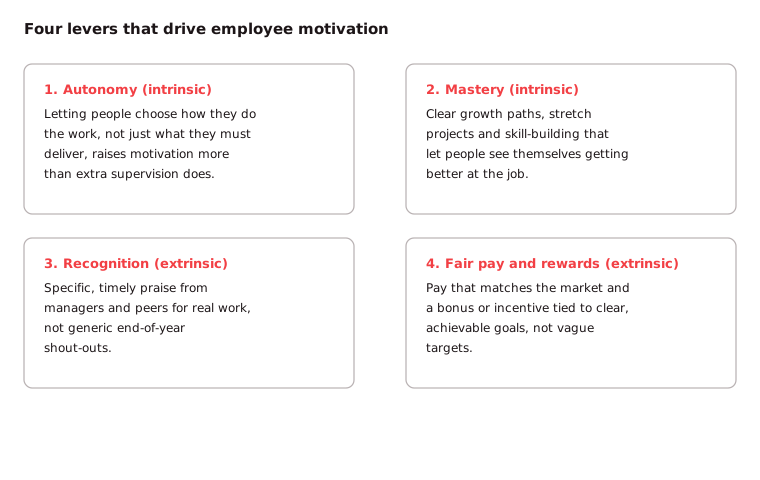
Most real motivation strategies work on one or both of four levers: autonomy, mastery, recognition and fair pay. A strategy that ignores all four, like a single pizza party, rarely changes behavior for more than a day.

Why does employee motivation matter for hiring teams?
Employee motivation matters to hiring teams because it shows up directly in retention, referrals and the quality of work candidates see when they research a company. Gallup's State of the Global Workplace research has repeatedly found that highly engaged teams run meaningfully lower turnover and absenteeism than teams with low engagement, which lowers the constant cost of replacing people. A team that is visibly motivated also becomes a recruiting asset on its own: candidates researching the company see it in reviews, referrals and how current employees talk about the work.
12 employee motivation strategies
- Give people real autonomy over how they work: Let employees choose their own method and schedule for hitting a goal, not just the goal itself. Autonomy over process, not just outcomes, is what raises motivation.
- Build visible paths to mastery: Pair each role with a skills ladder and stretch projects, so people can see themselves getting better, not just doing the same tasks for another year.
- Make recognition specific and timely: Praise the actual thing someone did, close to when they did it. "Thanks for catching that pricing error before it went to the client" works; "great job this year" does not. SHRM's toolkit on managing recognition programs recommends setting clear criteria for what gets praised so recognition stays consistent across managers.
- Fix pay gaps before adding perks: Check pay against the market first. No amount of recognition or flexibility makes up for a role that is clearly underpaid relative to the market rate.
- Give managers real one-on-one time: A short, regular one-on-one where a manager actually listens does more for motivation than an all-hands shout-out, because it signals the person matters individually.
- Set goals the person helped write: Goals someone had a hand in setting carry more weight than goals handed down, even when the target itself is identical.
- Remove friction, not just add rewards: Ask what slows people down (broken tools, unclear approvals, too many meetings) and fix it. Removing a daily annoyance often motivates more than adding a new benefit.
- Offer flexible, not just remote, work: Flexibility in when and how someone works, within clear limits, tends to motivate more consistently than remote work alone or a fixed in-office schedule.
- Connect the work to a visible outcome: Show people the customer, the number or the result their work actually changed. Work that visibly matters motivates more than work that disappears into a pipeline.
- Use peer recognition, not just top-down praise: Let coworkers nominate or thank each other for specific help. Peer recognition reaches moments a manager never sees.
- Protect against burnout, deliberately: Build in real breaks after a crunch and watch for people who never take time off. Burned-out employees are not under-motivated; they are depleted, and more "motivation" tactics make it worse.
- Tie a meaningful share of pay to clear, achievable goals: A bonus or incentive only motivates when the target is specific, realistic and within the person's control; vague or unreachable targets do the opposite.
Pro tip: Pick 2 or 3 strategies from this list that fit your current gap (not all 12 at once), run them for a full cycle, and check the results before adding more.
Intrinsic vs. extrinsic: Which strategies should you start with?
Lever | Example strategies from the list | Best for |
|---|---|---|
Autonomy (intrinsic) | Real autonomy over process, flexible work | Experienced employees who already know the job well |
Mastery (intrinsic) | Visible skills ladder, stretch projects | Early-career employees and anyone plateauing in the role |
Recognition (extrinsic) | Specific timely praise, peer recognition | Any team, especially right after a hard project |
Fair pay (extrinsic) | Market-aligned pay, goal-based incentives | Any team where pay has fallen behind the market |
Key takeaway: If pay is below market, fix that first. Every other strategy on this list works far better once the pay floor is fair, and almost none of them fix a pay problem on their own.
How do you measure whether a motivation strategy is working?
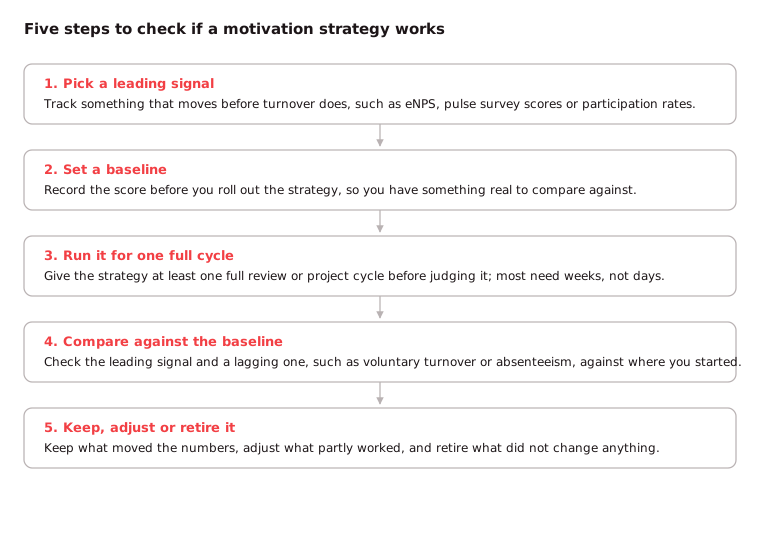
- Pick a leading signal: Track something that moves before turnover does, such as eNPS, pulse survey scores or participation rates in the new initiative.
- Set a baseline: Record the score before you roll out the strategy, so you have something real to compare against later.
- Run it for one full cycle: Give the strategy at least one full review or project cycle before judging it; most strategies need weeks, not days, to show an effect.
- Compare against the baseline: Check the leading signal and a lagging one, such as voluntary turnover or absenteeism, against where you started.
- Keep, adjust or retire it: Keep what moved the numbers, adjust what partly worked, and retire what did not change anything, rather than letting every strategy run forever by default.
What mistakes should you avoid?
- Treating pay as fixed and perks as the fix: If pay is below market, recognition and flexibility will not close the gap; they will just delay people noticing it.
- Running every strategy at once: Twelve new initiatives in one quarter makes it impossible to tell which one, if any, actually changed behavior.
- Confusing engagement surveys with action: Running a survey and changing nothing afterward lowers motivation more than not surveying at all, because it signals leadership heard the problem and did not act.
- Copying another company's program exactly: A motivation strategy that fits a sales floor rarely fits an engineering team; match the strategy to what the specific team actually lacks.
Hire people who stay motivated
Motivation strategies work best on people who were a good fit for the role in the first place. Testlify's skills and personality assessments help hiring teams spot candidates whose strengths match the role before they start, and a broader employee engagement strategy extends these motivation tactics into a full program. Start a free trial to see how Testlify helps you hire for the roles you are trying to keep motivated.
FAQ

Content Writer
Yashika Khandelwal is a Content Writer with 3+ years of experience creating research-backed content on hiring, talent assessment, and HR technology. She is a registered Organizational Psychologist and subject matter expert who combines behavioral science with practical recruitment insights to produce accurate, evidence-based content.
LinkedInRelated resources
View all
Workplace culture
How to boost employee morale: 9 ways that work

Workplace culture
Organizational change management in 2026: why change stalls and what HR should do

Workplace culture
How to reduce employee absenteeism: 10 steps that work

Workplace culture
External recognition programs: what they are and how to run one

Workplace culture
Employee communication best practices for 2026

Workplace culture
What is an upskilling strategy? A practical guide for HR teams
Get started.
Hire on proof, not resumes.
Run your first skills-based assessment free — no credit card required.