
What Is Interview Intelligence? A 2026 Guide for TA Teams
Explore how AI-powered insights help talent acquisition teams structure interviews, reduce bias, uncover candidate potential, and make smarter, data-driven hiring decisions.

Interview intelligence is software that captures what happens in a job interview, organizes it against the role's requirements, and turns it into scored, searchable evidence for the hiring decision. Instead of relying on memory and scattered notes, every candidate is judged on the same criteria and every score can be explained.
TL;DR: Interview intelligence uses AI to turn job interviews into structured, scored evidence, helping hiring teams compare candidates more consistently and make better-informed decisions. It includes live interview copilots and AI interviewers for automated first-round screening, with features such as transcription, skill-based scoring, integrity checks and ATS integration. The right tool should provide evidence behind every score, support human oversight and meet applicable compliance requirements.
 ChatGPT
 Gemini
 Claude
 Grok
 Perplexity
What is interview intelligence?
Interview intelligence is the use of AI to record, transcribe, organize and score job interviews so hiring teams decide on evidence instead of recall. Gartner describes these tools as new to the market, using AI to transcribe video interviews, summarize each candidate and guide interviewers before, during and after the interview.
The term covers two kinds of product. The first sits beside a live interview between people: it joins the call, takes notes, and drafts a summary and scorecard. The second runs the interview itself: an AI interviewer asks a fixed set of role-based questions by video, voice or chat, then scores every answer against the same criteria.
Gartner's market overview puts transcription, summaries and interviewer guidance at the core of the category.

How does interview intelligence work?
Interview intelligence works in three stages: it sets the structure before the interview, captures and tags what candidates say during it, and scores and summarizes the answers after. The result is a scorecard tied to the role's skills, with the answer or clip behind each score.
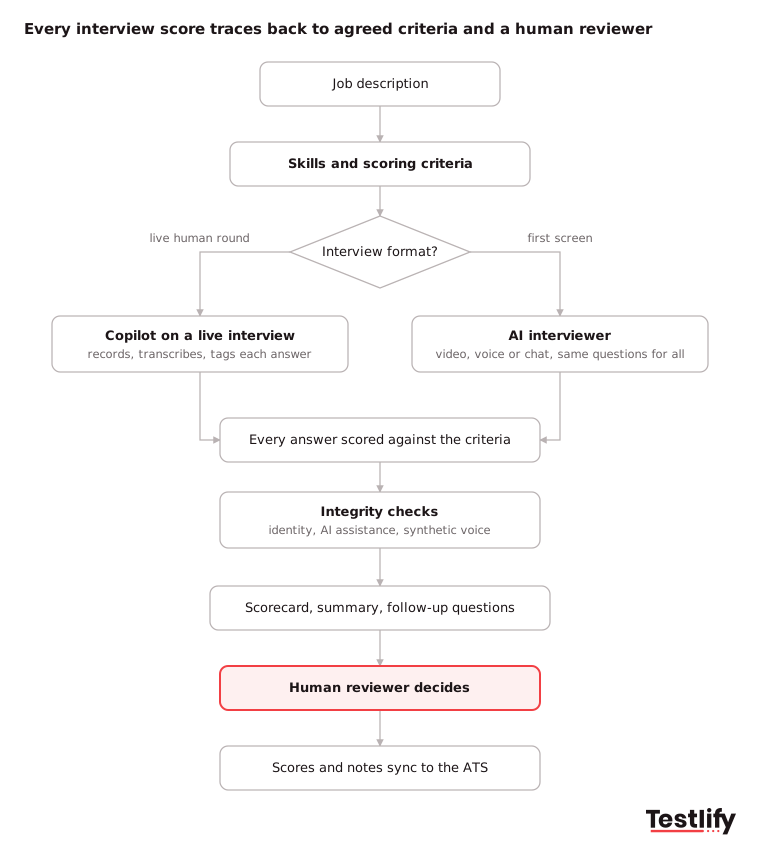
- Before the interview. The hiring team agrees on the skills the role needs and the questions that test each one. Many tools suggest skills and scoring criteria straight from the job description.
- During the interview. The tool records and transcribes the conversation, or the AI interviewer asks the questions. Each answer is tagged to the skill it covers.
- After the interview. Answers are scored against the agreed criteria. The tool writes a summary, flags anything that was not covered, and suggests follow-up questions for the next round.
- Across interviews. Scores roll up into a ranked view of candidates and a view of interviewers, so the team can spot who goes off script or scores harder than peers.
Pro tip: Agree on the scoring criteria before you switch the tool on. AI scoring follows whatever structure you give it, so vague criteria produce vague scores that only look precise.
What are the two types of interview intelligence tools?
Interview intelligence tools come in two types: copilots for live interviews and AI interviewers for structured first rounds. Copilots help people take better notes and stay on script. AI interviewers remove scheduling and score every candidate the same way, which suits early screening and high-volume hiring.
Copilot for live interviews | AI interviewer | Manual notes (no tool) | |
|---|---|---|---|
Who asks the questions | Human interviewer | AI, by video, voice or chat | Human interviewer |
Best stage | Final rounds, senior roles | First screen, volume hiring | Any |
Scheduling | Needed for every interview | None, candidates take it any time | Needed for every interview |
Consistency across candidates | Depends on the interviewer | Same questions and criteria for all | Low |
Scoring | Draft scorecard, a person finalizes | Every answer scored, a person reviews | Interviewer's judgment |
Main risk | Interviewers still drift off script | Weak criteria, candidate trust | Forgotten details, missing notes |
Most enterprise teams end up using both: AI interviews to reach a shortlist, then a copilot in the human rounds that follow.
What features do interview intelligence tools include?
Interview intelligence tools usually include recording and transcription, AI notes and summaries, interview guides with scorecards, automatic scoring, interviewer insights, integrity checks and ATS sync. The first three are standard. Scoring, integrity checks and interviewer insights are where tools differ most.
- Recording and transcription: a searchable record of every interview, so nothing depends on memory.
- AI notes and summaries: a short write-up per candidate, ready before the debrief.
- Interview guides and scorecards: the same questions and criteria for every candidate in a role.
- Automatic scoring: each answer rated against the criteria, with the evidence a reviewer can check.
- Interviewer insights: who covers every topic, who talks too much, and whose scores sit far from the group.
- Integrity checks: signs of AI-assisted answers, impersonation or synthetic voice, especially in remote interviews.
- ATS sync: scores, notes and recordings sent back to the applicant tracking system without manual export.
What are the benefits of interview intelligence?
Interview intelligence gives hiring teams fairer comparisons, faster shortlists, less admin and better interviewers. Every candidate is assessed on the same criteria, recruiters stop writing notes by hand, and hiring managers walk into the debrief with evidence instead of impressions.
- Fairer comparisons. The same questions and criteria for every candidate make it easier to compare people on skill rather than on how the conversation felt.
- Faster shortlists. AI interviewers screen candidates around the clock, so the first round no longer waits on calendars.
- Less admin. Notes, summaries and scorecards are drafted for the interviewer, who only reviews and edits.
- Better interviewers. Teams can see who skips topics or scores out of line, and coach them with real examples.
- Better data on quality of hire. Interview scores can be compared with on-the-job performance later, so the process improves with every hire.
The pressure to hire well has not eased. SHRM's 2025 Talent Trends found that nearly 70% of organizations still struggle to recruit for full-time roles, so teams are looking for ways to screen faster without lowering the bar.
Demand for AI help is growing too. LinkedIn's Future of Recruiting 2025 found that 37% of organizations are now using or testing generative AI in hiring, up from 27% a year before, and 61% of TA professionals believe AI can improve how they measure quality of hire. Among teams already using it, 26% put the time saved into skills assessment.
What does interview intelligence measure?
Interview intelligence usually measures four things: whether each answer shows the skill being tested, whether the interview covered every skill in the same way, whether the answer is genuinely the candidate's own, and whether different reviewers would score it alike. A tool that only produces a transcript and a summary covers the first at best.
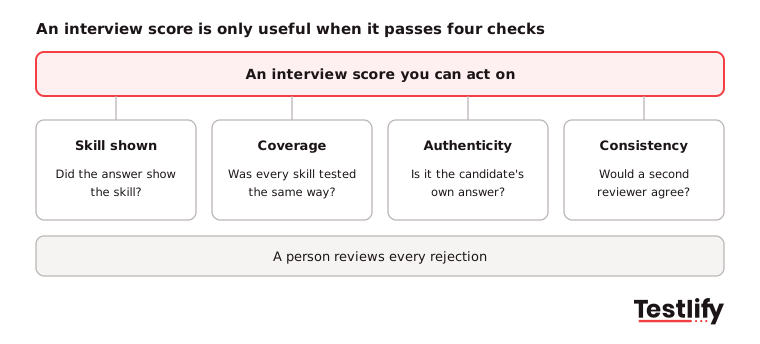
What is measured | The question it answers | What to look for in a tool |
|---|---|---|
Skill shown | Did the answer show the skill? | A score per skill, linked to the exact answer |
Coverage | Was every skill tested, the same way? | Gaps flagged, the same questions for every candidate |
Authenticity | Is this the candidate's own answer? | AI-assistance detection, identity checks, synthetic voice checks |
Consistency | Would another reviewer score it the same? | Side-by-side reviewer scores, overrides with a reason |
Authenticity matters more every year. Candidates can read answers from a second screen or use a cloned voice, and a score is only useful if the person behind it is real.
What are the risks and compliance rules?
Interview intelligence carries three main risks: unfair scoring, candidates not knowing AI is assessing them, and decisions made without human review. Two rules set the bar in 2026, New York City's Local Law 144 and the EU AI Act, and both expect employers to audit and disclose AI that scores candidates.
- New York City. Under Local Law 144, employers cannot use an automated employment decision tool unless it has had a bias audit within one year of use, the audit results are public, and candidates get notice.
- European Union. Annex III of the EU AI Act classes AI used to recruit or select people, including to evaluate candidates, as high-risk. That brings duties on risk management, human oversight and record-keeping.
- Consent and recording. Recording and transcribing interviews often needs candidate consent under local privacy law. Tell candidates what is recorded, why, and how long it is kept.
Keep a person in the loop for every rejection. Treat the AI score as evidence for a reviewer, not as the decision.
How do you choose an interview intelligence tool?
Choosing an interview intelligence tool starts with the hiring stage you need to fix: live final rounds point to a copilot, high-volume first rounds point to an AI interviewer. From there, test five things on a real role: control over criteria, evidence behind scores, integrity checks, compliance support and ATS sync.
Ask every vendor these five questions:
- Can we write and edit our own skills and scoring criteria, or only use yours?
- Can a reviewer see the exact answer behind every score?
- How do you detect AI-assisted answers, impersonation and synthetic voice?
- Do you have an independent bias audit, and can we share it with candidates?
- Do scores and summaries sync back to our ATS without manual export?
Key takeaway: Interview intelligence improves hiring only when it keeps interviews consistent. Choose for control over criteria and visible evidence first. Transcripts and summaries are the easy part.
How does Testlify approach interview intelligence?
Testlify runs AI interviews inside the same platform as its skills tests, so each candidate reaches the human round with scored evidence already attached. Video AI, Voice AI and Chat AI interviews ask role-based questions, score every answer, and give reviewers the clip behind each score.
- Structure first. AI suggests skills and scoring criteria for the role, and interviews run alongside 3,500+ validated tests and 25+ question types. AI interviews explained
- Evidence for reviewers. Each candidate gets a report with a per-skill breakdown, AI-written strengths and gaps, and suggested follow-up questions. A Reviewers Portal gives interviewers one place to score and comment.
- Integrity built in. 20+ proctoring checks, AI-assistance detection, photo ID face match and speech authenticity detection for voice and video answers. anti-cheating and proctoring
- Audited and global. Testlify's matching model completed a third-party bias audit under Local Law 144 on June 16, 2023, and assessments run in 15+ languages. NYC bias audit
For where people still beat the AI, see AI interviewer vs human interviewer.
Frequently asked questions
Ready to run your first AI interview?
See how scored, evidence-backed interviews work on a real role. Start a 7-day free trial of Testlify, no credit card required, and build your first AI interview from your own job description.

Content Writer
Yashika Khandelwal is a Content Writer with 3+ years of experience creating research-backed content on hiring, talent assessment, and HR technology. She is a registered Organizational Psychologist and subject matter expert who combines behavioral science with practical recruitment insights to produce accurate, evidence-based content.
LinkedInRelated resources
View all
Recruitment Technology
Recruitment technology: Meaning, benefits and hiring use cases

Recruitment Technology
Case studies of companies that successfully used recruitment technology

Recruitment Technology
How to choose the right recruitment technology
HR Toolkit
Performance Evaluation Template: Free Form, Rating Scale and Examples

HR & recruitment
How Do Employee Benefits Affect Total Employment Compensation?

Workplace culture
Participative Leadership: Meaning, Types, Pros and Cons
Get started.
Hire on proof, not resumes.
Run your first skills-based assessment free — no credit card required.