
How to hire your first engineer as a founder: a step-by-step guide
Your first engineer shapes the product and the next ten hires. Learn when to hire, how to test skills you can't judge, and what to offer.

Knowing how to hire your first engineer as a founder comes down to four decisions: when to hire, what kind of person the company needs, how to check skills you may not be able to judge, and what to offer.
The first engineering hire, often called a founding engineer, writes the first real version of your product and sets the habits every later engineer inherits. Get it right and you move faster for years. Get it wrong and you lose months of runway and rebuild the code.
TL;DR / Key takeaways
- Hire your first engineer once the problem is validated, you have runway for at least a year, and you can write down what the person must ship in their first 90 days.
- Pre-product with no technical founder? Look for a technical co-founder or a fractional CTO first. For a fixed, short project, a contractor carries less risk.
- Your first engineer should be a senior generalist who owns problems, talks to customers and ships without a manager.
- Test real skills, not resumes: a short paid work sample on a real problem, a coding test, and a structured debrief scored by someone technical you trust.
- Pave's founding engineer data puts senior cash pay in top US markets at about $187k to $250k, with equity of roughly 0.3% to 1.3%, usually on a four-year vest.
- Plan for four to eight weeks of hiring and hundreds of outreach messages. Start with your own network and your investors' networks.
 ChatGPT
 Gemini
 Claude
 Grok
 Perplexity
When should a founder hire the first engineer?
A founder should hire the first engineer when the problem is validated, there is funding for at least 12 months of salary, and the roadmap is bigger than what the founders can build alone. If you cannot yet say what the person will ship in their first 90 days, you are too early for a full-time hire.
Watch for these signals:
- The problem is validated: Customers have told you, with money, signed pilots or clear repeat use, that they want the thing you are building.
- Founder time is the bottleneck: Building, fixing bugs and talking to customers no longer fit in the founders' week.
- You have funding or revenue: You can pay a market salary for a year without the hire becoming a survival bet.
- You can name the outcomes: You can write three to five concrete results for the first 90 days.
Start earlier than feels comfortable. Strong engineers have options: the US Bureau of Labor Statistics projects employment of software developers to grow 10% from 2025 to 2035, much faster than average, according to its Occupational Outlook Handbook. Most good candidates are not looking, so the search takes time.

Do you need a technical co-founder, a founding engineer or a contractor?
The right first technical person depends on how much is still unknown. A technical co-founder fits when there is no product and no one owns the architecture. A founding engineer fits once direction is clear and you need someone to build fast. A contractor or agency fits a fixed, well-defined project.
The difference between a co-founder and a founding engineer is mostly legal and structural. Co-founders join at formation with founder stock and a say in how the company is run. A founding engineer joins as an early employee with stock options and a defined role, even if that role is very broad.
Technical co-founder | Founding engineer | Contractor or agency | Fractional CTO | |
|---|---|---|---|---|
Best when | No product, no technical owner | Validated problem, clear direction | Fixed scope, short timeline | You need technical judgment, not daily coding |
Pay | Founder equity, little or no cash | Market salary plus meaningful options | Hourly or project fee | Part-time fee or small equity |
Owns architecture | Yes | Yes, with founder input | No | Advises |
Long-term commitment | Years | Years | Weeks to months | Months |
Main risk | Co-founder conflict | Hiring too junior | Code nobody in-house understands | Advice without execution |
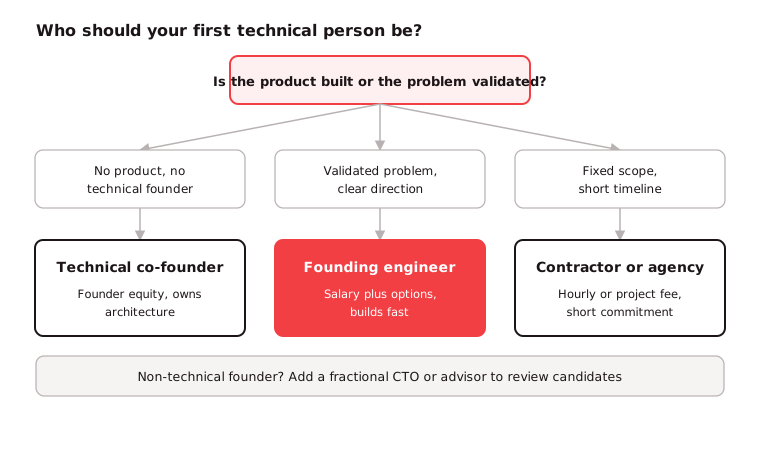
Many non-technical founders do both: a fractional CTO or trusted technical advisor helps write the role and review candidates, and the founding engineer does the building.
What should your first engineer be able to do?
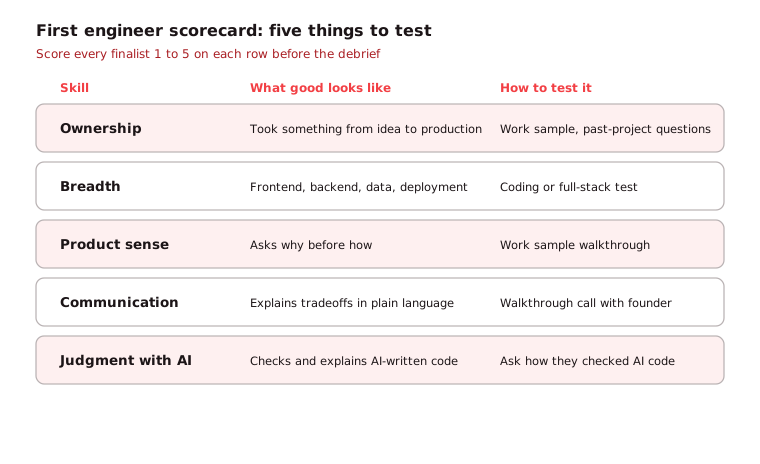
Your first engineer should be able to take a vague problem, turn it into working software and ship it without a manager telling them how. That usually means a senior generalist with a few years of work in small teams, who is comfortable across the stack and happy to talk to customers.
Look for these traits:
- Ownership: They take a problem from idea to production and fix what breaks at 2 a.m. without being asked.
- Breadth over depth: They can work on the frontend, backend, database and deployment. Specialists come later.
- Product sense: They ask why a feature matters before asking how to build it, and they push back on work that will not move a metric.
- Clear communication: They explain technical tradeoffs in plain language a founder or customer can follow.
- Judgment with AI tools: They use AI coding assistants to move faster but can spot and fix code that is almost right.
- Comfort with chaos: Priorities change weekly at this stage. They need to be fine with that.
Ignore signals that matter less than they look. A famous school or a big-tech logo says little about how someone works with no structure around them. Experience in your exact framework is nice but not essential, because good engineers learn new tools quickly.
Stage changes the profile. At seed, you want a builder who can talk to customers and ship rough versions. Closer to Series A, you may need someone who can also set up code review, hiring and on-call, and later lead the team.
How to hire your first engineer as a founder: what are the steps?
Hiring your first engineer as a founder works best as an eight-step process: define the outcomes, choose the hire type, write the role, source from your network, screen for fit, test real skills, run a structured debrief, then make a clear offer. Most founders can complete it in four to eight weeks.
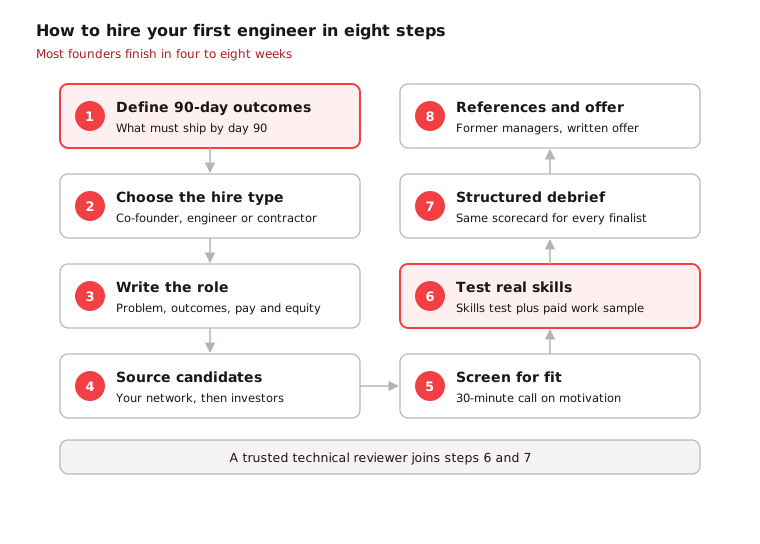
- Define the 90-day outcomes: Write down what must be live, fixed or decided by day 90. This becomes the heart of the job description and the scorecard.
- Choose the hire type: Co-founder, founding engineer, contractor or fractional CTO, using the table above.
- Write the role: Describe the problem, the outcomes, the stack you lean toward, pay range and equity range. A software engineer job description template is a useful starting point; replace the generic duties with your 90-day list.
- Source candidates: Start with people you and your investors know, then widen out.
- Screen for fit and motivation: A 30-minute call on why they want an early-stage role, what they have shipped and any dealbreakers on both sides.
- Test real skills: A short skills test, then a paid work sample on a real problem, reviewed by a technical person you trust.
- Run a structured debrief: Score every finalist against the same criteria before anyone shares a gut feeling.
- Check references and make the offer: Call former managers, then send a written offer with salary, equity, vesting and start date.
Pro tip: Write the scorecard before the first call. Once you like a candidate, it is hard to decide what "good" means without bending it toward them.
Where do you find your first engineer?
The best first engineers usually come from your own network or your investors' networks, because trust matters more than usual at this stage. Most strong engineers are not job hunting, so plan on reaching out to many people. Wellfound's guide estimates about 500 outreach contacts to get the 13 to 18 screening calls a typical engineering hire needs.
Work through these channels in order:
- Your own network: List every strong engineer you have worked with or met. Ask each one who the best engineer they know is.
- Investors and advisors: Most early-stage investors keep talent networks and will make warm introductions.
- Communities: Open-source projects, local meetups, hackathons and developer communities in your product's niche.
- Startup job boards: Useful for reach, but expect more noise and plan time to filter.
- Remote candidates: Opening the role to remote work widens the pool a lot. The Stack Overflow 2025 Developer Survey found that about a third of developers work fully remote and only about 18% work fully in person.
Sell the problem, not the perks. You cannot outbid large companies on cash, so explain why the problem matters, what the person will own and how early they are getting in.
How do you test an engineer's skills if you can't code?
Founders who cannot code test engineering skills by borrowing technical judgment and using evidence instead of conversation. Bring in a trusted engineer, advisor or fractional CTO to review the work, and base the decision on a skills test and a paid work sample rather than on how confident a candidate sounds.
A founder-run skills loop looks like this:
- A short screening test: A timed coding test or full-stack test filters for baseline skill before anyone spends hours on interviews. Add a problem-solving test if the role mixes product and engineering work.
- A paid work sample: Give finalists a small, real problem from your product, capped at three to four hours, and pay them for it. You learn how they scope work, what they ask and how they explain their choices.
- A walkthrough call: The candidate explains the work sample to you and your technical reviewer. You judge clarity and product thinking; the reviewer judges code quality.
- A structured debrief: Everyone scores the same criteria on a scorecard before discussing. A structured interview keeps finalists comparable and cuts bias.
Check how candidates use AI tools. AI help is now normal: 84% of developers use or plan to use AI tools, but only 33% trust the accuracy of the output, according to the Stack Overflow 2025 Developer Survey AI results. The same survey found the top frustration was AI answers that are almost right, but not quite. Ask finalists to show where they used AI in the work sample and how they checked it. Good engineers can explain every line they kept.
For more on running technical interviews without a technical background, see this guide to interviewing a software developer as a non-tech recruiter.
What interview questions should you ask your first engineer?
The best interview questions for a first engineer ask about real past work and real tradeoffs, not puzzles. Each answer should show ownership, judgment and the ability to explain technical choices in plain language. Ask what they did, not what they would do.
Question | What a strong answer shows |
|---|---|
Tell me about something you built from nothing. What would you change now? | Ownership, honest reflection |
Describe a time you shipped something rough on purpose. Why? | Speed versus quality judgment |
How would you choose a stack for our product in week one? | Pragmatism over hype, thinking about hiring later |
Tell me about a bug that reached customers. What happened next? | Accountability, calm under pressure |
When did you push back on a feature request? | Product sense, healthy disagreement |
How do you use AI coding tools, and when do you not trust them? | Judgment, verification habits |
What would you need from me in your first month? | Self-awareness, realistic expectations |
Why an early-stage company, and why now? | Motivation, risk tolerance |
For deeper technical questions your reviewer can use, see these full-stack developer interview questions.
How much should you pay your first engineer?
A first engineer at a funded US startup usually gets a salary somewhat below big-tech pay plus a meaningful equity grant. Pave's founding engineer benchmarks, updated February 2025, put senior cash pay in top US markets at about $187k to $250k, with equity of roughly 0.33% to 1.32% of the company.
Use more than one data point:
- Market median: The US Bureau of Labor Statistics puts median pay for software developers at $135,980 (May 2025). That figure covers all levels, so senior founding engineers in large tech hubs usually earn more.
- Founding engineer bands: In the same Pave data, a 75th percentile offer was about $215k cash and 0.62% equity. Equity drops quickly for hires two to ten.
- Cash versus equity: Some candidates will trade cash for more equity. Offer two or three packages and let them choose.
- Vesting: Four-year vesting with a one-year cliff is standard. Agree on it before the offer, along with what happens if the company is sold.
Explain the equity clearly: number of options, percentage of the company, strike price and vesting schedule. Most startup grants are stock options, and the tax treatment depends on the type of option. The IRS explains the difference between incentive and nonstatutory options in its stock options tax topic. Put every term in a written offer letter, and have a lawyer review the equity plan.
Key takeaway: Being vague about equity is one of the fastest ways to lose a strong candidate late in the process. Know your numbers before the first call.
What should your first engineer achieve in the first 90 days?
A first engineer's first 90 days should produce shipped work, a clear view of technical risks and a plan for what to build next. Agreeing on these outcomes before the start date gives both sides a fair way to judge whether the hire is working.
- First 30 days: Ship one small feature or fix to real users. Learn the product, the customers and any existing code.
- Days 31 to 60: Own a meaningful part of the roadmap. Raise the biggest technical risks, such as security, data or scaling gaps.
- Days 61 to 90: Deliver a larger milestone and recommend what to build, buy or fix next, including when to hire the second engineer.
Use a simple onboarding checklist for access, tools and customer calls so the first week goes to building, not waiting.
What mistakes do founders make with the first engineering hire?
The most common mistakes with a first engineering hire are hiring too junior, hiring on resume prestige, being vague about the role or equity, and skipping a real skills check. Each one is hard to undo, because the first engineer shapes the code, the culture and the next several hires.
- Hiring too junior: There is no senior engineer to teach them. Cheaper salary often costs more in rework.
- Trusting logos over evidence: A big-tech resume does not prove someone can build with no structure. Test the work.
- No technical reviewer: If no qualified engineer looks hard at the candidate's actual work before the offer, you are guessing.
- Hiring before the problem is validated: Use a contractor until you know what to build.
- Rushing because of runway: A wrong first hire costs more time than a longer search.
- Skipping references: Call former managers, not only the names the candidate picked. A reference check should ask what they shipped and whether the manager would hire them again.
How does Testlify help founders hire their first engineer?
Testlify helps founders hire their first engineer by turning the job description into a skills test, so you see real coding and problem-solving ability before you spend hours on interviews. Every candidate takes the same test and gets scored the same way, which makes the debrief with your technical reviewer faster and fairer.
- Ready-made and custom tests: Choose from 3,500+ tests, including coding, full-stack and problem-solving tests, or generate a custom assessment from your job description with the AI test builder.
- Real coding tasks: Live coding and coding questions sit alongside 25+ question types, such as video answers and practical tasks, so you can mirror your work sample.
- Integrity checks: 20+ proctoring checks, including AI-assistance detection and copy-paste tracking, help you trust that the work is the candidate's own. See anti-cheating and proctoring.
- Clear reports: Automated scoring, a per-skill breakdown and AI-suggested follow-up questions give your reviewer a head start on the walkthrough call.
Founders at funded startups can start with the Testlify for startups page and scale as hiring grows.
Ready to hire your first engineer?
Try the full-stack developer test on your next candidate, or build a test from your own job description. Start a 7-day free trial of Testlify, no credit card required.
Frequently asked questions

Content Writer
Yashika Khandelwal is a Content Writer with 3+ years of experience creating research-backed content on hiring, talent assessment, and HR technology. She is a registered Organizational Psychologist and subject matter expert who combines behavioral science with practical recruitment insights to produce accurate, evidence-based content.
LinkedInRelated resources
View all
Hiring Guide
Finance director job description: duties, skills and template

Hiring Guide
How to hire a data analyst: a 2026 step-by-step guide

Hiring Guide
What is lateral hiring and why is it important?

Hiring Guide
How to improve healthcare industry hiring with pre hire tests

Hiring Guide
Executive hiring playbook: a step-by-step guide

Hiring Guide
How to handle sensitive information in the hiring process
Get started.
Hire on proof, not resumes.
Run your first skills-based assessment free — no credit card required.