
How to hire top talent using pharmacy technician test results
A practical guide to using a pharmacy technician skills test: what it covers, how it fits with certification and how to rank candidates.

To hire top talent using pharmacy technician test results, check the license first, send every applicant the same short skills test, shortlist the people above a fixed cut-off, and spend interview time only on them. The test shows who can work out a day supply, catch a wrong strength and calm a frustrated patient before a pharmacist trusts them at the counter.
TL;DR / Key Takeaways
- The fastest way to hire top talent using pharmacy technician test results is a 15 to 20 minute role test sent to every applicant after the license check, before any interview.
- Test dispensing accuracy, pharmacy math, prescription processing, inventory, pharmacy law and customer service. Those six areas match the daily work.
- Certification and a skills test answer different questions. PTCB or NHA shows exam knowledge; your test shows how the person handles your workflow today.
- Add one setting-specific test: customer service for retail, sterile and inventory topics for hospitals, data entry accuracy for mail-order pharmacies.
- Set the cut-off from your current good technicians, not from a guess, and rank everyone above it by their weakest area as well as the total score.
- Demand stays high: BLS projects about 44,700 pharmacy technician openings a year through 2035, so a fast, consistent screen is a real advantage.
 ChatGPT
 Gemini
 Claude
 Grok
 Perplexity
Why hire top talent using pharmacy technician test results instead of resumes?
Pharmacy technician resumes look almost identical: a certificate, a store or hospital name, and the same list of duties. A skills test gives hiring teams a score on the tasks that cause real errors, such as a wrong day supply or a missed refill rule, so the shortlist rests on evidence rather than wording.
The volume problem makes this urgent. The US Bureau of Labor Statistics counts about 471,200 pharmacy technician jobs in 2025, projects 6% growth from 2025 to 2035 and expects about 44,700 openings each year. Most of those openings replace people who leave, which means retail chains and health systems run the same hiring loop again and again.
Retention matters too. PTCB's 2025 workforce survey of 17,112 technicians found that 63% now see the job as a long-term career, up from 59% in 2022, and that lack of pay and incentives is the top reason people leave. A hire who fits the work is more likely to stay, and a test is the cheapest way to check fit before you invest in training.

What does a pharmacy technician assessment test measure?
A pharmacy technician assessment test measures the job tasks a technician does under a pharmacist's supervision: reading and entering prescriptions, calculating quantities, dispensing accurately, managing stock, following pharmacy law and serving patients. A good test uses short scenarios from real pharmacy work instead of textbook definitions.
The Testlify pharmacy technician test covers six skills in 18 questions and 15 minutes, at intermediate level. The task list lines up with the O*NET profile for pharmacy technicians, which ranks verifying prescriptions, entering data and maintaining patient profiles as top tasks, with attention to detail, integrity and dependability as key work styles.
Skill | What the question looks like | Why it matters on the job |
|---|---|---|
Medication dispensing | Pick the right product, strength and label for an order | Wrong strength or wrong patient is the classic dispensing error |
Pharmacy calculations | Day supply, quantity to dispense, simple dose conversions | Math slips cause insurance rejections and patient harm |
Prescription processing | Spot a missing field or an expired refill | Clean order entry saves the pharmacist's verification time |
Inventory management | Handle a shortage, a recall or short-dated stock | Out-of-stocks and expired drugs cost money and trust |
Pharmacy law and ethics | Controlled substance handling, privacy, refill limits | Mistakes here create compliance risk for the whole store |
Customer service | Calm an upset patient while keeping the queue moving | Most technicians work at a counter or on the phone |
Pro tip: Read the questions yourself before you send the test. If a question would not come up in your pharmacy, swap it for a custom one so the score reflects your work.
How is a skills test different from PTCB or NHA certification?
Certification and a pre-employment skills test answer different questions. A PTCB or NHA credential shows that a candidate passed a broad knowledge exam at some point. A skills test shows how that candidate handles your tasks, your products and your counter today, and it can be given to trainees who are not certified yet.
PTCB's CPhT exam has 90 multiple-choice questions over 1 hour and 50 minutes and covers medications, federal requirements, patient safety and quality assurance, and order entry and processing. NHA's ExCPT has 100 questions. Both credentials renew every 2 years. PTCB says employers prefer, and many require, certified technicians, and its 2025 survey found certified techs earn about 20% more than uncertified peers.
PTCB or NHA certification | Pre-employment skills test | |
|---|---|---|
What it proves | Passed a national knowledge exam | Can do your pharmacy's tasks now |
When it happens | Before or after hiring, renewed every 2 years | During screening, before interviews |
Who can take it | Eligible candidates only | Every applicant, including trainees |
What you control | Nothing, it is a fixed exam | Skills, difficulty, cut-off and custom questions |
Best use | Meets state or employer rules | Ranks applicants and focuses interviews |
Use certification as a gate where your state or policy requires it, then use the test to rank everyone who passes the gate. State rules vary, so check your state board of pharmacy before you treat any certificate as optional.
What should you test for each pharmacy setting?
Pharmacy technicians do different work in different settings, so the core test should be paired with one add-on that fits the role. BLS data shows 51% of technicians work in pharmacies and drug retailers, 18% in hospitals and the rest in general merchandise stores, grocery stores and other outpatient care, each with its own daily pressure.
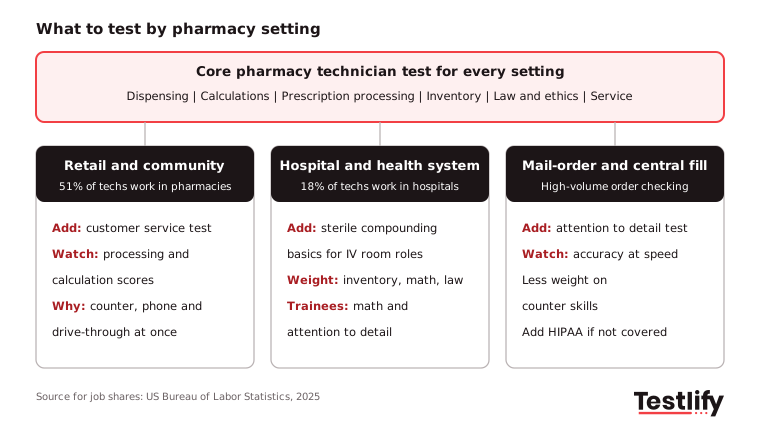
- Retail and community pharmacy: Add a customer service test and watch the prescription processing and calculation scores closely. The counter, the phone and the drive-through all happen at once.
- Hospital and health system: Weight inventory, calculations and law higher, and add questions on sterile compounding basics if the role works in the IV room. Hospitals that train technicians in-house can test trainees for math and attention to detail instead.
- Mail-order and central fill: Add an attention to detail test. These roles enter and check large batches of orders, so accuracy at speed matters more than counter skills.
- Any setting that handles patient records: Add the HIPAA test if privacy questions are not already covered.
How do you hire top talent using pharmacy technician test scores step by step?
Hiring teams that hire top talent using pharmacy technician test scores follow the same six steps for every opening: confirm the license, send the test, shortlist by cut-off, interview the shortlist, run a short practical task, and let the pharmacist in charge sign off. Each step removes a different kind of risk.
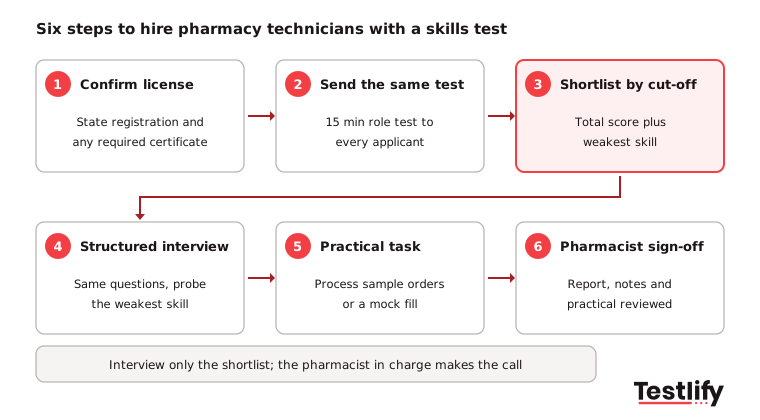
- Confirm license or registration: Check the state registration and any required certificate before anyone spends time on the test.
- Send the same test to every applicant: Invite people straight from the job post or your ATS so nobody waits for a phone screen.
- Shortlist by cut-off: Move only candidates above your cut-off forward, and look at each skill score, not only the total.
- Run a structured interview: Ask the same questions of everyone and probe the weakest skill from the report. The pharmacy technician interview questions list is a good starting bank.
- Add a short practical task: Ask finalists to process two or three sample orders or count and label a mock fill in the pharmacy.
- Pharmacist sign-off: The pharmacist in charge reviews the report, the interview notes and the practical, then makes the call.
For the wider process around these steps, such as job boards, outreach emails and rejection templates, use the pharmacy technician hiring guide and the pharmacy technician job description template.
How should you set a cut-off score and rank candidates?
A cut-off score for a pharmacy technician test should come from your own good technicians, not from a round number. Have three to five technicians you would happily rehire take the test, note their lowest total, and set the cut-off a little below it. Review the cut-off after your first 20 to 30 applicants.
Then rank in two passes:
- Total score: Sort everyone above the cut-off by total score to see the strongest overall candidates.
- Weakest skill: Check each shortlisted candidate's lowest skill score. A candidate with 85% overall but 40% on calculations is a bigger dispensing risk than one with 75% across the board.
- Must-pass skills: Treat dispensing accuracy and pharmacy calculations as must-pass areas for any role that fills prescriptions, and set a minimum for each.
Key takeaway: A cut-off filters out people who are not ready. The skill breakdown decides who you interview first and what you ask them.
How do you keep the test fair, accessible and hard to cheat?
A fair pharmacy technician test gives every candidate the same questions, time and scoring, explains what the test covers before it starts, and offers reasonable accommodations on request. Short tests also help: a 15 minute assessment keeps hourly and part-time applicants in the process instead of losing them to a faster employer.
- Same test, same rules: Use one test per role and one cut-off, so every applicant is judged the same way.
- Accommodations: Offer extra time or other adjustments when a candidate asks. The EEOC guidance on reasonable accommodation says the duty covers applicants, including during tests.
- Integrity checks: Turn on proctoring and anti-cheating checks such as full-screen mode, tab tracking and webcam snapshots, so the score reflects the candidate's own work.
- Same-day invites: Many applicants apply between shifts. Sending the test the day they apply keeps good people from accepting another offer first.
Which screening mistakes cost pharmacies good hires?
The most common screening mistakes are testing too late, testing the wrong things, and treating certification and testing as the same check. Each one either loses good applicants or lets weak ones through to the counter.
- Testing after the interview: By then the team has already spent hours. Test first and interview only the shortlist.
- One long generic exam: A 60 minute general health quiz drives applicants away and still misses insurance and inventory tasks.
- Ignoring skill scores: A strong total can hide a weak calculation score, which is the error that reaches patients.
- Skipping the license check: A great score does not replace state registration or required certification.
- No feedback loop: Compare test scores with 90 day performance and adjust the cut-off and add-ons once or twice a year.
How does Testlify support pharmacy hiring teams?
Testlify gives pharmacy hiring teams a ready pharmacy technician test plus the tools to run it at volume: a library of 3,500+ tests for add-ons such as basic math, custom questions, automatic scoring with per-skill reports, and 20+ proctoring checks included.
- Ready role test: The pharmacy technician test is available in English, Spanish, French, German and Dutch.
- Custom questions: Add your own scenarios with 25+ question types, including video, audio and file upload, so finalists can explain how they would handle a real order.
- Ranked shortlist: Every candidate is scored automatically, with a per-skill breakdown and benchmarking to compare applicants.
- ATS sync: 100+ ATS and HRIS integrations send invites and results without copying data by hand.
- Built for volume: Multi-site pharmacy chains can use volume hiring workflows with score thresholds that move candidates forward automatically.
Healthcare employers can see more on the Testlify healthcare page.
Ready to hire pharmacy technician candidates faster?
Send the pharmacy technician test to your next batch of applicants and compare the shortlist with your current process. Testlify is credit-based, so you pay only when a candidate starts a test, and the 7-day free trial needs no credit card. Hiring across many stores or a health system? Book a demo to set up a multi-site workflow.
Frequently asked questions (FAQs)

Content Writer
Yashika Khandelwal is a Content Writer with 3+ years of experience creating research-backed content on hiring, talent assessment, and HR technology. She is a registered Organizational Psychologist and subject matter expert who combines behavioral science with practical recruitment insights to produce accurate, evidence-based content.
LinkedInRelated resources
View all
HR & recruitment
How to hire Photoshop experts with a skills test

HR & recruitment
Challenges of candidate screening: common problems and how to solve them

HR & recruitment
Tips to overcome legal compliance issues related to equal employment opportunity

HR & recruitment
How to manage and prioritize multiple open positions simultaneously

HR & recruitment
Small business background check: how to run a rigorous one on a lean budget

HR & recruitment
Cultural awareness in hiring: how to assess it fairly
Get started.
Hire on proof, not resumes.
Run your first skills-based assessment free — no credit card required.