
How to hire event staff: a step-by-step guide for hiring teams
A practical guide to hire event staff: plan roles and headcount, pick agency or direct hiring, screen for reliability and stop no-shows.

One no-show at the main entrance can leave a queue of guests waiting outside. Your event gets judged in those first ten minutes.
Most hiring teams book event staff late, check them loosely and hope everyone turns up. That is how gaps appear on the day.
To hire event staff, list every task, turn those tasks into roles and a headcount, then choose direct hiring or an agency. Screen every candidate on reliability and service skills, confirm shifts in writing and keep a standby list for no-shows.
TL;DR:
- Hiring event staff works best as a batch hire: define roles, set a headcount, screen every candidate the same way, confirm in writing and keep a standby list.
- Plan headcount from a task list and a venue map, add one supervisor per team, and book a few standby workers on top of the core crew.
- Hire directly when you run events often and want a bench you trust. Use an agency or staffing app for one-off events, last-minute gaps or roles you rarely fill.
- Screen for reliability, customer service and clear communication first. Most event tasks can be taught in a briefing, but showing up on time cannot.
- In the US, every hire needs a Form I-9, and you are responsible for classifying workers correctly as employees or contractors.
- Most no-shows can be prevented with early offers, a written shift confirmation, a re-confirmation 48 hours out and a paid standby list.
 ChatGPT
 Gemini
 Claude
 Grok
 Perplexity
What does event staff do?
Event staff are the temporary or part-time workers who run an event on the day: they welcome guests, check tickets, serve food and drinks, manage crowds, set up and break down the venue, and solve problems before attendees notice them.
The roles you need depend on the type of event. A corporate conference leans on registration and hospitality staff, a concert leans on security, ushers and concessions, and a product launch leans on brand ambassadors.
Role | What they do | What to screen for |
|---|---|---|
Registration and check-in staff | Check guests in, print badges, answer first questions | Accuracy, calm under pressure, clear speaking |
Ushers and ticket takers | Scan tickets, guide guests to seats, manage entry lines | Reliability, crowd awareness, following procedures |
Servers and bartenders | Serve food and drinks, keep stations stocked | Speed, customer service, food safety and alcohol rules |
Brand ambassadors and promoters | Demo products, collect leads, represent the brand | Communication, product learning, confidence with strangers |
Security and crowd staff | Control access, watch crowds, respond to incidents | Licences where required, judgment, de-escalation |
Setup and breakdown crew | Build stages, booths and seating, then pack it all away | Physical fitness, safety habits, punctuality |
Team leads and supervisors | Brief staff, assign posts, handle swaps and issues | Experience, decision making, people management |
Event staff usually report to an event coordinator or planner. If you also need that permanent role, the event coordinator hiring guide covers it.

How many event staff do you need?
The number of event staff you need comes from the tasks, not from a rule of thumb. List every task that has to happen from setup to breakdown, estimate how many people each task needs at its busiest moment, and add supervisors and a standby list on top.
A simple way to build the headcount:
- List the tasks: Write down every job, from unloading the truck to the last guest leaving. Include breaks, because a post that must stay covered for eight hours needs more than one person.
- Map the venue: Mark entrances, bars, food stations, stages and exits. Each one is a post that needs coverage during peak times.
- Find the peak: Doors opening, meal service and the end of the event are usually the busiest moments. Staff for the peak, then send people home early if it is quiet.
- Add team leads: Give each group of staff one supervisor who owns the briefing, the breaks and the problems.
- Add standby workers: Book a few people who are paid to be on call, so one no-show does not leave an entrance empty.
Pro tip: Keep the task list and headcount from every event. After three or four events, you will have your own staffing ratios, which beat any industry average because they come from your venues and your guests.
Should you hire event staff directly or use an agency?
Hiring event staff directly gives you the most control over quality and cost, while an agency or staffing app gives you speed and backup when you have little time. Most teams that run events often use a mix: a direct bench for core roles and an agency to fill gaps.
Factor | Direct hire | Event staffing agency | Staffing app or marketplace |
|---|---|---|---|
Best for | Recurring events, core roles | Large or one-off events, specialist roles | Short shifts, last-minute gaps |
Control over who works | Full | Shared with the agency | Limited, you rate workers after shifts |
Lead time | Weeks | Days to weeks | Hours to days |
Cost per hour | Lowest | Highest, the agency adds its fee to the wage | In between, platform fee on top of pay |
Paperwork and payroll | Yours | The agency's, as employer of record | Usually the platform's |
No-show backup | Your own standby list | Agency sends a replacement | Open the shift to other workers |
Training and fit | You train once, reuse the team | Agency trains basics, you brief on the day | Brief on the day |
The choice is less about price than about repeat work. If you hold the same kind of event every month, every hour you spend building a direct team pays back at the next event.
If the event happens once, an agency is usually faster and safer. For the general rules that apply to short-term workers, see the guide on how to hire a temporary employee.
How do you hire event staff step by step?
Hiring event staff follows seven steps: define the roles, set the budget, write the job post, source candidates, screen them, confirm and onboard, then review after the event. Starting early is the single biggest factor, because good event workers get booked first.
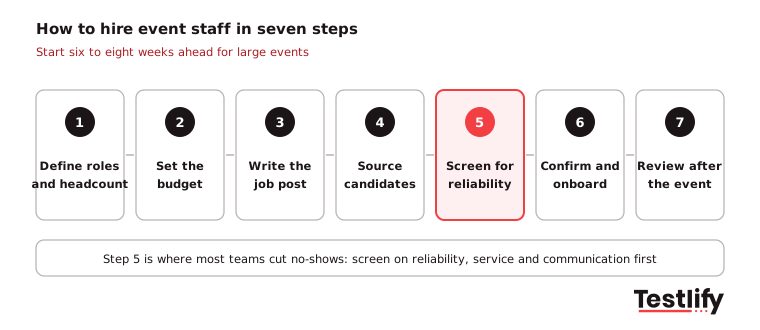
- Define roles and headcount: Use the task list from the planning stage. Write one line per role on what success looks like on the day.
- Set the budget: Multiply hours by pay rate for every role, then add setup and breakdown time, overtime, meals, travel, uniforms and any agency fee.
- Write the job post: State the date, hours, location, pay, dress code and what the role involves. Event workers compare offers fast, so put pay and hours near the top.
- Source candidates: Start with past workers, then referrals, local job boards, community groups, colleges and agencies. As a working rule, start six to eight weeks ahead for large events and three to four weeks ahead for smaller ones.
- Screen candidates: Use a short online check for reliability, service skills and communication, then a brief call with the people who pass. Details are in the next section.
- Confirm and onboard: Send a written offer with the shift, location, contact person and what to bring. Collect paperwork before the event day, not at the door.
- Review after the event: Rate each worker on punctuality, effort and guest feedback. Invite the best back first next time.
For teams that run many events a year, the same steps apply to batch hiring at scale. The volume hiring page shows how teams screen hundreds of applicants for the same role in a short window.
How should you screen event staff candidates?
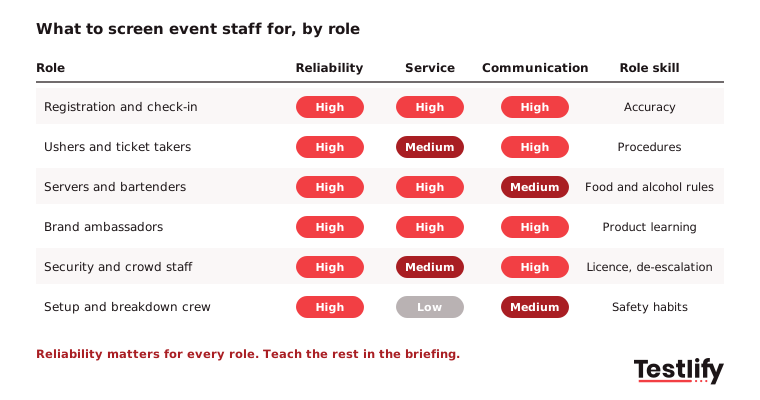
Event staff candidates are best screened on reliability, customer service and communication, because those three traits decide whether a shift goes well and are hard to fix in a one-hour briefing. Product knowledge, venue layout and procedures can be taught on the day.
Resumes say little about event workers. Many good candidates are students, career changers or people who work events alongside another job, so experience on paper is a weak signal.
A short, job-relevant check gives every applicant the same chance and gives you scores you can compare.
- Reliability: A work reliability test asks how candidates handle commitments, schedules and rules. Use it for every role.
- Customer service and judgment: Short scenarios such as "a guest without a ticket insists on entering" show how candidates think on their feet.
- Communication: A communication test or a short recorded video answer shows whether a candidate can give clear directions to a stressed guest.
- Role skills: Cash handling for concessions (the cashier test fits), food and alcohol rules for servers and bartenders, licences for security.
- Availability and commitment: Ask candidates to confirm the exact dates and hours inside the application, not later by text.
Keep the check short, ideally under 20 minutes and mobile-friendly, because event applicants often apply from a phone and drop out of long forms. Testlify lets you build this kind of short screen from its library of 3,500+ tests, invite candidates by link and rank them by score, with 20+ proctoring checks if you need to confirm the person taking the test is the person you hire.
Key takeaway: Hire for reliability and attitude, then train for the task. A reliable worker with no event experience is a safer bet than an experienced one who cancels on the morning of the event.
What interview questions should you ask event staff?
Event staff interview questions should test reliability, service, and judgment in real event situations. Keep the call to 10 or 15 minutes and ask every candidate the same questions so you can compare answers fairly.
- Tell me about a time you had to be somewhere early and something went wrong on the way. What did you do?
- A guest is angry because their name is not on the list. Walk me through what you say.
- You notice a crowd building at an exit during the event. Who do you tell and what do you do first?
- How do you get to the venue, and what is your backup if that plan fails?
- What would make you cancel a shift you had already confirmed?
- Which of these dates and times can you commit to right now?
For hospitality roles, the guides on how to hire a waiter and hiring restaurant and hospitality staff add role-specific questions.
How much does it cost to hire event staff?
The cost to hire event staff is the hourly pay for every worker multiplied by the hours they are on site, plus setup and breakdown time, overtime, meals, uniforms, travel, payroll costs and any agency or platform fee. Pay rates vary by city, role and date, so price each role separately.
Public pay data from the US Bureau of Labor Statistics gives you a baseline. The BLS Occupational Outlook for waiters and waitresses lists a median of $16.94 an hour in May 2025, with about 423,100 openings expected each year from 2025 to 2035.
That shows how much competition there is for hospitality workers. In an April 2026 guide, Skift Meetings reports that registration desk temps are often paid about $20 an hour.
Costs that teams often forget:
- Paid time outside the event: Setup, briefing, breaks and breakdown are paid hours.
- Overtime: Long event days can push workers past daily or weekly overtime limits, depending on the state.
- Agency or platform fees: Agencies add their fee to the wage. Ask for the full bill rate per hour, not just the worker's pay.
- Standby workers: Paying a few people to be on call costs less than an empty entrance or bar.
- Replacement hiring: Every no-show you replace at short notice costs more than a worker booked early.
What paperwork do you need when you hire event staff?
The paperwork to hire event staff in the US includes a Form I-9 for every employee, the right worker classification, wage and hour records, and a written agreement that sets out the shift, pay and rules. Agencies handle most of this when they are the employer of record; direct hires make it your job.
- Form I-9: Every person hired for work in the US needs a completed Form I-9. According to USCIS instructions, the employer section is due within three business days of the first paid day, and by the first day when the job lasts less than three business days.
- Employee or contractor: Event workers who follow your schedule, wear your uniform and work under your supervisor are usually employees. According to the US Department of Labor guidance on misclassification, employers are responsible for getting this right, and misclassified workers can lose minimum wage and overtime protection.
- Wage and hour rules: Track every hour, including setup and breakdown, and check state and city minimum wages for the venue's location.
- Tips and service charges: Decide in advance who receives tips and write it down.
- Licences and certificates: Security licences, food handler cards and alcohol service permits are required for some roles in many states.
- Shift agreement: Date, hours, pay, dress code, conduct rules, cancellation policy and an emergency contact.
Outside the US, the rules differ. In the UK, for example, employers must check the right to work of every worker before they start.
When the rules are unclear, check with your HR or legal team before the event, not after. The HR glossary entries on seasonal employment and the gig worker explain how these worker types differ.
How do you reduce event staff no-shows?
Event staff no-shows drop when commitment is confirmed in writing, re-confirmed close to the date, and backed by a paid standby list. Most no-shows are people who were available when they applied but never committed to the specific shift.
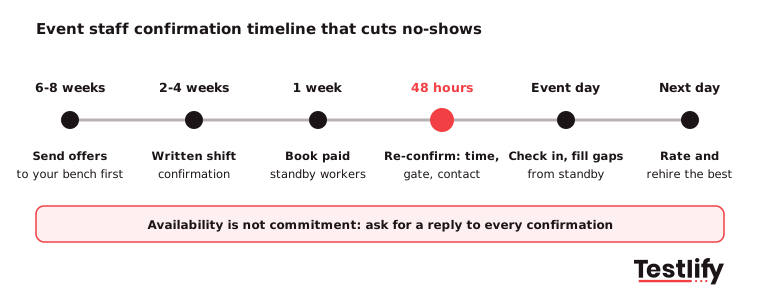
- Offer early: Good workers fill their calendars first. An early, clear offer beats a higher rate sent two days before the event.
- Confirm in writing: Ask workers to accept the exact shift, not just "the weekend".
- Re-confirm 48 hours out: Send a short message with the arrival time, entrance, contact person and dress code, and ask for a reply.
- Keep a paid standby list: Pay standby workers a small fee to stay on call, and send them to whichever post is empty.
- Make the day easy: Share parking, transit and entrance details. Many late arrivals start with a wrong gate.
- Track and reward reliability: Rehire the people who show up, offer a small bonus for perfect attendance across a season, and stop booking repeat no-shows.
Ready to screen event staff faster?
When an event needs dozens or hundreds of workers, the screening stage is where most time goes. Testlify lets hiring teams send one short, mobile-friendly assessment to every applicant and score reliability, communication and role skills.
Browse the Testlify test library for role skills, or start a 7-day free trial with no credit card. Prefer a walkthrough? Book a demo to see how Testlify fits your event hiring.
Frequently asked questions (FAQs)

Human Resources Lead
Snehi Parmar leads People at Testlify, owning hiring, culture, performance, and retention for a 90-person team. She writes on practical HR strategy and building people processes that scale.
Related resources
View all
High volume hiring
High-volume hiring trends: What the latest data tells us this year

High volume hiring
Automated candidate scoring: how it works and speeds up hiring

High volume hiring
How high-volume hiring works with AI interviews

High volume hiring
How to utilize artificial intelligence for large volume hiring?

High volume hiring
High volume hiring: 11 strategies and a checklist for 2026

High volume hiring
Mass recruitment: how to hire at volume without losing quality
Get started.
Hire on proof, not resumes.
Run your first skills-based assessment free — no credit card required.