
Enterprise Recruitment: Process, Challenges and Software in 2026
How large organizations hire at scale: the enterprise recruitment process, the main challenges, the tools you need and how to pick them.

Enterprise recruitment is the way large organizations hire at scale: many roles, many hiring managers and often many countries, run under one shared process, one set of standards and one connected tech stack. The goal is to hire quickly without letting quality, fairness or compliance slip as volume grows.
TL;DR: - What enterprise recruitment is and how it differs from hiring at a smaller company. - The seven steps of the enterprise recruitment process. - The challenges that slow large teams down, and the strategies that hold up at scale. - The tech stack you need and how to choose enterprise recruitment software. - The metrics to track. - Where Testlify fits as the skills and interview layer.
 ChatGPT
 Gemini
 Claude
 Grok
 Perplexity
What is enterprise recruitment?
Enterprise recruitment is the full hiring operation of a large employer: planning, sourcing, screening, assessing, interviewing and onboarding people across departments, business units and regions under one strategy.
Three things set enterprise recruitment apart:
- Hiring never stops. The process has to run the same way in month one and month twelve.
- Decisions are spread out. Recruiters, hiring managers and panels all take part, so standards drift unless the process holds them in place.
- The data has to last. A candidate who was a strong runner-up last quarter should still be findable this quarter.

How is enterprise recruitment different from regular recruitment?
Enterprise recruitment differs from regular recruitment in scale, structure and risk. A small company fills a handful of roles with one recruiter and a spreadsheet. An enterprise fills hundreds or thousands of roles a year, across regions, with many stakeholders, several connected systems and legal exposure in every market it hires in.
Factor | Regular recruitment | Enterprise recruitment |
|---|---|---|
Volume | A few roles at a time | Hundreds to thousands of hires a year |
Who decides | Founder or one hiring manager | Recruiters, hiring managers, panels, approvers |
Process | Informal, changes per role | Standard stages, scorecards and approvals |
Tools | One ATS or a spreadsheet | ATS or HRIS plus assessment, interview, scheduling and CRM tools |
Geography | Usually one country | Many countries, languages and time zones |
Compliance | Basic employment law | Local labour law, data privacy, AI hiring rules, audits |
Main risk | A bad hire | Inconsistent decisions, slow cycles and legal exposure at scale |
What are the steps in the enterprise recruitment process?
The enterprise recruitment process follows a clear path from the first headcount plan to the new hire's first months on the job. The steps look like any hiring process. The difference is that each one is standardized, measured and connected to the next system. Here is how the process runs, step by step.
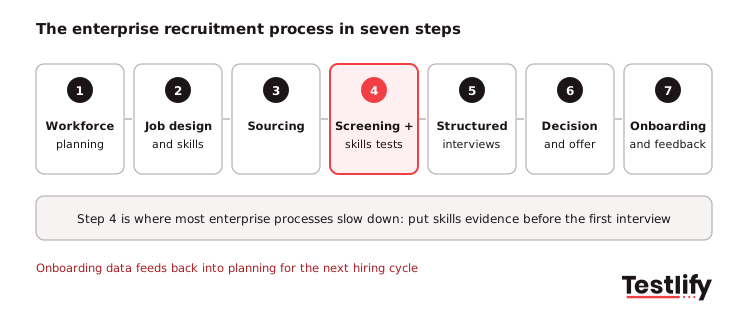
- Workforce planning. HR, finance and business leaders agree how many people each team needs, when, and at what budget. Approved requisitions open in the ATS.
- Job design. Each role gets a job description and a short list of the skills that matter most. These skills become the scoring criteria for every later step.
- Sourcing. Recruiters post jobs, mine the talent CRM, run referrals and work with agencies. At enterprise scale, one role can draw thousands of applicants.
- Screening and skills assessment. Resumes are screened, then candidates take a role-specific skills test or a structured AI interview so the shortlist rests on evidence, not keywords.
- Interviews. Shortlisted candidates meet hiring managers and panels using the same questions and scorecards for everyone in the role.
- Decision and offer. Scores and notes are compared side by side, approvals run, and the offer goes out. Background checks follow.
- Onboarding and feedback. The new hire starts, and their early performance is fed back so the team can see which signals predicted a good hire.
Step 4 is where most enterprise processes break. Resume screening at volume is slow and inconsistent, so strong candidates wait or get missed. For a deeper look at drop-off between steps, see the enterprise hiring funnel.
What are the biggest enterprise recruitment challenges?
Enterprise recruitment challenges come from volume and spread: too many applicants for recruiters to read, skills that are hard to judge from resumes, disconnected tools, slow approvals, uneven candidate experience and growing compliance rules. Most of them get worse, not better, as the company grows.
The talent market is not making this easier. SHRM's 2025 Talent Trends found that 69% of organizations are still struggling to fill full-time roles, and 28% now require new skills for those roles.
- Applicant volume. A popular role can draw thousands of applications. Recruiters skim, and good candidates are lost in the pile.
- Judging skills. Resumes show job titles, not ability. Hiring managers end up interviewing too many people to find the few who can do the work.
- Disconnected systems. Candidate data sits in the ATS, assessment scores in another tool and interview notes in email. Nobody sees the full picture.
- Slow approvals. Every extra sign-off adds days. Strong candidates accept other offers while the requisition waits.
- Inconsistent decisions. Different interviewers ask different questions and score in different ways, so two regions can hire very differently for the same role.
- Candidate experience. Long gaps, no updates and repeated questions push candidates away, and at scale that hurts the employer brand.
- Compliance. Each market adds rules on data privacy, record keeping and, more and more, the use of AI to screen or score candidates.
Which enterprise recruitment strategies work at scale?
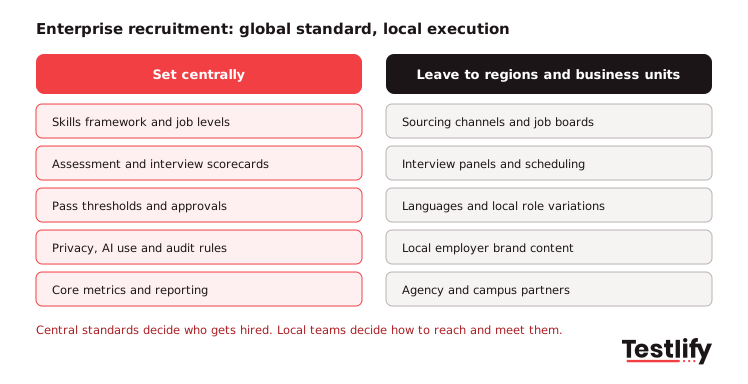
Enterprise recruitment strategies that work at scale share one idea: standardize what decides who gets hired, and let regions and business units adapt everything else. In practice that means a common skills framework, skills-based screening early, structured interviews, connected data and a short list of metrics everyone reports on.
Across the teams we work with, the biggest gains come from moving skills evidence earlier. When candidates take a short, role-specific assessment before the first interview, recruiters stop reading every resume and hiring managers only meet people who have already shown the core skills.
The data backs the shift. LinkedIn's Future of Recruiting 2025 found that 93% of TA professionals say accurately assessing skills is crucial for quality of hire, yet only 25% feel highly confident measuring quality of hire.
Moving skills evidence earlier only works if every region follows the same rules. The graphic below shows how large teams split the work. Global standards, such as the skills framework, structured scorecards and shared metrics, are set centrally. Each region then runs sourcing, scheduling and local compliance in the way that suits its market.
Pro tip: Pilot changes on one high-volume role family, such as customer support or sales, before a global rollout. Compare time to shortlist and hiring manager satisfaction against the old process for one quarter, then expand. We have seen pilots win budget faster than any business case slide.
For more tactics on hiring at scale, see high-volume hiring strategies for enterprises.
What should an enterprise recruitment tech stack include?
An enterprise recruitment tech stack usually has four layers: a system of record (ATS and HRIS), a skills evidence layer (assessments and AI interviews), an engagement layer (CRM, career site, scheduling, messaging) and an analytics layer. The ATS holds the process together, but it rarely tells you whether a candidate can do the job.
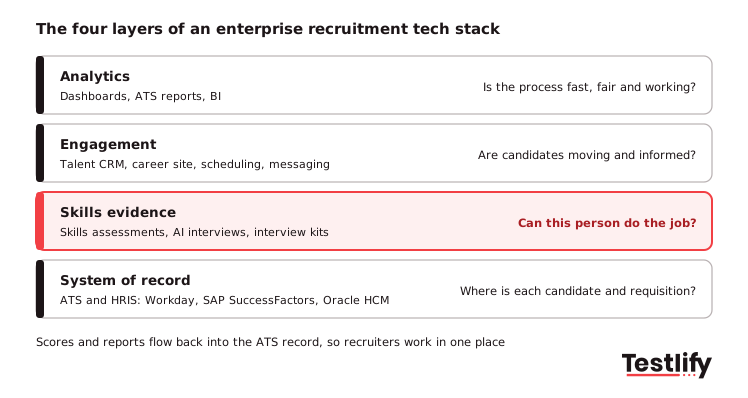
The layers only work if data flows between them. Scores and reports should land in the ATS candidate record automatically, so recruiters and hiring managers never export a CSV to compare people. Gartner's 2026 talent acquisition trends point the same way: high-volume recruiting is going AI-first, and AI is reshaping how organizations assess talent (Gartner, October 2025).
How do you choose enterprise recruitment software?
Choosing enterprise recruitment software starts with the gap you need to close, then tests every option on integration, security, scale, candidate experience and compliance. Most enterprises already have an ATS, so the decision is often which layer to add on top, not which system to replace.
Ask every vendor these questions on a real role:
- Integration. Does it sync two ways with our ATS and HRIS, and how long does setup take?
- Security. Which certifications does it hold (for example ISO 27001 and SOC 2 Type II), and does it support SSO, role-based access and data residency in our regions?
- Scale. Can it handle our peak volume, many business units and many languages without separate instances?
- Evidence. Can a hiring manager see the answer or result behind every score?
- Integrity. How does it detect cheating, impersonation and AI-assisted answers in remote assessments?
- Compliance. Has the AI been bias audited, and can we share the results with candidates?
- Candidate experience. Is it mobile friendly, and how long does the candidate side take?
Compliance deserves extra weight. Under New York City's Local Law 144, an automated employment decision tool needs a bias audit within one year before use, a public summary of the results and notice to candidates. In the EU, Annex III of the AI Act lists AI used for the recruitment or selection of people as high-risk.
Key takeaway: At enterprise scale, the best software is the one that fits your stack and holds every region to the same standard. Pick for integration, evidence and compliance first. Features lists are the easy part.
Which enterprise recruitment metrics should you track?
Enterprise recruitment metrics should cover speed, quality, cost, fairness and experience, reported the same way in every region. Five to seven shared metrics beat a dashboard of forty that nobody reads.
Metric | What it tells you |
|---|---|
Time to hire | Days from application to accepted offer |
Time to shortlist | How fast screening produces interview-ready candidates |
Quality of hire | Performance and retention of new hires after 6 to 12 months |
Interview-to-offer ratio | Whether screening sends the right people to interviews |
Offer acceptance rate | How competitive and fast your offers are |
Pass rates by group | Whether any step affects some groups more than others |
Candidate satisfaction | How candidates rate the process, including those rejected |
For definitions and benchmarks, see enterprise hiring metrics.
How does Testlify support enterprise recruitment?
Testlify supports enterprise recruitment as the skills evidence layer that sits next to your ATS. It builds role-specific assessments, runs AI interviews, scores every candidate on the same criteria and sends results back to your ATS. Here is how that works in practice:
- One library for every role. The 3,500+ tests in the Testlify test library cover tech and non-tech roles, with 25+ question types and an AI test builder that creates an assessment from a job description.
- Structured AI interviews. Video, voice and chat AI interviews ask role-based questions and score every answer, alongside one-way video and live coding interviews.
- Fits the stack. Testlify offers 100+ ATS and HRIS integrations, including Workday, SAP SuccessFactors, Oracle HCM and Greenhouse, with two-way sync plus a REST API and webhooks.
- Integrity at volume. 20+ anti-cheating and proctoring checks include AI assistance detection, face detection and copy-paste tracking.
- Global and governed. Assessments in 15+ languages, role-based access, SAML SSO on enterprise plans, regional data residency, ISO 27001, SOC 2 Type II and GDPR.
- Audited. Testlify's matching model completed a third-party bias audit under Local Law 144 on June 16, 2023.
Enterprise teams get the most from Testlify when they start with one high-volume role family and connect it to their existing ATS. You can also try the platform first with the 7-day free trial, no credit card needed. To see how it would fit your existing hiring workflows, book a demo with Testlify.
Frequently asked questions (FAQs)

Related resources
View all
Enterprise hiring
Return migration: Hiring strategies targeting professionals reshoring to Asia

Enterprise hiring
Culture-first hiring: Why engagement is becoming the #1 hiring criterion for U.S. firms

Enterprise hiring
Conversational AI audio interviews for call center hiring: Faster, fairer, and more scalable recruitment

Enterprise hiring
How enterprises can reduce candidate drop-off with smarter assessments

Enterprise hiring
How are chat simulations shaping the future of enterprise hiring?

Enterprise hiring
How to craft effective coding skills tests for tech recruitment?
Get started.
Hire on proof, not resumes.
Run your first skills-based assessment free — no credit card required.