
AI vs human-led hiring assessments: Which is better?
Check out what is AI vs. human-led hiring assessments to find the best approach for your recruitment strategy and improve hiring decisions.

Recruitment is evolving rapidly, and new technologies are shaping hiring processes. One of the most talked-about trends in HR is the integration of Artificial Intelligence (AI) into hiring assessments. But how does this compare to traditional human-led assessments? Which one is better for your organization?
In this post, we’ll examine both sides of the equation, considering the advantages and disadvantages of AI vs. human-administered hiring tests, and assist you in making an educated choice for your HR approach.
 ChatGPT
 Gemini
 Claude
 Grok
Grok Perplexity
What is AI in hiring?
AI is a term for applying algorithms and machine learning to automate part of the recruitment process. It can be from screening resumes to conducting chat-based interviews, analyzing candidates’ answers, and even estimating their possible performance.
Computer algorithms can sift through hundreds of applications, recognize patterns, and even rank applicants against how well they fit the job post. HR professionals use such tools more frequently because they aim to automate hiring processes and minimize the influence of personal biases.

What is human-led hiring?
Human-guided hiring tests include HR experts, managers, and other human assessors conducting interviews, reading resumes, and evaluating candidates’ abilities and cultural adaptation. It is a human-dependent process based on judgment and intuition, providing a more customized method for choosing the most suitable candidate.
Human-managed hiring evaluations usually include face-to-face interviews, skill evaluations, and behavior tests, during which the recruiting team assesses the candidate’s experience, qualifications, and interpersonal skills.
The pros and cons of AI-led hiring assessments
AI-based hiring tests are revolutionizing recruitment through automation, efficiency, and data-driven decisions. Though these systems have numerous advantages, they also have some challenges, especially regarding bias, emotional intelligence, and privacy issues. Let’s delve deeper into the strengths and weaknesses of applying AI in hiring.
Pros of AI-led hiring assessments
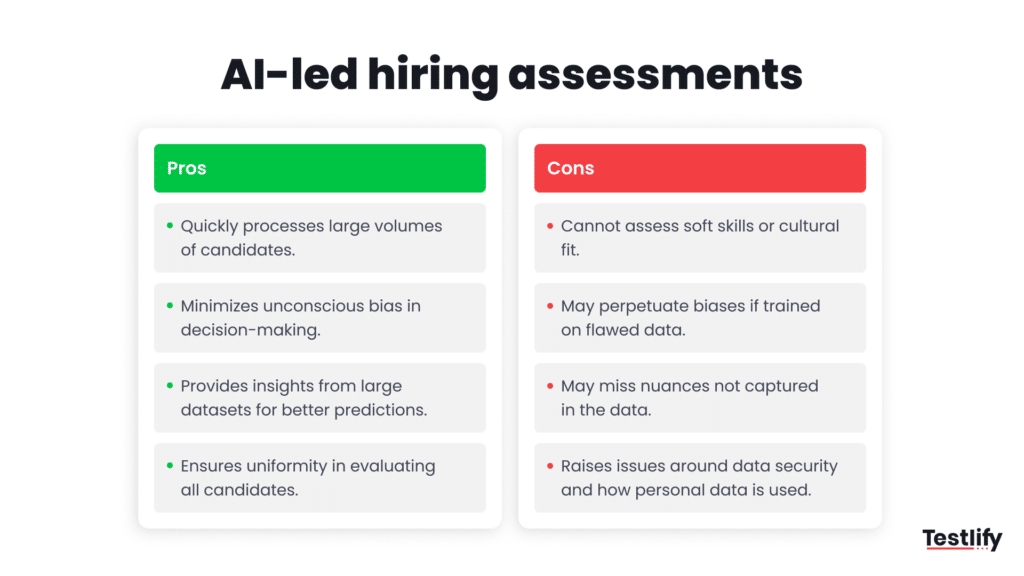
- Efficiency and speed
One of the major benefits of AI recruitment is that it is quick. AI can scan thousands of applications and resumes in minutes compared to how long it would take a human to go through them. This leaves HR teams free to use their time and energy to screen the top candidates instead of sorting through irrelevant applications.
- Reduced bias
AI can reduce unconscious bias that may be present in human assessors. For example, AI systems can disregard demographic information like age, gender, or race and only consider the candidate’s skills, qualifications, and experience. This can result in a more diverse and inclusive recruitment process.
- Data-driven decision making
AI can analyze huge data, giving invisible insights to human recruiters. For instance, AI can evaluate the behavioral patterns of candidates, forecast how they would perform as per the role, and suggest the best talent based on historical hiring process data.
- Consistency
AI evaluations will be able to make sure each candidate is examined based on the same standards, providing a level playing field. This consistency keeps favoritism or human miscalculation at bay and ensures that each candidate is fairly judged.
Cons of AI-led hiring assessments
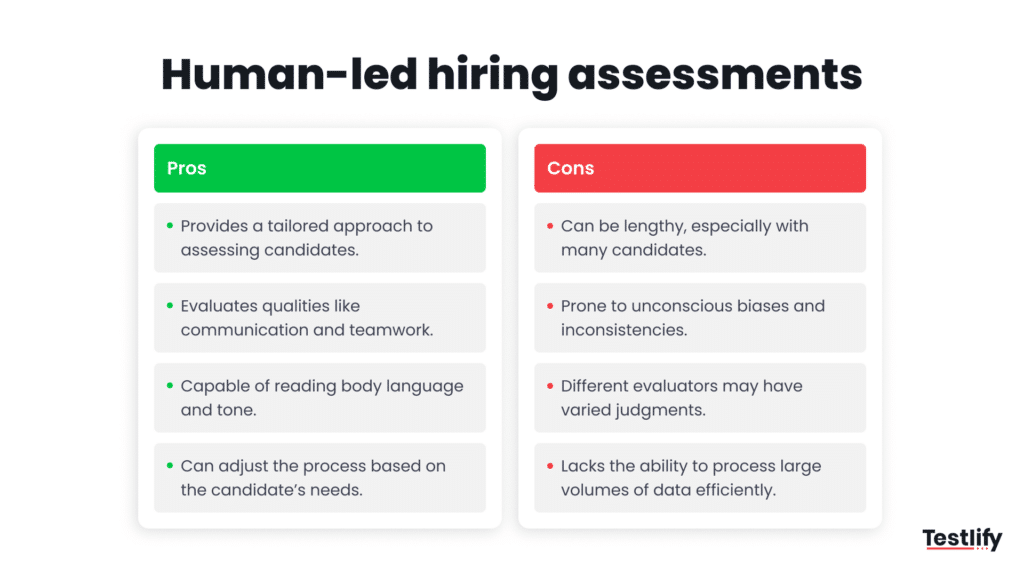
- Lack of human touch
Although AI is extremely efficient, it cannot replicate the emotional intelligence and depth of understanding human assessors provide. AI is not likely to be able to completely gauge a candidate’s cultural alignment, soft skills, or personality attributes, which are highly significant in measuring long-term performance at an organization.
- Potential for algorithmic bias
While AI can minimize human prejudice, it is not without its prejudice. If the data used to train AI systems is biased, the system may unwittingly reinforce them. For instance, if an AI system is trained on data provided by a company with more male workers, the AI system will tend to give preference to male applicants.
- Over-reliance on data
AI-based evaluations depend to a great extent on data, and if the data is incomplete or inaccurate, then the evaluation may be misleading. Human experience and intuition can sometimes reveal matters not apparent in a data-driven approach, particularly when judging individuals with out-of-the-box backgrounds or special talents.
- Privacy concerns
The application of AI in recruitment tests usually includes the gathering and processing of large volumes of personal data. This is a source of concern regarding privacy and data protection. Applicants might be uneasy providing personal details or be concerned about the use of their data.
Pros and cons of human-led hiring assessments
Human-involvement hiring tests depend on the experience and judgment of HR experts, providing a customized recruitment method. Although this approach provides a deeper insight into candidates, it has limitations, including subjectivity and lengthy processes. Let us look at the advantages and disadvantages of human-involvement hiring decisions.
Pros of human-led hiring assessments
- Personalized evaluation
Human-led screening offers a personalized recruitment method. A hiring manager can pose additional questions, explore a candidate’s history in more depth, and determine their personality and cultural match through interactions that AI cannot truly duplicate.
- Soft skills assessment
Human interviewers are adept at evaluating soft skills like communication, problem-solving, and collaboration. These skills are usually important determinants of a candidate’s success in a position, and human interviewers are well-suited to gauge these attributes using interviews, group discussions, or practical evaluations.
- Emotional intelligence
Humans can interpret body language, tone, and other non-verbal indicators, which are significant in gauging a candidate’s genuine feelings and motives. Emotional intelligence determines how well a candidate can integrate into a team or perform under stress.
- Flexibility and adaptability
Human recruiters are accommodating and can bend the rules to the particular requirements of an individual candidate. If a candidate has trouble with a specific assessment or an interview, a human recruiter can tailor the process to level the playing field for the candidate.
Cons of human-led hiring assessments
- Time-consuming
Human-conducted hiring evaluations may take time, especially where there are numerous candidates to sift through. Having to carry out several rounds of interviews, go through resumes, and verify references may quickly become burdensome for HR staff, especially in the case of high-volume hiring.
- Bias and subjectivity
Even with attempts to be neutral, human recruiters are bound to make unconscious biases. Personal preferences, cultural variations, or a candidate’s appearance can affect hiring. Subjectivity here can result in biased judgments and losing out on diverse talent.
- Inconsistent decision making
Human recruiters can also judge candidates differently depending on their experiences or mood. This inconsistency can pose difficulties in making equitable and consistent decisions among many candidates.
- Limited data analysis
Human recruiters use intuition and experience, which can be helpful but is not always supported by data. Lacking the capability to review enormous amounts of information, human-driven evaluations can overlook significant patterns that might contribute to improved hiring.
AI vs. human-led hiring assessments: The key differences
In comparing AI and human-led hiring tests, there are major differences in speed, objectivity, and customization. AI is good at rapidly processing large amounts of data, whereas human tests provide more insight into personality and fit. Let’s outline the major differences between these two methods to determine which is most suitable for your organization.
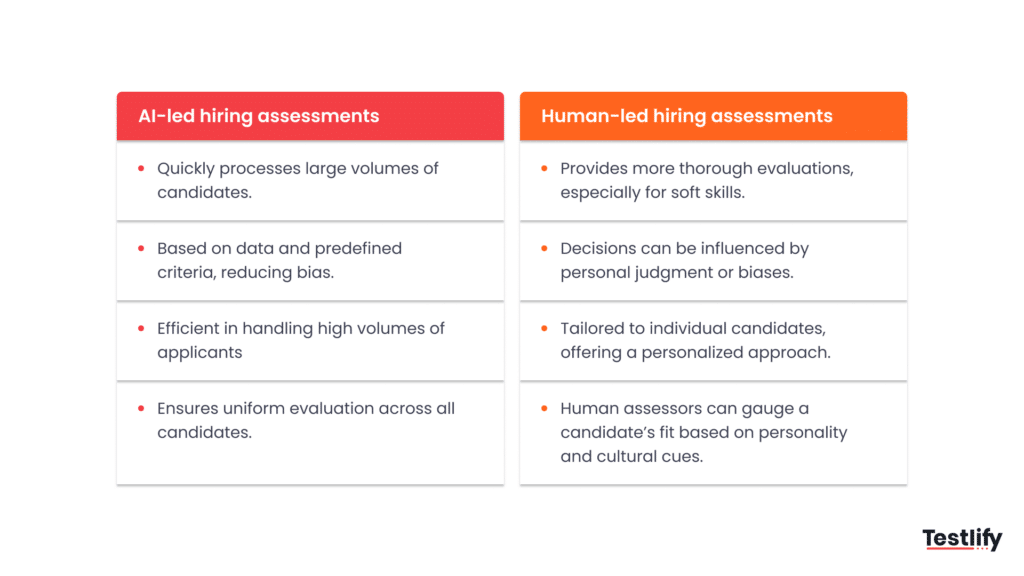
1. Speed vs. depth
AI tests are superior in terms of speed, and they are perfect for the fast screening of a large number of candidates. However, human-administered tests are more in-depth, where hiring managers can inquire about candidates’ personalities, soft skills, and cultural adaptation. AI is the way to go if you must hire many people quickly. Human-administered tests would be better if you search for an exceptionally specialized candidate or long-term match.
2. Objectivity vs. subjectivity
AI is more objective based on data-driven metrics and pre-defined criteria. It can eliminate human biases in some cases. However, human-led evaluation offers a more subjective approach, which can be useful when assessing qualities such as creativity, communication, and emotional intelligence that AI may overlook.
3. Scalability vs. customization
AI is extremely scalable, making it a great fit for businesses that must screen many candidates quickly. Human-led testing, however, is extremely customizable. It enables a customized evaluation process that considers each candidate’s subtleties, which can result in more effective long-term hires.
Combining AI and human judgment: The best of both worlds
Although both human-led and AI-driven hiring assessments are good in their respective ways, there is a case for merging the two processes. AI is well-suited for routine tasks, including resume screening and preliminary candidate review, leaving HR teams to take care of the more intricate part of the hiring process, such as conducting interviews and evaluating cultural alignment.
By using AI to automate the first phase of the hiring process, HR professionals can save time and money while still enjoying the benefits of human judgment in the later decision-making phases. This blended strategy takes advantage of AI and human judges, resulting in better and more streamlined hiring decisions.
Conclusion: What’s the right choice for your organization?
So, is AI better than human-led hiring tests? The answer isn’t quite so straightforward as one being superior to the other. Both methods have advantages, and the correct choice is based on your company’s requirements.
If speed and efficiency, particularly for high-volume recruitment, are your priority, AI may be the route. But if you’re recruiting for highly specialized positions or to determine cultural fit, human-conducted assessments offer the individualized attention required to make the right decision.
The takeaway is that AI and human judgment do not have to conflict. Together, they can support one another, which results in more intelligent, effective hiring choices. By discovering the proper equilibrium between technology and human know-how, your HR staff can create a more efficient, equitable, and customized hiring process that benefits the company and candidates.

Content Writer
Yashika Khandelwal is a Content Writer with 3+ years of experience creating research-backed content on hiring, talent assessment, and HR technology. She is a registered Organizational Psychologist and subject matter expert who combines behavioral science with practical recruitment insights to produce accurate, evidence-based content.
LinkedInRelated resources
View all
HR & recruitment
What makes a hiring test legally compliant?

HR & recruitment
30 Onboarding Email Templates: Pre-Boarding to 90-Day (2026)

HR & recruitment
How long should the hiring process take?

HR & recruitment
10 free job offer email templates

HR & recruitment
How Dedicated Development Teams Improve Project Delivery and Efficiency

HR & recruitment
The Science of Persuasive Communication: Why HR Leaders Should Master Academic Writing
Get started.
Hire on proof, not resumes.
Run your first skills-based assessment free — no credit card required.