
AI for performance reviews: what it does and where it falls short
AI for performance reviews drafts summaries and flags bias, but it cannot replace manager judgment. See the uses, risks and a rollout plan.

Every review season, managers face a blank page and a pile of scattered notes. AI for performance reviews offers a faster start: it drafts summaries, condenses feedback and flags rating patterns.
The catch is that AI only prepares material, so a manager still edits it and owns the final call. Here is what the tools do well, where they fall short and how to pilot them safely.
TL;DR:
- AI for performance reviews drafts summaries from notes and peer feedback, turns raw data into a first version of a review, and flags rating patterns a manager might miss across a team.
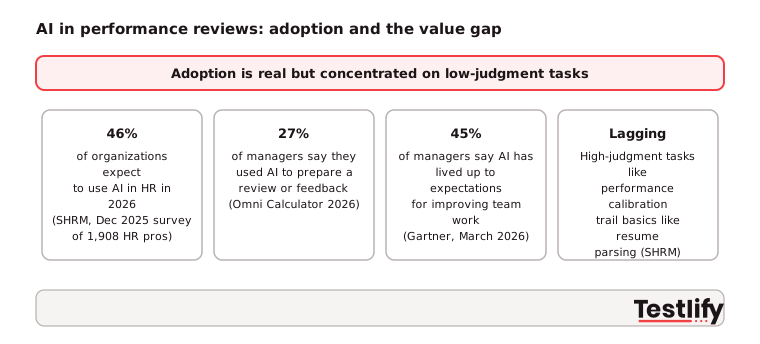
- Adoption is real but uneven: SHRM's State of AI in HR 2026 research, fielded in December 2025 among 1,908 HR professionals, found 46% of organizations expect to use AI in HR in 2026, with high-judgment tasks like performance calibration lagging well behind basics like resume parsing.
- Managers are already using it informally. One 2026 survey found 27% of managers said they had used AI to prepare a review or feedback, and Gartner's own HR research puts manager experimentation with AI even higher.
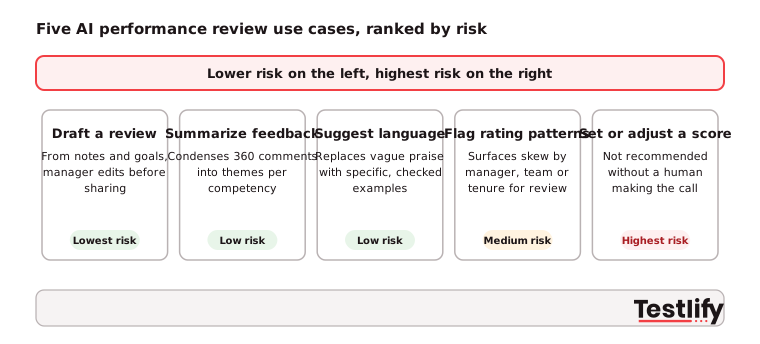
- The two safest uses today are drafting and bias-pattern detection. The riskiest use is letting AI set or adjust a rating without a person checking it first.
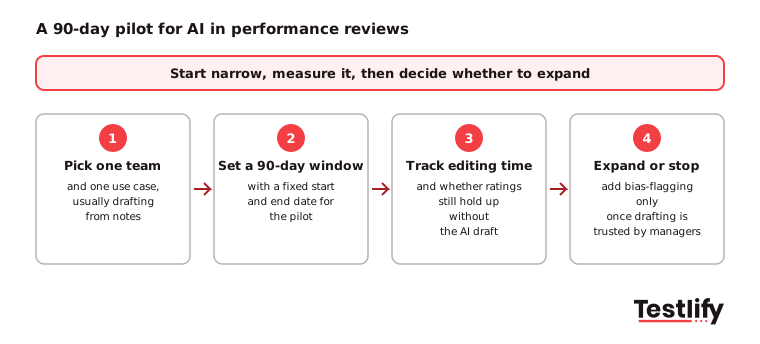
- A rollout works best in a narrow pilot: pick one team, one use case (usually drafting), set a 90-day review, and keep a person accountable for every final score.
- Testlify does not run performance reviews, but the same before-you-hire assessment data AI performance tools lean on for "signal" starts with a fair, structured skills test.
 ChatGPT
 Gemini
 Claude
 Grok
 Perplexity
What does AI for performance reviews actually do?
AI for performance reviews takes inputs a manager already has, such as self-assessments, peer feedback, 1:1 notes and goal-tracking data, and turns them into a structured first draft.
Most tools built for this job do three things. They summarize long feedback threads into a few sentences per competency. They suggest specific, job-related language instead of vague praise. They flag statistical patterns, such as one manager rating everyone a 4 out of 5 or a team's ratings skewing by tenure or location.
None of this is new in concept. Performance reviews have used structured forms and rating scales for decades.
What is new is the speed: a draft that took a manager 45 minutes to write from scratch now takes 10 minutes to review and edit, according to vendors selling into this space, though independent, audited time studies are still thin.

How many companies actually use AI in performance reviews?
Adoption is higher in pockets than it looks at the aggregate level. SHRM's State of AI in HR 2026 research, fielded in December 2025 among 1,908 HR professionals, found that 46% of organizations expect to use AI in HR in 2026.
Secondary coverage of the same report notes that usage still concentrates on lower-judgment tasks, chatbots and resume parsing. High-judgment work like performance calibration and succession planning lags well behind.
Manager-level use looks further ahead of formal policy. A 2026 Omni Calculator survey found 27% of managers admitted to using AI to prepare a performance review or feedback.
Gartner's own HR research found manager experimentation with AI running even higher in a separate 2025 survey, well ahead of most companies' written AI-use policies. That gap between official policy and actual manager behavior is one reason HR teams are writing AI-use guidelines for reviews now rather than waiting for a bigger rollout.
Use case | What the AI does | Who stays accountable |
|---|---|---|
Draft a review from notes | Turns 1:1 notes, goals and peer quotes into a first-draft narrative | Manager edits and signs off before it is shared |
Summarize 360 feedback | Condenses many short comments into themes per competency | Manager checks the summary against the raw comments |
Flag rating patterns | Surfaces a manager who rates everyone near the same score, or score gaps by team, tenure or location | HR or a calibration committee reviews the flag and decides if action is needed |
Suggest specific language | Replaces vague praise ("great team player") with examples tied to goals | Manager confirms the example actually happened |
Set or adjust a score | Not recommended without human review; legally and practically risky | A person must make and own the final rating |
Pro tip: start with the lowest-risk use case first. Drafting and summarizing save time without touching the actual decision; pattern-flagging for bias comes next, once managers trust the drafts. Setting or changing scores with AI is the last step to attempt, if ever.
Where does AI help the most in a review cycle?
AI for performance reviews helps the most in two places: drafting and consistency checking. Drafting saves the most manager time because writing clear, specific feedback from scratch is slow, and a first draft built from real notes is easier to edit than a blank page.
Consistency checking catches what one manager cannot see alone: whether their ratings across a team cluster oddly compared to the rest of the company, or whether language and scores differ by who the employee is rather than what they did.
Key takeaway: the strongest AI use cases in performance management are the ones that leave the decision with a person and only speed up the writing and the checking around it.
What are the risks of using AI in performance reviews?
The main risks are accuracy, bias, and accountability. Accuracy risk shows up when an AI summary smooths over disagreement, for example compressing three negative peer comments and two positive ones into a neutral-sounding paragraph that hides a real problem.
Bias risk shows up when a tool's training data reflects past ratings that were already uneven by team, tenure or demographic group. The AI's "pattern detection" then repeats that pattern instead of correcting it.
Accountability risk is the legal one. Where pay transparency or anti-discrimination rules apply, an employer must be able to explain why someone got their rating. "The AI suggested it" is not an explanation a regulator or a court will accept.
Gartner's March 2026 HR survey found only 45% of managers said AI had lived up to their expectations for improving their team's work, which is a useful reality check against vendor marketing that assumes managers trust these tools by default.
How should a company roll out AI for performance reviews?
A rollout works best as a narrow pilot rather than a company-wide switch. Start with one team and one use case, usually drafting from notes, since it has the clearest time savings and the lowest risk.
Set a fixed pilot length, 90 days is common, and track two things: how much editing time the draft actually saves, and whether final ratings in the pilot team still make sense to a calibration committee once the AI-assisted drafts are removed from the picture.
Expand to bias-pattern flagging only after managers trust the drafting tool. Keep a named person, usually an HR business partner or a calibration committee, accountable for every final score the system touches.
Build a 90-day review that still works without AI before adding AI on top of it. A messy review process gets faster and messier with AI; a clear one gets faster and stays clear.
Does AI replace the manager in a performance review?
No. Every credible use case keeps a person as the final decision maker.
The research reviewed here, from SHRM, Gartner and Omni Calculator, measures AI as an assistant that drafts, summarizes and flags, not as a tool that scores an employee on its own. An employer that lets AI set a final rating without a human check takes on legal and trust risk the time savings do not justify.
Review quality still starts earlier than the review itself: a hiring process built on a fair, job-related assessment gives managers clearer goals and a shared bar to measure against all year. See how a structured skills assessment sets that bar before day one.
How can Testlify support better hiring data for review season?
Testlify is a skills assessment platform for hiring, not a performance review tool. Its 3,500+ validated tests give recruiters structured, job-related evidence before an offer. That same habit of using clear, explainable evidence instead of gut feel is what makes reviews easier to defend later.
Ready to build hiring and assessment data your managers can rely on when review season starts? Book a demo to see how Testlify works.
Frequently asked questions (FAQs)

Co-Founder and CTO
Jiten Modi is Testlify's CTO and leads a 50-person engineering organization. He writes on technical hiring, evaluating developers with real-world assessments, and building engineering teams.
LinkedInRelated resources
View all
HR tools
Top talent acquisition tools that integrate with existing HR systems
HR tools
10 top-rated recruitment automation tools for 2026
HR tools
12 best online interview platforms for hiring teams in 2026
HR tools
What is AI proctoring and why it matters in certification
HR tools
Prioritization matrix: What it is & how to use it effectively
HR tools
What is timesheet management? Benefits and best practices
Get started.
Hire on proof, not resumes.
Run your first skills-based assessment free — no credit card required.