
Testlify vs Weirdly: A detailed comparison
Discover the perfect solution for evaluating your candidates’ skills with Testlify. Dive into our comprehensive Testlify vs Weirdly…
Choosing an assessment platform is really a bet on one question: what evidence do you trust enough to move a candidate forward? Weirdly bets on values and soft-skill alignment, scored fast and at volume. Testlify bets on measuring the work itself, across a wide test library, with proctoring and reporting attached. Both are defensible bets. They just solve different hiring problems.
Here is the short answer. Weirdly fits teams whose bottleneck is ranking thousands of applicants by cultural alignment for frontline, retail, or graduate intakes. Testlify fits teams who need to verify role-specific skills across technical and non-technical roles, with anti-cheating controls and reporting a hiring manager can act on the same day.
 ChatGPT
 Gemini
 Claude
 Grok
Grok Perplexity
TL;DR: Testlify vs Weirdly at a glance
- Weirdly screens for values and soft-skill fit using customizable quizzes and video intros, and ranks applicants against a culture profile you define.
- Testlify screens for demonstrated ability across role-specific, coding, cognitive, psychometric, and software-skills tests, with 45+ programming languages supported.
- Weirdly does not publish pricing. Testlify publishes plan pricing openly, including a free tier, so you can size the spend before a sales call.
- Anti-cheating is the widest gap: Testlify ships session recording, snapshot capture, IP tracking, and question randomization. Weirdly does not offer an equivalent proctoring layer.
- If you need both culture signal and skill proof, Testlify covers behavioral and personality testing alongside hard-skill validation, which is why most teams evaluating the two end up choosing on breadth rather than on price.

What is the difference between Testlify and Weirdly?
The difference is what each platform treats as proof. Weirdly treats alignment with your stated values as the primary screening signal and ranks candidates on it. Testlify treats demonstrated capability as the primary signal, then adds behavioral and cognitive evidence around it. One narrows a large applicant pool by fit; the other verifies whether shortlisted people can do the job.
That distinction drives everything downstream. A values quiz can be answered honestly by someone who cannot perform the role, and a coding test can be passed by someone who will clash with the team. The practical question is not which signal is better in the abstract. It is which signal is currently failing you.
Why does your screening method matter now?
Because the thing you are screening for is moving. Employers expect 39% of workers' core skills to change by 2030, according to the World Economic Forum's Future of Jobs Report 2025. A screening method anchored to a static profile ages badly against that rate of change.
The cost of getting it wrong is well documented. Skills gaps are now the single biggest barrier to business transformation, cited by 63% of employers. On the hiring side, SHRM's 2025 talent research found 69% of organizations still struggling to fill roles. And when a hire does not work out, Gallup puts the replacement cost at one-half to two times the employee's annual salary.
Adoption of skills-first methods is real but uneven: SHRM reports 34% of organizations often or almost always use skills-first strategies, while 86% of HR professionals hit hurdles putting them into practice. Tooling is a large part of that gap. A platform that only measures one kind of signal quietly caps how far skills-first hiring can go inside your process.
This is the reasoning behind the Testlify Multi-Signal Talent Evaluation Model: combine multiple role-relevant signals, including assessments, interviews, simulations, references, and reviewer feedback, rather than resting a decision on a resume, a single test, or one interviewer's read. One signal is fragile. Several pointing the same direction is a decision you can defend.
Feature-wise comparison for Testlify vs Weirdly
The table below sets the two platforms side by side across test library, assessment building, candidate experience, anti-cheating, reporting, enterprise features, and support. Read it for shape rather than for a score: the pattern of gaps tells you which platform was designed for which job.
Features | Testlify | Weirdly |
|---|---|---|
Test Library | ||
Role-specific tests | ✓ | ✗ |
Cognitive ability tests | ✓ | ✗ |
Programming Tests | ✓ | ✗ |
No. of programming languages supported | 45+ | ✗ |
Situational judgment tests | ✓ | ✗ |
Typing test | ✓ | ✗ |
Software skills tests | ✓ | ✗ |
Non-technical tests | ✓ | ✓ |
Psychometric tests | ✓ | ✗ |
Personality tests | ✓ | ✗ |
Motivation test | ✓ | ✗ |
Assessment templates | ✓ | - |
Custom assessments creation | ✓ | - |
Test recommendations for different job roles | ✓ | ✗ |
Coding tests | ✓ | ✗ |
Assessments | ||
Custom assessment builder | ✓ | ✗ |
Custom coding questions | ✓ | ✗ |
Multiple-choice questions | ✓ | - |
Descriptive questions | ✓ | - |
Video interview questions | ✓ | ✗ |
Assessments curated by I/O psychologists | ✓ | - |
Google doc | ✓ | ✗ |
Google sheets | ✓ | ✗ |
Google slides | ✓ | ✗ |
Audio questions | ✓ | ✗ |
Qualifier questions | ✓ | ✗ |
File upload questions | ✓ | ✗ |
Quality check | Extensive process incl. peer reviews, sample testing, review by psychometrician & more | - |
Video interview questions | ||
One-way video interview | ✓ | ✓ |
Custom video questions creation | ✓ | ✓ |
Candidate's recording attempts per question | ✓ | - |
Live video interview | ✗ | - |
Candidate experience | ||
Fully customizable email templates | ✓ | ✗ |
Custom invitation and rejection email | ✓ | ✓ |
Mobile-friendly | ✓ | ✓ |
Candidate support | ✓ | ✓ |
Instructions before assessment | ✓ | ✓ |
Average assessment length | 40-60 minutes | ✗ |
Anti-cheating features | ||
Session recording | ✓ | ✗ |
Snapshot capturing | ✓ | ✗ |
Mouse tracking | ✓ | ✗ |
Copy-paste disabled | ✓ | ✗ |
Microphone and camera access | ✓ | ✗ |
Location access | ✓ | ✗ |
IP address tracking | ✓ | ✗ |
Randomization of question sequence | ✓ | ✗ |
Time limit on tests | Yes, typically 10 minutes | ✓ |
Reporting and analytics | ||
Detailed reports | ✓ | - |
Easy to share reports and scorecards | ✓ | ✗ |
Exportable/downloadable reports | ✓ | - |
Recruiting analytics | ✓ | ✗ |
Candidate benchmarking | ✓ | ✗ |
Completion rate and response insights | ✓ | ✗ |
Enterprise friendly | ||
White label feature | ✓ | ✗ |
Custom branding | ✓ | ✗ |
ATS integration | ✓ | ✓ |
User, role, and access management | ✓ | ✓ |
Bulk candidate invite | ✓ | ✗ |
Share public link invite to candidates | ✓ | ✗ |
Candidate pipeline management | ✓ | ✗ |
Internationalization | ✓ | ✗ |
Campus hiring support | ✓ | ✗ |
Dedicated account manager | ✓ | - |
GDPR compliant | ✓ | - |
Multilingual abilities | ✓ | ✗ |
Customer support | ||
24/7 support | ✓ | ✓ |
On-call support | ✓ | ✗ |
Email support | ✓ | ✓ |
Product demo | ✓ | - |
Training & onboarding tour | ✓ | ✗ |
How does Weirdly approach candidate screening?
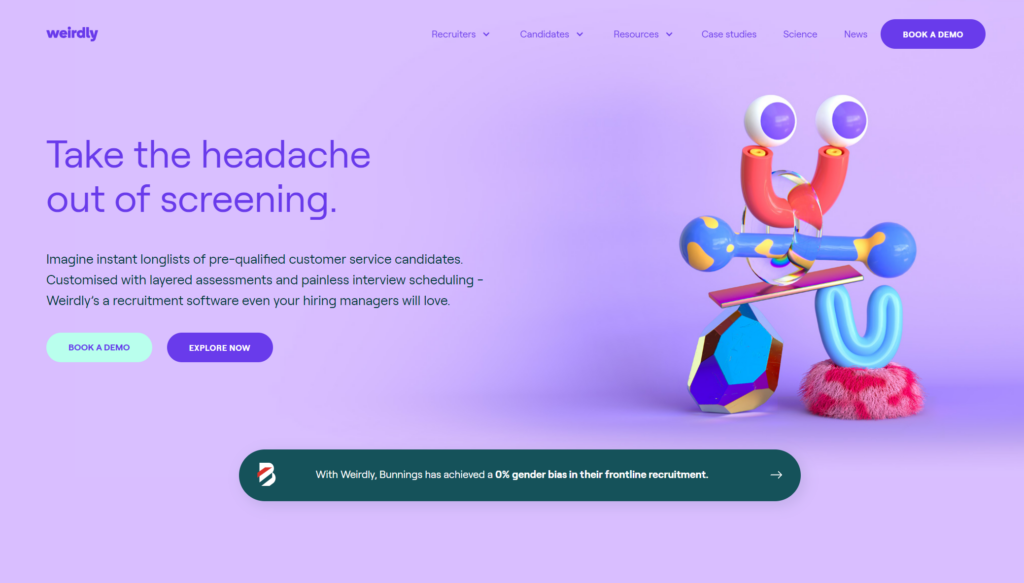
Weirdly is recruitment software built around values-based pre-employment quizzes for high-volume hiring. You define what a strong cultural match looks like, and the platform ranks applicants against that profile automatically. It runs either as part of Weirdly's end-to-end hiring platform or as a standalone screening layer bolted onto an existing process.
Its assessment set covers customizable soft-skill and values quizzes, video intros, and graduate capability assessments. Because ranking happens automatically on submission, a recruiter working a 3,000-application intake can open a shortlist instead of a queue. That is a real advantage when the volume is the problem.
The trade-off is scope. Weirdly does not offer coding tests, cognitive ability tests, situational judgment tests, typing tests, software skills tests, psychometric tests, or motivation tests. It also does not publish pricing, and it does not ship the proctoring controls that regulated or remote-first hiring teams increasingly ask for. For a values-led frontline intake, none of that may matter. For a mixed hiring plan spanning engineering, finance, and support, it will.
How does Testlify approach candidate screening?
Testlify starts from the role rather than from the culture profile. You pick or build assessments mapped to the competencies the job actually needs, then combine them: role-specific tests, coding tests across 45+ programming languages, cognitive ability, situational judgment, personality, motivation, language, and software-skills tests, plus one-way video questions and custom questions of your own.
Results arrive as candidate report cards broken down per skill, not as a single blended number, so a hiring manager can see that someone is strong on data handling and weak on written communication and decide what that means for the role. Reviewer scoring, benchmarking, and exports sit on top, and results sync into the ATS through integrations.
Assessment integrity is the other structural difference. Session recording, snapshot capture, mouse tracking, copy-paste disabling, camera and microphone access, location and IP tracking, and question randomization are all available, which matters when a test result has to survive scrutiny from a hiring manager or an auditor.
Testlify also covers the culture ground Weirdly specializes in, through personality and behavioral assessments, so a values signal does not have to be given up to gain skill validation. Browse what is available in the Testlify test library before deciding how much of your current screening stack it would replace.
How do Testlify and Weirdly compare on pricing?
Pricing is where the two diverge most visibly, and it is the question buyers raise first.
Weirdly pricing
Weirdly does not publish pricing. Quotes are assembled around integrations, hiring volume, and customization, so you need a sales conversation before you know your number. For a procurement process that needs a budget figure early, that is friction worth planning around.
Testlify pricing
Testlify publishes plan pricing openly, including a free tier, with monthly and annual billing on every plan. You can size the cost against your expected assessment volume before speaking to anyone. Current plans and limits are on the Testlify pricing page.
Pro Tip: Price the two on cost per completed assessment, not on the sticker figure. A cheaper plan that caps assessments or charges per additional role gets expensive fast during a peak intake, and that is exactly when a hiring freeze on your assessment budget hurts most.
Which platform should you choose?
Match the platform to the failure you are actually seeing in your funnel.
Choose Weirdly when applicant volume is the constraint and the roles are broadly similar. High-volume retail, hospitality, contact centre, and graduate intakes fit this shape well: hundreds or thousands of applicants for near-identical roles, where culture and soft-skill alignment genuinely is the differentiator and hard-skill variance is low.
Choose Testlify when the roles differ from each other and the risk sits in capability rather than in fit. A talent team hiring backend engineers, financial analysts, and customer support leads in the same quarter needs different evidence for each, plus proctoring that holds up for remote candidates and reporting that lets three different hiring managers compare notes on a common scale.
A worked example makes the split concrete. A grocery chain filling 400 seasonal store roles and 12 supply-chain analyst roles in the same quarter has two distinct problems in one hiring plan. The 400 store roles are a ranking problem: a values quiz sorts the pool quickly and cheaply, and the cost of a marginal mis-sort is low. The 12 analyst roles are a verification problem: a wrong hire costs months of ramp and, at Gallup's replacement figure, a meaningful share of that person's annual salary. Running both through a single values-based screen leaves the analyst roles unverified. Running both through a single skills-heavy screen adds friction the store intake does not need. The decision rule is per-role, not per-vendor, and any platform that covers both shapes reduces the number of tools your team has to keep current.
If Weirdly is the incumbent and you are testing a move, run one role in parallel rather than migrating everything at once. Pick a role where you already know what good looks like, assess the next intake on both systems, and compare the shortlists against how those hires actually perform at 90 days. That is the Testlify Quality-of-Hire Learning Model in practice: connect pre-hire evidence to post-hire outcomes, then keep the signals that predicted success. For a wider view of the market before committing, the roundup of Weirdly alternatives covers the field beyond these two, and the collected skills-based hiring statistics are useful for building an internal business case.
Hire on evidence, not on a hunch
See how Testlify handles your actual roles before you commit to anything. Start free with the full test library, or walk through your hiring plan with the team and get a build recommendation for your first three roles.
Key Takeaways
- The two platforms answer different questions. Weirdly answers "who fits our culture?" and Testlify answers "who can do this job?". Naming which question your funnel is currently failing on is the whole decision, and it takes ten minutes with your last two hiring post-mortems. Teams that skip this step usually buy on feature count and end up with a tool aimed at a problem they did not have.
- Breadth of test library is the widest functional gap. Weirdly does not offer coding, cognitive, situational judgment, typing, software-skills, psychometric, or motivation tests. If your hiring plan spans technical and non-technical roles, that gap forces a second tool, and running two screening systems means two candidate experiences and two sets of data that never quite reconcile.
- Anti-cheating is not a nice-to-have for remote hiring. Session recording, snapshot capture, IP tracking, and question randomization are what let a remote test result survive a hiring manager's scepticism. Without that layer, results get quietly discounted in the debrief, which wastes both the candidate's time and yours.
- Published pricing shortens the buying cycle. Testlify's plans are public, including a free tier; Weirdly quotes on request. Price on cost per completed assessment rather than headline plan cost, because per-assessment caps are what actually bite during a peak intake.
- Culture signal and skill proof are not mutually exclusive. Personality and behavioral assessments give you the values read alongside hard-skill validation, so choosing skills-first does not mean giving up on fit. Treat culture as one signal among several rather than as the filter that runs first and eliminates most of the pool.
- Decide per role, not per vendor. A single quarter can contain a 400-person volume intake and a 12-person specialist search, and those need different evidence. Map the evidence each role needs first, then check which platform covers the most of that map without a second subscription.
- Validate the switch on one role before migrating. Run the next intake through both systems, then compare the shortlists against 90-day performance. Real outcome data on one role beats a feature matrix argued in a meeting, and it gives you the internal evidence to move the rest of the hiring plan across.
FAQs
Related resources
View all
Competitor Comparisons
Testlify vs Toggl Hire: A detailed comparison
Competitor Comparisons
Testlify vs Searchlight: A detailed comparison
Competitor Comparisons
Testlify vs SalesDrive: A detailed comparison
Competitor Comparisons
Testlify vs Paradox: A detailed comparison
Competitor Comparisons
Testlify vs Drawmetrics: A detailed comparison
Competitor Comparisons
Testlify vs EVA: A detailed comparison
Get started.
Hire on proof, not resumes.
Run your first skills-based assessment free — no credit card required.