
Testlify vs. Mercer Mettl: Which Platform is Best for HR Teams?
Testlify vs. Mercer Mettl: Discover which skills assessment platform best suits your hiring needs
Testlify is the better Mettl alternative for hiring teams that want published pricing, AI-led chat, voice and video interviews, and an integration list that covers 100+ ATS and HR platforms. Mercer Mettl is the stronger fit when you run campus drives in the thousands or need proctored certification exams with a human proctor desk. That is the short answer, read straight off both vendors' own pages in September 2026. The rest of this page shows the figures behind each call, so you can check the maths yourself.
TL;DR
- Testlify publishes its prices ($139 a month for the Standard plan, or $1,668 a year for 100 candidate credits). Mercer Mettl asks you to request a personalised quote, so you cannot compare cost without a sales call.
- Both platforms cover skills, coding, cognitive and psychometric tests with remote proctoring. Only Testlify adds conversational AI interviews across chat, voice and video inside the same assessment.
- Testlify lists 100+ ATS and HR integrations. Mettl's partner page lists 16 ATS integrations and one LMS.
- Mettl still wins on proctored online exams, certification programmes and campus drives at very high volume, because that is what its product menu is built around.
- Whichever you pick, test it against the same evidence bar: job-relevant work samples and structured questions, a documented adverse-impact check, and proctoring that catches AI-assisted cheating.
 ChatGPT
 Gemini
 Claude
 Grok
Grok Perplexity
Is Testlify a better Mettl alternative?
For most hiring teams outside campus-scale recruiting, yes. Testlify gives you a 3,500+ test library, chat, voice and video AI interviews, twelve proctoring layers switched on by default, and a price you can read on the website. Mercer Mettl matches it on core assessment types and beats it on exam and certification tooling, but every plan is quote-only and its published ATS list is far shorter.
That verdict comes with edges, and the honest ones are worth stating up front. If your talent team runs a single campus season with 10,000 test-takers and a proctor floor watching live feeds, Mettl was designed for exactly that job. If you hire 30 to 3,000 people a year across sales, support, engineering and operations, and you want to know what next year costs before you sign, Testlify is the safer bet.
Testlify's Multi-Signal Talent Evaluation Model is the lens this comparison uses. The idea is simple: one signal is fragile, several signals that point the same way create confidence. So a platform earns points here for combining a skills test, a coding or work-sample task, a cognitive or personality measure and a structured interview into one scored view, not for any single feature in isolation.

What is Mercer Mettl?
Mercer Mettl is an online assessment and examination platform owned by the HR consulting firm Mercer. Its product menu, read on 5 September 2026, covers talent assessments, coding assessments, hiring solutions for lateral, technical, sales, blue-collar and campus recruiting, online examinations, remote proctoring, an online certification platform, virtual learning and development tools, 360-degree feedback, and hackathons.
The pattern behind that list matters more than the list itself. Mettl's menu is weighted toward campus hiring, examinations and certification, so its strengths are volume, proctoring depth and exam administration. It is as much an examination engine as a hiring tool. That is a real advantage for a university or a certifying institute. For a 400-person software company hiring a customer success lead, most of that machinery goes unused.
How Mercer Mettl works
The workflow is conventional and reliable. Recruiters pick from Mettl's pre-built tests or build a custom one, load candidates into test-taker banks (individually or by bulk upload), send invitation links with the access window and proctoring settings they choose, and receive a scored report per candidate once the test closes.
- Create an assessment from the library or from your own questions, including coding, case-study and whiteboard formats.
- Invite candidates in bulk through test-taker banks, with a spreadsheet template for large lists.
- Set access rules and proctoring intensity per test link, from webcam snapshots up to live human proctors.
- Review the report, which breaks results down by section and competency, and export it as PDF or CSV.
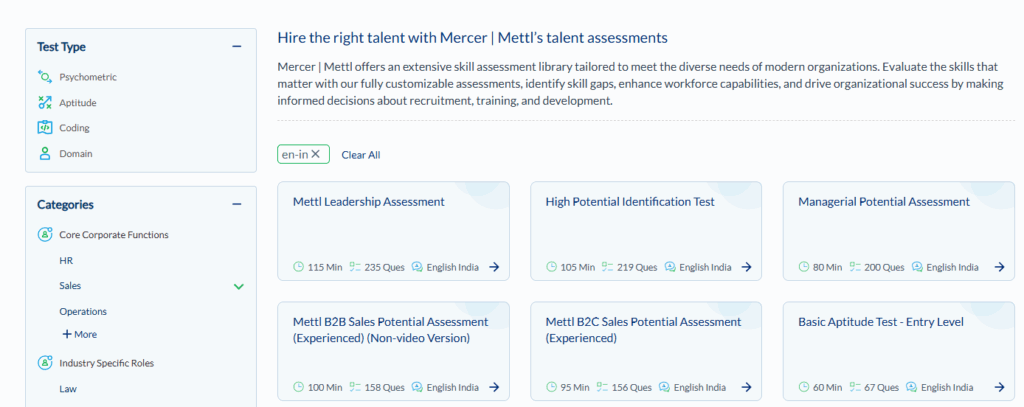
Mettl's own coding-tests page describes a library of technical questions and coding simulators for entry-level and experienced hires, with easy, medium and hard tiers per skill. We could not find a published total test count on the pages we read, so this page does not quote one. Where an older version of this article said "400+ tests" or "30+ languages", treat those figures as unverified and dropped.
What is Testlify?
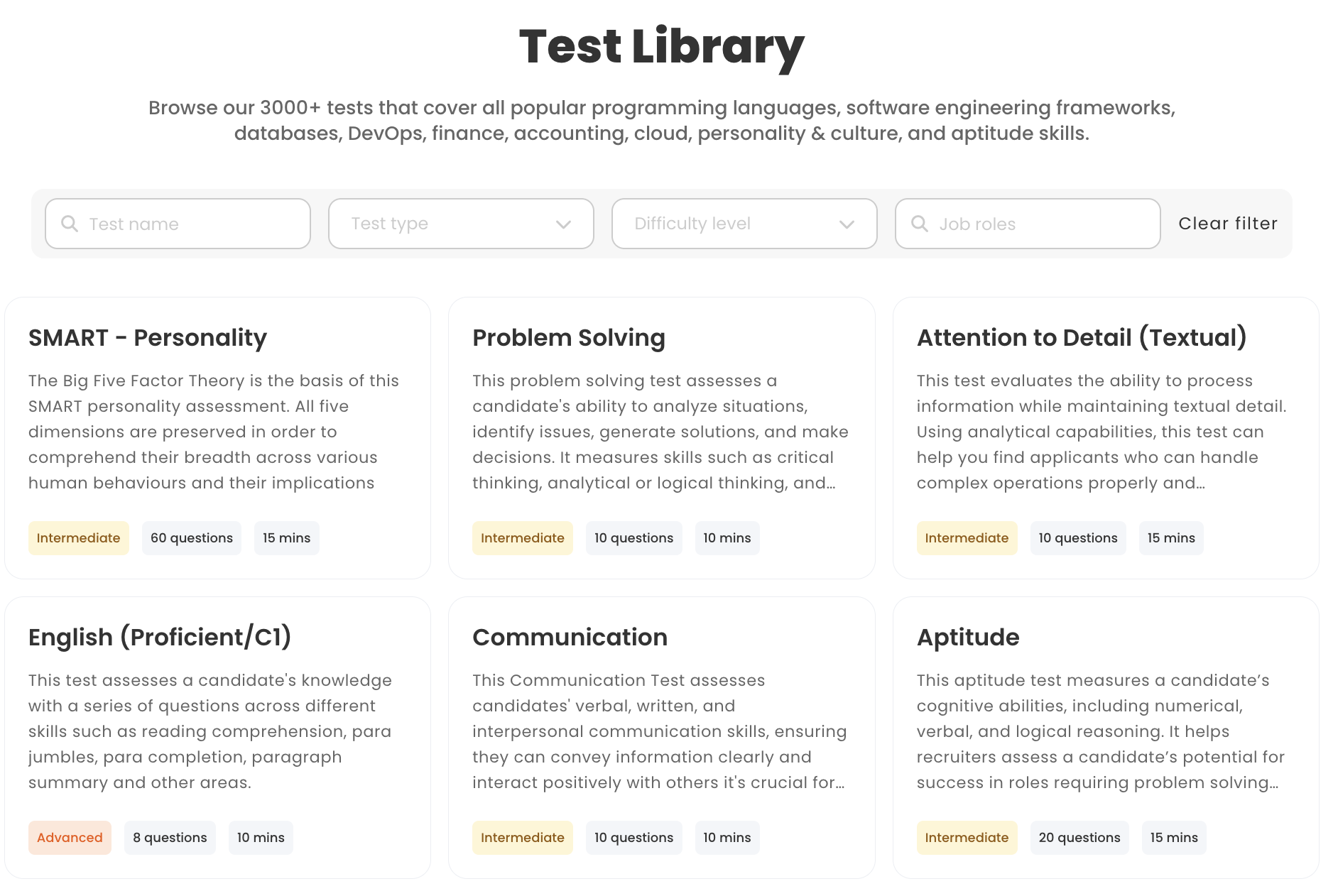
Testlify is a pre-hire talent assessment platform that combines a library of 3,500+ tests with conversational AI interviews, proctoring, AI-written candidate summaries and 100+ ATS and HR integrations. Recruiters build a role-specific assessment, invite candidates by link or through the ATS, and get a ranked shortlist with skill-level scores and an integrity report for every test-taker.
It is built for teams that hire across many roles rather than one function. The same account can run a live coding test for a backend engineer on Monday and a situational judgment test for a store manager on Tuesday, with the same scoring logic and the same proctoring settings underneath.
How Testlify works
- Pick tests from the Testlify test library or generate custom questions with AI, then combine them into one assessment for the role.
- Add a conversational AI interview in chat, voice or video if the role needs communication or judgment evidence, not just knowledge.
- Invite candidates by email, public link or straight from the ATS. Candidates need no account; they open the link and start.
- Proctoring runs during the test: session recording, snapshots, tab and screen-switch detection, AI assistance detection and identity verification, all on by default.
- AI scores the assessment and writes a plain-English summary of strengths and gaps. Reviewers add their own ratings, and the combined view syncs back to the ATS.
Test types cover the full hiring spread:
- Cognitive ability tests for problem solving, numerical and logical reasoning and attention to detail
- Role-specific tests built around what the job actually asks people to do
- Programming tests and live coding across the mainstream languages and frameworks
- Software skills tests for Excel, Google Sheets, CRMs and other everyday tools
- Psychometric tests covering personality, motivation and behavioural tendencies
- Blue-collar hiring tests for frontline, warehouse and skilled-trade roles
- Typing tests and language tests for data entry, support and multilingual roles
Conversational AI interviews
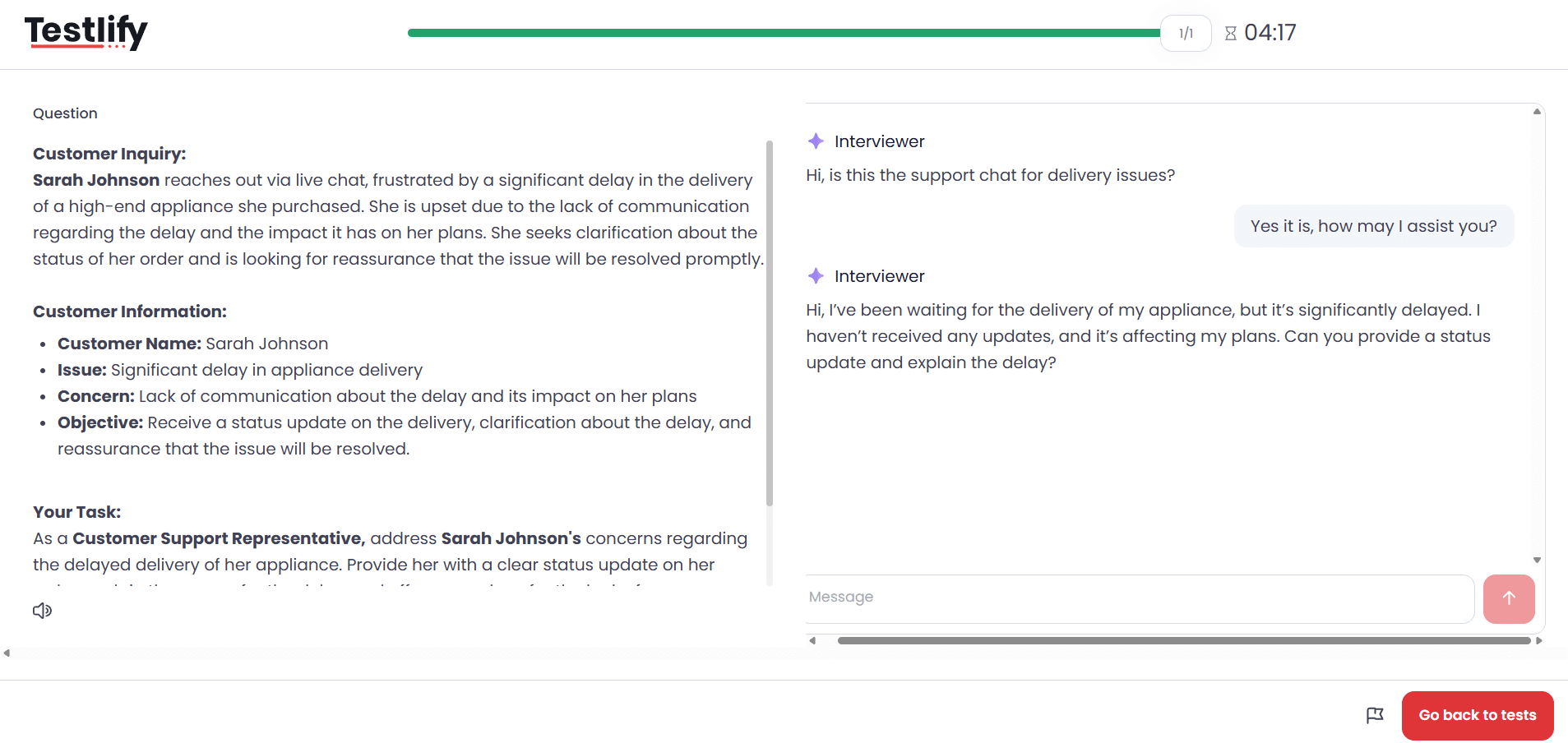
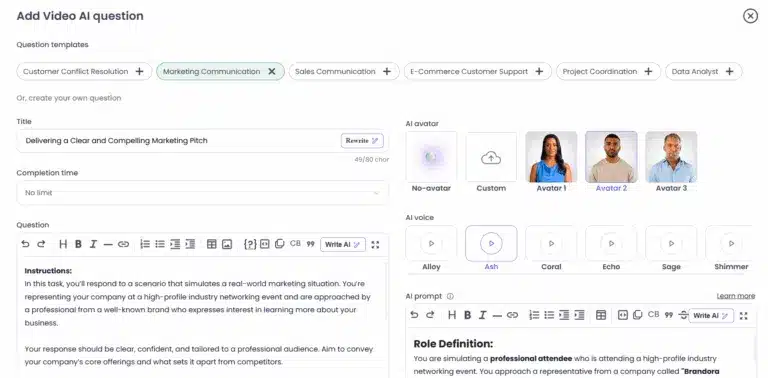
This is the feature that separates the two platforms most clearly. Testlify's conversational AI interviews put the candidate inside a realistic work scenario and score how they handle it, in three formats.
Chat AI runs a text conversation, for example a customer disputing an invoice, and scores written communication, judgment and problem solving from the transcript.
Voice AI asks role-specific spoken questions and scores fluency, tone and persuasion, which is the evidence a sales or support manager actually wants before a phone screen.
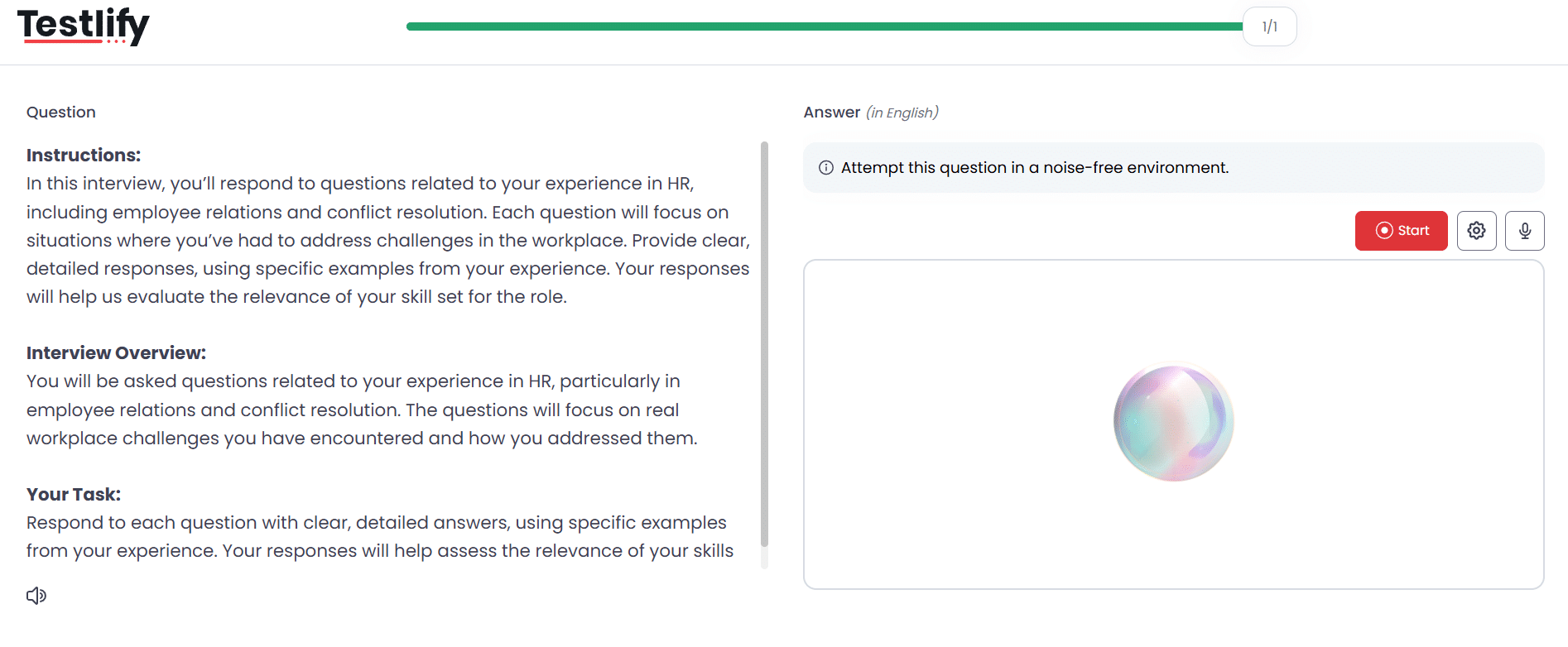
Video AI uses an AI interviewer to walk the candidate through a scenario asynchronously, so a hiring manager can review presence, structure and confidence without booking a slot.
Mettl's product menu, as read in September 2026, is built around assessments, exams, proctoring and learning. A chat, voice or video AI interview is not among the products it lists. Teams that want that evidence on the Mettl side currently run it as a separate step with a human interviewer.
Testlify vs Mercer Mettl: feature comparison
The table below keeps only what each vendor publishes on its own site as of September 2026. Where a figure could not be verified on either site, the cell says so rather than guessing. That is a deliberate change from older versions of this comparison, which carried counts nobody could trace.
Area | Testlify | Mercer Mettl |
|---|---|---|
Pre-built test library | 3,500+ tests, published on the test-library page | Talent, coding, psychometric and domain tests; no library total published on the pages we read |
Coding assessments | Yes, including live coding sessions | Yes, a dedicated coding-assessment product line with simulators and projects |
Conversational AI interviews (chat, voice, video) | Yes, inside the assessment | Not in the published product menu |
Remote proctoring | Twelve integrity layers on by default, including AI assistance detection and AI identity verification | AI-based proctoring suite (SecureProctor, Mettl Secure Browser) with live human proctor options |
Online examinations and certification | Hiring assessments only | Yes, separate examination and certification products |
Learning and development, 360 feedback | No | Yes, virtual L&D tools and 360-degree feedback |
ATS and HR integrations | 100+ platforms, including Workday, SAP SuccessFactors, Greenhouse, Lever, SmartRecruiters and Workable | 16 ATS partners plus one LMS listed on the partners page, including Greenhouse, Lever, iCIMS, SmartRecruiters, Workable and Zoho Recruit |
AI-written candidate summary | Yes, strengths and gaps per candidate | Reports are built around section scores and competency sub-scores |
Published pricing | Yes: Standard at $139 a month, Custom for 25,000+ candidates a year | No: personalised quote only |
Free trial | 7 days, no credit card | Not published |
Money-back guarantee | 30 days | Not published |
Campus and lateral hiring | Yes, with bulk and public-link invites | Yes, a named campus and lateral hiring line |
Test library and question types
Both platforms cover the assessment types a modern hiring team needs: role-specific knowledge, coding, cognitive ability, personality, situational judgment, typing and language. The difference is breadth and packaging. Testlify publishes a 3,500+ test count and lets you mix multiple-choice, open-ended, file-upload, spreadsheet, coding and AI-interview questions in one assessment. Mettl's library is deep in technical and campus-style aptitude testing, and its custom builder supports case-study, diagram and whiteboard formats that engineering teams like.
Verdict: Testlify for breadth across non-technical roles and for AI-interview questions inside the same test. Mettl for teams that want a large bank of aptitude and technical items ready for a campus season.
Anti-cheating and proctoring
Proctoring is where buyers should be most demanding in 2026, and the reason is not theoretical. Gartner's July 2025 survey of 3,000 job candidates found that 6% admitted to interview fraud (posing as someone else, or having someone pose as them), and Gartner predicts that by 2028 one in four candidate profiles worldwide will be fake. A platform that cannot spot an AI-written answer or a second person in the room is scoring the wrong candidate.
Testlify's proctoring stack runs twelve integrity layers by default: session recording and webcam snapshots, location and IP tracking, copy-paste blocking and screen-switch detection, question randomisation, AI assistance detection that analyses answers for signs of ChatGPT or code generators, snapshot proctoring, full-screen enforcement, mouse-out and tab proctoring, honesty agreements and private invites, question-level activity logs, AI identity verification and mandatory screen sharing. Mettl's SecureProctor and Mettl Secure Browser cover the classic controls (webcam and screen proctoring, browser lockdown, snapshots, IP monitoring) and add what Testlify does not: a live human proctor tier for exam-day floors.
Verdict: a draw for standard hiring, decided by what you fear most. If AI-assisted cheating on remote tests is the threat, Testlify's answer-level detection is the more useful control. If the threat is impersonation across a 5,000-seat exam, Mettl's human proctoring tier is the one you want.
Reporting, AI summaries and benchmarking
Testlify's reports show skill-level scores, question-level behaviour, candidate benchmarking against the wider pool and an AI-written summary of each candidate's strengths and gaps, exportable as PDF, Excel or CSV. The summary is the part that saves time at volume: a recruiter screening 300 applicants reads one paragraph per person instead of decoding a score grid.
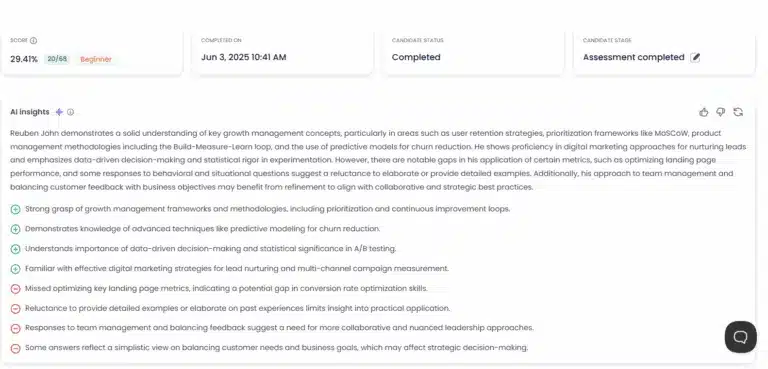
Mettl's reports are thorough in a more traditional way, with section scores, competency sub-scores and narrative interpretation written into the test design. They are well suited to a psychometric read-out for a leadership programme. They ask more of the reader for a fast screen.
Verdict: Testlify for screening speed and AI summaries. Mettl for detailed psychometric narrative reports.
Integrations and workflows
Testlify's integrations page lists 100+ ATS and HR platforms with two-way sync, so candidates, stages and scores move in both directions and most connections are set up in minutes without an engineer.
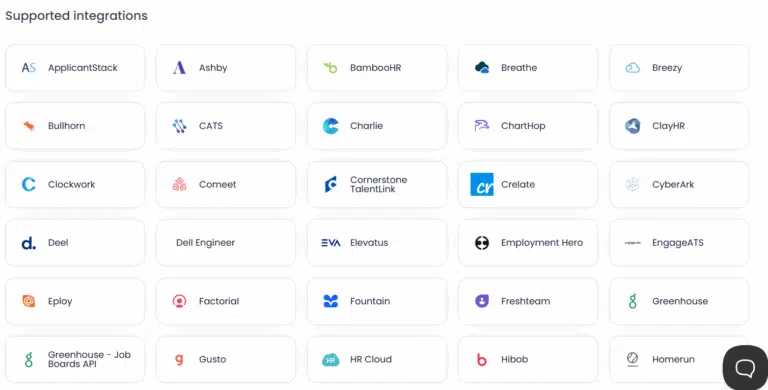
Mettl's partners page lists 16 ATS integrations (Greenhouse, Lever, iCIMS, SmartRecruiters, Workable, Zoho Recruit, Darwinbox, Keka HR and others) plus D2L on the learning side, alongside an API for anything not on the list.
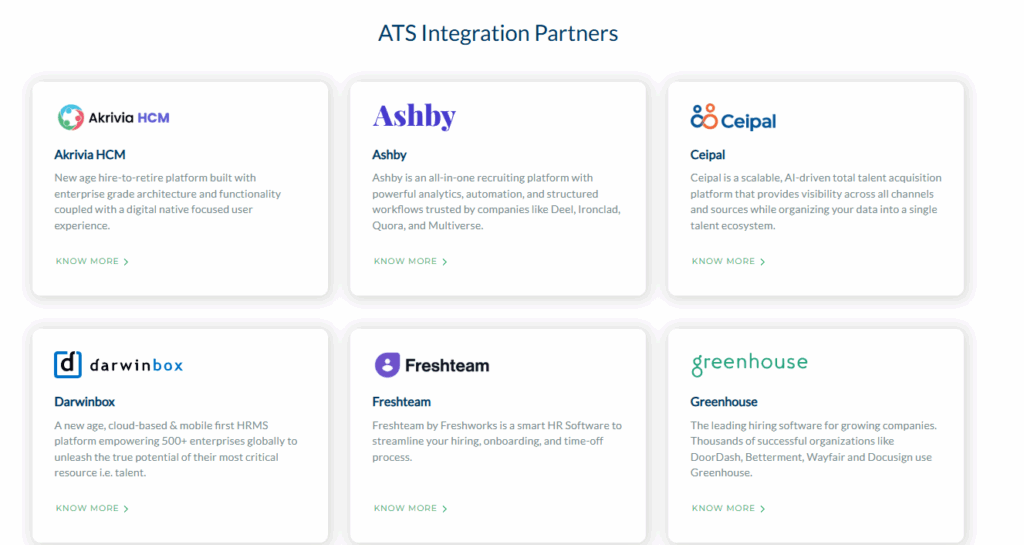
Verdict: Testlify, by a wide margin, if your ATS is not on Mettl's list of 16. Check the list before a demo; it is the single fastest way to rule a vendor in or out.
White-labelling, compliance and support
Testlify's white-label option lets you put your logo, colours, custom domain and your own invitation and rejection emails in front of candidates, and its GDPR page sets out how candidate data is handled in the EU, with SOC 2, ISO 27001 and CCPA listed on its trust pages. Both vendors run multi-channel support with onboarding, a help centre and a dedicated contact for enterprise accounts, so support is rarely the deciding factor. Ask each for their current security certificates in writing during procurement rather than relying on a comparison page, including this one.
How does Mercer Mettl pricing compare with Testlify?
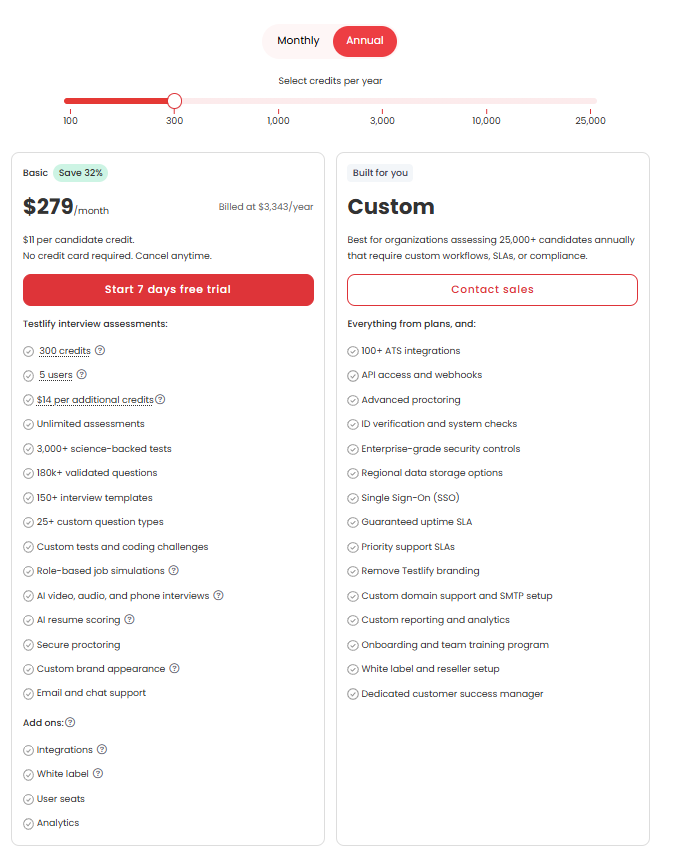
Testlify publishes its prices; Mercer Mettl does not. Testlify's Standard plan is $139 a month, billed at $1,668 a year, and includes 100 candidate credits ($16.68 each), 3 user seats, a 7-day free trial with no credit card, and a 30-day money-back guarantee. Mettl's pricing page describes "personalised pricing plans" and asks you to call for a quote.
Plan detail | Testlify Standard | Testlify Custom | Mercer Mettl |
|---|---|---|---|
Price | $139 a month, billed $1,668 a year | Custom | Personalised quote only |
Included candidates | 100 credits a year ($16.68 per credit) | Volume-based, for 25,000+ candidates a year | Not published |
Extra candidates | $21 per additional credit | Part of the quote | Not published |
User seats | 3 included, $15 per extra seat a month | Part of the quote | Not published |
Trial | 7 days, no credit card | Talk to sales | Not published |
Guarantee and price lock | 30-day money-back; base price locked for 24 months | Part of the quote | Not published |
Mercer Mettl plans: what is actually published?
Very little, and that is a design choice rather than an oversight. Mettl sells configured bundles: which product lines you take (assessments, coding, proctoring, exams), how many test-takers per season, and what proctoring tier you need. The quote reflects that mix. For a campus recruiter buying 20,000 proctored seats it can work out well, because volume discounts are negotiated per deal. For a smaller team it means a sales cycle before you know whether the tool fits the budget at all.
Testlify pricing: the numbers on the page
Take a team that assesses 250 candidates a year. On Testlify's Standard plan that is the $1,668 annual base (100 credits) plus 150 extra credits at $21, so $3,150 more, for a total of about $4,818, or roughly $19 per candidate assessed. Above a few thousand candidates the Custom plan becomes the better conversation, and above 25,000 a year it is the only one. The base price is locked for 24 months, which is the detail finance teams tend to care about most, because it turns a subscription into a two-year budget line.
Pro Tip: Before any vendor call, write down three numbers: candidates assessed last year, candidates you expect next year, and the number of recruiter seats that will log in monthly. A quote-only vendor will price off those three anyway, and a published-price vendor lets you run the maths in two minutes. Comparing both on the same three inputs is the only fair test of cost.
Verdict: Testlify on transparency and on predictable cost below enterprise volume. Mettl can still land the cheaper deal at campus scale, but only after a negotiation you cannot benchmark in advance.
What are the Mercer Mettl pros and cons?
Mettl is a mature platform with real strengths, and a fair comparison says so. The cons below are the ones that show up when a mid-market hiring team, rather than a university or certifying body, runs it day to day.
Pros
- Exam-grade proctoring, including live human proctors, which most hiring-only platforms do not offer.
- A product range that covers online examinations, certification programmes, hackathons and L&D as well as hiring, so one vendor can serve HR, learning and a training academy.
- Deep aptitude and technical item banks that suit campus drives where thousands of similar candidates sit the same test.
- Backing from Mercer, which matters to procurement teams that shortlist on vendor size and consulting pedigree.
Cons
- No published pricing or trial terms, so you cannot compare cost without a sales conversation.
- A published integration list of 16 ATS partners, against 100+ on Testlify's side.
- No conversational AI interview in the product menu, so communication and judgment evidence still needs a separate interview step.
- Reports built for psychometric depth rather than screening speed; there is no AI-written summary to read at a glance.
- A workflow (test-taker banks, bulk templates, access windows) shaped by exam administration, which feels heavy for a team hiring five people a month.
Testlify has its own trade-offs, and hiding them would make this page worthless. It has no examination or certification product, no L&D tooling, and no live human proctor floor. If those are on your requirements list, Testlify is not the answer and the comparison ends there.
Why do teams look for a Mettl competitor?
Across the buyers we talk to, the switch conversation starts with one of four triggers: an ATS that is not on Mettl's list, a renewal quote that cannot be benchmarked, a hiring mix that has shifted from campus volume to experienced hires across many roles, or a manager who wants interview evidence earlier than the phone screen. None of those is a complaint about Mettl's test quality. They are fit problems, and fit is what a competitor comparison should test.
Tools like Mettl, by hiring situation
Hiring situation | What matters most | Testlify | Mercer Mettl |
|---|---|---|---|
Campus drive, 5,000+ test-takers in one season | Seat volume, proctor floor, exam scheduling | Workable with bulk and public-link invites, but no human proctor tier | Purpose-built for this |
Growth-stage company, 50 to 500 hires a year across functions | Library breadth, ATS sync, predictable cost | Strong fit: 3,500+ tests, 100+ integrations, published price | Quote-only, shorter ATS list |
Technical hiring for engineers | Live coding, plagiarism and AI-assist detection | Live coding plus AI assistance detection in every test | Dedicated coding line with simulators and projects |
Frontline, retail and blue-collar volume | Short mobile tests, situational judgment, typing and language | Dedicated blue-collar, SJT, typing and language libraries | Blue-collar hiring is a named solution line |
Regulated enterprise with adverse-impact reporting | Documented process, exportable evidence, reviewer scorecards | Question-level logs, multi-reviewer scoring, exports | Detailed psychometric reports, exam-grade audit trail |
Which Mercer Mettl competitor fits which team?
Testlify is the direct like-for-like when you want the same test coverage plus AI interviews and open pricing. If your shortlist is wider, the 15 Mercer Mettl alternatives page ranks the field by hiring need, and the talent assessment tools comparison puts the whole category side by side. Whatever you shortlist, run each vendor against the evidence checklist in the next section, because every tool like Mettl claims validity and only some can show it.
How should you evaluate any Mettl alternative?
Judge the evidence the platform produces, not the length of its feature list. Four checks settle most decisions: does it measure job-relevant skills with structured, scored tasks; can you document that scoring is consistent and fair across groups; does its proctoring catch the cheating that actually happens now; and does the result reach the people who decide, in a form they will use?
The first check has the best research behind it. Sackett and colleagues' 2022 reanalysis of selection-method validity in the Journal of Applied Psychology puts structured interviews among the strongest predictors of job performance and years of education and general experience among the weakest. So a platform that scores a realistic task or a structured scenario is measuring something the evidence supports; one that mostly scores what a resume already says is not. The exact coefficients are still argued over in print, but the ranking of structured over unstructured has survived every reanalysis.
The second is fairness you can show. The US Uniform Guidelines on Employee Selection Procedures set out the four-fifths rule: when one group's selection rate falls below 80% of the highest group's rate, enforcement agencies treat it as evidence of adverse impact. It is a rule of thumb, not a legal definition, but it is the number an auditor will ask for. Whichever platform you pick, it must export selection rates by stage so you can run that check yourself.
The third is scoring discipline. Kuncel and colleagues' 2013 meta-analysis found that combining assessment information mechanically predicts outcomes as well as or better than experts reworking the same information by intuition. In practice that argues for fixed weights, reviewer scorecards and a combined score, which is what Testlify's multi-reviewer view does and what Mettl's report exports support if you build the scorecard yourself.
The fourth is proctoring against the 2026 threat. Go back to the Gartner figure: 6% of 3,000 surveyed candidates admitted to interview fraud. At 250 candidates a year that is about 15 people, and at a 5,000-seat campus drive it is closer to 300. A platform that only locks the browser is not built for that.
Put together, that is the Multi-Signal Talent Evaluation Model in checklist form. An illustrative example: a 600-person logistics company hiring 40 dispatchers a quarter could run a 25-minute situational judgment and attention-to-detail assessment, add a five-minute Voice AI scenario with an upset driver, and send the combined score to the ATS before any recruiter time is spent. The numbers in that scenario are hypothetical, but the workflow is what both platforms are sold to do, and only one of them lets you price it before the call.
Where is Mercer Mettl still the stronger fit?
Three cases, stated plainly. First, campus and university drives where thousands sit the same aptitude test on the same day and a proctor floor watches live feeds; Mettl's exam heritage shows here. Second, certification and online examination programmes, where the product is the exam itself and hiring is secondary. Third, organisations that want assessment, examinations, hackathons and L&D from one vendor under one Mercer contract. In each of those, the quote-only model is a minor cost of doing business, and Testlify simply does not sell the product.
Outside those cases, the calculation flips. A team that hires across functions, wants AI interview evidence early, syncs to an ATS that is not on a 16-vendor list, or needs a price before procurement will sign, is better served by Testlify, and can prove it inside a 7-day trial before spending anything.
Frequently asked questions

Director of Marketing
Akash Patange is the Director of Marketing at Testlify, where he works closely with HR leaders and recruiters to help organizations improve hiring outcomes. He writes about talent assessment, recruitment technology, and data-driven hiring practices.
LinkedInRelated resources
View all
Competitor Comparisons
Testlify vs. Codility: Which Platform is Best for HR Teams?
Competitor Comparisons
Testlify vs. Vervoe: Which Platform is Best for HR Teams?
Competitor Comparisons
Testlify vs. Adaface: Which Skills Assessment Platform Wins in 2026?
Competitor Comparisons
Testlify vs TestGorilla: Which Talent Assessment Platform is Best for You?
Competitor Comparisons
Testlify vs Mercer Talent Enterprise: A detailed comparison
Competitor Comparisons
Testlify vs Skillsarena: A detailed comparison
Get started.
Hire on proof, not resumes.
Run your first skills-based assessment free — no credit card required.