
Testlify vs. iMocha: Which Skills Assessment Platform is Best for HR Teams?
Testlify vs. iMocha: Discover which skills assessment platform best suits your hiring needs
Testlify is the better choice for a company under about 200 people that hires across more than one function and wants to see the price before a sales call. iMocha is the better choice for an enterprise that wants a skills taxonomy and workforce mapping alongside its hiring tests, and is comfortable buying on a quote. That's the short answer to Testlify vs iMocha. The rest of this page shows the evidence: what each platform ships as of September 2026, what it costs, how the proctoring differs, and where each one wins.
 ChatGPT
 Gemini
 Claude
 Grok
Grok Perplexity
TL;DR: Testlify vs iMocha in 60 seconds
- Both sell a large test library, AI interviews, remote proctoring and ATS integrations. The difference is what each is built around: Testlify is a screening and interviewing platform, iMocha is a skills-intelligence platform that also screens.
- Testlify publishes its prices (Starter from $139 a month on annual billing, 7-day trial, no card). iMocha shows a demo form and no price on either of its pricing pages.
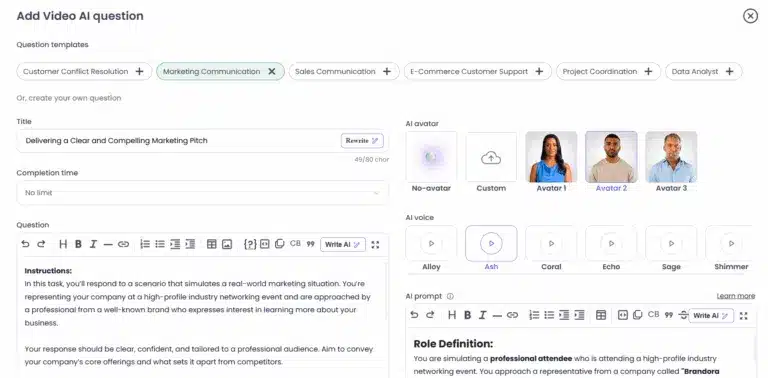
- Testlify's AI interviews run as one-way video, two-way conversational video, audio and outbound phone, with selectable avatars and voices and a human override on every AI score. iMocha's Tara interviewer is conversational and scores tone and pace, but its product page doesn't say which formats it supports.
- Both can record the candidate's screen. iMocha's screen recording is an add-on you switch on in its payment portal; Testlify's is one of 20+ measures in three proctoring presets, next to dual-device proctoring and an AI checker that labels an answer Human, AI generated or Mixed.
- If you mostly hire engineers with a large budget, or you need an enterprise skills map, iMocha earns its place. For most teams searching for an iMocha alternative, Testlify does the screening job at a visible price.

What is iMocha?
iMocha is a skills assessment and skills-intelligence platform sold to enterprises. It sells a library it describes as 10,000+ evaluations, an AI interviewer called Tara, remote proctoring, and a skills taxonomy that maps employees against job roles for hiring and upskilling. The company started as Interview Mocha in Pune, India, and dropped the "Interview" in August 2020 as it moved beyond video interviewing.
Three details matter to a buyer. First, the library numbers move depending on which iMocha page you read: the product page says 10,000+ assessments across 10,000+ skills and 300+ job roles, the library FAQ says 3,000+ assessments tailored to functions and experience levels, and the coding section claims 5,000+ coding problems with 30+ compilers. Second, iMocha's question types include AI-LogicBox, which it describes as patented, code-free logic assessments, and AI-EnglishPro, a CEFR-aligned English test across speaking, writing, reading and listening. Third, the positioning has shifted upmarket: the homepage now calls iMocha "The Context Layer for Skills & Work Intelligence" and says it is trusted by 300+ enterprises. A 40-person company shopping for a screening tool is not the customer that copy was written for.
How iMocha works
You pick or build an assessment from the library, invite candidates, and set the proctoring level. Candidates take the test in the browser with image or video proctoring, window-violation tracking and, if you've enabled it, screen recording. iMocha then returns a scorecard with skill-level scores, candidate and industry benchmarks, and a proctoring log with timestamped violations. Enterprise customers feed those scores into the skills taxonomy so the same data drives internal mobility and upskilling, which is the part of iMocha most hiring teams never touch.
What is Testlify?
Testlify is a pre-hire skills assessment and interviewing platform. It ships a library of 3,500+ tests built from 180,000+ validated questions, 25+ question types, AI interviews across video, voice and phone, proctoring with three presets, candidate reports with question-level analytics, and 100+ ATS integrations. It also includes a simple built-in hiring pipeline for teams that don't run an ATS yet. Pricing is on the website, with a 7-day free trial that needs no card.
Where iMocha is a skills-intelligence platform that also screens, Testlify is a screening platform first. You set up a role, pick or generate the assessment, invite candidates, and get a ranked shortlist with the proctoring evidence attached. That is the whole product, on purpose.
How Testlify works
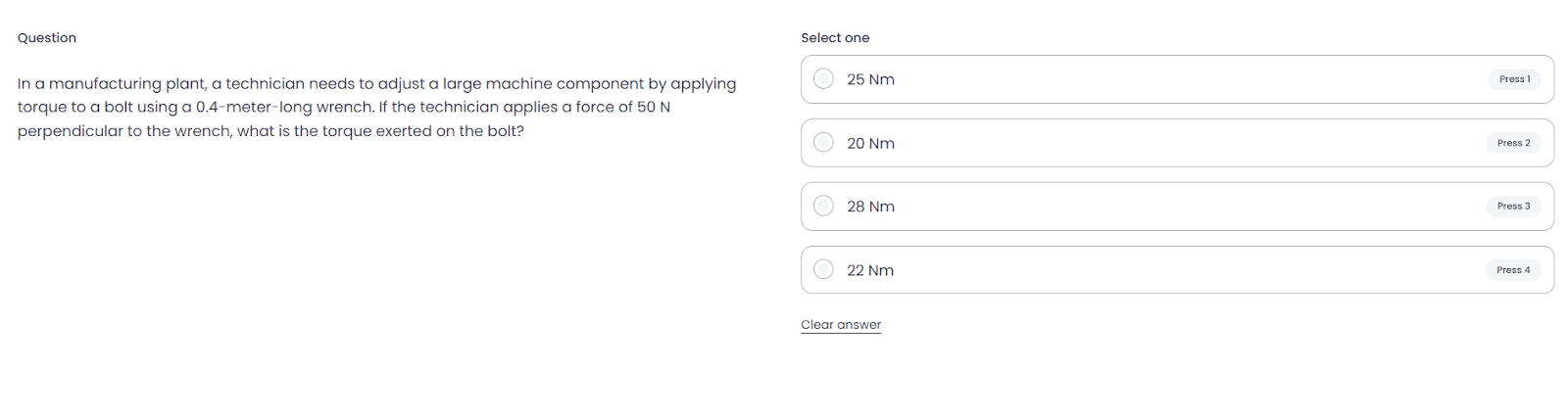
- Build the assessment. Choose from the library of 3,500+ tests or let the AI generate up to 20 questions from a job description. Question types include single and multiple select, coding (single file or a multi-file project in an embedded VS Code editor), typing, file upload, and live tasks inside Google Docs, Sheets and Slides and Microsoft Word, Excel and PowerPoint.
- Invite candidates. Email invites, a public link, or a push from your ATS. Candidates confirm their email with a 6-digit code, accept the data-processing consent and start.
- Run it proctored. Pick the Standard, Strict or Custom preset. Options include photo ID with face match, webcam snapshots, screen and camera recording, tab-switch and multi-monitor detection, AI-tool detection, and dual-device proctoring, where the candidate's phone becomes a second camera.
- Interview with AI. Add a one-way video question, a two-way conversational AI interview with a chosen avatar and voice, or have the AI phone the candidate (billed at $0.18 a minute). Transcripts are automatic and multilingual.
- Score and decide. AI scores open answers, code, spreadsheets and recordings, then writes a strengths-and-gaps summary. The product's own disclaimer reads "AI scores and insights are for guidance only. Use human judgment for final decisions," and a toggle keeps the AI score out of the final average entirely if you want it that way.
- Sync and report. Push results to your ATS, export PDF or CSV, and share a report link with show-and-hide controls for AI insights, proctoring flags and correct answers.
Testlify vs iMocha: feature comparison at a glance
The table sticks to what each vendor publishes. Where a vendor doesn't publish something, the cell says so instead of guessing.
Feature | Testlify | iMocha |
|---|---|---|
Test library | 3,500+ tests, 180,000+ validated questions, 12 categories | 10,000+ evaluations on the product page; 3,000+ assessments in the library FAQ; 300+ job roles |
Question types | 25+, including live Google Workspace and Microsoft Office tasks, multi-file coding, typing, file upload | Multiple choice, coding with 30+ compilers, AI-LogicBox code-free logic, audio and video, file upload |
AI interviews | One-way video, two-way conversational video, audio, outbound phone; selectable avatar and voice; auto-score with human override | Tara conversational AI interviewer; formats not stated on its product page |
Screen recording | Included in the proctoring presets | Available; enabled per account through the payment portal |
Second-device proctoring | Yes, phone as a second camera, required before the test starts | Not listed on its proctoring pages |
AI-written answer detection | AI checker labels each answer Human, AI generated or Mixed; separate AI-tool detection | Not listed on its proctoring pages |
Question analytics | Difficulty index, discrimination index, quality-risk flag per question | Candidate and industry benchmarking against skill data pooled across its customers |
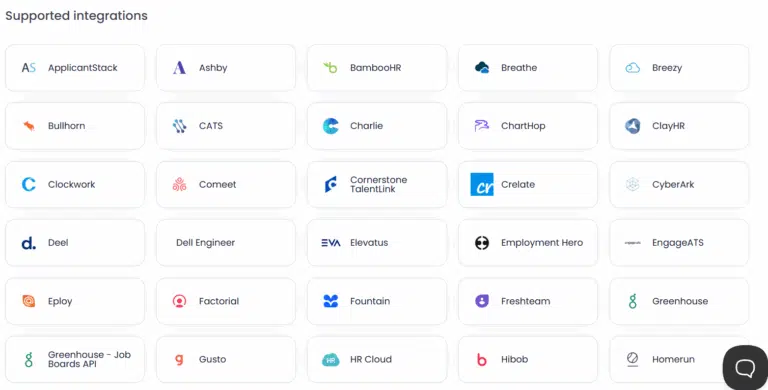
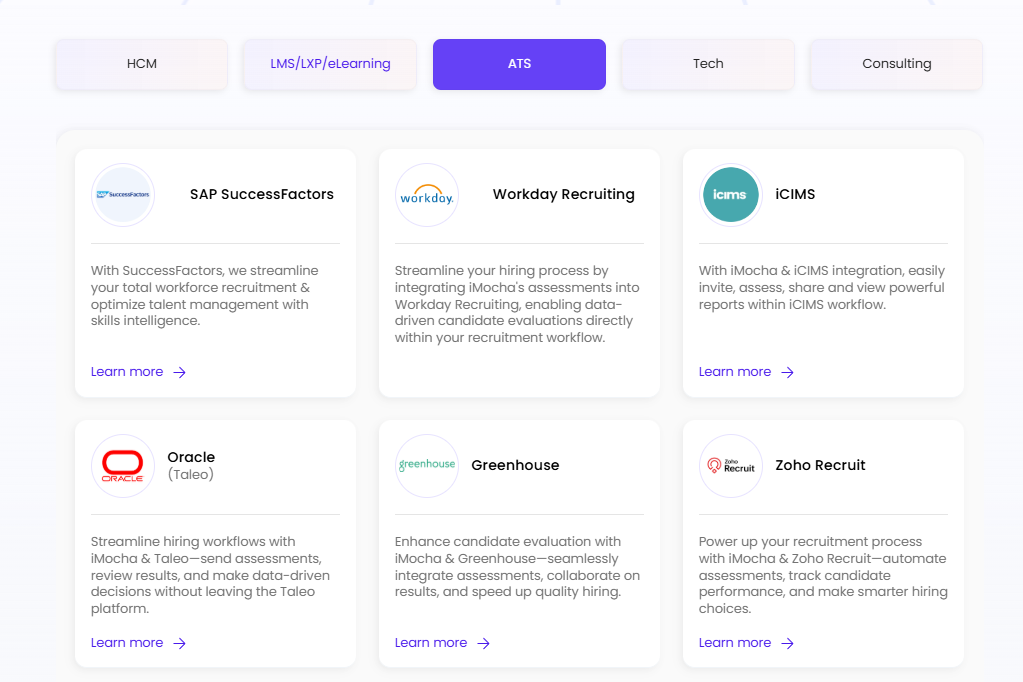
ATS and HR integrations | 100+; $2,388 a year add-on on self-serve tiers, included on Custom | 15 ATS and 4 HCM suites named on its partners page, plus LMS platforms and Zapier |
White label | Custom domain, custom SMTP, hide branding; $2,388 a year add-on, included on Custom | Employer branding features; detail not published |
Published pricing | Yes, from $139 a month on annual billing | No, demo form only |
Free trial | 7 days, no card | Not stated on its pricing pages |
Sources: the Testlify pricing page and product as of September 2026; iMocha's product, proctoring, help-center, benchmarking and integration-partner pages, checked September 2026.
Which has the better test library and question types?
iMocha has the bigger raw count and the deeper coding bench. Testlify has the wider spread of question types for non-technical roles. If most of your hiring is engineers, iMocha's 5,000+ coding problems and 30+ compilers are a real advantage. If you hire account managers, bookkeepers, site supervisors and support reps as well as developers, Testlify's Office and Google Workspace tasks and role-specific tests do more of the job.
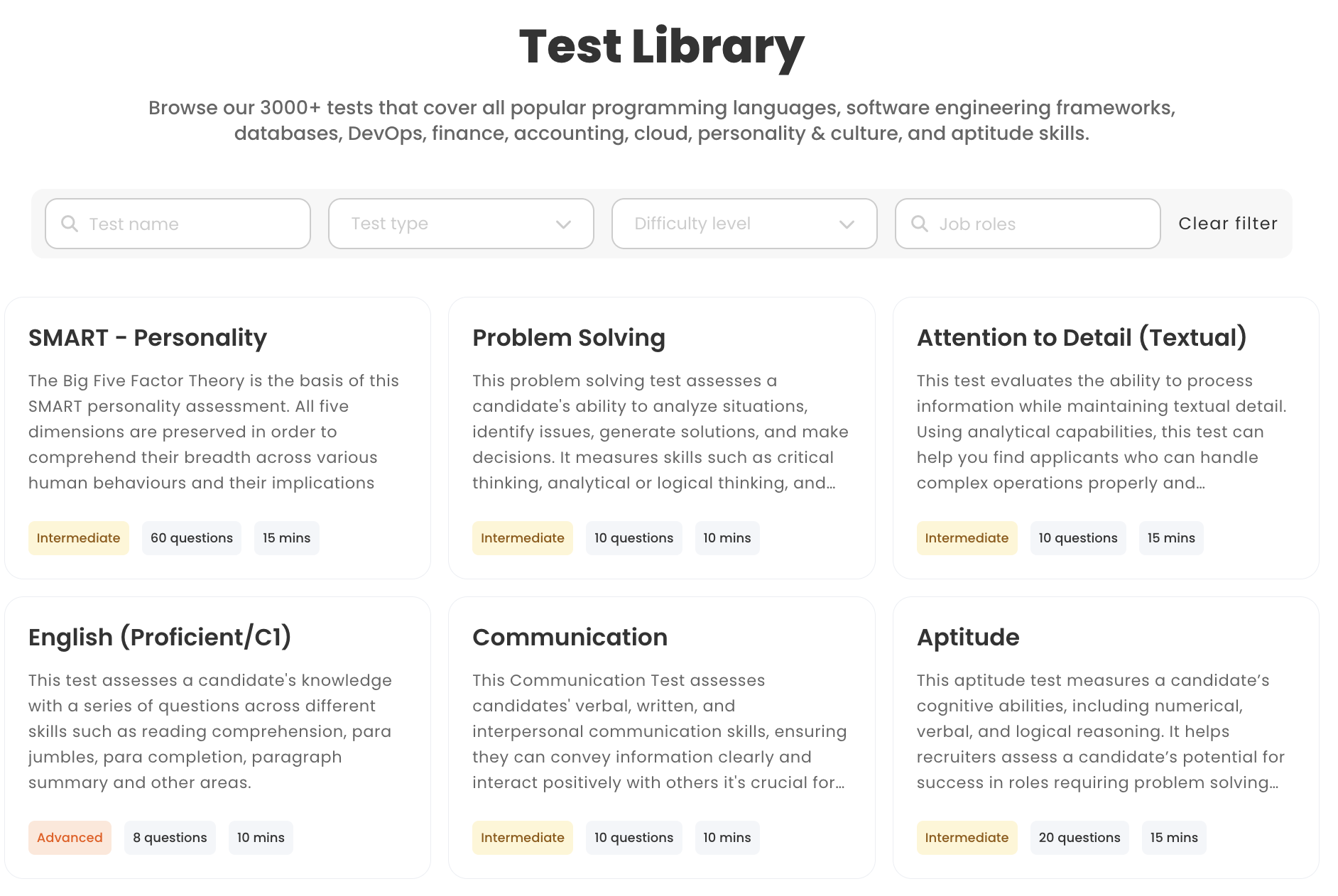
Testlify's library is organised by role, so a staff accountant or retail store manager assessment exists before you start, across 12 categories from cognitive ability to blue-collar skills. The 25+ question types include live Microsoft Excel, Word and PowerPoint tasks and Google Docs, Sheets and Slides tasks, which means an analyst candidate builds a real pivot table rather than answering a multiple-choice question about one. Coding questions can be a single file or a multi-file project in an embedded VS Code editor, with up to 20 test cases, hidden or visible, and a vibe-coding mode that lets candidates direct AI tools to a working solution instead of typing syntax by hand. Typing tests score 60% accuracy and 40% speed by default, and you can change the weighting.
- Cognitive ability, problem-solving and attention to detail
- Role-specific tests for hiring outside engineering
- Coding tests with per-test-case scoring and SQLite database cases
- Software skills, including the live Office and Workspace tasks above
- Psychometric, personality and culture (qualitative, so no total score)
- Situational judgment and typing
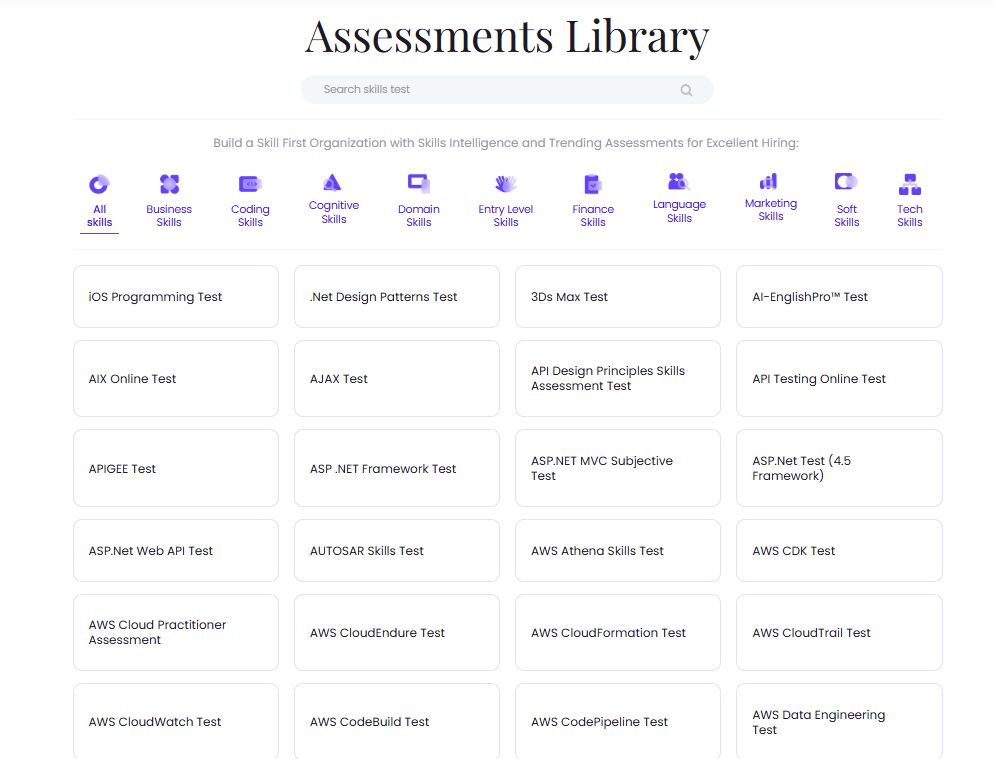
iMocha's library leans technical. Its own category list runs coding, cognitive, design, domain, Gen AI readiness, entry-level, language, next-gen, soft skills, typing and tech skills. AI-LogicBox tests logic without a compiler, which is useful for junior developer screening where syntax isn't the point, and AI-EnglishPro returns a CEFR level across four language skills. What you won't find is a live spreadsheet or document task; iMocha's software questions test knowledge of the tool rather than use of it.
Verdict: library and question types
iMocha for coding depth and code-free logic testing. Testlify for role coverage and work-sample realism outside engineering. The research favours the work sample: Sackett and colleagues' 2022 re-analysis in the Journal of Applied Psychology puts structured interviews at an operational validity of .42, work samples at .33 and cognitive ability tests at .31, which is why a live Excel task tells you more about an analyst than a quiz about Excel.
How do Testlify and iMocha AI interviews compare?
Testlify runs AI interviews in four formats: one-way asynchronous video, two-way conversational AI video, audio or voice questions, and outbound AI phone interviews. iMocha runs conversational interviews through Tara. The difference a buyer can verify is configurability: Testlify lets you choose the avatar, the voice, the persona, the prompts, the number of attempts and the recording time, and shows every AI score next to a human override.
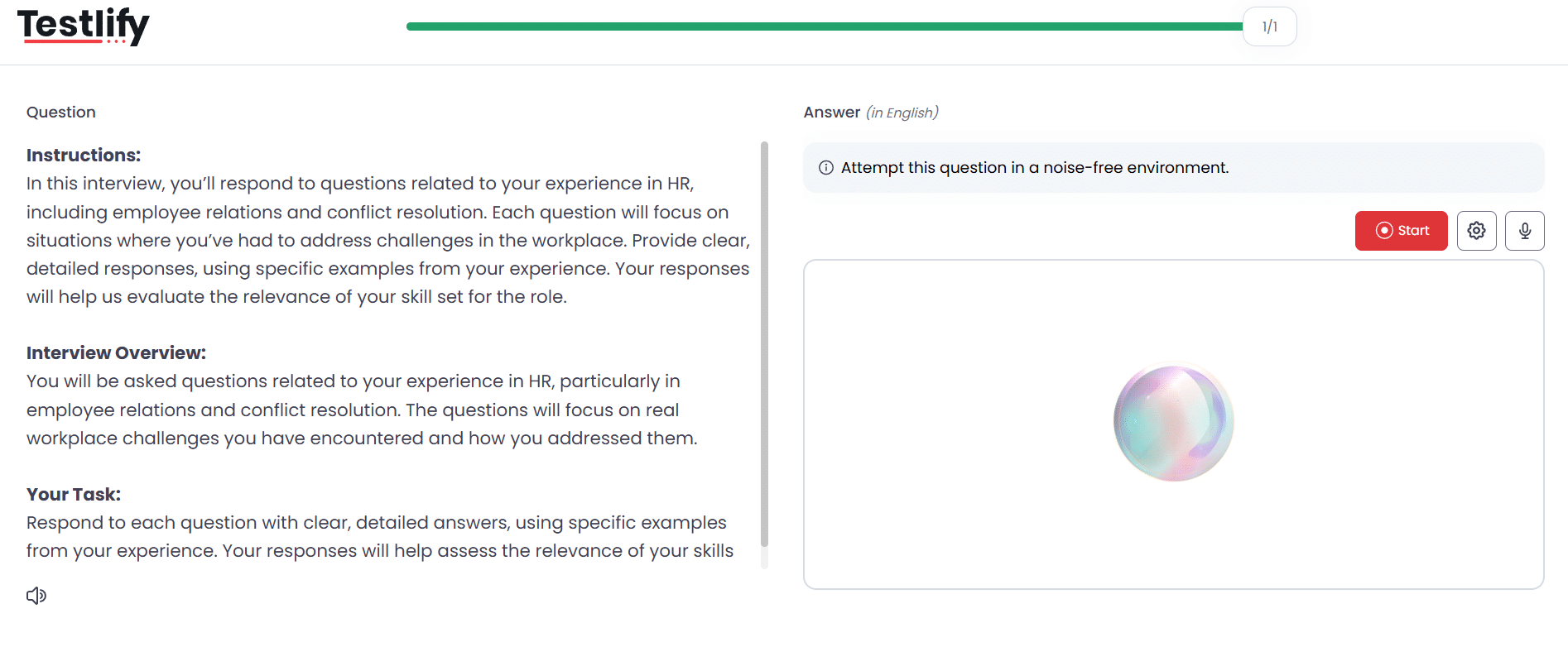
In Testlify, a recruiter picks an AI avatar and voice, writes or generates the prompts from the job description, sets attempts (including no limit) and recording time up to 5 minutes per video, and can auto-start recording after a preparation countdown. Candidates run a device check and record a test video first. During a live AI voice interview the candidate sees "You're muted while the AI is speaking," which is real turn-taking, not a recorded prompt. Afterwards the reviewer gets the video, an automatic transcript in whatever language the candidate spoke, an interview report and AI insights, and can regenerate the report or download the audio. A text-chat AI interview appears in the product labelled "coming soon" as of September 2026, so don't buy on it yet.
iMocha's Tara page describes an interviewer that "adapts, engages, and uncovers skills," "understands tone, pace, and candidate context," and returns "structured scoring on skills and responses." What the page doesn't say is which formats Tara supports, whether an avatar is used, how many attempts a candidate gets, or whether a human can override the score. Ask those four questions on the demo.
Verdict: AI interviews
Testlify, on the strength of what can be verified: four formats, phone included, and a documented human override. Tara is a credible conversational interviewer and may match some of that, but iMocha doesn't put the detail in writing. That matters beyond features. Gartner's July 2025 survey found only 26% of job applicants trust AI to evaluate them fairly, and the EU AI Act classifies AI used to recruit or evaluate candidates as high-risk under Annex III. An interview tool whose AI score is advisory, visible and overridable is easier to defend to a candidate and a regulator than one that ranks silently.
Does iMocha record your screen? Proctoring compared
Yes. iMocha records the candidate's entire screen for the length of the test when Screen Recording is enabled, and it can run with or without the webcam. iMocha's help center says the feature "must be enabled for your account through the payment portal," so it is an account-level add-on rather than a default, and pairing it with Video Proctoring records the webcam and the screen at the same time. Testlify records the screen and the camera as part of its proctoring presets, and keeps the recordings for a number of days you set.
Beyond screen recording, the two suites differ in depth and in what they do with a flag. iMocha's published measures are candidate ID verification, image and video proctoring, window-violation tracking, IP address restriction, question and answer randomisation, a safe assessment browser, face detection for no face, multiple faces or an unrecognised face, screen integrity (blocks screenshots, extra monitors and screen capture, with blackout and forced full screen), browser patrolling for tab exits, copy-paste locking and virtual-machine detection. Violations land in the report under Proctoring Details with a low, medium or high cheating-intensity label, and a threshold can end the test automatically.
Testlify's list is longer, 20+ measures across identity, environment, browser lockdown, AI monitoring and session evidence, and two items stand out. Dual-device proctoring turns the candidate's phone into a second camera pointed at them and their screen, and the assessment won't start until that camera is live. The AI checker classifies each written answer as Human, AI generated or Mixed, with a separate detector for AI tools and browser extensions used during the test. iMocha's proctoring pages, as of September 2026, don't list detection of AI-written answers. That gap is the one to ask about, because it is the cheating method growing fastest: in the same Gartner release, a survey of 3,000 candidates in the second quarter of 2025 found 6% admitted to interview fraud, and Gartner expects one in four candidate profiles worldwide to be fake by 2028.
How a flag is handled matters as much as how it is caught. Testlify shows a three-tier result: green when the session met every rule, yellow when "a quick manual review is recommended," and red when cheating was confirmed. Auto-termination is a separate opt-in with a recruiter-set threshold, so a nervous candidate who glances away doesn't get rejected by a script. This is the Testlify Assessment Integrity Framework in practice: identity checks, environment control, behaviour monitoring, AI-assistance detection and reviewable evidence, with the final call left to a person. Face-verification data is deleted after 30 days and candidates can withdraw consent at any time. The full list is on the anti-cheating and proctoring page.
Pro Tip: Match the preset to the role. Strict proctoring with dual-device on a junior retail role costs you completions; a Standard preset with ID verification and the AI checker catches most of what matters. Save Strict for remote, high-salary or regulated roles where impersonation is the real risk.
Verdict: proctoring
Testlify for depth, AI-answer detection and second-device coverage. iMocha covers the basics well, and its screen recording plus video proctoring combination is solid for exam-style tests, but budget for the add-on and confirm what its fraud detection actually looks for.
Which platform reports and integrates better?
Reporting is close; integrations are not, once you count the add-on. Both platforms give skill-level scores, benchmarks, shareable report links and PDF or CSV export. Testlify adds question-level psychometrics and a customer-controlled toggle for every AI element in a shared report. iMocha names 15 ATS and 4 HCM suites on its partners page, while Testlify lists 100+ integrations but sells them as a $2,388-a-year add-on on its self-serve tiers.
Testlify's reporting shows, for every question, a difficulty index, a discrimination index and a quality-risk flag for items with very low accuracy or high skips. That is test-publisher territory, and it is the fastest way to find a bad question in your own assessment. Benchmarks include percentile rank, candidate rank and "better than" comparisons against other candidates and other reviewers. Report types run from a DISC personality report to CEFR language levels, a compliance report and a reviewer-score report, and the reporting and analytics can be scoped to one assessment, one workspace or the whole account. AI insights sit in the same report, with a summary, strengths and improvement areas per candidate.
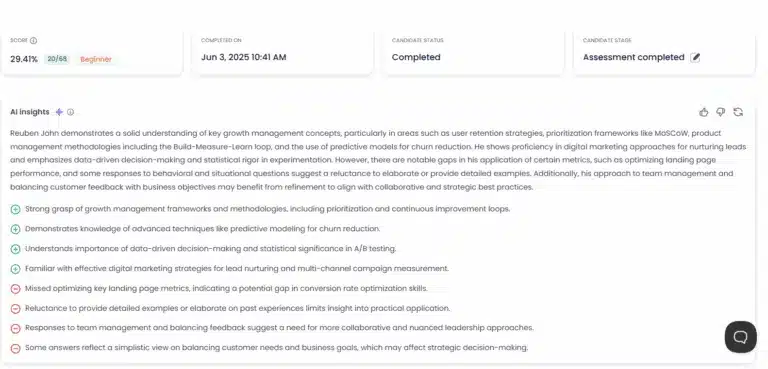
iMocha's benchmarking runs two ways. Candidate benchmarking compares a candidate's skill level with the average of candidates already assessed inside your organisation. Industry benchmarking compares the score with skill data pooled across assessments run by other iMocha customers, a genuinely useful view that Testlify's per-account benchmarks don't replicate. iMocha builds job profiles from the customer's taxonomy and ontology and aligns each to skills and proficiency levels, which is the format its skills-intelligence customers use for upskilling as much as for hiring.
On integrations, iMocha's partners page names SmartRecruiters, iCIMS, Greenhouse, Zoho Recruit, Workable, BambooHR, Lever, Recruitee, Freshteam, PageUp, Darwinbox, Hirecraft, Bullhorn, Jobvite and Ceipal on the ATS side; Workday, SAP SuccessFactors, Oracle Cloud HCM and Oracle Taleo on the HCM side; and learning platforms including Degreed, Cornerstone, Udemy and Coursera. Testlify's 100+ ATS integrations sit behind a $2,388-a-year add-on on the Starter, Basic and Business tiers and are included on Custom. Webhooks, an API, Zapier, SAML SSO with SCIM provisioning, custom roles, and real-time audit streaming to a SIEM round out the enterprise set. Teams without an ATS get Testlify's simple built-in pipeline: post the job, take applications, screen with evidence, and move candidates through applied, reviewed, shortlisted and rejected.
Both platforms support employer branding. iMocha's comparison pages list branding features without publishing the detail. Testlify's white label hides its branding, runs on your domain and your SMTP server, and is a $2,388-a-year add-on on self-serve tiers, included on Custom.
Verdict: reporting and integrations
Testlify for question analytics and enterprise security controls. iMocha for cross-customer industry benchmarks and for learning-platform integrations if upskilling is part of the plan. On ATS integrations, count the add-on on Testlify and the contract minimum on iMocha before comparing.
Testlify vs iMocha pricing: what does each cost in 2026?
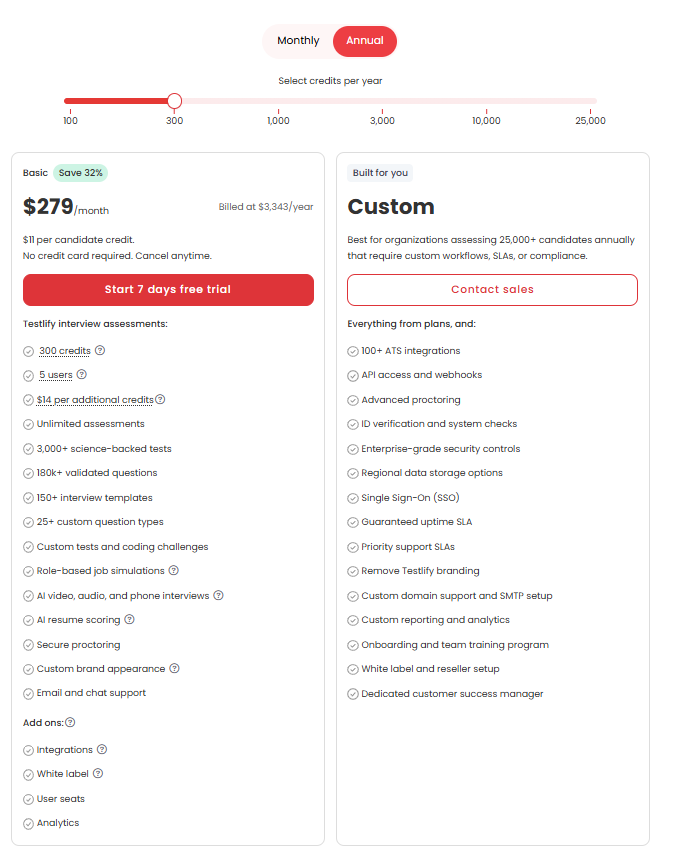
Testlify publishes its prices; iMocha doesn't. As of September 2026, Testlify's Starter plan is $139 a month on annual billing ($1,668 a year) for 100 candidate credits and 3 seats, Basic is $279 a month ($3,348 a year) for 300 credits and 5 seats, and Business is $699 a month ($8,388 a year) for 1,000 credits and 10 seats. iMocha's two pricing pages show a demo form and no plan or figure, so the price is whatever the quote says.
Testlify pricing
One credit is one started assessment by a qualified candidate; unused credits expire at the end of the cycle. Monthly billing uses smaller credit bundles at a higher unit price: Starter is $198 a month for 10 credits, Basic $398 for 30 and Business $998 for 100. Premium (3,000 credits a year), Enterprise (10,000) and Custom (25,000+) are quoted. Extra seats are $15 a month each on every tier, extra credits cost $21 on Starter, $14 on Basic and $10 on Business on the annual plans, and the base price is locked for 24 months. The trial is 7 days with no card, there is a 30-day money-back guarantee, and non-profits get 25% off. Three add-ons are priced separately on the self-serve tiers and included on Custom: ATS integrations at $2,388 a year, white labelling at $2,388 a year, and SAML SSO with two-factor authentication. AI phone interviews are metered at $0.18 a minute and face verification at $0.50 an attempt. Full detail is on the Testlify pricing page.
iMocha pricing
iMocha's /pricing and /pricing-skills-assessment pages, checked in September 2026, carry a demo request form, testimonials and a contact number, but no plan names, prices or trial terms. Review aggregators list figures for iMocha and vendor comparison pages repeat them, but iMocha itself doesn't confirm any of them, so this page doesn't either. One feature is known to be sold separately: screen recording is switched on through the payment portal.
To get a like-for-like quote from iMocha, ask for five numbers: the price per test attempt at your expected volume, the contract length and minimum, the cost of screen recording and video proctoring, the number of admin seats included, and whether Tara interviews are billed per interview. Then put the Testlify plan for the same volume next to it.
A worked example, hypothetical but typical of the companies that search for this comparison. A 45-person accounting firm plans to hire six staff accountants and two client-service coordinators over the next year, screening about 25 candidates per role. That's roughly 200 started assessments. On Testlify's annual Basic plan the firm pays $3,348 for 300 credits and 5 seats, so the two partners and the office manager can each review, and it gets a live Excel task, an AI video interview and dual-device proctoring on every candidate, with 100 credits to spare. On Starter it would pay $1,668 for 100 credits plus 100 extra credits at $21, or $3,768 in total, so Basic is the cheaper route above about 180 candidates a year. On iMocha the same firm needs a demo before it learns the number.
Verdict: pricing
Testlify, and not because it is always cheaper. At enterprise volume iMocha's quote may compete. Testlify wins because a small team can price the whole year in five minutes, try it for a week without a card, and leave with a refund inside 30 days. Transparent pricing is a feature when the buyer is a founder or office manager who does this once.
Is Testlify a good iMocha alternative?
Yes, for the teams that typically search for one: companies under about 200 people, hiring across several functions, that want a visible price, role-specific tests beyond coding, configurable AI interviews, and proctoring that can detect AI-written answers. Testlify covers all four. It is not the right iMocha alternative if what you actually need is iMocha's skills taxonomy and workforce-mapping analytics, because Testlify doesn't sell those.
The reason this question comes up is that iMocha's strength, enterprise skills intelligence, becomes the thing many customers pay for but don't use. A firm hiring 20 people a year doesn't need a map of 10,000 skills. It needs a shortlist by Friday and a price it can approve without a procurement cycle. The market is moving that way too. The World Economic Forum's Future of Jobs Report 2025 expects 39% of key skills to change by 2030, and in SHRM's April 2026 Talent Trends survey of 2,094 HR professionals, 68% still reported difficulty recruiting for full-time roles and 80% said the hardest skills to find were judgment, decision-making and complex problem-solving. Those are skills you see in a work sample and an interview transcript, not on a resume.
When Testlify is the better pick
- You hire for non-technical roles as well as technical ones and want the assessment to look like the job (a real spreadsheet, a real customer call).
- You want to see the price, start a trial today and cancel if it doesn't fit.
- You care about AI-written answer detection and second-device proctoring for remote hires.
- You want every AI score to stay advisory, with a logged human decision, for defensibility under rules like the EU AI Act or NYC Local Law 144.
- You don't have an ATS and want a simple pipeline included, or you already have one and want Testlify to plug into it as the screening layer.
When iMocha is the better pick
- You are an enterprise buying skills intelligence: a taxonomy, workforce mapping and upskilling analytics, with hiring tests as one input.
- Your hiring is mostly engineers and you value the coding depth, code-free AI-LogicBox tests and cross-customer industry benchmarks.
- Your learning team needs LMS integrations such as Degreed, Cornerstone or Coursera in the same platform.
- Procurement expects a negotiated annual contract, and a demo-first process is normal for you.
What are the best iMocha alternatives?
Testlify is the best all-round iMocha alternative for a multi-function team under about 200 people. Beyond it, the right pick depends on the job: developer-only platforms such as HackerRank, HackerEarth and Coderbyte for engineering teams; Mercer Mettl or TestInvite for exam-grade proctored drives; Predictive Index or Talogy for behavioural fit; and TestDome if you want to pay per candidate with no subscription.
Alternative | Best for | Main trade-off |
|---|---|---|
Testlify | Multi-function hiring at a published price with AI interviews and proctoring you can configure | No enterprise skills taxonomy or upskilling analytics |
HackerRank, HackerEarth, Coderbyte | Engineering-only teams | Thin outside coding |
Mercer Mettl, TestInvite | High-volume, exam-style proctored drives | Heavy for a small team hiring one role |
Predictive Index, Talogy | Behavioural and personality fit | Not a skills or coding test platform |
TestDome | Paying per candidate, no subscription | No AI interview, basic proctoring |
Fifteen of them, with September 2026 pricing and a scoring rubric, are in the iMocha alternatives guide. TestGorilla, the other name that comes up in this search, has its own TestGorilla alternatives comparison.
Hire on evidence: try Testlify on one open role
The fastest way to settle Testlify vs iMocha is to run one real role through Testlify while you wait for the iMocha quote. Start the 7-day free trial, no card needed, pick the role-specific assessment, add an AI video interview and switch on the Standard proctoring preset. Or book a 30-minute demo and bring the job description; the team will build the assessment with you on the call.
FAQs

Director of Marketing
Akash Patange is the Director of Marketing at Testlify, where he works closely with HR leaders and recruiters to help organizations improve hiring outcomes. He writes about talent assessment, recruitment technology, and data-driven hiring practices.
LinkedInRelated resources
View all
Competitor Comparisons
Testlify vs. Mercer Mettl: Which Platform is Best for HR Teams?
Competitor Comparisons
Testlify vs. Codility: Which Platform is Best for HR Teams?
Competitor Comparisons
Testlify vs. Vervoe: Which Platform is Best for HR Teams?
Competitor Comparisons
Testlify vs. Adaface: Which Skills Assessment Platform Wins in 2026?
Competitor Comparisons
Testlify vs TestGorilla: Which Talent Assessment Platform is Best for You?
Competitor Comparisons
Testlify vs Mercer Talent Enterprise: A detailed comparison
Get started.
Hire on proof, not resumes.
Run your first skills-based assessment free — no credit card required.