
Testlify vs Eggup: A detailed comparison
Discover the perfect solution for evaluating your candidates’ skills with Testlify. Dive into our comprehensive Testlify vs Eggup…
 ChatGPT
 Gemini
 Claude
 Grok
Grok Perplexity
Searching for an Eggup alternative?
Eggup is a soft-skill assessment service from the Zucchetti Group in Rome. It measures how people think, communicate and work together, using questionnaires drawn from a library of more than 220 skills. It does not test whether a candidate can write SQL, close a support ticket or run a payroll cycle. That one distinction decides most of this comparison.
So the honest version is not "Eggup is worse than Testlify". It is that the two tools answer different questions. Eggup answers "what is this person like to work with?" Testlify answers "can this person do the job?" If you are screening candidates and you only ask the first question, you are guessing at the second.
TL;DR
- Eggup is a soft-skill and behavioural questionnaire product, part of the Zucchetti Group, with more than 50 ready-made assessments and team reports built on 13 parameters.
- It publishes no technical, coding, typing or software-skills tests, and no proctoring. If you screen for job skills, that gap is the whole decision.
- Eggup does not publish a price on its own site. It does run a free trial that needs a business email. Directory listings quote a starting figure the vendor does not confirm.
- Testlify publishes 3,500+ ready-made tests, its plans and its prices, and covers skills, coding, cognitive and personality evidence in one place.
- Best use of Eggup: team development, climate surveys and coaching after someone is hired. Best use of a skills platform: deciding who gets the interview.
- If you rank or filter candidates in the EU, the assessment picks up high-risk duties under the AI Act from 2 December 2027, and those duties land on you, not the vendor.

What is Eggup, and who owns it?
Eggup is a digital assessment service that analyses and strengthens people's soft skills through personalised questionnaires and self-development suggestions. It is a company inside the Zucchetti Group, the Italian software group, and it is based in Rome.
That ownership matters more than a feature list. Zucchetti sells a full HR suite in Italy, so Eggup's natural gravity is toward Zucchetti's own recruiting and HR products. If your stack already runs on Zucchetti, that is a real advantage. If it does not, you are buying a component whose roadmap answers to a suite you do not use, and the vendor publishes its site in English and Italian only.
The product supports three stated processes: recruitment (soft-skill pre-screening), training and development, and organisational analysis. Two of those three are post-hire. That is a fair reading of where the product's centre of gravity sits.
What does Eggup actually measure?
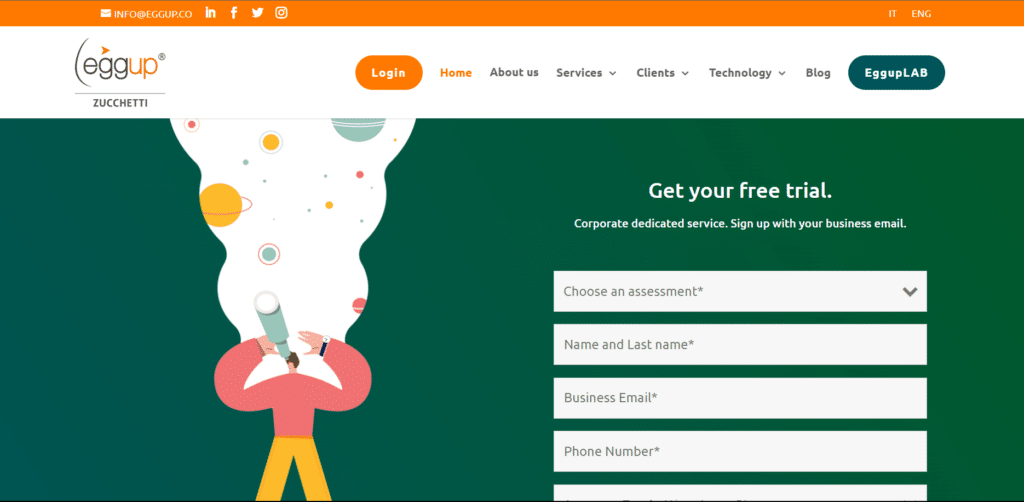
Eggup builds and delivers tests on soft skills to produce individual and team data. Its assessment catalogue holds more than 50 preconfigured assessments, grouped by use: recruitment, training and development, and multifunctional. You can also build a custom assessment by mapping your company values or competency model onto its skill library.
The team side is the more distinctive part. Eggup produces team reports across 13 parameters, including team potential, team effectiveness and team commitment, and it draws on Belbin's work on team roles. Around that sit skills mapping, 360 evaluation, a workplace climate survey, and Smart Coach, which suggests books, talks and courses based on a person's results.
What is not in any of that: coding tests, typing tests, software-skills tasks, role-specific job-knowledge tests, or proctoring. Eggup does not claim them either, which is the honest way to put it. Marking a vendor "absent" on capabilities it never advertised tells a buyer nothing, and a comparison built that way is worth less than no comparison at all.
Testlify vs Eggup: what each vendor publishes
Every row below is checkable against each vendor's own published material. Where a vendor documents nothing, the cell says "Not published" rather than claiming the capability is missing. Absence of a claim is not proof of absence.
Dimension | Testlify | Eggup |
|---|---|---|
What it measures | Job-relevant skills, coding, cognitive ability, personality and behaviour | Soft skills, behaviour, team dynamics |
Ready-made content | 3,500+ tests across roles | More than 50 preconfigured assessments, drawn from 220+ skills |
Custom assessments | Yes, custom questions and an assessment builder | Yes, mapped from your values or competency model |
Coding and technical tests | Yes | Not published |
Typing and software-skills tests | Yes | Not published |
Team-level reporting | Not published as a team product | Yes, 13 parameters including team potential and commitment |
360 feedback and climate survey | Not published | Yes |
Post-assessment coaching | Not published | Yes, Smart Coach suggestions |
Proctoring and anti-cheating | Yes | Not published |
Published pricing | Yes, plans and prices on the pricing page | Not published on the vendor site |
Free trial | 7 days, no credit card | Yes, business email required |
Vendor site languages | English | English and Italian |
Ownership | Independent | Zucchetti Group, Rome |
How much do Testlify and Eggup cost?
Eggup pricing
Eggup does not publish a price on its own site. It runs a free trial that asks for a business email, and the buying route is a conversation. Software directories list a starting figure, but that number comes from the directory, not from Eggup, so treat it as a rumour until a quote lands in writing.
Ask for two things in that quote: whether you are buying assessments or seats, and what happens to unused volume at renewal. Questionnaire products are often priced per person assessed, which gets expensive quickly if you plan to screen everyone who applies rather than a shortlist.
Testlify pricing
Testlify publishes its plans openly. The Standard plan is $139 a month, billed at $1,668 a year for 100 candidate credits, which works out at $16.68 per candidate assessed. There is a 7-day free trial with no credit card and a 30-day money-back guarantee. Volume above 25,000 candidates a year moves to a custom plan. Full detail sits on the Testlify pricing page.
The reason to care about published pricing is not virtue. It is that you can model a hiring year without a sales call, and you can compare two vendors on the same basis instead of comparing a real number to a maybe.
Which tool fits which hiring problem?
Use Eggup when the question is about people you already employ. Mapping the soft skills in a department, running a climate survey, understanding why a team of capable individuals keeps missing deadlines, giving someone a development path after a review: that is where a soft-skill questionnaire with a coaching layer earns its keep.
Use a skills-assessment platform when the question is who to interview. A support hire needs to handle an angry customer in writing. A data analyst needs to spot the error in a spreadsheet. A junior developer needs to debug something. None of those show up in a questionnaire about personality traits, and a candidate who scores well on collaboration can still be unable to do the work.
None of this makes soft skills a soft concern. In the World Economic Forum's Future of Jobs Report 2025, analytical thinking is the most sought-after core skill, named essential by seven in ten employers, with resilience, flexibility and agility close behind at 67%. Those are exactly the qualities Eggup is built to describe. The argument here is about when you measure them, not whether they matter.
Plenty of teams need both, and that is fine. The mistake is using one where the other belongs. Screening on a behavioural questionnaire alone is the most common version of that mistake, and it is expensive, because you find out at week six. A pattern we keep seeing on vendor shortlists: the development tool gets bought first, because it demos beautifully, and the screening problem it was supposed to solve is still there a quarter later.
Also Read: Testlify vs Alva Labs: Which Skills Assessment Platform Wins in 2026?
Related Read: Testlify vs Canditech: Which Assessment Platform Wins in 2026?
Related Read: Testlify vs Adaface: Which Skills Assessment Platform Wins in 2026?
What does the validity evidence say?
Selection research is blunt about this. The most-cited modern reanalysis, Sackett and colleagues (2022), revised many long-quoted validity numbers downward and put structured interviews at .42 and cognitive-ability tests at .31 for predicting job performance. General personality inventories sit below that group, not above it.
Read that carefully, because it cuts both ways. It does not say behavioural measurement is worthless. It says a self-report questionnaire about how someone prefers to work is a weaker predictor of job performance than evidence of the work itself, and it should therefore sit alongside skill evidence rather than in front of it. The same paper's estimates are still argued over in print, so treat the ranking as the durable finding and the exact decimals as contested.
There is a second, quieter problem with using any self-report soft-skill questionnaire to screen: candidates know what a good answer looks like. Someone applying for a sales job can work out which option reads as "resilient". That pressure does not exist when a person is already hired and taking the same questionnaire for development, which is the setting these tools were built for.
This is what the Testlify Multi-Signal Talent Evaluation Model is for. Combine several role-relevant signals (a skills assessment, a structured interview, a work sample, reviewer feedback) instead of leaning on one. One signal is fragile. Several pointing the same way is a decision you can defend.
What do EU and US hiring rules require?
An assessment used to rank or filter job applicants is regulated in a way a development questionnaire is not, and the duty falls on the employer.
In the EU, AI systems used for recruitment and candidate evaluation are listed as high risk under Annex III of the AI Act. The European Commission's AI Act timeline now sets application of those Annex III rules at 2 December 2027, extended from the original date under the AI Act simplification agreement. That is breathing room, not a reprieve, and the obligations include risk assessment, documentation, human oversight and monitoring.
In New York City, Local Law 144 already requires an annual independent bias audit of an automated employment decision tool, published results, and notice to candidates. If a scored questionnaire meaningfully narrows your shortlist, it is in scope.
So ask any vendor, Eggup included, for the same three artefacts: what the tool measures and how it was validated, what evidence exists on group differences in scores, and what you can export if you have to answer a candidate or a regulator. A vendor that cannot produce those has handed you the liability.
How do you choose between them?
Six checks, in the order that actually saves money:
- Write down the decision the tool informs. Screening a shortlist and developing a team are different purchases.
- List the job-relevant skills for one real open role. If the tool cannot evidence them, it is not a screening tool for you.
- Get the price in writing, per candidate and per year, including what happens to unused volume.
- Check the languages your candidates actually speak, not the languages the marketing site offers.
- Ask for the validation evidence and the bias-audit position before the pilot, not after.
- Pilot on one role with a scorecard agreed in advance, and compare the shortlist to what your hiring manager would have picked.
Pro Tip: run the pilot on a role you have already hired for. You know who worked out. If the assessment ranks your good hires near the top, that is the only validity signal that will convince a hiring manager, and it costs you one afternoon.
Ready to see what job-relevant skill evidence looks like for one of your open roles? Browse the Testlify test library to see what a role-based assessment covers, check how it plugs into your stack on the integrations page, or book a demo and bring a role you are struggling to screen.
Key takeaways
- Eggup and a skills platform are not substitutes. Eggup measures behaviour and team dynamics; a skills platform measures whether someone can do the job. Buying one expecting the other is the failure mode this page exists to prevent, and it usually surfaces six weeks after a hire starts.
- Eggup's strongest ground is post-hire. Team reports on 13 parameters, 360 evaluation, climate surveys and Smart Coach are development tools. If your problem is an existing team that is not working, that is a genuine fit and worth a trial.
- The pricing gap is a planning gap. Eggup publishes no price on its own site, so you cannot model a hiring year without a sales call. Testlify's $139 a month Standard plan and $16.68 per candidate credit let you do the maths before you talk to anyone.
- Weigh the evidence, not the vendor's confidence. Sackett and colleagues put structured interviews at .42 and cognitive-ability tests at .31, with general personality inventories lower. A self-report questionnaire belongs beside skill evidence, not in front of it, and candidates can guess the "right" answers when a job is on the line.
- The compliance duty is yours. EU Annex III obligations for recruitment AI apply from 2 December 2027, and NYC Local Law 144 bias-audit duties apply now. Get validation evidence and audit positions in writing before the pilot, because the regulator asks the employer, not the vendor.
- Zucchetti ownership cuts both ways. If you run Zucchetti HR software, Eggup will fit neatly. If you do not, you are buying a component built to orbit a suite you do not own, with a vendor site published in English and Italian only.
FAQs
Related resources
View all
Competitor Comparisons
Testlify vs easy.jobs: A detailed comparison
Competitor Comparisons
Testlify vs Discover Assessments: A detailed comparison
Competitor Comparisons
Testlify vs ExpertRating: A detailed comparison
Competitor Comparisons
Testlify vs ExaminLab: A detailed comparison
Competitor Comparisons
Testlify vs eVerifile: A detailed comparison
Competitor Comparisons
Testlify vs Quest Wing: A detailed comparison
Get started.
Hire on proof, not resumes.
Run your first skills-based assessment free — no credit card required.