
Testlify vs. Harver: Which Skills Assessment Platform is Best for HR Teams?
Testlify vs. Harver: Discover which skills assessment platform best suits your hiring needs
Testlify and Harver both replace resume screening with evidence, but they are built for different companies. Harver is an enterprise, high-volume hiring platform for teams filling hundreds or thousands of similar roles a year, sold on a custom quote. Testlify is a self-serve assessment and AI interviewing platform with published pricing, aimed at teams that want the same rigor without an enterprise rollout.
That is the whole fork, and most of the buying decision follows from it. The rest of this page shows where each platform is genuinely stronger, what a Harver test actually measures, how the pricing models differ, and which one fits the way your team hires.
 ChatGPT
 Gemini
 Claude
 Grok
Grok Perplexity
TL;DR
- Harver is purpose-built for high-volume hiring at scale: game-based and situational assessments, ready-made job profiles, and one-way video, wrapped in an implementation project.
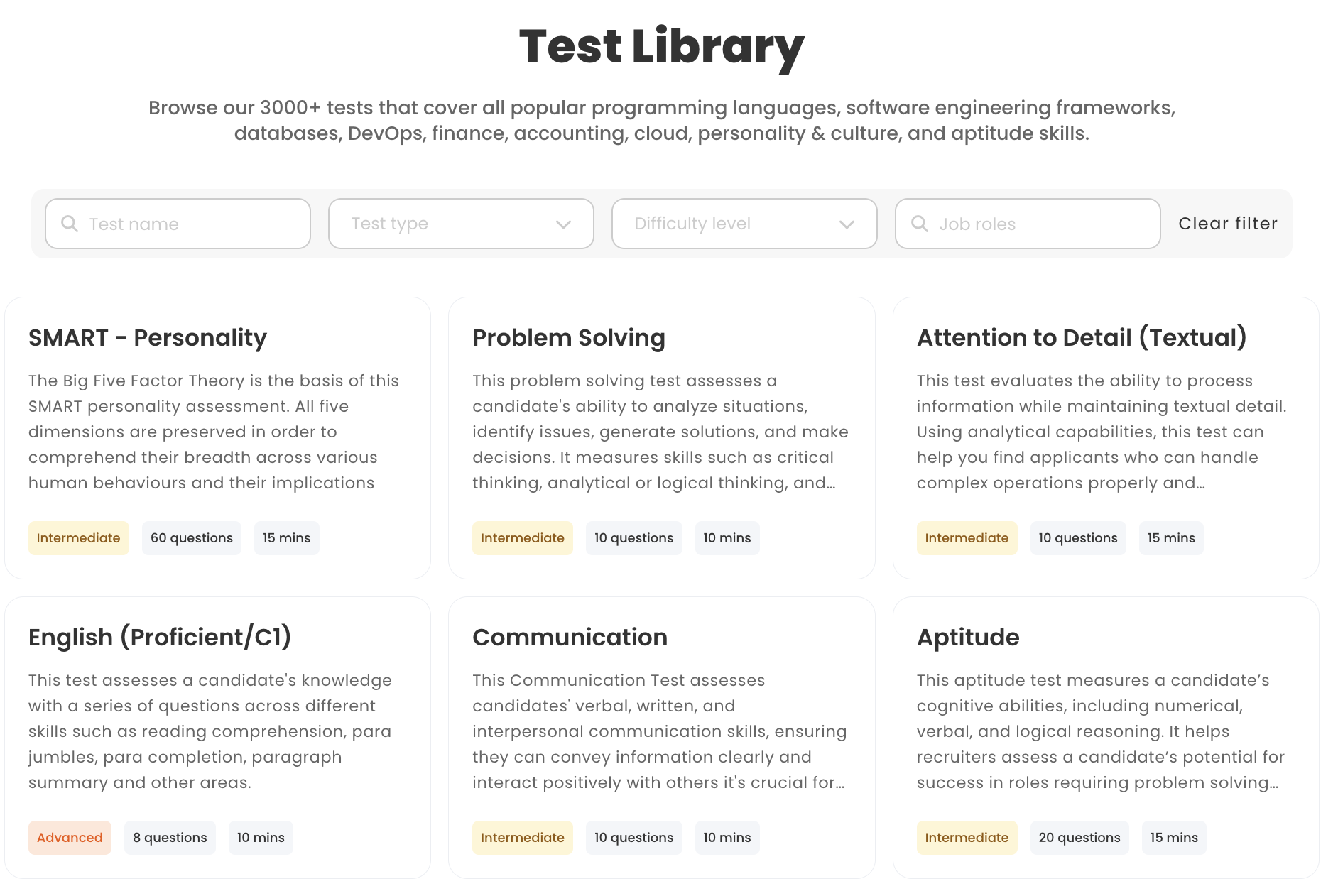
- Testlify covers a wider range of question types (25+, including live coding in a browser VS Code editor and real Google and Microsoft Office tasks) and ships two-way conversational AI video, voice and phone interviews in the same product.
- Testlify publishes its prices. Harver does not, so the cost comparison is a quote conversation rather than a pricing page.
- Testlify's dual-device proctoring (the candidate's phone becomes a second camera) and item-level psychometrics are the two capabilities that are hardest to find anywhere else.
- Pick Harver if you hire at industrial volume in retail, contact centers or logistics and have the budget and time for an enterprise deployment. Pick Testlify if you want skills evidence running this week.

What is Testlify?
Testlify is a pre-hire assessment and interviewing platform. Teams use it to test skills before the first call: role-based tests, cognitive ability, personality and culture, coding, and language, plus AI-led interviews across video, voice and phone. It also ships a simple built-in hiring pipeline for teams that do not already run an applicant tracking system, and it integrates with more than 100 ATS platforms for the teams that do.
The part that surprises evaluators is the depth of the question set. There are 25+ question types, and several of them are genuinely uncommon. Candidates can be asked to work inside a real Google Sheet, Google Doc, Microsoft Excel workbook or PowerPoint deck. Coding questions run in an embedded VS Code editor with up to 20 test cases, hidden or visible, including SQLite database test cases. There is a "vibe coding" mode that asks candidates to direct AI tools toward a working solution instead of writing syntax by hand, which is closer to how engineers actually work in 2026 than a whiteboard-style puzzle.
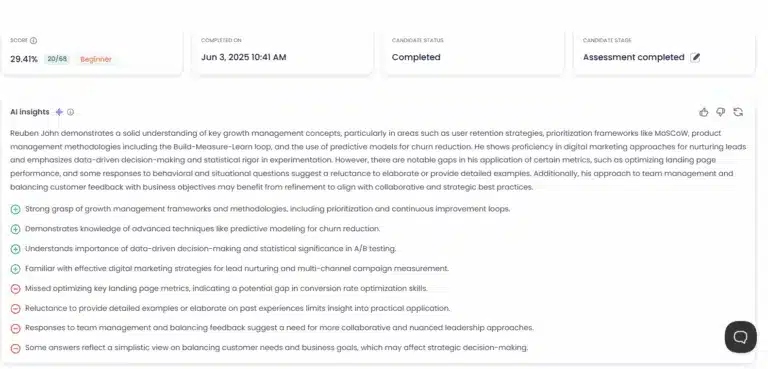
Testlify approaches all of this through the Testlify Human+AI Evidence-Based Hiring Framework: combine AI-assisted evaluation with human judgment, using structured evidence instead of resumes, intuition, or inconsistent interviews. In practice that means the AI scores, and a person decides. The product ships the disclaimer itself: "AI scores and insights are for guidance only. Use human judgment for final decisions." Whether AI scores are shown to reviewers at all, and whether they count toward the final average, are both toggles a customer controls.
What is Harver?
Harver is a volume hiring platform. It grew out of predictive hiring methods for roles that get filled in bulk: retail floor staff, contact center agents, warehouse and logistics crews, hospitality. Its own materials describe 15+ validated assessment types spanning cognitive ability, personality, culture fit, multitasking, situational judgment and spoken language, and more than 900 ready-made job profiles that a team can adopt rather than build.
Harver's game-based assessments are its signature. Rather than asking a candidate to self-report how they handle pressure, the platform observes behavior during a short interactive task and infers traits such as risk aversion and decision-making. For a company screening 20,000 applicants for seasonal retail roles, that is a defensible way to rank people fast, and Harver's fairness controls (consistent question order, face blurring on video review) are designed with exactly that adverse-impact scrutiny in mind.
Harver also runs one-way video interviews, which puts it alongside the wider set of interviewing platforms, and integrates with the major ATS platforms, deployable as an embedded widget or a standalone branded experience. What it does not do is publish a price.
Testlify vs Harver at a glance
Area | Testlify | Harver |
|---|---|---|
Built for | Lean teams and mid-market hiring across varied roles | High-volume, repeatable hiring at enterprise scale |
Question types | 25+, including Office app tasks, VS Code coding, vibe coding, typing, practical file or URL submissions | 15+ validated assessment types plus game-based tasks, per Harver's own materials |
Ready-made job content | Large test library plus AI assessment creation from a job description | 900+ ready-made job profiles, per Harver's own materials |
Video interviewing | One-way, two-way conversational AI video, voice and outbound AI phone calls, with selectable avatars and voices | One-way asynchronous video with fairness controls such as face blurring |
Live human panel scheduling | No | Interview scheduling is part of the automation suite |
Proctoring | Three presets, 20+ measures, dual-device phone-as-second-camera monitoring, AI-tool detection | Assessment integrity controls oriented to volume screening |
Item-level psychometrics for recruiters | Difficulty index, discrimination index, quality risk, answer distributions | Validation is handled by Harver's science team rather than exposed per item |
Pricing | Published: $139, $279 and $699 per month on annual billing, then contact sales | Custom quote only, not published |
Free trial | 7 days, no card required | Demo and scoping call |
What does a Harver test actually measure?
A Harver test measures fit for a specific high-volume role rather than raw skill in isolation. A typical assessment blends a cognitive component, a personality or culture-fit component, a situational judgment scenario, and often a game-based task that captures behavioral signals like risk tolerance and decision speed. The output is a match score against a job profile.
That design choice matters more than any feature list. Harver is optimized for ranking a very large applicant pool against a known role shape, which is why the 900+ pre-built profiles exist. It is a strong answer when the role is standardized and the volume is enormous.
It is a weaker answer when the roles are varied. A 90-person marketing agency hiring a paid-media analyst, a motion designer and a client-services lead in the same quarter does not have a job profile to match against, and does not want to commission one. That team needs to see whether the analyst can actually build a pivot table and whether the designer can talk through a brief. Different question, different tool.
Harver competitors: how does Testlify compare?
Against Harver and the other platforms in its category, Testlify's advantage is breadth of evidence per candidate rather than throughput. Four things separate it, and none of them are marketing lines.
Work-sample depth. Office-app questions are bound to the real products, so a candidate signs into Google or Microsoft and does the actual task. Coding questions run in a browser-based VS Code editor. That is a different class of evidence from a multiple-choice proxy, and it is the reason a hiring manager trusts the shortlist.
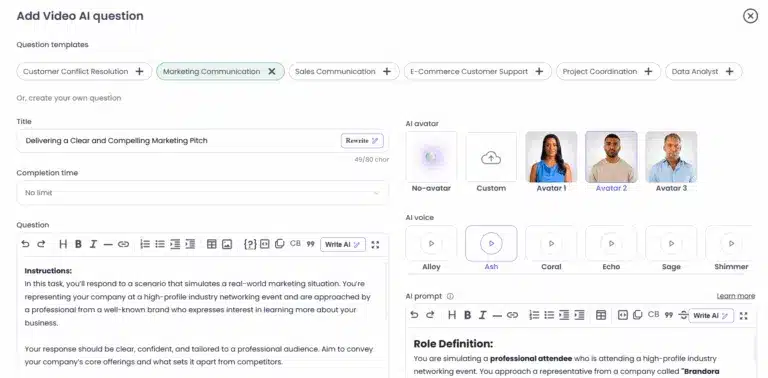
Interviewing in the same product. Testlify runs one-way video, two-way conversational AI video, voice questions and outbound AI phone interviews (billed at $0.18 per minute). The AI interviewer is configurable down to the avatar, the voice, the persona, the context and the custom prompts, with recording-time limits, attempt limits (including no limit), auto-start with preparation time, and automatic multilingual transcripts for any recording of at least 30 seconds. Responses are auto-scored, and a human can override. During a live AI voice interview the candidate is muted while the AI is speaking, which is real turn-taking rather than a recorded prompt.
Dual-device proctoring. The candidate's phone becomes a second camera, positioned to capture both the candidate and the laptop screen. It is a hard gate: the assessment will not start until mobile monitoring is active, and ending it mid-session is logged and reported to the administrator. Almost nothing else in this market does it.
Item-level psychometrics, shown to recruiters. Difficulty index, discrimination index, quality risk flags on questions with very low accuracy or high skip rates, answer distributions, and per-question timing. This is test-publisher territory, and most platforms keep it internal. Exposing it means a recruiter can find out that the question everyone fails is a bad question, not a hard one.
Pro Tip: run the same role through both tools with five real candidates before you sign anything. Vendors demo their strongest workflow. Your own hiring pattern will expose the gap faster than any comparison page, this one included.
How do you compare Harver alternatives?
Most buyers compare Harver alternatives on feature checklists, which is the wrong axis. Feature lists converge; every platform in this category will claim assessments, video and integrations. Three questions actually separate them.
How many roles, and how similar are they? If you are hiring 2,000 people into four job shapes, profile-matching and game-based ranking earn their keep. If you are hiring 40 people into 25 different job shapes, pre-built profiles are dead weight and you want authoring flexibility instead.
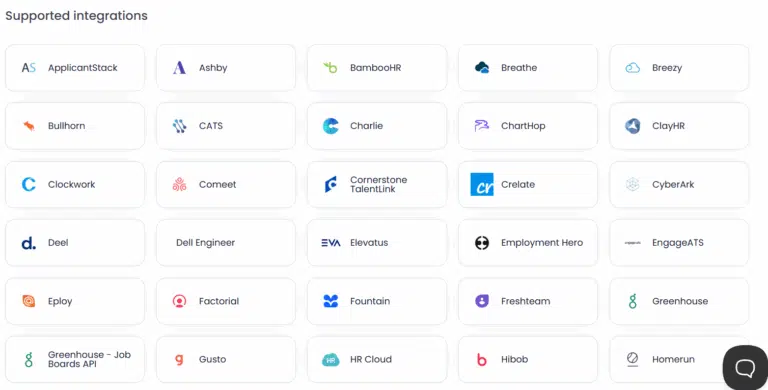
What happens after the score? A score that lands in a spreadsheet gets ignored. Check whether the platform pushes candidates into the system you already use. Testlify integrates with 100+ ATS platforms and can auto-advance a candidate to the next ATS stage when they clear a cut-off score, and it defers to your ATS as the system of record. It is worth pricing carefully: those ATS integrations are a $2,388 per year add-on on the self-serve tiers rather than included, which is a real line item and one of the more common surprises in this comparison.
Can you defend the decision? This is the question that gets skipped until a rejected candidate asks. Testlify's answer is evidence-first rather than automatic: proctoring flags are green, yellow or red, and yellow explicitly reads "a quick manual review is recommended" rather than triggering a rejection. Auto-termination is a separate, opt-in setting with a threshold the recruiter picks. Face verification data is deleted after 30 days and consent can be withdrawn at any time. Those are the details a legal team asks about, and vague answers cost deals.
How do the two compare on pricing?
Testlify publishes its pricing and Harver does not, so this is less a price comparison than a difference in how the two companies sell.
On annual billing, Testlify's Starter plan is $139 per month (100 assessment credits a year, 3 seats), Basic is $279 per month (300 credits, 5 seats), and Business is $699 per month (1,000 credits, 10 seats). Premium, Enterprise and Custom tiers are quote-based. Monthly billing uses the same tier names with different credit counts and higher per-credit costs. One credit is consumed per assessment started by a qualified candidate, credits do not roll over, and extra seats are $15 per seat per month on every tier. There is a 7-day free trial with no card, a 30-day money-back guarantee, and pricing is locked for 24 months.
Two things to budget for beyond the headline number. White labeling and the 100+ ATS integrations are each $2,388 per year on the self-serve tiers, included only on Custom. And metered items are billed separately: AI phone interviews at $0.18 per minute, face verification at $0.50 per attempt.
Harver's pricing is not published anywhere on its site. Cost depends on hiring volume, the modules selected, integration work and any custom content development, and it arrives after a scoping conversation. Third-party estimates circulate, but none are from Harver, so treat them as noise and ask for a quote against your actual req volume.
The practical difference: a 70-person company can start using Testlify this afternoon on a card, and cannot start using Harver without a sales cycle. For a large enterprise that cycle is normal and the scoping is genuinely useful. For a lean team it is the reason the project never starts.
Which platform fits your team?
Harver fits when hiring is industrial. Hundreds or thousands of hires a year into a small number of standardized roles, a dedicated talent acquisition function, an incumbent applicant tracking system already in place, and budget and appetite for an implementation. Retail chains, BPO and contact center operators, logistics networks and large hospitality groups are the natural shape.
Testlify fits when hiring is varied and the team is lean. Under roughly 200 employees, a handful of hires a month across quite different roles, no dedicated assessment specialist, and a preference for starting this week rather than next quarter. Agencies, professional-services firms, accounting and real-estate practices, regional retail groups and outsourcing teams tend to land here.
The honest boundaries on the Testlify side: it does not schedule live human interview panels, so calendar coordination for a four-person panel still happens in your ATS or calendar tool. Assessments run on Chromium desktop browsers (Chrome or Edge), with the mobile app as a capture fallback for audio and video rather than a way to sit a full test on a phone. AI resume scoring is currently limited to Greenhouse integrations. And Testlify's built-in hiring pipeline is a simple one, meant for teams that have no ATS, not a replacement for an enterprise system of record.
Hire on evidence instead of guesswork
Median time to fill a nonexecutive role now sits at 39 calendar days, according to SHRM's 2025 recruiting benchmarking data. Meanwhile US employers made 5.1 million hires in July 2026 against 3.1 million quits, per BLS JOLTS data, and the hires rate has settled at 3.4 percent, a level Indeed Hiring Lab characterizes as a low-hire, low-fire market. Fewer roles, longer to fill, and a higher cost to getting each one wrong.
Set up an assessment for one open role, send it to five candidates you have already screened, and compare the ranking to your gut. Start a 7-day free trial with no card, or book a walkthrough against your own roles.
Key Takeaways
- Volume decides the tool, not the feature list. Harver is engineered for ranking huge applicant pools against standardized job profiles, and Testlify for gathering deep evidence on individual candidates across varied roles. Match the tool to the shape of your hiring, because a platform built for 2,000 identical hires is overhead when you are making 40 different ones.
- Published pricing is a buying-speed signal. Testlify lists $139, $279 and $699 per month tiers on annual billing; Harver quotes. Enterprises absorb a scoping cycle easily, but for a lean team it usually decides whether the project happens at all, so factor the sales cycle into your timeline, not just the license fee.
- Budget the add-ons before you compare totals. ATS integrations and white labeling are $2,388 per year each on Testlify's self-serve tiers, and AI phone interviews are metered at $0.18 per minute. A headline monthly price is not the total, and this is where comparison spreadsheets usually go wrong.
- Interviewing in the same product removes a handoff. Testlify runs one-way video, two-way conversational AI video, voice and outbound phone interviews with configurable avatars, prompts and attempt limits, auto-scored with human override. That collapses the screening-to-interview gap where candidates go cold, which matters when the median role already takes 39 days to fill.
- Defensibility is a product feature, and it is worth auditing. Green, yellow and red proctoring flags with an explicit "manual review recommended" state, opt-in auto-termination, a 30-day deletion window on face verification data and withdrawable consent are the specifics a legal review asks for. Ask any vendor for the equivalent detail in writing before you sign.
- Test with your own candidates before committing. Run one real role through a shortlist of five on each platform. Demos are built around each vendor's strongest workflow, and the gap between a demo and your hiring pattern is the single most expensive thing to discover after purchase.
FAQs

Director of Marketing
Akash Patange is the Director of Marketing at Testlify, where he works closely with HR leaders and recruiters to help organizations improve hiring outcomes. He writes about talent assessment, recruitment technology, and data-driven hiring practices.
LinkedInRelated resources
View all
Competitor Comparisons
Testlify vs. Talview: Which Skills Assessment Platform is Best for HR Teams?
Competitor Comparisons
Testlify vs. Cangrade: Which Skills Assessment Platform is Best for HR Teams?
Competitor Comparisons
Testlify vs Test Partnership: Comparison Guide for HR Teams
Competitor Comparisons
Testlify vs. Alva Labs: Which Skills Assessment Platform Wins in 2026?
Competitor Comparisons
Testlify vs. Pixonality: Which Skills Assessment Platform is Best for HR Teams?
Competitor Comparisons
Testlify vs. Perspect AI: Which Skills Assessment Platform is Best for HR Teams?
Get started.
Hire on proof, not resumes.
Run your first skills-based assessment free — no credit card required.