
Testlify vs. Criteria Corp: Which Skills Assessment Platform is Best for HR Teams?
Testlify vs. Criteria Corp: Discover which skills assessment platform best suits your hiring needs
Testlify is the better choice when you need a large role-specific test library, coding tests, conversational AI interviews, proctoring that's on by default, and a price you can read before you talk to sales. Criteria Corp is the better choice when you want a small set of validated cognitive, personality and emotional-intelligence instruments backed by more than 15 years of normative data, and you're fine with quote-based pricing. That is the short answer. The rest of this page shows the evidence behind it: what each platform does, a feature-by-feature table built only from things both vendors publish, 2026 pricing, and how Criteria Corp stacks up against Harver, TestGorilla and eSkill, since those are the comparisons buyers run in the same week.
 ChatGPT
 Gemini
 Claude
 Grok
Grok Perplexity
TL;DR: which platform should you pick?
- Pick Testlify if you hire across many roles (technical and non-technical) and want one platform for skills tests, coding tests, conversational AI interviews and proctoring, with a published $139 per month entry price.
- Pick Criteria Corp if your process leans on psychometrics (cognitive aptitude, personality, emotional intelligence, risk) and you value long-running norms over library breadth. Coding tests are not part of its catalog.
- Proctoring is the widest gap. Testlify ships twelve integrity layers on by default. Criteria's AI Proctoring is an add-on built on automatic candidate photos plus periodic screen and audio captures.
- Both integrate with the major ATS platforms. Criteria names 72 partners on its integrations page; Testlify lists 100+, but on the Standard plan ATS integration is a paid add-on, so budget for it.
- Criteria doesn't publish prices, so treat any number you see on a review site as a negotiated contract, not a rate card.
- If you searched "Harver vs Criteria Corp", the honest framing is volume-hiring automation (Harver) versus psychometric depth (Criteria), and Testlify sits between the two with broader skills coverage than either.

What is Testlify?
Testlify is an AI-assisted, human-led talent assessment platform. Hiring teams use it to screen candidates on real skills instead of resumes, using a library of 3,500+ tests, conversational AI interviews across chat, voice and video, and layered proctoring. AI scores and summarizes the evidence; recruiters and hiring managers make the decision. It's built for teams from a first hire to 25,000+ candidates a year.
The reason breadth matters more than it did three years ago is simple. The World Economic Forum's Future of Jobs Report 2025 found that employers expect 39% of workers' core skills to change by 2030. A library that adds new role tests quickly keeps up with that churn. A fixed set of aptitude instruments, however well validated, can't.
How does Testlify work?
Testlify runs the assessment stage of hiring end to end. Here's the workflow, start to finish.
1. Build the assessment
Pick tests from the library or generate custom questions with AI. Question formats include multiple choice, open-ended, file upload, Microsoft Office and Google Workspace tasks, and live coding challenges. Conversational AI interviews simulate on-the-job situations in chat, voice or video.
2. Invite candidates
Send invitations by email, a public link or straight from your ATS. Candidates don't create an account; the link opens the assessment.
3. Protect the results
Twelve proctoring layers run by default: session recording with webcam snapshots, IP and location checks, copy-paste blocking, tab and mouse-out tracking, forced full screen, AI-assistance detection, AI identity verification and mandatory screen sharing among them. You set your own violation tolerance per assessment.
4. Score and summarize
Tests are auto-scored, and an AI summary flags each candidate's strengths and gaps so a recruiter can read a shortlist in minutes rather than an afternoon. Reviewers add their own ratings alongside the scores.
5. Sync with your stack
Push results into 100+ ATS and HR tools, including Greenhouse, Lever, Workday and SAP SuccessFactors, so the shortlist lands where recruiters already work.
6. Stay compliant
Testlify is GDPR compliant and holds SOC 2 Type II and ISO 27001 certifications, with role-based access, audit logs and data governance controls for enterprise security reviews.
What is Criteria Corp?
Criteria Corp is a pre-employment testing platform grounded in industrial-organizational psychology. It sells six assessment families: cognitive aptitude, personality, emotional intelligence, risk (integrity, rule adherence, unsafe behavior), skills (job readiness, computer skills, Microsoft Office, English proficiency) and short game-based assessments. Its site reports "60 Million+ Tests Administered" across 15+ years and 60 countries. Video interviewing, AI proctoring and post-hire development tools are sold alongside or as add-ons.
What Criteria doesn't sell is worth knowing too. Its assessments page lists no coding or programming tests, no live-coding environment and no conversational AI interviews. Teams hiring engineers alongside customer-service reps end up pairing Criteria with a second tool.
How does Criteria Corp work?
The Criteria workflow is a classic testing pipeline: pick validated instruments, invite, score, report.
1. Choose assessments
Select from the cognitive, personality, emotional-intelligence, risk, skills and game-based catalogs, or build a knowledge test with TestMaker, which supports multiple choice, true/false, yes/no, open-ended and check-all-that-apply items.
2. Invite candidates
Share a testing link by email, embed it in your application flow, or trigger it from an integrated ATS. Candidates complete assessments on desktop, tablet or mobile.
3. Score and compare
Score reports translate psychometric results into plain-language profiles, and recruiters can compare candidates side by side against role benchmarks.
4. Report and sync
Results export as PDF or Excel, share inside the platform, or sync to the ATS through one of the 72 named integrations or the API.
How do Testlify and Criteria Corp compare on features?
The table below uses only facts each vendor publishes on its own site as of September 2026. Where a capability depends on a paid add-on, it says so, because that changes the real price more than any headline feature does.
Capability | Testlify | Criteria Corp |
|---|---|---|
Test library | 3,500+ tests across 4,500+ roles and 50+ industries | Six assessment families (cognitive, personality, emotional intelligence, risk, skills, game-based); no total published |
Coding and programming tests | Yes, including live coding in 45+ languages | Not listed |
Custom questions | 25+ question types, AI-generated questions, file upload, Office and Workspace tasks | TestMaker: multiple choice, true/false, yes/no, open-ended, check-all-that-apply |
Conversational AI interviews (chat, voice, video) | Yes, included | No; async and real-time video interviewing in the Interview and Hire packages, AI Interview Agent as an add-on |
Proctoring | Twelve layers on by default; photo ID verification $0.50 per attempt and live video proctoring $5 per attempt as add-ons on Standard | Non-AI proctoring included; AI Proctoring (automatic candidate photos, periodic screen and audio captures) is an add-on |
AI candidate summaries | Yes, in every report | AI scoring, transcripts and summaries sold as an "AI Features" add-on |
ATS and HRIS integrations | 100+; add-on priced at $2,388 per year on the Standard plan, included on Custom | 72 named partners plus API; "Premium Integrations" as an add-on |
White-label branding | Yes; $2,388 per year add-on on Standard, included on Custom | Branded experience included in every package |
Benchmarking and reporting | Skill-level breakdowns, question analytics, benchmarks, PDF / CSV / XLSX export | Score reports, side-by-side comparison, PDF / Excel export |
Security | SOC 2 Type II, ISO 27001, GDPR, CCPA | SSO and MFA in every package |
Published pricing | Yes: $139 per month Standard, Custom at 25,000+ candidates a year | No; request a quote |
Free trial | 7 days, no credit card | Not offered on the pricing page |
Test library and test types
Testlify's library covers 4,500+ roles across 50+ industries, and the test families map to how hiring managers actually think about a role:
- Cognitive ability tests for problem solving, numerical and logical reasoning, and attention to detail
- Role-specific tests for sales, support, finance, marketing, operations and hundreds more
- Programming tests and live coding across 45+ languages
- Software skills tests for Excel, CRMs and everyday tooling
- Psychometric tests for personality, emotional intelligence and behavior
- Situational judgment tests for decision-making under realistic pressure
- Blue-collar hiring tests, typing tests and language tests
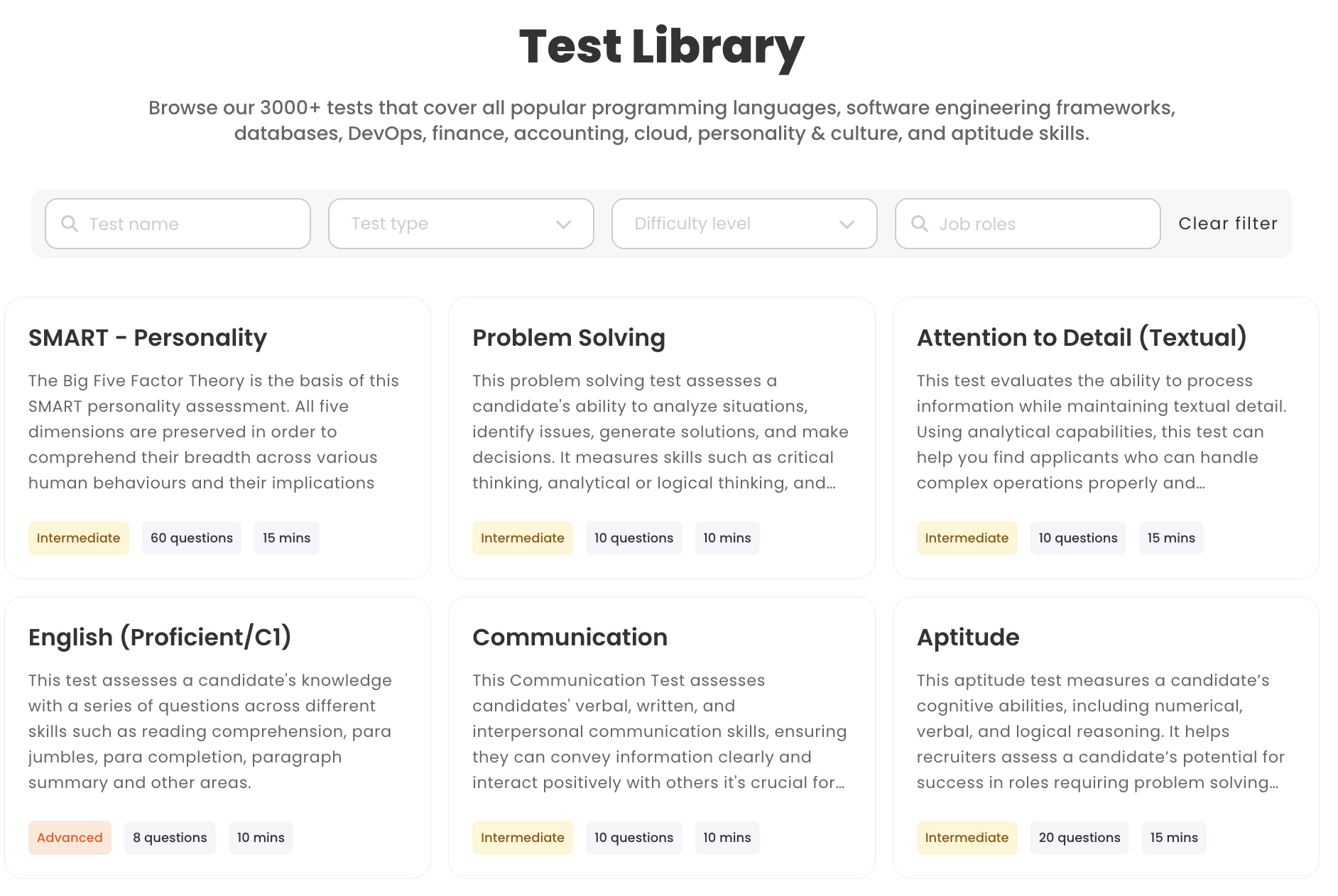
Criteria Corp goes narrow and deep. Its cognitive, personality, emotional-intelligence and risk instruments have been administered tens of millions of times, which gives its norms real weight. Its skills family is limited to job readiness, computer skills, Microsoft Office and English.
Verdict: Criteria wins if the question is "how good is your aptitude test?" Testlify wins if the question is "can you assess this exact role?" For most enterprise teams the second question comes up far more often, because they hire warehouse leads, SDRs and backend engineers in the same quarter.
Custom questions and TestMaker
Testlify supports 25+ question types, and you can have AI draft role-specific questions from a job description and then edit them. File-upload questions let a designer submit a mockup and a finance analyst submit a model. Office and Workspace tasks test the actual software rather than trivia about it.
Criteria's TestMaker is a knowledge-test builder. Five item types (multiple choice, true/false, yes/no, open-ended, check-all-that-apply) cover product knowledge and policy quizzes well. They don't cover work samples, and a work sample (build the spreadsheet, fix the bug, answer the angry customer) tells you more about day-one performance than a quiz about the topic ever will.
Verdict: Testlify, clearly, for custom assessment design. Criteria's builder is fine for a compliance quiz and thin for anything else.
Conversational AI interviews vs video interviewing
Testlify's conversational AI puts the candidate inside a job situation and scores how they handle it, without a recruiter in the room.
- Chat AI: the candidate resolves a billing dispute or an angry-customer thread in text, and the platform scores written communication, judgment and problem solving.
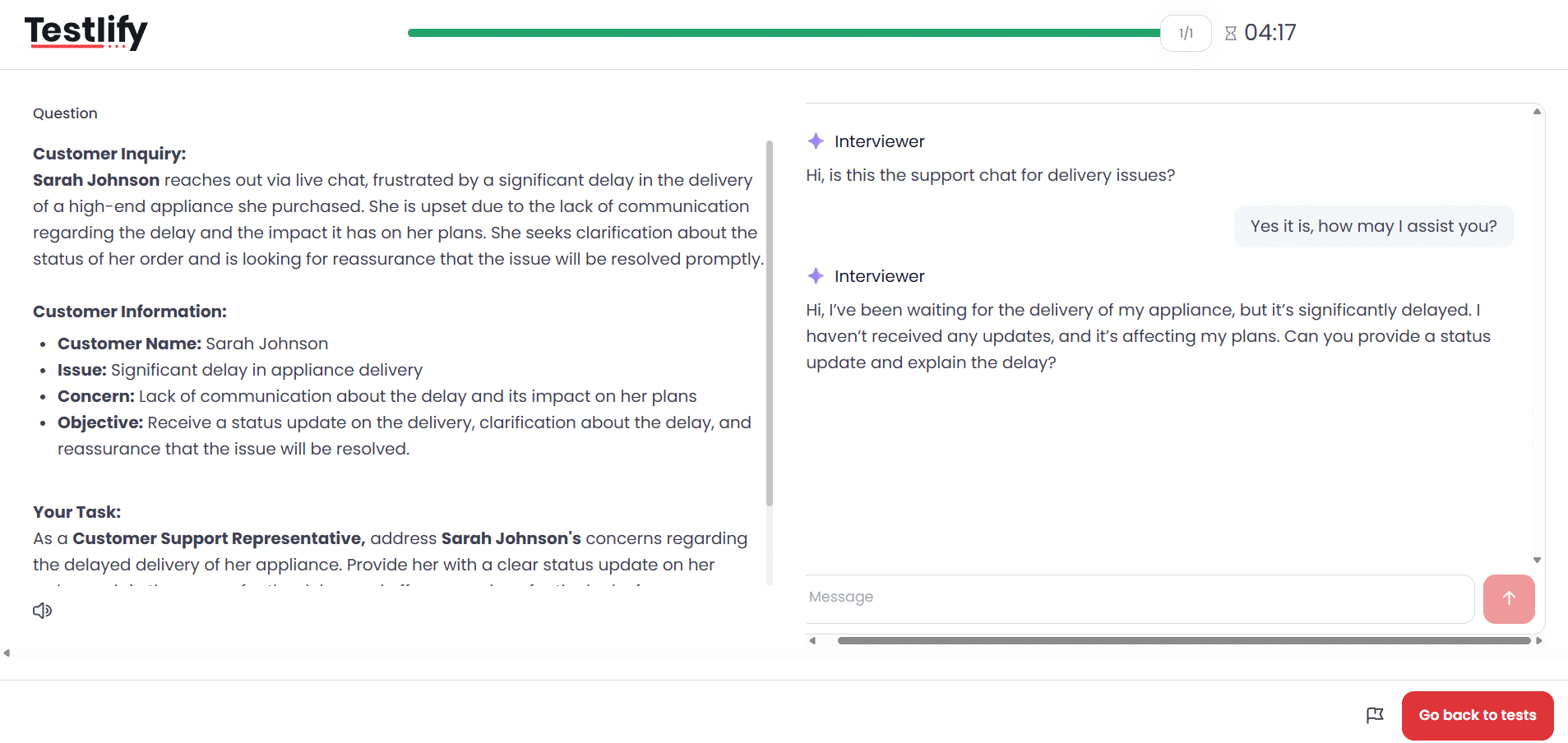
- Voice AI: candidates respond to spoken prompts for sales, support or leadership roles, and fluency, tone and persuasion are evaluated.
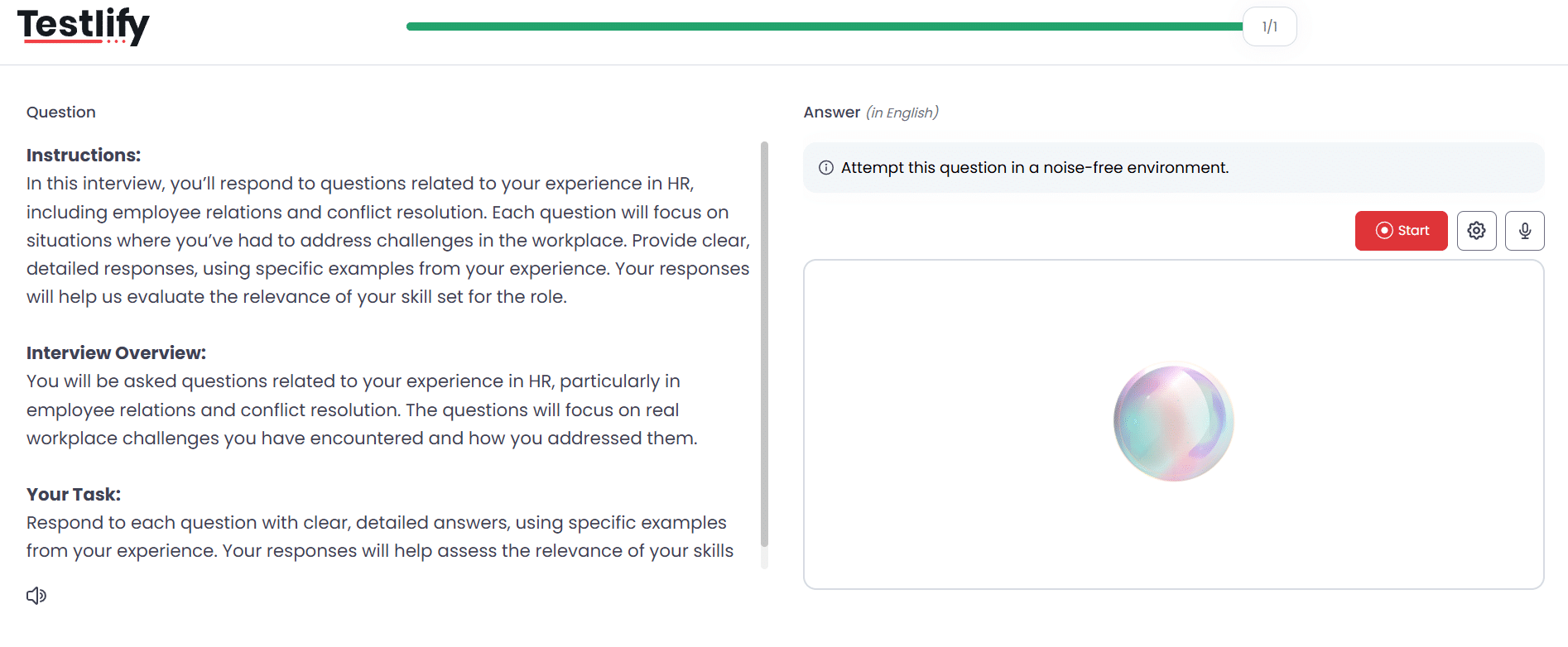
- Video AI: an AI avatar walks the candidate through a multi-step scenario in an asynchronous video interview.
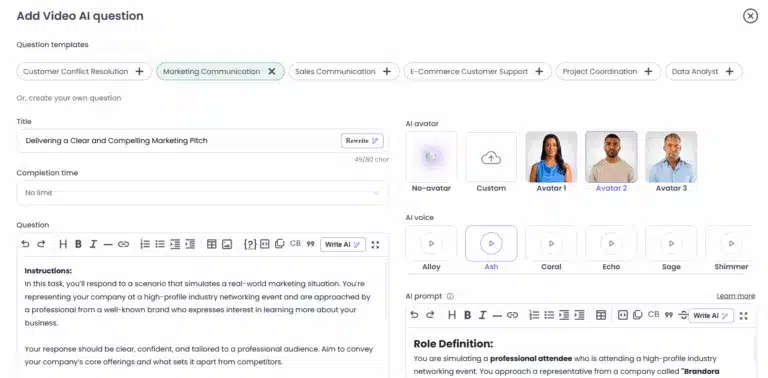
Criteria's Interview and Hire packages include async video interviews (candidates record answers to set questions) and real-time video interviews with transcripts, summaries and insights. An AI Interview Agent for conversational screening is sold as an add-on. These are structured-interview tools, and structured interviews earn their place: Sackett and colleagues' 2022 reanalysis of selection validity puts structured interviews among the strongest predictors of job performance, with years of education and general experience among the weakest.
Verdict: Testlify, for screening at volume, because a chat or voice simulation scales without interviewer hours. Criteria, if what you want is a tidy structured-interview module bolted onto its tests, and you're willing to pay for the AI agent separately.
Anti-cheating and proctoring
This is where the two platforms diverge most, and it's the section enterprise security teams read first. Gartner's July 2025 survey of 3,000 candidates found that 6% admitted to interview fraud (posing as someone else, or having someone pose as them), 4 in 10 used AI during the application process, and Gartner predicts 1 in 4 candidate profiles worldwide will be fake by 2028. Proctoring is no longer a nice-to-have on a remote assessment.
Testlify's answer is the Testlify Assessment Integrity Framework: protect validity through identity checks, environment controls, behavior signals, AI-assistance detection and reviewable evidence, while keeping the final call human. In the product that's twelve layers, on by default, including:
- Session recording with real-time webcam snapshots, plus interval-based snapshot proctoring
- AI identity verification that matches the live camera feed to the candidate's photo ID
- Location and IP address checks
- Copy-paste blocking, tab and screen-switch detection, mouse-out tracking
- Full-screen and forced full-screen modes, with mandatory screen sharing available
- AI-assistance detection that analyzes behavior and answers for signs of ChatGPT-style tools and code generators
- Question randomization, honesty agreements and private invites
- Question-level activity logs showing time spent per item
- A configurable violation tolerance so a warehouse assessment and a CFO assessment don't run the same rules
Criteria's AI Proctoring is an add-on. Its page describes automatic candidate photos taken throughout the assessment, AI comparison of those images to catch a swapped candidate or a second face, and periodic captures of the candidate's screen and audio to spot unauthorized resources or a second device. Candidates are told about monitoring before they begin. The page doesn't say whether video is recorded continuously.
Verdict: Testlify, by a distance, on breadth of evidence and on the fact that it's included rather than sold separately. One caveat that applies to both: a flag is a prompt for a human review, not a verdict. Neither vendor's AI proves intent, and a team that auto-rejects on flags will lose good candidates with bad webcams.
Scoring, ranking and AI candidate summaries
Both platforms auto-score. The difference is what happens next. Testlify generates an AI summary of each candidate's strengths and gaps inside the report, ranks the pool, and lets several reviewers rate independently before scores are aggregated.
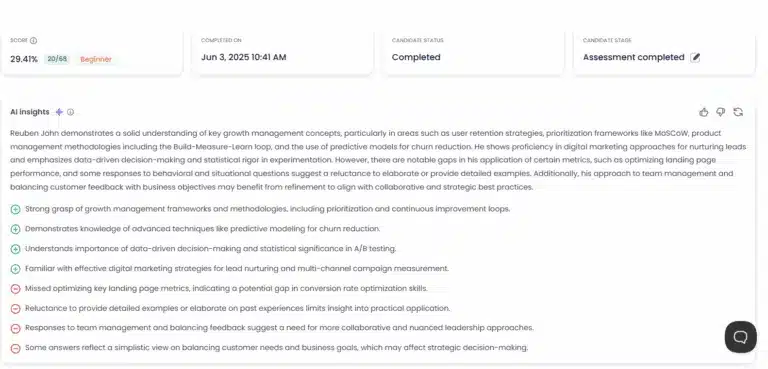
Criteria's score reports are clear and its side-by-side comparison is useful, but AI-generated summaries, transcripts and scoring sit in a paid "AI Features" add-on. Recruiters on the base package interpret the profiles themselves.
Why ranking rules matter: Kuncel and colleagues' 2013 meta-analysis found that combining assessment data mechanically predicts outcomes as well as or better than experts re-weighting the same data by feel. Whichever platform you pick, set the weights before you see the candidates and don't rework the numbers at the end.
Verdict: Testlify, because the summaries and multi-reviewer scoring are in the box. Criteria is close if you buy the AI add-on.
Integrations
Testlify connects to 100+ ATS and HR tools. One honest note: on the Standard plan, ATS integration is a $2,388 per year add-on; it's included on the Custom plan. If your recruiters live in Greenhouse or Workday, price that in from day one.
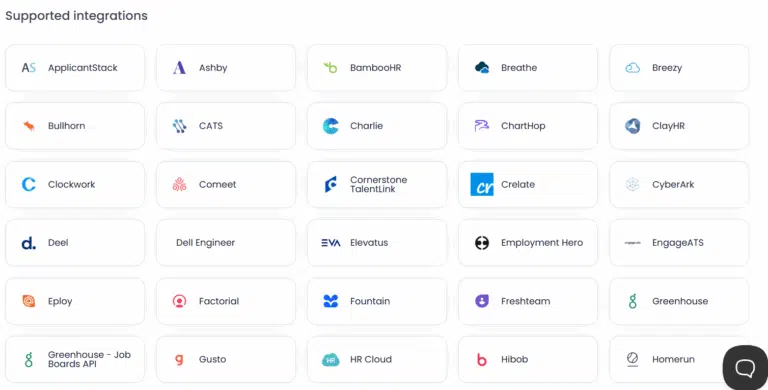
Criteria names 72 integration partners (54 ATS platforms including Greenhouse, Lever, Workday, SAP SuccessFactors and iCIMS, 13 HCM and HRIS systems, and a handful of solution providers) and offers an API for the rest. "Premium Integrations" are an add-on there too.
Verdict: A draw for most buyers. Both cover the major ATS platforms, and both charge extra for the deeper connections. Testlify has the longer list; Criteria's list is precise and public.
White-labeling and candidate experience
Testlify's white-label option puts your logo, colors, custom domain and branded invitation and rejection emails on the whole candidate journey. On Standard it's a $2,388 per year add-on; Custom includes it. Criteria includes a branded experience (logo, colors, welcome video) in every package.
Verdict: Criteria, narrowly, on price transparency for branding. Testlify goes further (custom domain, branded emails) if you pay for it.
Reporting and benchmarking
Testlify's reporting gives skill-level breakdowns, question-level analytics, completion-rate insights and benchmarks by role and industry, with PDF, CSV and XLSX exports. Criteria gives intuitive score reports, custom baselines built from your current employees, and PDF or Excel exports.
Verdict: Both are strong. Criteria's custom baselines are a genuine plus for teams with an existing workforce to benchmark against. Testlify's question-level analytics are the better tool for tuning the assessment itself.
Security, compliance and fairness
Testlify holds SOC 2 Type II and ISO 27001 and is GDPR and CCPA compliant. Criteria includes SSO and MFA in every package and states that its proctoring supports EEOC and data-privacy requirements.
The fairness yardstick in the United States is the same for both: the Uniform Guidelines on Employee Selection Procedures (29 CFR Part 1607) supply the four-fifths rule, a rule of thumb for spotting adverse impact, not a definition of unlawful discrimination. Whichever platform you buy, you need pass-rate reporting by group to run that check. Ask for it in the demo.
Pro tip: Run your own two-week validation before you sign. Give the same 30 shortlisted candidates one Testlify assessment and one Criteria assessment, then compare the rank order against your hiring managers' final calls. The platform whose scores agree with your best managers, on your roles, is the one to buy. Vendor benchmarks are somebody else's roles.
How much do Testlify and Criteria Corp cost in 2026?
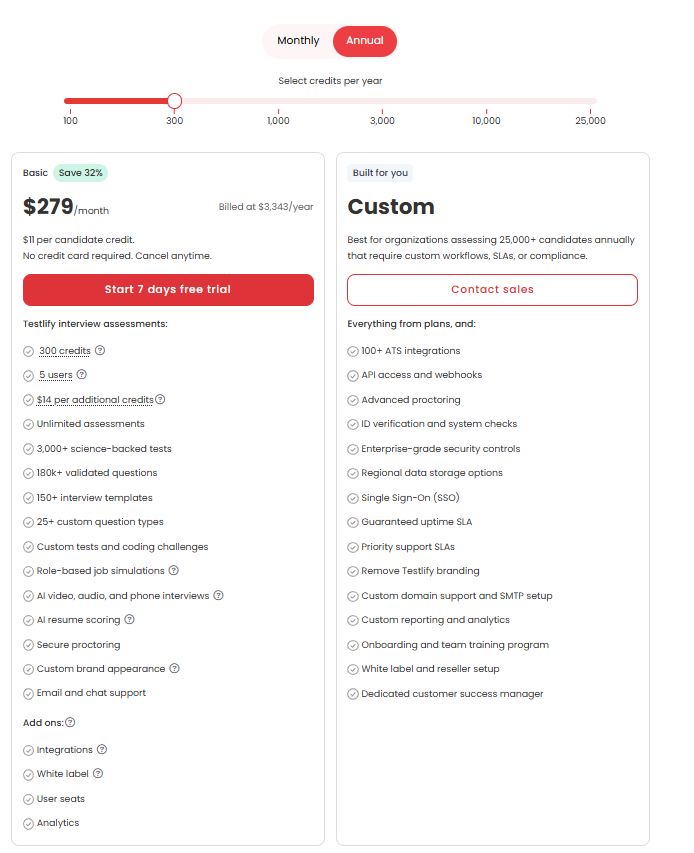
Testlify publishes its prices; Criteria doesn't. Testlify's Standard plan is $139 per month, billed as $1,668 per year, and it includes 100 candidate credits (about $16.68 per candidate), 3 user seats and a 7-day free trial with no credit card. Extra credits are $21 each, extra seats are $15 per month, and the base price is locked for 24 months. Criteria sells three packages, Assess, Interview and Hire, on request-a-quote terms.
Here's how Testlify's credit model works in practice:
- Standard, $139 per month: $1,668 billed annually, 100 credits a year, 3 seats. One credit is used per candidate when they start an assessment, and unused credits expire at the end of the cycle.
- Add-ons on Standard: white-labeling $2,388 per year, ATS integrations $2,388 per year, system requirement checks $0.25 each, photo ID verification $0.50 per attempt, live video proctoring $5 per attempt.
- Custom: for teams assessing 25,000+ candidates a year, with white-labeling and integrations included. Pricing on request.
Criteria's Assess package bundles all assessments, TestMaker and the template library, non-AI proctoring, branded experience, standard ATS integrations, and SSO and MFA. Interview bundles async and real-time video interviewing. Hire combines both. AI Proctoring, AI Features, the AI Interview Agent, Criteria Develop (post-hire check-ins and coaching) and Premium Integrations are each priced as add-ons. No dollar figures appear on the plans page; the site says it will "build the right package and add-ons" around your headcount.
A worked example makes the difference concrete. Say a 600-person company screens 250 candidates in a year, needs Greenhouse connected, and hires for both engineering and support.
Line item | Testlify Standard | Criteria Corp |
|---|---|---|
Base subscription | $1,668 (100 credits, 3 seats) | Quote only |
150 extra candidates | $3,150 (150 x $21) | Quote only |
ATS integration | $2,388 | Standard integrations included; premium ones quoted |
Coding tests | Included | Not offered; second vendor needed |
AI proctoring | Included (twelve layers) | Add-on, quoted |
Annual total | $7,206, about $28.82 per candidate | Unknown until you ask |
Drop the ATS add-on and Testlify lands at $4,818 for the year, about $19.27 per candidate. The point isn't that Testlify is always cheaper; without a Criteria quote nobody can say that. The point is that you can build this table yourself before a sales call, which is exactly what a procurement team wants.
Harver vs Criteria Corp: where does Testlify fit?
Harver and Criteria Corp solve different problems. Harver is a volume-hiring platform built for BPOs, contact centers and retail: situational judgment tests, cognitive and personality questionnaires, live-chat simulations, spoken-language checks, video interviews, interview scheduling, reference checking, and the pymetrics game-based assessments it offers. Criteria is a psychometrics vendor first. Neither publishes pricing.
So the "Harver vs Criteria Corp" decision usually comes down to one question: are you automating a funnel of thousands of frontline applicants, or are you trying to measure aptitude and personality with instruments you can defend? Harver for the first. Criteria for the second.
Testlify sits between them and covers more ground than either on skills. It handles high-volume screening with automated invites, chat and voice simulations and twelve-layer proctoring, and it covers the cognitive, personality and situational-judgment ground Criteria owns, while adding coding tests, software-skills tasks and 3,500+ role tests neither Harver nor Criteria list. What it doesn't do is interview scheduling or reference-check workflows the way Harver does; Testlify is an assessment platform, not a hiring suite, and it integrates with the ATS for the rest.
Criteria Corp vs Harver for AI-powered hiring
On AI specifically: Harver markets predictive assessments and an AI decision layer for volume funnels. Criteria sells AI as add-ons, namely AI Proctoring, AI Features for scoring and transcripts, and an AI Interview Agent. Testlify's AI is included at the core: AI-generated questions, conversational AI interviews, AI scoring, AI candidate summaries and AI-assistance detection, all with humans making the final decision. If "AI-powered" is the requirement, check what's in the base price on each platform, because on two of the three it's mostly an add-on.
TestGorilla vs Criteria: which is better?
TestGorilla is a broad-library skills-testing platform with automated ranking and a free entry tier; Criteria is a narrower, psychometrics-first platform with deeper norms. TestGorilla is the better pick for fast, wide screening across many roles. Criteria is the better pick when cognitive and personality depth matter more than coverage. Both compete directly with Testlify, so this page describes them without linking to them or repeating their marketing figures.
Where Testlify differs from both: conversational AI interviews in chat, voice and video are included rather than bolted on, proctoring runs on twelve layers by default, and the library reaches into blue-collar and role-specific tests that a generic skills library skips. A team that has narrowed the field to TestGorilla or Criteria usually finds Testlify covers the strongest argument for each.
Is Testlify a good Criteria Corp alternative?
Yes, and for most HR teams it's the stronger option. Testlify covers the assessment ground Criteria owns (cognitive, personality, emotional intelligence, situational judgment) and adds what Criteria doesn't offer: coding and programming tests, conversational AI interviews, proctoring that's on by default, and published pricing. Here's the case in four points:
- Broader coverage: 3,500+ tests across 4,500+ roles, including engineering, versus six assessment families and no coding tests.
- Included AI: AI questions, AI interviews, AI summaries and AI-assistance detection in the base product, where Criteria sells AI Proctoring, AI Features and the AI Interview Agent as separate add-ons.
- Proctoring depth: twelve integrity layers with a configurable tolerance, versus photo capture plus screen and audio sampling as an add-on.
- Price you can plan around: $139 per month with every add-on priced on the page, versus a quote.
Across the teams we work with, the switch usually happens when a company that started with an aptitude-test vendor begins hiring technical roles and realizes it's paying for two platforms. One platform, one candidate experience, one reporting layer is the practical argument.
When is Criteria Corp the better pick?
Being fair about this matters more than winning the comparison. Criteria Corp is the better choice in three cases:
- Your selection process is built on validated aptitude and personality instruments and your legal or I-O team wants the long-running norms and documentation that come with 15+ years of data on the same tests. Testlify's psychometric tests are strong, but Criteria's are its whole business.
- You want a branded candidate experience without paying an add-on. Criteria includes it in every package; on Testlify Standard it's $2,388 per year.
- You already run structured video interviews inside Criteria and don't need coding tests or simulations. Switching costs are real, and a working process beats a marginally better one.
If none of those describe you, the breadth, included AI and transparent pricing on Testlify win.
What are the best alternatives to Criteria Corp?
Beyond Testlify, the platforms that show up most often in Criteria Corp evaluations are TestGorilla and Vervoe for broad skills libraries, Harver for volume hiring, eSkill for customizable knowledge tests (its library spans 70,000+ questions across 600+ subjects, with an AI reporting layer called Linea), Mercer Mettl for enterprise psychometrics, and HireVue for video-first screening. Each is a direct competitor of Testlify, so this page names them without linking. The full ranked list, with pros, cons and pricing notes for each, lives in our guide to the top Criteria Corp alternatives and competitors.
A quick way to shortlist: write down the three roles you hire most, then check whether each vendor has a ready test for all three, whether proctoring is included or extra, and whether you can see a price. That filter removes half the list in an hour.
FAQs

Director of Marketing
Akash Patange is the Director of Marketing at Testlify, where he works closely with HR leaders and recruiters to help organizations improve hiring outcomes. He writes about talent assessment, recruitment technology, and data-driven hiring practices.
LinkedInRelated resources
View all
Competitor Comparisons
Testlify vs. WeCP: Which Skills Assessment Platform is Best for HR Teams?
Competitor Comparisons
Testlify vs. Xobin: Which Skills Assessment Platform is Best for HR Teams?
Competitor Comparisons
Testlify vs. Saville Assessment: Which Platform is Best for HR Teams?
Competitor Comparisons
Testlify vs. Talogy: Skills Assessment Platform Comparison
Competitor Comparisons
Testlify vs. Hire Success: Which Skills Assessment Platform is Best for HR Teams?
Competitor Comparisons
Testlify vs. Testgrid: Which Skills Assessment Platform is Best for HR Teams?
Get started.
Hire on proof, not resumes.
Run your first skills-based assessment free — no credit card required.