
Testlify vs. WeCP: Which Skills Assessment Platform is Best for HR Teams?
Testlify vs. WeCP: Discover which skills assessment platform best suits your hiring needs
Pick WeCP if you hire engineers, mostly engineers, and a lot of them. Pick Testlify if the same hiring team also has to fill sales, support, ops and finance roles and cannot buy a separate tool for each one. That is the honest split between these two platforms, and most of the feature-by-feature noise around them comes back to it.
Both are credit-priced, both proctor, both run AI interviews. So the real decision is about coverage and cost shape, not about who ticks more boxes. Here is what the two actually do in 2026, with list prices and the arithmetic that goes with them.
TL;DR
- WeCP is a developer-screening specialist: roughly 1,000 pre-built tests aimed at about 2,000 engineering skills, with question formats (DevOps, machine learning, database, project) that general platforms do not match.
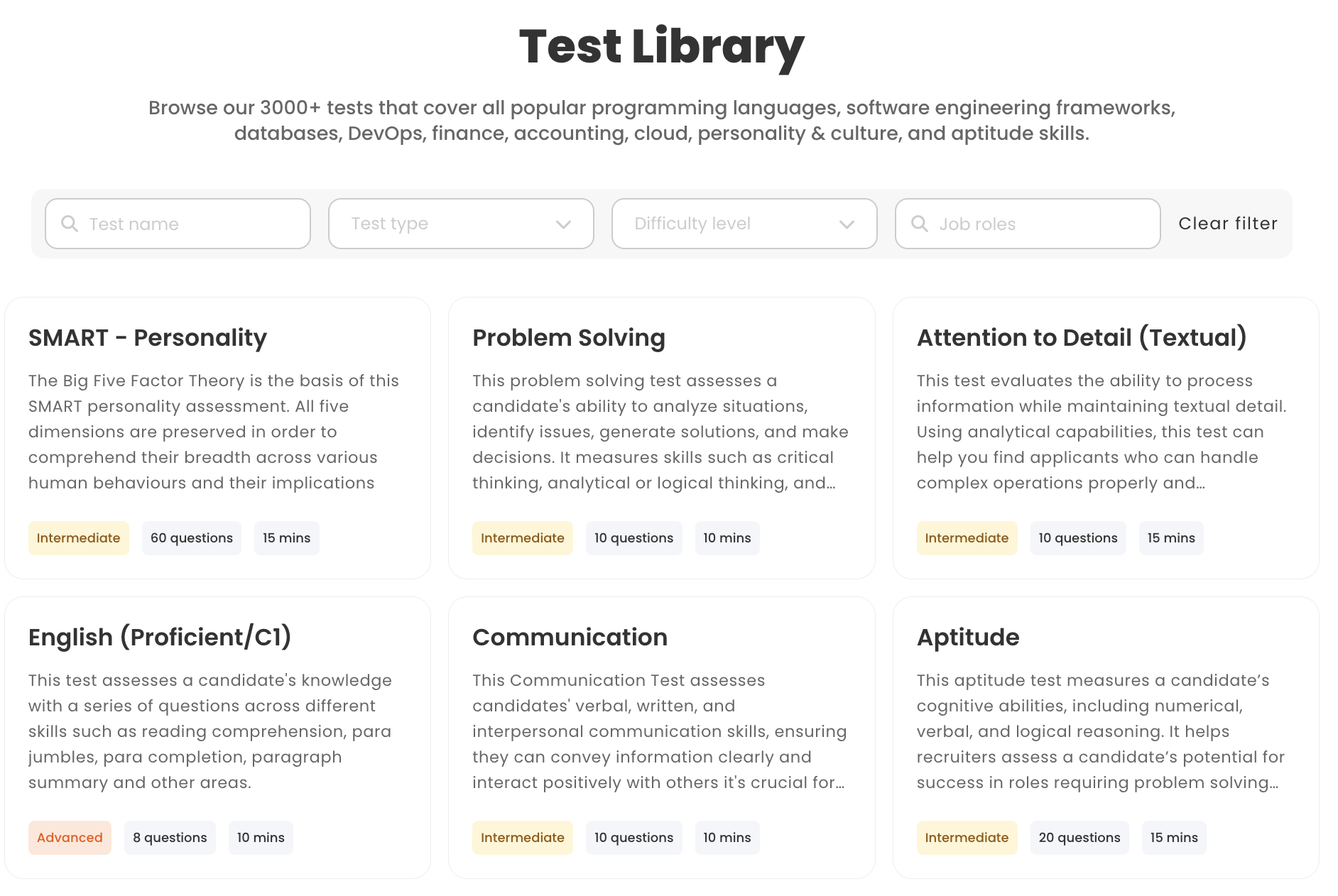
- Testlify is broader: 3,500+ tests across 4,500+ roles and 50+ industries, 25+ question types, and work-sample tasks in real Microsoft Office and Google Workspace files.
- On sticker price WeCP is often cheaper. Its Premium plan runs $240 a month for 40 credits a month, which works out at $6.00 per candidate. Testlify's Business tier is $8.39 per candidate.
- The catch is the cycle: WeCP quotes credits per month, Testlify quotes them per year. Lumpy hiring wastes a monthly allowance.
- Testlify pulls ahead on evidence quality: item-level psychometrics, an AI checker that separates human from AI-written answers, and dual-device proctoring that no mainstream rival ships.
- Neither tool should make the hire. Both put a score in front of a human, and the human decides.
 ChatGPT
 Gemini
 Claude
 Grok
Grok Perplexity
What is the WeCP assessment platform?
WeCP (short for We Create Problems) is a technical talent assessment platform built for screening software engineers, data professionals and IT specialists at volume. It combines a coding-heavy test library, an AI Interviewer for asynchronous video and audio rounds, and a proctoring layer the company brands as Sherlock AI.
The library sits at roughly 1,000 pre-built tests covering about 2,000 developer skills. Where WeCP earns its reputation is question format rather than raw count. Alongside standard multiple choice and subjective questions it ships project-based tasks, DevOps exercises, machine-learning problems, database queries and a format it calls CodeGaps. If you are screening backend engineers all day, that catalogue is deep in exactly the right place.
Compliance is covered: WeCP states GDPR and ISO 27001 compliance for candidate data handling.

What is Testlify and who is it for?
Testlify is an AI-assisted, human-led assessment and interviewing platform covering 3,500+ tests, 180,000+ validated questions, 4,500+ roles and 50+ industries. It runs skills tests, coding tests across 45+ programming languages, cognitive and psychometric tests, and AI interviews in video, voice and phone formats.
The buyer it fits best is not a dedicated technical-recruiting function. It is the growing company where one team screens a backend engineer on Tuesday and a customer success lead on Wednesday, and where the person signing off is often a founder or an ops lead rather than a hiring specialist. That team cannot justify a developer-only tool plus a second platform for everyone else.
Testlify runs on the Testlify Multi-Signal Talent Evaluation Model: combine several role-relevant signals (assessments, interviews, simulations, references, reviewer feedback) rather than betting a hire on one test score or one polished interview. One signal is fragile. Several pointing the same way is a decision you can defend.
There is research behind that. A 2022 reanalysis of selection-method validity in the Journal of Applied Psychology revised many long-standing estimates downward, but structured evaluation held its position among the strongest predictors of job performance, well ahead of proxies like years of education. The ranking survives every reanalysis even where the exact coefficients stay contested.
Testlify vs WeCP: feature comparison
The table below covers the areas buyers actually ask about. Rows marked "Coming soon" are labelled that way inside the product and are not shipping capability.
Capability | Testlify | WeCP |
|---|---|---|
Pre-built tests | 3,500+ | 1,000+ |
Roles covered | 4,500+ across 50+ industries | Developer and IT focused |
Question types | 25+ | 13 |
Programming languages | 45+ | 50+ |
Project, DevOps, ML and database question formats | Coding and practical tasks | Yes, purpose-built |
Microsoft Office and Google Workspace work samples | Yes | No |
Vibe coding (candidate directs AI to a working solution) | Yes | No |
Psychometric and personality tests | Yes | No |
Typing test | Yes, 60% accuracy plus 40% speed by default | No |
One-way video and audio interviews | Yes | Yes |
Two-way conversational AI video | Yes | No |
Outbound AI phone interviews | Yes, $0.18 per minute | No |
Chat AI scenarios | Coming soon | No |
Selectable AI avatars, voices and personas | Yes | No |
Dual-device (phone as second camera) proctoring | Yes | No |
AI checker (human vs AI-written answers) | Yes | No |
Item-level psychometrics (difficulty, discrimination) | Yes | No |
ATS and HRIS integrations | 100+ (paid add-on on self-serve tiers) | 18+ |
White labelling | Yes (paid add-on on self-serve tiers) | Logo and banner only |
SOC 2 Type II | Yes | Not stated |
ISO 27001 and GDPR | Yes | Yes |
Where WeCP is genuinely stronger
Two places. First, depth of engineering question formats: purpose-built DevOps, machine-learning and database-query tasks are not something a generalist library replicates by adding more coding tests. Second, cost at steady mid-volume technical hiring, which the pricing section works through in numbers.
If your entire 2026 hiring plan is engineers and you screen a predictable number every month, those two points are most of the argument, and a broader library is capacity you will not use.
Where Testlify pulls ahead
Coverage is the obvious one, but the more interesting gap is evidence quality. Testlify surfaces item-level psychometrics to recruiters: a difficulty index, a discrimination index, and a quality-risk flag that marks questions with very low accuracy or high skip rates. That is test-publisher instrumentation, and it tells you when a question is broken rather than when a candidate is weak.
It sits alongside the usual candidate reporting and analytics, but it is the part WeCP has no equivalent for. Then there is the AI checker, which classifies an answer as human, AI generated, or mixed. In 2026 that matters more than another hundred coding questions, because the thing you are actually trying to establish is whether the work in front of you is the candidate's.
And work samples in real files. Testlify ships question types bound to actual Microsoft Word, Excel, PowerPoint, Google Docs, Sheets and Slides documents, plus vibe coding, where a candidate directs AI tools toward a working solution instead of writing syntax by hand. For a finance analyst or an ops hire, a real spreadsheet task beats a multiple-choice question about spreadsheets.
How do Testlify and WeCP compare on price?
Both platforms charge per candidate credit, so headline monthly prices are close to meaningless on their own. WeCP quotes credits per month. Testlify quotes them per year. Convert both to an annual cost per candidate and the picture changes.
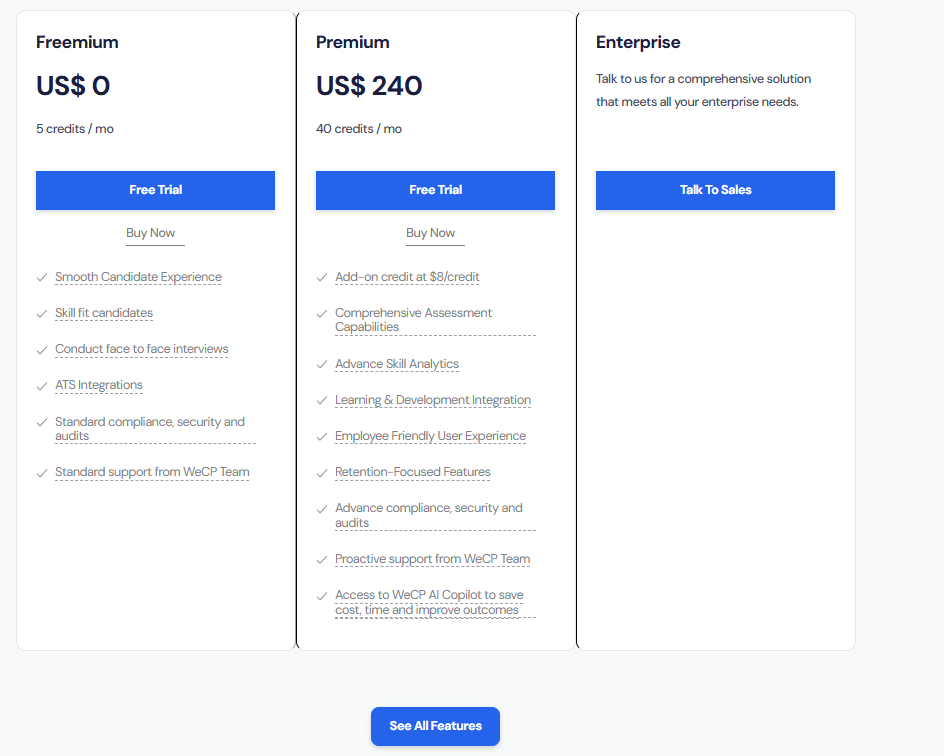
WeCP list pricing, as published on its own pricing page in September 2026:
- Freemium, $0: 5 credits a month, prebuilt questions, standard cheat prevention, basic ATS integrations.
- Screen, $100 a month: 10 credits a month plus 1 seat. Extra seats $8 each, extra credits $10 each.
- Premium, $240 a month: 40 credits a month, advanced skill analytics, L&D integration, AI Copilot access. Extra credits $10 each.
- Enterprise: custom pricing.
- Advanced AI add-on: $50 per agent per month.
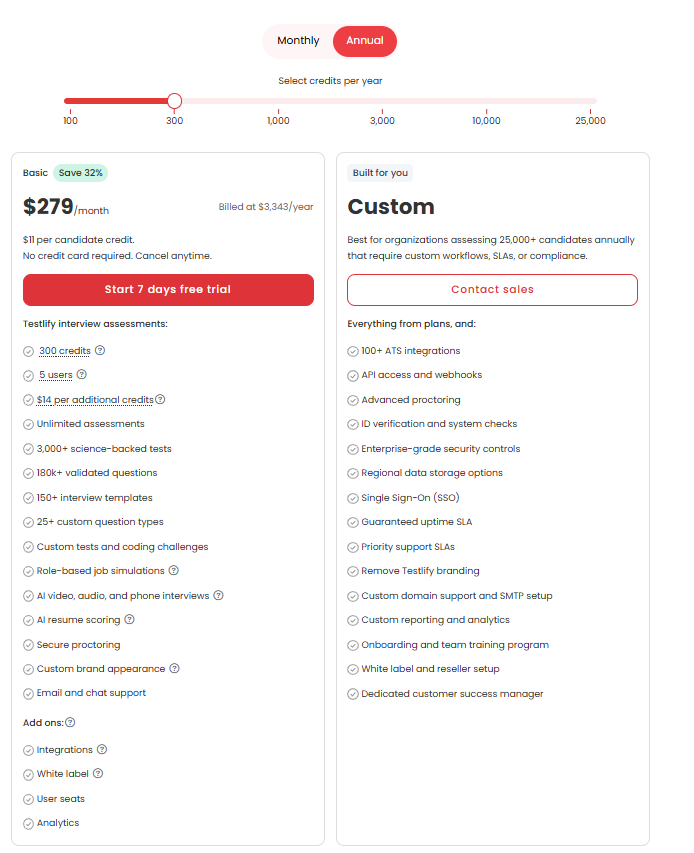
Testlify list pricing, from its published plan tiers, billed annually:
- Starter, $139 a month billed $1,668 a year: 100 credits, 3 seats, extra credits $21.
- Basic, $279 a month billed $3,348 a year: 300 credits, 5 seats, extra credits $14.
- Business, $699 a month billed $8,388 a year: 1,000 credits, 10 seats, extra credits $10.
- Premium, Enterprise and Custom: 3,000, 10,000 and 25,000+ credits, contact sales.
Now the arithmetic nobody publishes. One credit is one started assessment on both platforms, so annual cost per candidate is the comparable number:
Candidates a year | WeCP list cost | Testlify list cost | Cheaper on sticker |
|---|---|---|---|
60 | $0 (Freemium, 5 a month) | $1,668 (Starter, 100 credits) | WeCP |
120 | $1,200 (Screen, $10.00 each) | $1,668 (Starter, $16.68 each) | WeCP |
300 | $2,880 (Premium, 480 credits) | $3,348 (Basic, $11.16 each) | WeCP |
480 | $2,880 (Premium, $6.00 each) | $5,868 (Basic plus 180 extra) | WeCP |
1,000 | $8,080 (Premium plus 520 extra) | $8,388 (Business, $8.39 each) | Roughly level |
Read that honestly: on list price WeCP is cheaper across most of the range, and only converges with Testlify around a thousand candidates a year. A comparison page that pretended otherwise would not survive five minutes with a spreadsheet.
Two things the table cannot show. The first is the cycle. WeCP's allowance is monthly, so a team that screens 90 candidates in March and none in April has to size its plan for the spike. Testlify's pool is annual, which absorbs lumpy hiring more gracefully, though credits do not roll over at the end of the cycle on either platform. Check that against your own hiring pattern before signing anything.
The second is what the credit buys. At 480 candidates the WeCP number covers developer screening. The Testlify number covers developers, the sales team, the finance hire and the support rota, plus psychometrics and AI interviews. Cost per candidate is the wrong metric if you end up buying a second platform for everyone the first one cannot assess.
Both vendors also meter extras, and both bury them. On Testlify, white labelling and the 100+ ATS integrations are $2,388 a year each on the self-serve tiers, included only on Custom. AI phone interviews bill at $0.18 a minute and face verification at $0.50 an attempt. Do not budget from the headline tier price alone on either side.
Pro Tip: before you compare tiers, count how many of last year's hires were engineering roles. Under about 60% and a developer-only platform will leave most of your funnel unscreened, whatever the per-credit maths says.
Which platform handles video interviews better?
Testlify runs more interview formats. WeCP's AI Interviewer handles asynchronous video and audio rounds with ID verification, which covers the standard one-way screening use case well. Testlify adds two-way conversational AI video, voice questions, and outbound AI phone interviews on top of the one-way format.
The configurability is where the gap widens. A Testlify interview can be set with a chosen AI avatar, a named voice, a persona and a custom prompt, plus controls for number of attempts (including no limit), recording time, completion time, and auto-start with preparation time so candidates get a moment to read the question before recording. Transcripts generate automatically and multilingually, with the AI detecting the spoken language for any recording of at least 30 seconds.
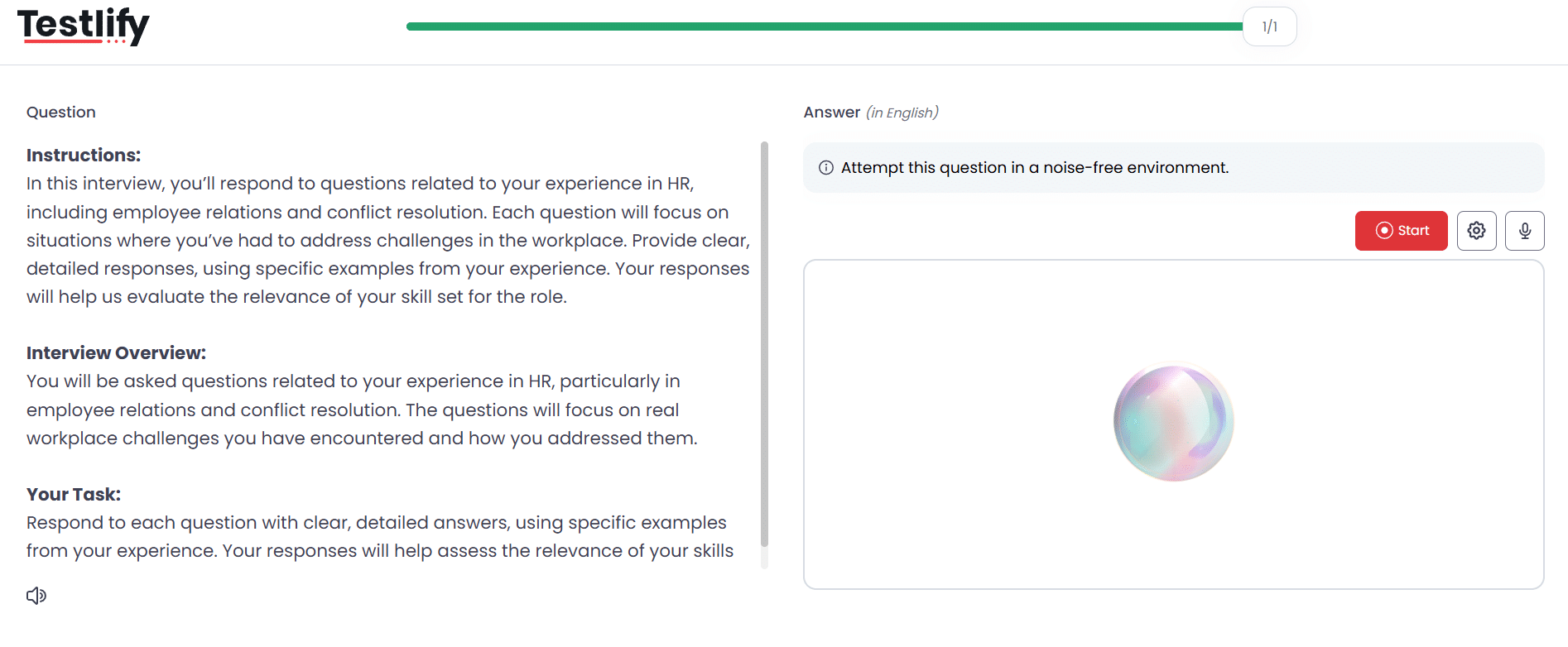
During a live AI voice interview the candidate sees a "you are muted while the AI is speaking" state, which is a small detail that tells you the turn-taking is real rather than a sequence of recorded prompts.
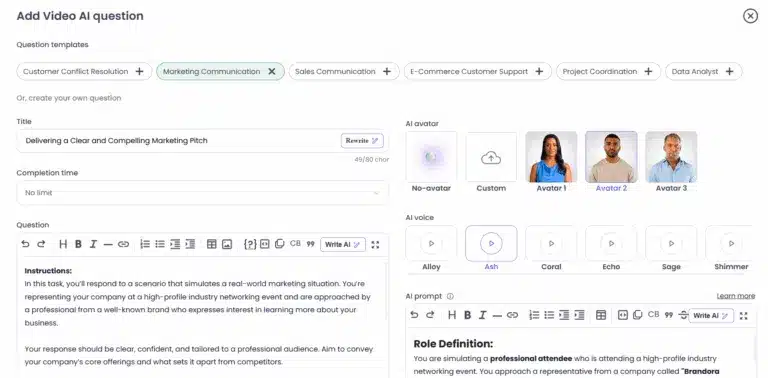
Reviewers get video and audio download, an interview report they can regenerate, screen replay and transcript download. Scoring is automatic with human override, and both "display AI scores to the reviewer" and "include AI score in the final average" are toggles, so a team can run AI scoring as advisory only.
One honest boundary: neither platform schedules live human interview panels. If you need calendar coordination for a four-person loop, that is a separate tool for both vendors.
How do the two compare on proctoring?
Closer than the rest of this comparison, with one exception. WeCP's Sherlock AI covers force full-screen, tab proctoring, webcam recording, multi-screen detection, IP allow and deny lists, email watermarking, location tracking, audio proctoring and activity logging. That is a serious integrity stack and it does the job for most remote screening.
Testlify runs a comparable list under three presets (Standard, Strict, Custom) and adds AI-tool and browser-extension detection, photo ID verification with face match against the ID, and a candidate honesty agreement. The full set of anti-cheating controls is configurable per assessment rather than fixed.
The exception is dual-device proctoring. The candidate's own phone becomes a second camera, positioned to capture both the candidate and the laptop screen, and it is a hard gate: the assessment will not start until mobile monitoring is active, and ending it mid-session is logged and reported to the administrator. No mainstream rival in this category ships it.
What matters more than the feature count is what happens with a flag. Testlify's are deliberately evidence-first: green means nothing suspicious, yellow means "a quick manual review is recommended", red means cheating was confirmed. Auto-termination is a separate opt-in setting with a threshold the recruiter picks, not something a flag does on its own. Face verification data is deleted after 30 days and candidates can withdraw consent at any time.
That distinction is the whole argument. A flag is evidence for a human to weigh, not a rejection. Get it backwards and you are automating a decision you cannot explain later.
Which platform fits your existing stack?
Testlify connects to 100+ ATS and HR platforms; WeCP publishes 18+ out-of-the-box integrations with major applicant tracking systems. If your team already runs Greenhouse, Workday or Lever, the assessment platform should slot in as a screening layer and leave the ATS as the system of record. Testlify is built to do that, and resume screening auto-advances candidates to the next ATS stage when they clear a cut-off score.
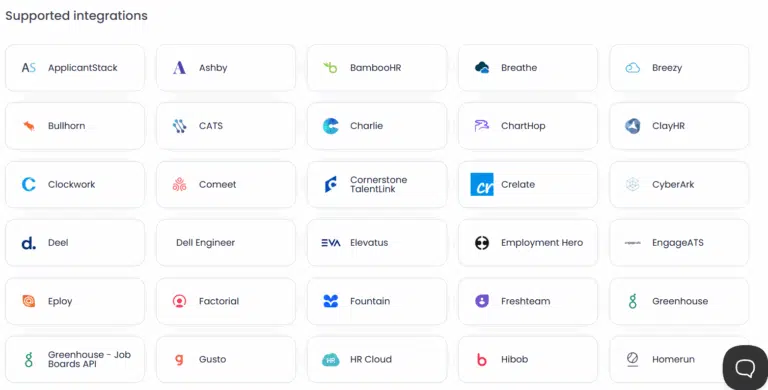
Worth pricing properly: those 100+ integrations are a $2,388 a year add-on on Testlify's self-serve tiers and are included only on the Custom plan. The pricing page's hero bar says otherwise; the comparison table is the one to trust.
For a team with no applicant tracking system at all, Testlify also ships a simple built-in hiring pipeline: job requisitions, an application form, publishing to job boards, a public listing, and applied through reviewed, shortlisted and rejected stages. It is deliberately basic, aimed at a company that does not want to buy a separate ATS yet. It is not a substitute for an incumbent system of record, and it is not sold as one.
On the enterprise side Testlify carries SAML SSO with group-to-role mapping, SCIM provisioning, OAuth token rotation, audit logs with CSV export, and real-time audit streaming to a SIEM provider. SSO and 2FA are add-ons on the self-serve tiers.
Is Testlify a strong WeCP alternative?
For most teams, yes, and the reason is coverage rather than any single feature. WeCP is the better buy for an engineering-only hiring plan at steady volume. Testlify is the better buy the moment the same team has to assess people who do not write code, which for a growing company is usually within a quarter.
Four things carry the argument:
- Breadth that is actually usable. 3,500+ tests across 4,500+ roles, 25+ question types, and work samples in real Office and Workspace files rather than questions about them.
- Evidence you can inspect. Item-level difficulty and discrimination indices, quality-risk flags, benchmarking and percentile ranks. You can tell a bad question from a bad candidate.
- Integrity built for 2026. Dual-device proctoring plus an AI checker that separates human from AI-written answers, which is the failure mode every assessment platform is now judged on.
- Interviewing in one place. One-way, two-way conversational AI video, voice and phone, with avatars, transcripts, auto-scoring and human override, instead of a second video tool.
If you want the wider market view rather than a head-to-head, the roundup of platforms competing with WeCP covers more of the field.
One caution that applies to both platforms. Assessment scores are inputs, not verdicts. A meta-analysis in the Journal of Applied Psychology found that combining assessment data consistently predicts outcomes at least as well as experts re-weighting the same information by instinct, which is an argument for using the scores as they are, not for letting software make the call. The EU's AI Act, Regulation 2024/1689, treats AI systems used in recruitment and candidate evaluation as high risk and requires meaningful human oversight, so keeping a person accountable for the decision is now a compliance position as well as a sensible one.
The skills themselves keep moving underneath all of this. The World Economic Forum's Future of Jobs Report 2025 estimates that 39% of existing skill sets will be transformed or outdated between 2025 and 2030, with 63% of employers naming the skills gap as the main barrier to transformation. Whichever platform you choose, the library has to keep pace, and so does the way you score it.
How to run the comparison yourself
- Count last year's hires and split them into engineering and everything else.
- Take the larger group and build one real assessment for a role in it on both platforms.
- Send it to two people already doing that job internally. If the scores do not separate your strong performer from your average one, the test is wrong.
- Price the winner at your actual annual volume, including seats and add-ons, not at the headline tier.
Ready to try it on a role you are hiring for now? Book a demo and walk through a live assessment build, or browse the skills test library to see whether the roles you hire for are covered. There is a 7-day free trial with no card required, and pricing is locked for 24 months after purchase.
Key Takeaways
- The split is coverage, not quality. WeCP is a developer-screening specialist with roughly 1,000 tests aimed at about 2,000 engineering skills; Testlify spans 3,500+ tests across 4,500+ roles. Neither is a worse product. They are built for different hiring mixes, and choosing on feature count instead of your own role mix is how teams end up paying for a second platform six months later.
- WeCP usually wins on sticker price, and that is worth saying plainly. Its Premium plan works out at $6.00 a candidate against Testlify's $8.39 on Business, and the two only converge near 1,000 candidates a year. If your hiring is engineering-only and predictable, that gap is real money.
- Check the credit cycle before the credit price. WeCP quotes an allowance per month, Testlify per year. Teams that hire in bursts have to size a monthly plan for their peak month, which quietly erases the per-credit advantage. Model it against last year's actual hiring curve, not an average.
- Add-ons decide the real total. On Testlify, white labelling and the 100+ ATS integrations are $2,388 a year each on self-serve tiers, AI phone interviews bill at $0.18 a minute, and WeCP meters an Advanced AI add-on at $50 per agent per month. Budget from the configured price, never the tier headline.
- Integrity is where the category is being judged now. Dual-device proctoring and an AI checker that separates human from AI-written answers address the problem every assessment platform has in 2026. Feature lists that stop at webcam snapshots are answering an older question.
- Evidence quality beats library size. Item-level difficulty and discrimination indices tell you whether a question is doing any work at all. Without them you cannot tell a broken test from a weak candidate, and you will keep screening people out for the wrong reason.
- Keep a human accountable for the decision. Both platforms score with AI, and the research favours using those scores consistently rather than re-weighting them on instinct. Under the EU AI Act, recruitment AI is high risk and needs meaningful human oversight, so advisory scoring with a named human deciding is both the defensible and the accurate setup.
FAQs

Director of Marketing
Akash Patange is the Director of Marketing at Testlify, where he works closely with HR leaders and recruiters to help organizations improve hiring outcomes. He writes about talent assessment, recruitment technology, and data-driven hiring practices.
LinkedInRelated resources
View all
Competitor Comparisons
Testlify vs. Xobin: Which Skills Assessment Platform is Best for HR Teams?
Competitor Comparisons
Testlify vs. Saville Assessment: Which Platform is Best for HR Teams?
Competitor Comparisons
Testlify vs. Talogy: Skills Assessment Platform Comparison
Competitor Comparisons
Testlify vs. Hire Success: Which Skills Assessment Platform is Best for HR Teams?
Competitor Comparisons
Testlify vs. Testgrid: Which Skills Assessment Platform is Best for HR Teams?
Competitor Comparisons
Testlify vs. Testello: Which Skills Assessment Platform is Best for HR Teams?
Get started.
Hire on proof, not resumes.
Run your first skills-based assessment free — no credit card required.