
Top 15 TalentLens Alternatives and Competitors
Discover 15 powerful TalentLens alternatives to streamline your hiring process and assess candidates with confidence.
TalentLens is Pearson's occupational testing arm, and it is best known for publisher-grade instruments like the Watson-Glaser critical thinking appraisal. If you are looking for TalentLens alternatives, the honest answer is that most teams are not looking for a better critical-thinking test. They are looking for a way to screen candidates on more than one signal, without a per-instrument license and without needing a certified test user on staff to press go.
That distinction matters more than any feature grid, so this guide starts there, then works through 15 TalentLens alternatives and what each one is genuinely good at.
 ChatGPT
 Gemini
 Claude
 Grok
Grok Perplexity
TL;DR
- TalentLens sells validated psychometric instruments. Most of the platforms below sell an assessment workflow. Those are different purchases, and picking the wrong category is the expensive mistake.
- The selection-science case for buying a single cognitive test has weakened. Recent reanalysis puts structured interviews among the strongest predictors of job performance, and finds that predictor composites built without a cognitive test can reach comparable validity.
- Combining predictors also tends to shrink subgroup differences, which matters if you hire in New York City, where automated employment decision tools carry a bias-audit duty.
- Testlify is the pick for teams that want breadth (3,500+ tests, 25+ question types, AI interviewing and proctoring in one tool) rather than a single licensed instrument.
- If you specifically need Watson-Glaser for a legal or graduate scheme where the instrument is named in the process, no alternative substitutes for it. Buy the instrument, not a platform.

Why do teams look for TalentLens alternatives?
Two reasons come up again and again in the buying conversations behind these searches, and neither is really about test quality.
The first is scope. TalentLens is deep on cognitive ability and personality and deliberately narrow everywhere else. If you need a coding test, a spreadsheet work sample, a situational judgment test and a recorded interview for the same requisition, you are assembling that from several vendors.
The second is access. Publisher-grade instruments are usually sold per candidate and gated behind test-user certification, because that is what responsible psychometric publishing looks like. It is a reasonable model. It is also a poor fit for a 40-person company hiring six people this quarter, which is where most of this search traffic comes from.
Pro Tip: Before comparing vendors, write down whether you are buying an instrument or a workflow. If a specific named test has to appear in your process for legal or scheme-compliance reasons, that is an instrument purchase and the list below mostly will not help. Everything else is a workflow purchase.
Does a cognitive test still have to be the center?
For years the default advice was that general cognitive ability was the single strongest predictor of job performance, so any serious selection process had to be built around one. That advice is being revised.
A 2022 reanalysis in the Journal of Applied Psychology by Sackett and colleagues found that earlier meta-analytic validity estimates had been systematically over-corrected for range restriction, and revised many of them downward. Its durable finding is about ranking rather than any single coefficient: structured interviews sit among the strongest predictors, while years of education and general experience sit among the weaker ones. Worth saying plainly: the exact corrected numbers are still argued over in print, so treat the ordering as the finding, not the decimals. The Society for Industrial and Organizational Psychology's write-up of that work reports structured interviews at .42 against cognitive ability at .31, which is a real reordering of the old hierarchy.
The follow-up paper is the one that actually changes a buying decision. Writing in Industrial and Organizational Psychology, the same group concluded that composites with and without cognitive ability can achieve comparable validity, and that equally valid composites with smaller group differences can be built. In plain terms: you can often get the same predictive power from a combination of job-relevant measures, with less adverse impact, than from leaning on one cognitive instrument.
That is the strongest argument for a platform over a publisher, and it is the argument every directory listing on this topic leaves out.
How did we evaluate these TalentLens alternatives?
Four criteria, weighted for the team that is actually running this search: a company under 200 people, no in-house psychometrician, hiring across several job families at once.
- Breadth of signal. Can one tool cover cognitive, personality, a job-relevant work sample and an interview, or are you buying three tools?
- Who can administer it. Does it need a certified test user, or can a hiring manager run it on a Tuesday?
- Defensibility. Proctoring evidence, human review of AI output, and whether the vendor can support a bias audit.
- Cost shape. Per-candidate licensing versus a subscription, and whether cost scales with hiring volume in a way you can forecast.
A note on the numbers below. Vendor pricing and public review scores move constantly, and several of these vendors publish nothing at all, so specific figures and ratings have been left out rather than quoted from memory. Confirm current pricing with the vendor before you shortlist. Testlify's own pricing is stated in full, because it is ours and it is verifiable.
TalentLens alternatives compared
Tool | Primary assessment focus | Pricing model | Best for |
|---|---|---|---|
Testlify | Broad: skills, cognitive, personality, coding, AI interviews | Credit-based subscription, published | Teams replacing several point tools with one |
TestGorilla | Broad pre-built test library | Subscription, published | Straightforward multi-test screening |
Adaface | Conversational, chat-led assessments | Subscription, published | Candidate experience and completion rates |
Vervoe | Job simulations, AI-graded | Per-candidate | Task performance over test scores |
Codility | Engineering assessment at scale | Subscription tiers | Large-volume developer hiring |
Mercer Mettl | Psychometric and behavioral, proctored | Custom quote | Campus and certification programs |
iMocha | Skills inventory and internal mobility | Subscription, published | Workforce skills mapping, not just hiring |
Maki People | Bias-conscious screening | Custom quote | Structured, high-volume screening |
TestDome | Work-sample tasks | Subscription | Small teams wanting realistic tasks |
Coderbyte | Technical tests and take-homes | Subscription | Startups hiring developers |
The Talent Games | Gamified assessment | Custom quote | Early-careers and graduate intakes |
TalentMetrix | Psychometric profiling | Custom quote | Development and coaching use cases |
HackerEarth | Technical screening and interviews | Subscription | Structured developer interview loops |
TestInvite | Exam-grade secure testing | Subscription | Certification and controlled exams |
eSkill | Clerical, software and role skills | Custom quote | Operational and administrative roles |
1. Testlify
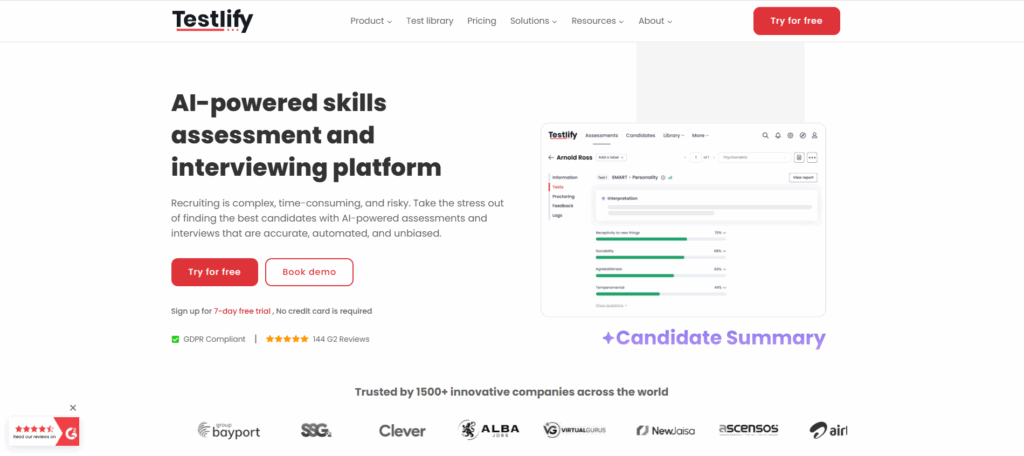
Testlify is an AI-powered skills assessment and interviewing platform. It covers the ground TalentLens covers (cognitive ability, personality and psychometric testing) and then keeps going into work samples, coding, situational judgment and recorded interviews, so a single requisition can be screened end to end in one place.
It is built on the Testlify Human+AI Evidence-Based Hiring Framework: combine AI-assisted evaluation with human judgment, using structured evidence instead of resumes, intuition, or inconsistent interviews. In practice that means the AI scores first and a person always decides. The product ships that as a rule, not a setting you have to remember: AI scores and insights are labeled as guidance only, displaying them to a reviewer is a toggle, and so is whether the AI score counts toward the final average at all.
Key features
- Test library: 3,500+ tests drawn from 180,000+ validated questions, mapped to 4,500+ roles across 50+ industries, including cognitive ability, personality and culture, situational judgment and psychometric categories.
- 25+ question types: single and multi select, ranking, fill in the blank, coding (single file or multi-file projects in an embedded VS Code editor), typing tests, and live work in Google Docs, Sheets, Slides, Word, Excel and PowerPoint.
- Interviewing built in: one-way async video, two-way conversational AI video, voice and audio questions, and outbound AI phone interviews, with selectable AI avatars and voices, custom prompts, attempt and recording-time limits, and 150+ interview templates.
- Item-level psychometrics: difficulty index, discrimination index and a quality-risk flag on every question, plus answer and score distributions. This is test-publisher tooling exposed to a recruiter, and it is rare outside a publisher like Pearson.
- Dual-device proctoring: the candidate's phone becomes a second camera showing both the candidate and their screen. The session will not start until mobile monitoring is active. Alongside 20+ other integrity measures across identity, environment, browser lockdown and AI-assistance detection.
- Integrations: 100+ ATS integrations including Greenhouse, Lever and Workable, plus Zapier and webhooks.
Pros
- One tool covers cognitive, personality, work sample and interview, so you stop stitching vendors together.
- No test-user certification needed to run an assessment.
- Human override is designed in, which is the story you need for a bias audit.
- Pricing is published, so you can forecast it.
Cons
- It does not schedule live human interview panels. Testlify runs the async and AI interviews; calendar coordination for a panel stays in your ATS or scheduling tool.
- Chromium desktop only for assessments. The mobile app is a capture fallback, not a way to sit a whole test on a phone.
- ATS integrations, white labeling and SSO are paid add-ons on the self-serve tiers rather than being bundled into every plan.
- If you need the Watson-Glaser specifically, Testlify does not license it.
Best for
Teams under a few hundred people who need validated screening across several job families and do not have a psychometrician on staff. If you already run an applicant tracking system you trust, Testlify plugs into it as the screening and interviewing layer and leaves your ATS as the system of record. If you have no ATS at all, there is a simple built-in hiring pipeline (job requisitions, an application form, job-board publishing and applied to shortlisted stages) so you are not forced to buy one.
Testlify pricing
Published plans and credits on annual billing, where one credit covers one started assessment:
- Starter: $139/month, billed $1,668/year. 100 credits/year at $16.68 each, 3 seats.
- Basic: $279/month, billed $3,348/year. 300 credits at $11.16 each, 5 seats.
- Business: $699/month, billed $8,388/year. 1,000 credits at $8.39 each, 10 seats.
- Premium: 3,000 credits, 20 seats. Contact sales.
- Enterprise: 10,000 credits, 30 seats. Contact sales.
- Custom: 25,000+ credits, 40 seats. Contact sales.
Monthly billing runs on the same tier names with different credit counts and prices. Extra seats are $15 per seat per month. There is a 7-day free trial with no card, a 30-day money-back guarantee, price locked for 24 months, and a 25% non-profit discount. AI phone interviews are metered at $0.18 per minute.
2. TestGorilla
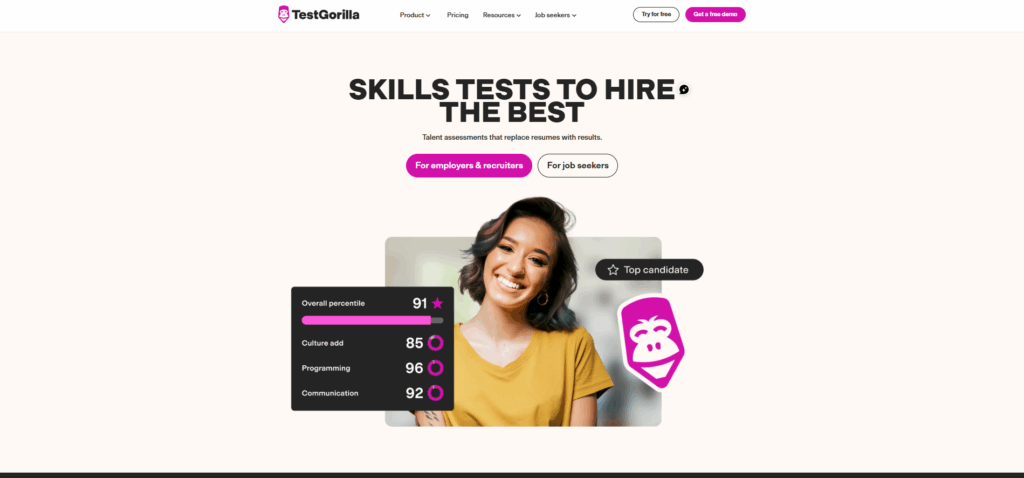
TestGorilla is a broad pre-employment testing platform built around a large library of ready-made tests that you combine into a single assessment. It is one of the more direct swaps for the screening half of what TalentLens does, and it is aimed at teams that want speed and simplicity over instrument depth.
Key features
- Pre-built assessments: a few hundred tests spanning coding, numerical reasoning, cognitive ability, personality and culture add-on.
- One-way video interviews: open-ended video prompts to read communication and customer empathy.
- Bias reduction: anonymous results and standardized scoring so reviewers compare like with like.
- Customization: your logo, colors and intro videos, plus control over test order, difficulty and timing.
Best for
Teams that want a straightforward multi-test screen and are happy to handle interviews elsewhere.
Pricing
Subscription tiers with a free entry option. Published pricing varies by company size, so check current rates directly.
3. Adaface
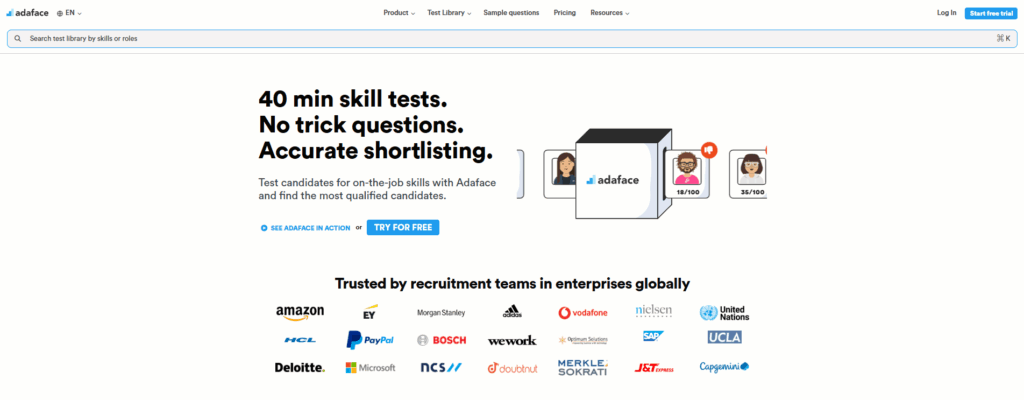
Adaface takes a different angle on candidate drop-off. Instead of a timed multiple-choice form, its assessments run as a chat conversation, which tends to feel less like an exam. If your problem with a cognitive test is that half your candidates abandon it, this is the category answer.
Key features
- Conversational assessments: a chatbot delivers contextual, recruiter-style questioning rather than a static form.
- Template library: pre-built tests for engineering, finance, support and operations roles.
- Real-time scoring: candidates are sorted into pass, borderline and fail bands to cut manual review.
- Question privacy: questions are authored in-house rather than sourced from public banks.
Best for
Roles where completion rate is the bottleneck, particularly high-demand technical candidates.
Pricing
Subscription with a free trial. Tiers scale with team size.
4. Vervoe
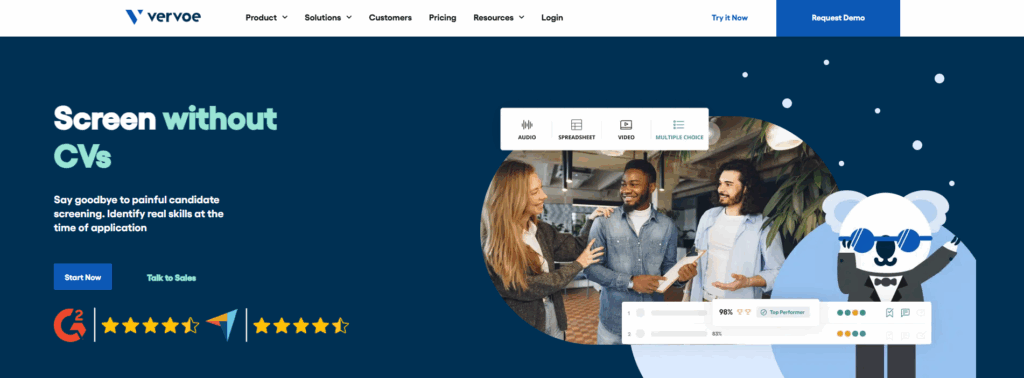
Vervoe pushes the work-sample argument harder than anyone else on this list. Rather than measuring an underlying trait and inferring performance, it asks candidates to do a version of the job and grades what they produce. Given the validity evidence for job-relevant measures, that is a defensible place to spend your screening time.
Key features
- Job simulations: a few hundred pre-built simulations across support, sales, marketing, technology and operations.
- Multi-format answers: text, video, file uploads and spreadsheets in one assessment.
- AI grading: responses are scored and ranked automatically, with the model tuned on your own grading.
- Team review: several reviewers can score and discuss responses in one dashboard.
Best for
Hiring where output quality is easy to judge and hard to fake.
Pricing
Pay-as-you-go by candidate volume, which suits uneven hiring cycles.
5. Codility
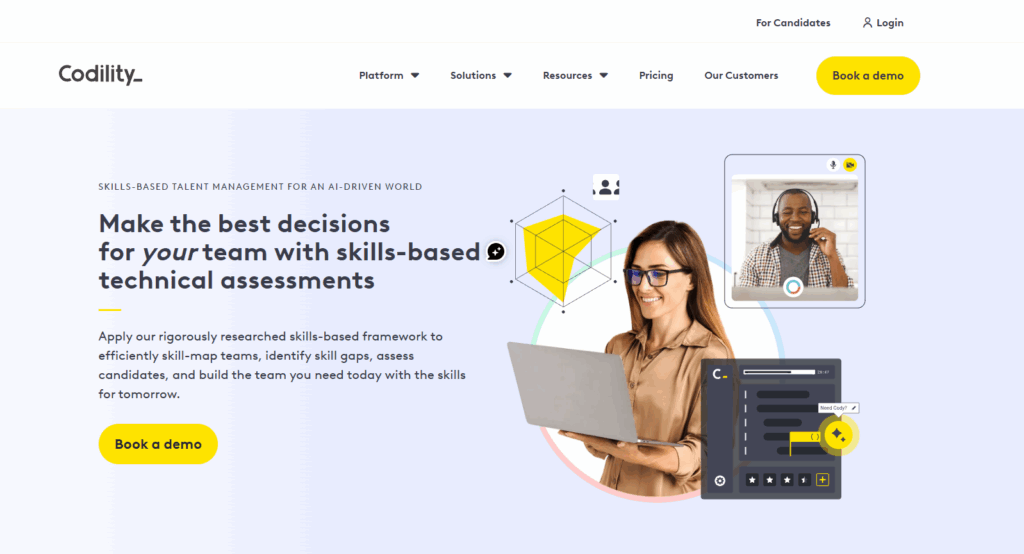
Codility is a coding assessment platform for engineering recruitment at volume. It is not a TalentLens replacement in any general sense, but if the roles driving your search are technical, it covers a gap TalentLens was never built for.
Key features
- Coding task bank: over 1,100 challenges across 45+ programming languages, from basic algorithms to system design.
- Live technical interviews: real-time collaborative sessions with syntax highlighting, a compiler and a test runner.
- Automated scoring: submissions assessed for correctness, efficiency and readability without manual code review.
- Reporting: task breakdowns, test-case results and code-quality scores per candidate.
Best for
Engineering organizations screening large developer pipelines.
Pricing
Structured annual tiers, with a custom option for large enterprises.
6. Mercer Mettl
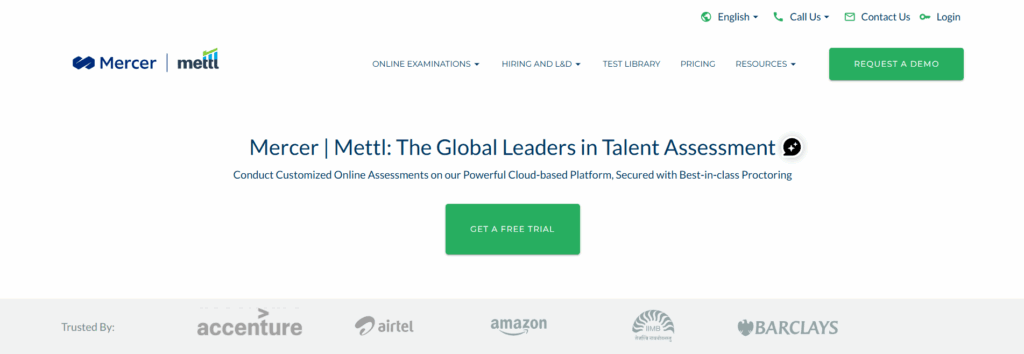
Of everything here, Mercer Mettl is closest to TalentLens in character: research-backed psychometric and behavioral assessment, sold with serious proctoring, aimed at large structured hiring programs. If you like the TalentLens model and want more coverage rather than a different model, start here.
Key features
- Test coverage: 200+ job-specific assessments across technical, cognitive, behavioral and psychometric domains.
- Proctoring: AI face recognition, browser lockdown and live human invigilation.
- Branding: customized assessments on a dedicated test domain.
- Reporting: competency scoring, percentile comparisons and hiring recommendations.
Best for
Campus recruitment, certification and regulated hiring at scale.
Pricing
Custom quote based on tests, candidate volume and features.
7. iMocha
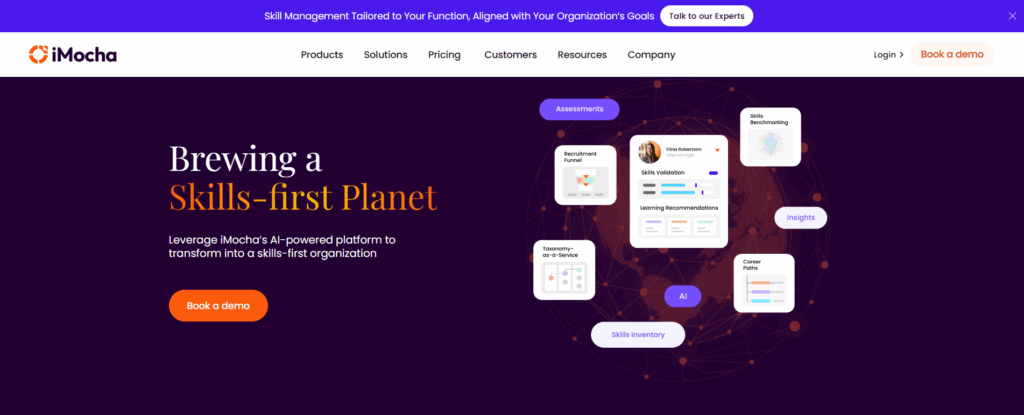
iMocha has drifted away from being a pure hiring tool toward skills intelligence: mapping what your existing workforce can do, not only screening applicants. If your TalentLens search is partly about internal mobility and development, that reframing is useful.
Key features
- Large skills taxonomy: thousands of ready assessments spanning a very wide skills catalogue, including niche areas like SAP and cybersecurity.
- Custom test builder: combine existing questions or author new ones with your own scoring logic.
- AI interviewer: a chat-based conversational assessment with adaptive questioning.
- Analytics: performance broken down by domain, skill group and question category.
Best for
Organisations treating assessment as workforce planning rather than only screening.
Pricing
Annual subscription with a free trial period.
8. Maki People
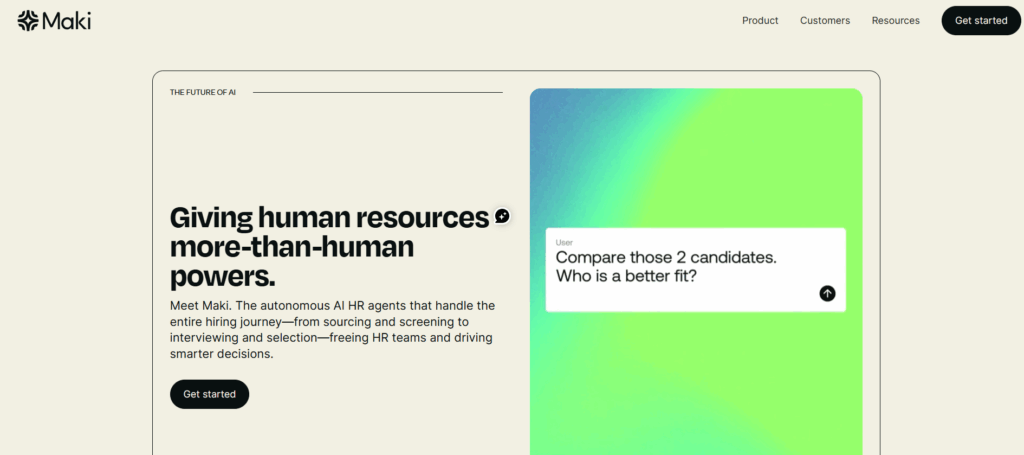
Maki People is a newer entrant focused on fast, bias-conscious screening and a candidate experience that does not feel like an ordeal. Its pitch is structured evaluation delivered quickly, which lands well for high-volume roles.
Key features
- AI hiring agents: configurable workflows that handle screening and scheduling steps automatically.
- Broad skills coverage: cognitive, soft skills, language proficiency and technical assessment in one library.
- Integrations: connects with 30+ ATS and HR systems including Workday and SmartRecruiters.
Best for
High-volume hiring where speed and consistency matter more than instrument depth.
Pricing
Not published. Custom quote from the vendor.
9. TestDome
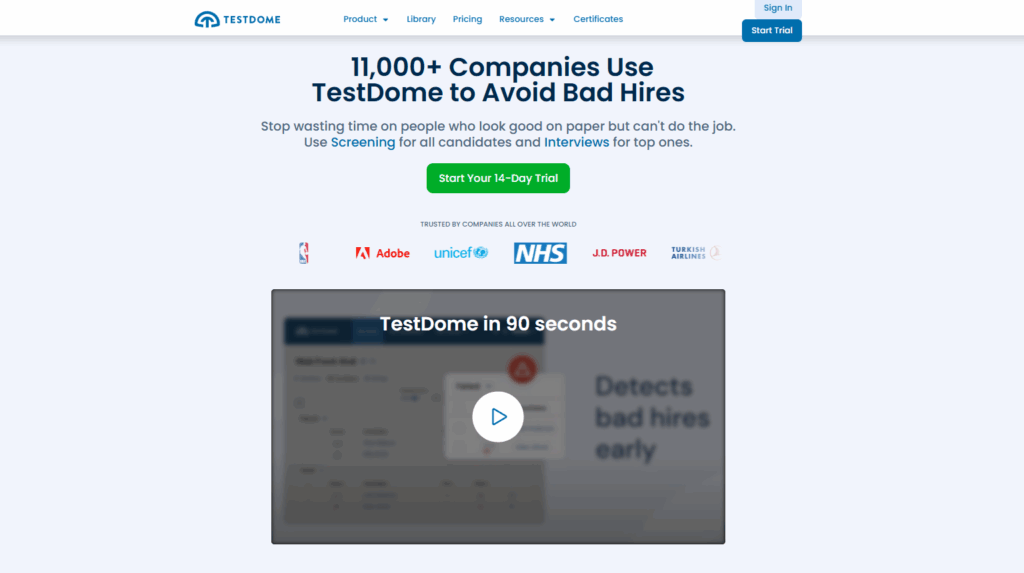
TestDome keeps things deliberately narrow: realistic work-sample tasks rather than trivia or theory. Its tests are short and built to filter out unqualified applicants quickly, across programming, IT, accounting and customer service.
Key features
- Work-sample testing: tasks that mirror real job responsibilities rather than abstract puzzles.
- Ready-made library: 150+ pre-built tests across technical and operational roles.
- Custom questions: author your own tasks or blend them with the library.
- Benchmarking: visual scorecards, percentile rankings and clear pass or fail indicators.
Best for
Small teams that want a quick, realistic filter without configuring much.
Pricing
Subscription based, with annual billing available at a discount.
10. Coderbyte
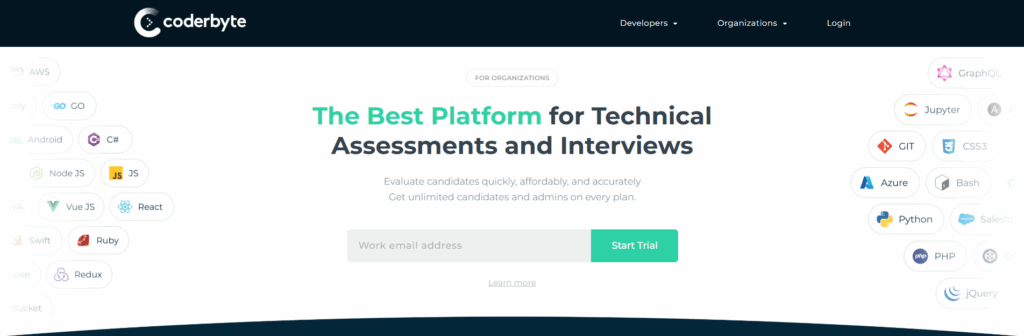
Coderbyte is a technical assessment platform aimed at startups and mid-sized teams hiring developers and data scientists, sold on a subscription that does not meter you per candidate.
Key features
- Challenge library: 1,000+ coding challenges across 30+ languages, plus project-based take-homes.
- Mixed question types: coding tasks alongside multiple choice, written answers and SQL queries.
- Live interviews: collaborative code editor with video, notebooks and a whiteboard for system design.
- Reporting: replayable coding sessions, automated scorecards and internal benchmarking.
Best for
Growing engineering teams that want predictable cost as volume moves around.
Pricing
Subscription covering unlimited candidates and tests, with annual discounts.
11. The Talent Games
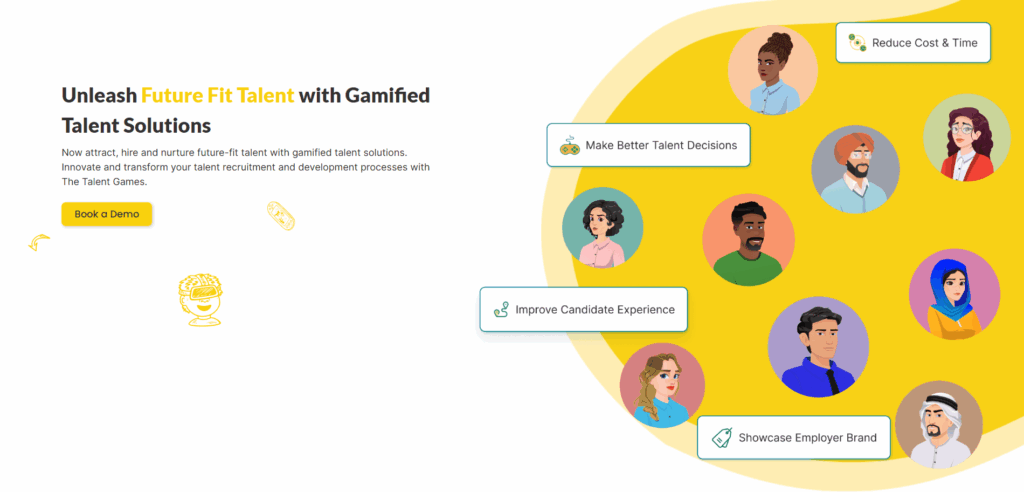
The Talent Games turns assessment into gameplay, which is a genuine answer to a real problem: graduate and early-careers candidates abandon long test batteries. Engagement is the product here.
Key features
- Gamified assessments: interactive games measuring decision-making, teamwork and adaptability.
- Timed challenges: scenarios that show how candidates perform under pressure.
- Job simulations: game-based previews of real job tasks.
Best for
Graduate schemes and early-careers intakes competing for the same applicants.
Pricing
Not published. Custom quote from the vendor.
12. TalentMetrix
TalentMetrix concentrates on psychometric profiling: personality, behaviour, emotional intelligence and the traits an interview tends to miss. It reads more like a consultancy product than a self-serve platform, and its reports lean qualitative.
Key features
- Psychometric batteries: personality, cognitive and emotional-intelligence assessment.
- Diagnostic reports: quantitative scoring paired with written interpretation.
- Straightforward administration: a simple interface for delivering assessments.
Best for
Development, coaching and succession work as much as selection.
Pricing
Not published. Custom quote from the vendor.
13. HackerEarth
HackerEarth is an enterprise technical hiring platform built for large-scale developer screening and structured interviews, with unusually broad coverage of modern engineering specialties.
Key features
- Large content library: tens of thousands of questions across software development, data science, machine learning, DevOps and cloud.
- Collaborative interviews: shared code editor with built-in question banks and a whiteboard.
- Proctoring: webcam monitoring, tab tracking and behavioral analysis, flagged in real time.
- Custom tests: templates or from scratch, with your own scoring logic and time limits.
Best for
Enterprises running structured, high-volume technical interview loops.
Pricing
Monthly plans scaling to larger teams and advanced needs.
14. TestInvite
TestInvite is an exam platform first and a hiring tool second, which is exactly why it belongs here. If your requirement is controlled, secure, auditable testing (certification, licensing, regulated assessment) it gives you more low-level control than most hiring-first products.
Key features
- Deep test authoring: multiple choice, essays, coding and video responses with custom scoring logic and timing.
- Ready test library: pre-built measures for problem-solving, communication and role-specific competencies.
- Configurable reporting: full control over metrics, benchmarks and score categorization, with written interpretations.
- Exam security: lockdown browser, AI cheating detection, randomized banks and video or audio monitoring.
Best for
Certification bodies and organizations running exam-grade assessment.
Pricing
Subscription starting low with attempt limits, scaling with usage and add-ons.
15. eSkill
eSkill covers the operational middle of an organization that assessment vendors often skip: clerical work, software proficiency, literacy and numeracy, accounting, call-center scenarios. Unglamorous, and frequently the roles you hire most of.
Key features
- Large test library: 600+ ready tests plus custom assessments built from a large question pool.
- Job simulations: interactive tasks such as a simulated support call or a data-entry exercise.
- Proctoring: monitoring for copy-paste, window switching and irregular response patterns.
- Analytics: score breakdowns by subject area and question type.
Best for
High-volume administrative, customer service and operational hiring.
Pricing
Not published. Custom quote from the vendor.
Which is the best TalentLens alternative?
For most teams running this search, Testlify. Not because it wins every category (Codility is better at engineering scale, TestInvite is better at exam control, Vervoe is better at pure simulation) but because it removes the assembly problem. Cognitive, personality, work sample, coding and interview live in one assessment, one candidate link, one report, and no test-user certification.
Choose differently in three cases. If a named instrument like the Watson-Glaser must appear in your process, stay with the publisher. If you hire almost exclusively engineers, a technical specialist will serve you better. And if you run campus intakes in the tens of thousands with live invigilation requirements, look at the enterprise psychometric vendors.
One thing worth checking whichever way you go: if you hire in New York City, automated employment decision tools fall under Local Law 144, which requires a bias audit within one year of use, public disclosure of that audit, and candidate notice 10 business days before the tool is used. Enforcement began on 5 July 2023. Ask any vendor on this list how they support that before you sign, not after.
See how Testlify compares on your roles
The fastest way to judge any of this is against a job you are actually hiring for. Start a free trial and build one assessment for a live requisition, or book a demo and have someone walk through the cognitive and psychometric library with you. If you want the head-to-head detail first, read the full Testlify and TalentLens comparison, or browse the assessment library to see what exists for your roles.
Key takeaways
- Decide instrument or workflow before you compare vendors. TalentLens sells validated instruments; most tools here sell a screening workflow. Teams waste weeks comparing across that line, then buy something that cannot do the job. If a named test must appear in your process for scheme or legal reasons, no platform on this list substitutes for it, and that is the one case where you should stay put.
- The single-cognitive-test model is weaker than it used to look. Reanalysis of the validity literature revised many older estimates downward and put structured interviews among the strongest predictors. The practical implication is that you should stop shopping for the best test and start shopping for the ability to combine several job-relevant measures.
- Combining predictors can also reduce adverse impact. Composites built with and without cognitive ability can reach comparable validity, and equally valid composites can be built with smaller subgroup differences. That means fairness and prediction are not always a tradeoff, which changes what you should ask a vendor to prove.
- Administration overhead is a real cost. Certification requirements and per-candidate licensing are sensible for publisher-grade instruments and painful for a small team hiring across several job families. Price the process, not just the license.
- Ask about the bias audit before you buy, not after. If you hire in New York City, Local Law 144 puts a bias-audit and candidate-notice duty on you, the employer, not on the vendor. A vendor who cannot tell you how they support it is a vendor who will cost you time later.
- Match the tool to where your volume actually is. Most teams over-index on the hardest role they hire and under-index on the role they hire twenty of. Pick for the second one.
FAQs

Director of Marketing
Akash Patange is the Director of Marketing at Testlify, where he works closely with HR leaders and recruiters to help organizations improve hiring outcomes. He writes about talent assessment, recruitment technology, and data-driven hiring practices.
LinkedInRelated resources
View all
Alternatives
Top 15 TalentMesh Alternatives and Competitors
Alternatives
Top 15 Maki People Alternatives and Competitors
Alternatives
Top 15 TestGenius Alternatives and Competitors
Alternatives
Top 15 Thrive Alternatives and Competitors
Alternatives
Top 15 Total Testing Alternatives and Competitors
Alternatives
Top 15 ThriveMap Alternatives and Competitors
Get started.
Hire on proof, not resumes.
Run your first skills-based assessment free — no credit card required.