
Startup hiring: a guide to your first 20 hires
A step-by-step startup hiring guide: who to hire first, how to test skills fairly, run lean interviews and make offers candidates accept.

Startup hiring is how a young, usually funded company fills its first roles without a dedicated HR team. There is no recruiter to screen resumes, no ATS pulling in applicants, and no time to get it wrong: one bad hire in a 10-person company changes the culture and burns months of runway.
This guide covers the order to hire in, how to source and screen candidates fairly, a lean interview process, and the compliance steps a startup cannot skip before its first hire.
TL;DR / Key takeaways
- Startup hiring means filling roles with no dedicated recruiter, so founders source, screen and interview candidates themselves, usually through their own network first.
- SHRM's 2025 recruiting benchmarking survey puts average cost-per-hire at roughly $5,475 for nonexecutive roles and $35,879 for executive roles, so a founder's time on hiring is not free even before a bad hire happens.
- Hire force-multiplier roles (the first engineer, first salesperson) before support roles (recruiting, office ops), and hire a generalist before you hire a specialist.
- A short skills test replaces resume-based gut feel and gives every candidate the same fair shot, even when the founder has no time to interview 40 people.
- Keep interviews to about an hour, cap interview days at five candidates, and debrief within 24 hours so good candidates do not go cold.
- A startup's first hire still needs an I-9, a written offer and a basic anti-discrimination check, even with no HR department yet.
 ChatGPT
 Gemini
 Claude
 Grok
 Perplexity
What makes startup hiring different?
Startup hiring differs from hiring at an established company in three ways: there is no dedicated recruiter, every hire is high-stakes because the team is small, and the process has to run alongside a founder's other jobs. A mis-hire at a 200-person company is a performance-management problem; at a 10-person company it can be the difference between shipping on time and missing a fundraising milestone.
SHRM's 2025 recruiting benchmarking report surveyed roughly 2,371 US HR professionals and found an average cost-per-hire of about $5,475 for nonexecutive roles and $35,879 for executive roles. Only a small share of organizations track quality of hire at all, which is part of why bad hires are so common: most teams, startups included, only find out a hire was wrong after the damage is done.
Mercury's 2025 Startup Economics Report, based on roughly 1,500 US early-stage founders and executives, found that hiring activity is picking up alongside AI adoption, meaning teams are hiring fewer generalists and more specialists earlier than they used to. That raises the bar on screening: a mis-hire in a specialist role is harder to recover from than in a generalist one.

Who should a startup hire first?
A startup should hire force-multiplier roles first: people whose work lets the founders do less of the thing they are worst at or busiest with, not people who make the founders' jobs more comfortable. The common mistake is hiring support roles (an office manager, a recruiter, a marketer) before the team has product-market fit and a repeatable way to sell or build.
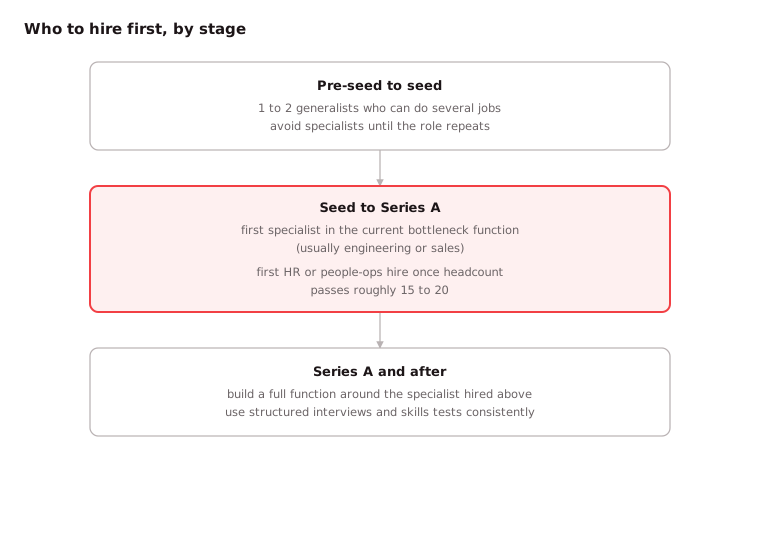
- Pre-seed to seed: Hire one or two generalists who can do several jobs (an engineer who can also talk to customers, an operator who can also do basic finance). Avoid specialists until the role is proven to repeat.
- Seed to Series A: Hire the first specialist in whichever function is now the bottleneck, usually engineering or sales. This is also when the first HR or people-ops hire tends to make sense, once headcount passes roughly 15 to 20.
- Series A and after: Build out a full function (a small engineering team, a sales team) around the specialist you hired in the stage before, and start using structured interviews and skills tests consistently rather than case by case.
For engineering-specific hiring, including how to write the job post and structure a technical loop, see developer hiring strategies for tech startups.
How do you source candidates with no recruiter and no budget?
A startup sources candidates with no recruiter by starting with its founders' own networks, then layering in referrals, before paying for marketplaces or agencies.
According to Gem's "Startup Hiring 101" guide for founders, a founder's first-degree network is consistently the highest-return channel for early hires, especially for the first engineers, because candidates trust a direct introduction more than a cold outreach message.
Across the teams Testlify works with, that pattern holds even once a company has a dedicated recruiter: a warm introduction still outperforms cold outbound for the hardest roles to fill.
- Founder networks first: Every co-founder should spend real time reaching out to former colleagues and classmates, not just the one founder who "does hiring."
- Referrals once you have a few hires: Make it easy and low-pressure for your first employees to refer people; do not turn it into a sales quota.
- Marketplaces and inbound next: Useful once your network is tapped out, but expect to spend more time qualifying candidates who do not already know your company.
- Agencies last: Typically cost 20 to 30% of first-year salary, so reserve them for a specialist role you genuinely cannot source or evaluate yourselves.
For a channel-by-channel breakdown and templates for first outreach, see sourcing for startups.
How do you screen candidates fairly without an HR team?
A startup screens candidates fairly without an HR team by testing the actual skill the role needs instead of judging résumés and gut feel, since a founder reading 150 résumés in a weekend will default to pattern-matching on schools and past employers, which is exactly the bias a small team cannot afford to bake into its first hires.
A short, role-specific skills test does three things a résumé cannot: it gives every candidate the same task, it surfaces strong candidates with unconventional backgrounds, and it gives the founder a scorecard instead of a feeling when two candidates seem equally likeable.
Role you're hiring | Skill to test | Example test type |
|---|---|---|
First engineer | Real coding ability, not trivia | |
First salesperson | Discovery and objection handling | |
First generalist/ops hire | Judgment under ambiguity | situational judgment test |
First HR or people-ops hire | HR fundamentals and process design |
Pro tip: Send the test before the first call, not after three rounds of interviews. It saves everyone's time and tells you within a day whether a candidate is worth your limited interview hours.
What does a lean startup interview process look like?
A lean startup interview process has three stages that take days, not weeks: a short screening call, one or two focused interviews, and a fast debrief. Unusual VC's field guide for early-stage hiring teams reports that founders who have run this process at scale keep each interview to about an hour (45 minutes of questions, 15 for the candidate to ask you anything), cap interview days at five candidates so interviewers do not burn out, and debrief with the team within 24 hours.
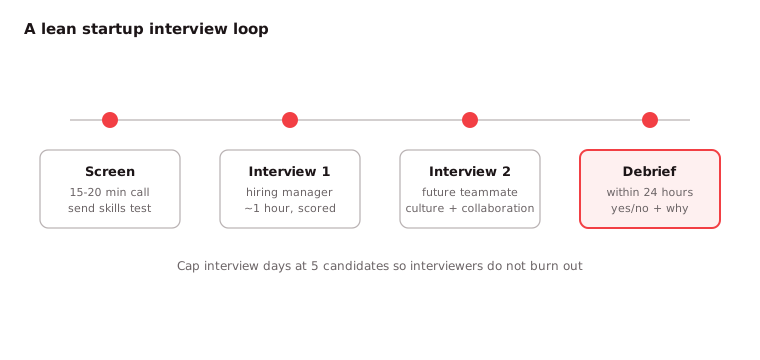
- Screen (15 to 20 minutes): Confirm the basics (location, compensation range, timeline) and send the skills test if you have not already.
- Interview 1, with the hiring manager or founder: One technical or role-specific conversation, scored against two or three agreed criteria.
- Interview 2, with a future teammate: A second, different angle (often culture and collaboration) so no single interviewer's opinion decides the hire.
- Debrief within 24 hours: Everyone gives an immediate yes or no with one sentence of reasoning, before memory fades and before the candidate loses interest in another offer.
Key takeaway: Speed is a competitive advantage in startup hiring. A strong candidate with other offers rarely waits two weeks for your third round.
What compliance basics does a startup need before its first hire?
A startup needs a short list of legal steps before its first hire, even with no HR department: verify work authorization with Form I-9, keep interview questions tied to the job (no questions about age, family plans or disability), issue a written offer letter that states at-will status and compensation clearly, and know your state's wage and hour basics before you set a pay rate. Skipping these is one of the most common and most avoidable startup hiring mistakes, because the fixes take an afternoon and the fines or lawsuits take much longer.
- Form I-9: Required for every US hire within three business days of the start date, regardless of company size.
- Interview questions: Stay on job-related topics; a well-meaning question about a candidate's family situation can still create legal exposure.
- Offer letter: State title, pay, start date and at-will status in writing; verbal offers invite disputes later.
- Pay basics: Check your state's minimum wage, overtime and pay-transparency rules before you post a salary range.
This is not legal advice; check state-specific rules or a lawyer before your first hire if anything here is unclear.
How do you make a startup job offer candidates will actually accept?
A startup makes an offer candidates will accept by moving fast, being upfront about equity and cash tradeoffs, and giving the candidate a real reason beyond salary to join a riskier employer than a large company. Confirm compensation expectations before the final interview, not after, so nobody wastes a week on a number that was never going to work.
- Speed: Send the offer within a day or two of the final interview; a slow offer reads as low priority to a candidate with other options.
- Equity, explained simply: State the number of shares or percentage, the vesting schedule, and the current valuation context; vague "upside" language erodes trust.
- A real pitch: Tell the candidate specifically what they would own and build, not just the role title; that is usually the actual reason someone joins a startup over a bigger, safer employer.
Ready to hire your next startup teammate?
Try a role-specific skills test on the next hire you make. Start a 7-day free trial of Testlify, no credit card required, and send a candidate a real task before you spend an hour interviewing them.
Frequently asked questions

Content Writer
Yashika Khandelwal is a Content Writer with 3+ years of experience creating research-backed content on hiring, talent assessment, and HR technology. She is a registered Organizational Psychologist and subject matter expert who combines behavioral science with practical recruitment insights to produce accurate, evidence-based content.
LinkedInRelated resources
View all
Hiring Guide
How to hire your first engineer as a founder: a step-by-step guide

Hiring Guide
Finance director job description: duties, skills and template

Hiring Guide
How to hire a data analyst: a 2026 step-by-step guide

Hiring Guide
What is lateral hiring and why is it important?

Hiring Guide
How to improve healthcare industry hiring with pre hire tests

Hiring Guide
Executive hiring playbook: a step-by-step guide
Get started.
Hire on proof, not resumes.
Run your first skills-based assessment free — no credit card required.