
What is skill issue: How to identify and address it?
Skill issues impact productivity and growth. Learn the key causes—technology shifts, poor hiring, and lack of training—and how to tackle them effectively.

Someone on your team keeps missing the mark on a task their job description says they own. Before you book a training course, it pays to work out which kind of problem you are actually looking at.
A skill issue is the gap between the skill a task needs and the skill the person doing it has right now. The phrase began as a gaming taunt, moved into everyday speech, and now turns up in performance conversations, where it carries far more weight than it ever did on a game stream.
Here is the part that costs money. A lot of what gets called a skill issue at work is something else wearing a disguise: a process nobody wrote down, a tool that fights the person using it, a role scoped for two people and filled by one. Label that a skill issue and you send a capable person to training while the real cause keeps running.
 ChatGPT
 Gemini
 Claude
 Grok
Grok Perplexity
TL;DR
- A skill issue is the gap between what a task requires and what someone can currently do. In gaming slang it means you lost because you were not good enough.
- At work the phrase is a diagnosis, not a taunt, and the diagnosis is wrong often enough to be expensive.
- Three types behave differently: hard skills, soft skills and transferable skills.
- Rule out process, tooling and role design first. Training transfers only when the work environment supports it, which is what the research on training transfer actually shows.
- Define the standard before you judge anyone against it, then measure everyone the same way instead of recalling who seemed sharp in a meeting.
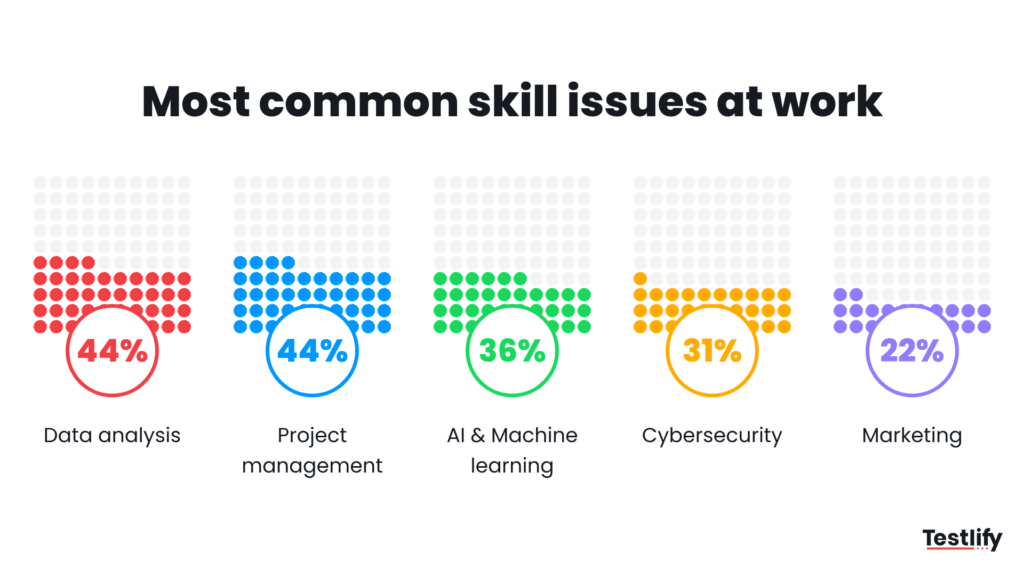
- Workers can expect 39% of their existing skill set to be transformed or outdated between 2025 and 2030, so some gaps open with nobody at fault.

What is a skill issue?
A skill issue is a gap between the skill a job or task requires and the skill the person performing it has right now. It covers technical ability, behavior, and fluency with the tools of the job. In gaming slang, the same two words mean something blunter: you lost because you were not skilled enough, and no excuse changes that.
Both meanings are in daily use, and which one you are reading depends entirely on where you met the phrase. On a game stream it is a jab. In a performance review it is a claim about someone's capability, and that claim decides who gets coached, who gets moved, and who gets managed out. Same words, very different stakes.
In HR language the workplace sense overlaps heavily with a skills gap, with one difference worth keeping straight: a skills gap is often discussed at the level of a company, an industry or a labor market, while a skill issue usually points at one person doing one task.
Where did the phrase skill issue come from?
Its exact origin is not documented, but the phrase is generally traced to competitive gaming and game streaming, and it spread widely on social media around 2020. Stronger players used it to wave away a weaker opponent's complaint: the map was not unfair, the lag was not the problem, you were simply outplayed.
It is often used ironically now, including for situations where skill has nothing to do with the outcome, which is exactly why it travels so well as a joke.
That history matters when the phrase crosses into work, because the taunt carries an assumption with it. "Skill issue" locates the entire problem inside one person. In a game, where everyone plays the same map with the same controls, that assumption is usually fair. At work, where the conditions are different for every person, it very often is not.
What are the different types of skill issues?
Skill issues split into three kinds, and each one hides in a different place. Confusing them is why so many development plans target the wrong thing.
Hard skill issues
Hard skills are the technical, job-specific abilities a role runs on: writing SQL, closing a month-end, operating a machine, building a financial model. They are measurable, which makes a genuine gap easy to confirm and hard to argue with.
These are the simplest to diagnose. Give the person the task under normal conditions and look at the output. A gap here shows up as work that is wrong, not work that is late.
Soft skill issues
Soft skills cover how the work gets done with other people: communication, handling conflict, giving an unwelcome update early instead of late. They resist clean measurement, so they attract the most guessing, and they generate most of the unfair skill-issue verdicts.
A soft skill gap and a soft skill that nobody has made room for look identical from the outside. An analyst who never flags risk might lack the skill, or might work for a manager who punishes bad news. If you want the difference, our guide on how to assess both skill types properly is the practical version, and hard skills versus soft skills covers where each one actually matters.
Transferable skill issues
Transferable skills move with a person across roles and industries: problem solving, prioritizing, adapting when the plan changes. A gap here tends to stay invisible until someone changes jobs, then it surfaces all at once.
This is the category most often misread as a sudden drop in ability. The ability did not drop. The scaffolding did. A specialist who was excellent inside a familiar system can struggle badly in a new one, which is what makes transferable skills worth naming explicitly when someone moves.
Is it a skill issue or a system issue?
This is the question the phrase itself discourages you from asking, and it is the one with the money in it.
Training research is unusually clear here. A meta-analytic review of transfer of training (Blume, Ford, Baldwin and Huang, 2010, published in the Journal of Management) found that whether trained skills actually get used back on the job depends on trainee characteristics, on how the training was designed, and on work-environment factors such as support and the climate for using the new skill. That last group is not about the learner at all. It means a person can genuinely acquire a skill and still fail to apply it, because the conditions around them do not allow it.
Read that backwards and you get the practical warning. If you treat every performance gap as a skill issue, the fix you reach for is training, and training is the one intervention the evidence says can be defeated by the environment you are sending people back into.
So before you label anyone, run the signals.
What you are seeing | Points to a skill issue | Points to a system issue | How to check it |
|---|---|---|---|
One person struggles on a task their peers handle fine | Likely, if conditions really are the same | Possible, if their accounts, territory or caseload differ | Compare output on the same task type, same inputs, across 3 or 4 people |
Everyone new to the role hits the same wall at about week 3 | Unlikely | Very likely, in onboarding or documentation | Ask the last 3 joiners where they got stuck, then read what they were given |
Quality dropped after a tool or process change | Possible, a real new-skill gap | Likely, if the drop starts the week of the change | Date the drop against the change log before anything else |
Strong in one context, weak in another | Unlikely, the skill demonstrably exists | Likely, something in the second context blocks it | Hold the task constant and vary the context |
Nobody can state the standard the work is judged against | Cannot be assessed yet | Certain, this is a management gap | Write the standard down in observable terms, then re-look |
That last row is the one that keeps showing up. If the standard lives only in a manager's head, a skill-issue verdict is a comparison against a memory, and memories flatter whoever the manager already rates.
How do you tell the difference without guessing?
You need a defined standard, one instrument used on everyone, and a refusal to read proxies as proof. In that order.
Define what good looks like, in observable terms. Not "strong communicator" but "flags a slipping deadline in writing before it slips, with a revised date". If you need a starting point for a role you have not mapped before, the O*NET skill definitions are free to read: an occupational database maintained for the US Department of Labor, which defines each skill and rates how important it is to the job.
Measure everyone the same way. A meta-analysis of mechanical versus clinical data combination in selection decisions (Kuncel and colleagues, 2013) found that combining assessment information mechanically predicts outcomes at least as well as experts recombining the same information by judgment. The practical reading is narrow and useful: once you have the evidence, do not let intuition quietly re-weight it at the end.
Do not accept credentials as skill evidence. A meta-analysis of grades and job performance (Roth and colleagues, 1996) found academic grades predict job performance far more weakly than hiring folklore assumes. That is not an argument that grades are worthless. It is an argument that a degree, a certification or a former employer's logo is a proxy, and a proxy cannot tell you whether the skill is present today.
This is what the Testlify Competency-to-Evidence Matrix is for: map every role to the competencies that matter, then connect each competency to evidence you can actually see, through assessments, work simulations, structured interviews and reviewer feedback. Its first rule is the one most teams skip. Do not start with a test. Start with the role.
Pro tip: run the measurement on two or three people who are doing the job well before you run it on the person you are worried about. If your strong performers score poorly on your new standard, the standard is wrong, and you just avoided putting a good employee on a development plan for failing a bad test.
What causes skill issues at work?
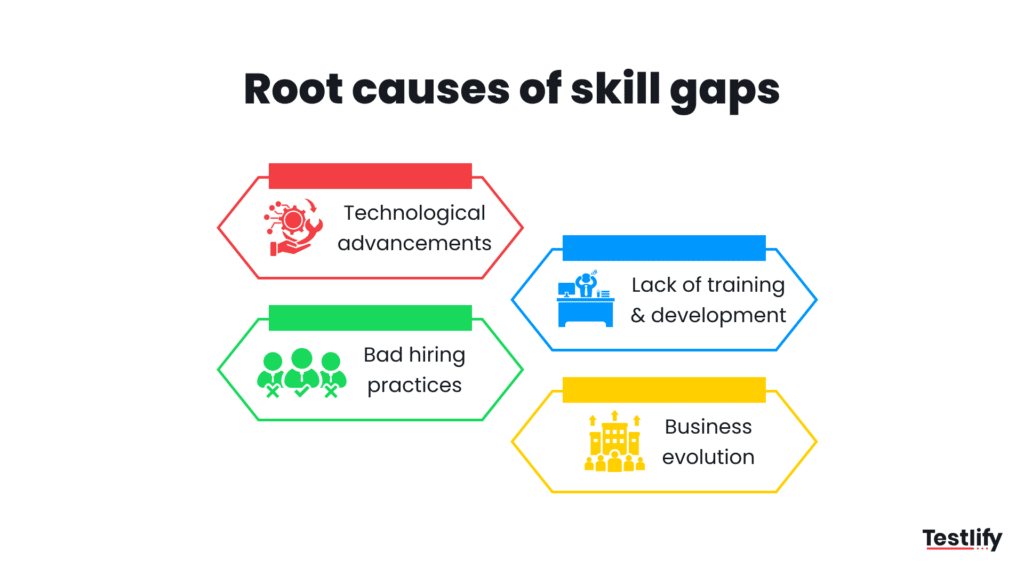
Four causes account for most of what you will meet, and only one of them is about the individual.
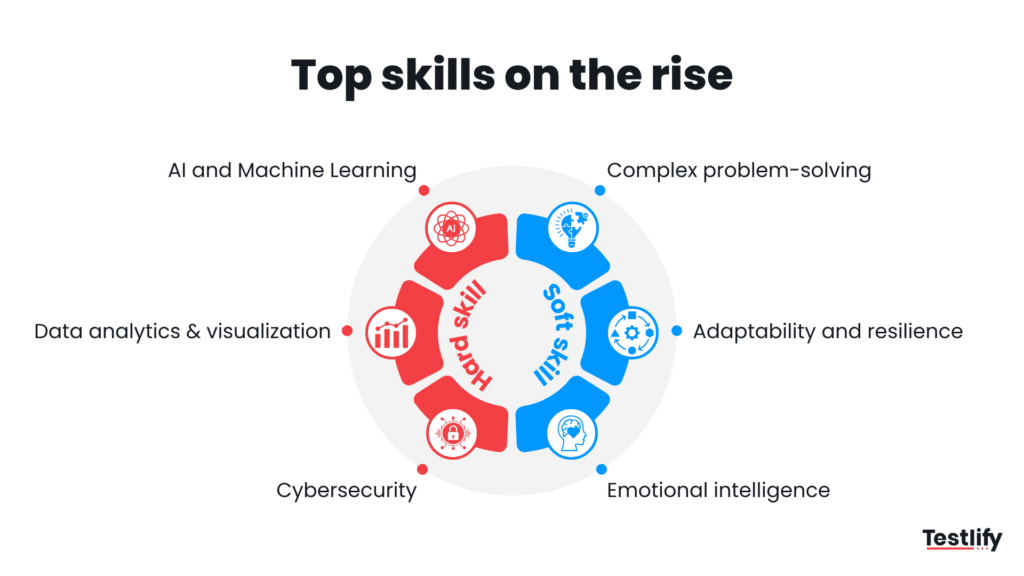
The work changed under the role
Skills decay because jobs move. The World Economic Forum's Future of Jobs Report 2025, built on responses from more than 1,000 employers representing over 14 million workers across 55 economies, reports that workers can expect two-fifths (39%) of their existing skill sets to be transformed or become outdated across the 2025 to 2030 period.
That number is falling, which is the part most coverage skips. The same measure of skill instability read 44% in 2023 and peaked at 57% in 2020. Churn is still high, but a permanently accelerating scramble is not what the data shows this year.
The same report puts 59% of the workforce as needing training by 2030, split into 29% who will be upskilled in their current roles, 19% who will be reskilled and redeployed, and 11% who are unlikely to get the training they need at all. Gaps of this kind are nobody's fault. Treating them as a personal failing is both wrong and a fast way to lose people who are still worth keeping.
Training that never transfers
Plenty of organizations do run the training and still carry the gap. That is the transfer problem from the previous section, and it is the reason a training and development budget can grow while capability stays flat. A course the work does not have room for is a cost, not a capability.
Roles designed as two jobs
Some skill issues are arithmetic. A role that quietly bundles two specialisms, or one that grew a second remit without losing the first, will read as a skill gap in whichever half the person is weaker. No training fixes a scope problem.
Hiring on proxies
If the hire was made on a resume, a familiar employer and a confident interview, nobody ever established that the skill was there. The gap did not open later. It was never measured, and it surfaced when the work did. This is the mechanism behind most skills mismatches, and it is the cheapest one to prevent.
How do you fix a skill issue?
- Write the standard down. Observable, specific, and agreed before anyone is assessed against it.
- Measure against it, the same way for everyone. Same instrument, same conditions, including for the people you already rate highly.
- Separate the three cases. Cannot do it yet, can do it but not in these conditions, and can do it but is choosing not to. Only the first is a skill issue, and the three need completely different responses.
- Pick one skill and one window. One skill, 30 to 60 days, one checkpoint you can see. Development plans that list six competencies move none of them.
- Change the conditions at the same time. Make room to use the new skill, or the transfer research says you may well be paying for training that cannot land.
- Re-measure, then update your own diagnosis. If nothing moved and the environment genuinely did change, the original call was wrong. That is information about the diagnosis, not a second failure by the person.
Step 2 is where most teams need help, because building a fair measurement from nothing is harder than it sounds. Testlify's test library covers role-specific skills, coding, cognitive ability, language, psychometric and situational judgement categories, with competency tagging down to sub-skills, three difficulty levels, and skill-level score breakdowns rather than a single pass or fail. That is what lets you say which skill is short, by how much, against a benchmark, instead of saying someone has a skill issue.
Hire for the skill, not the resume
Most skill issues are cheapest to solve before someone joins. If you want to see what measuring a skill properly looks like, you can start a free trial of Testlify, or book a demo and walk through a role you are hiring for right now. If you are working on gaps in the team you already have, our guide to identifying skills gaps with assessments is the place to go next.
FAQs

B2B SaaS Content Writer
Rishav Kumar is a B2B SaaS content writer with 4 years of experience. He loves crafting engaging content. Always exploring fresh ideas, he's passionate about helping businesses grow through impactful writing.
LinkedInRelated resources
View all
HR & recruitment
What is counterproductive work behavior & how to fix it?

HR & recruitment
How AI-powered education tools help HR improve employee retention and performance

HR & recruitment
All you need to know about direct sourcing

HR & recruitment
What Is Job Design? Elements, Approaches, and Best Practices (2026)

HR & recruitment
Phased return to work: a complete guide for HR teams

HR & recruitment
What Is Adaptive Leadership? Definition, Principles, and HR Applications (2026)
Get started.
Hire on proof, not resumes.
Run your first skills-based assessment free — no credit card required.