
Performance Evaluation Template: Free Form, Rating Scale and Examples
A free performance evaluation template that rates goals, skills and behaviors, with sample comments and a 90-day review for new hires.

A performance evaluation template is a ready-made form that managers use to rate an employee's work against the same goals, skills and rating scale as everyone else in the role. A good template turns a review from a memory test into a record of evidence: what the person delivered, how they delivered it, and what happens next.
TL;DR: - A free performance evaluation template you can copy today. - The eight sections every template needs. - A 5-point rating scale with a plain description for each level. - The main template types: annual, quarterly, self, 360 and 90-day. - How to fill one out, plus example comments and what to leave off the form. - How a 90-day evaluation shows hiring teams whether their hiring process picked the right people.
 ChatGPT
 Gemini
 Claude
 Grok
 Perplexity
What is a performance evaluation template?
A performance evaluation template is a standard document, usually a form or spreadsheet, that sets out the criteria, rating scale and comment fields a manager fills in when reviewing an employee's performance over a period. Because every employee in a role is rated on the same sections, results can be compared across teams and over time.
Teams use the terms performance evaluation template, performance review template, employee evaluation form and performance appraisal template for the same thing. The format matters less than the content: a template only works when the criteria match the job and the rating levels mean the same thing to every manager. For the wider process the form sits in, see the performance management cycle.

What should a performance evaluation template include?
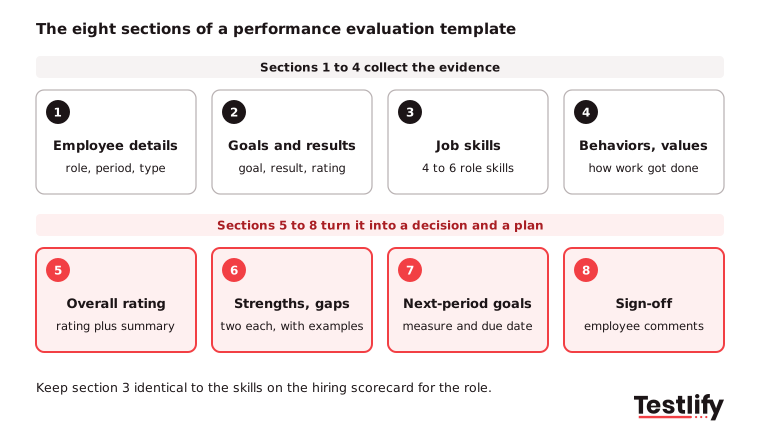
A performance evaluation template should include eight sections: employee details, goals and results, job skills and competencies, behaviors and values, an overall rating, strengths and development areas, goals for the next period, and sign-off with employee comments. The first four collect evidence, the last four turn it into a decision and a plan.
Section | What goes in it | Why it matters |
|---|---|---|
1. Employee details | Name, role, team, manager, review period, review type | Ties the record to the right job and period |
2. Goals and results | Each goal set last period, the result, a rating | Measures what was achieved |
3. Job skills | The 4 to 6 skills the role depends on, each rated | Measures how well the work was done |
4. Behaviors and values | Collaboration, ownership, communication, company values | Measures how the results were reached |
5. Overall rating | One rating plus a two-line summary | Feeds pay, promotion and talent decisions |
6. Strengths and development areas | Two of each, with examples | Gives the employee something to act on |
7. Next-period goals | 3 to 5 goals with a measure and a date | Sets up the next review |
8. Comments and sign-off | Employee comments, both signatures, date | Records that the review happened and was discussed |
Pro tip: Use the same skills in section 3 that you used in the job description and hiring scorecard for the role. You then compare the person's work with what you hired them to do, not with a generic list.
What does a performance evaluation template look like?
A performance evaluation template looks like a short form with fixed headings, a rating column and space for written evidence. Copy the version below into Word, Google Docs or your HR system, then replace the sample skills with the ones your role needs.
Performance evaluation form
- Employee name / role / team:
- Manager:
- Review period: (for example, January to June 2026)
- Review type: Annual / Mid-year / Quarterly / 90-day / Probation
Part A: Goals and results. For each goal: goal, measure, result achieved, rating (1 to 5), evidence.
Part B: Job skills. Rate each skill 1 to 5 and add one example: job knowledge, quality of work, productivity, problem solving, communication, and one role-specific skill (for example, SQL for an analyst or objection handling for a sales rep).
Part C: Behaviors and values. Rate 1 to 5 with an example: collaboration, ownership, adaptability, and each company value.
Part D: Overall rating. 1 to 5, plus a two-sentence summary of the period.
Part E: Strengths. Two strengths, each with a specific example.
Part F: Development areas. Two areas, each with the support the company will give (training, mentoring, a stretch project).
Part G: Goals for next period. Three to five goals, each with a measure and a due date.
Part H: Employee comments. The employee's view of the review, including anything they disagree with.
Sign-off. Employee signature and date, manager signature and date, second-level approver if your policy needs one.
Which rating scale should a performance evaluation use?
A performance evaluation should use a 5-point rating scale with a short behavior description for each level, so that a 4 from one manager means the same as a 4 from another. Five levels give enough range to separate strong from solid performers, and the descriptions stop the scale from drifting.
Rating | Label | What it looks like in practice |
|---|---|---|
5 | Far exceeds expectations | Beat every goal, raised the standard for others, took on work above the role |
4 | Exceeds expectations | Met every goal and beat most; needed little direction |
3 | Meets expectations | Met the goals and the skill standard for the role; reliable, solid work |
2 | Partly meets expectations | Met some goals; one or more skills below the role standard |
1 | Does not meet expectations | Missed most goals; needs a clear improvement plan |
Three-point and four-point scales are also common. A four-point scale removes the middle option and forces a lean up or down, which some teams like. Whatever you pick, write the descriptions down and keep "meets expectations" as a good result, not a warning.
What types of performance evaluation templates are there?
Performance evaluation templates come in six common types: annual, mid-year or quarterly, 90-day or probation, self-evaluation, 360-degree or peer, and upward (manager) evaluations. Most companies run an annual or mid-year review and add one or two of the others for specific needs.
Template type | When to use it | What changes in the form |
|---|---|---|
Annual review | Once a year, often before pay decisions | Full form, all eight sections |
Mid-year or quarterly | Check-ins between annual reviews | Goals, progress, blockers; rating often optional |
90-day or probation | End of a new hire's first three months | Role skills from the hiring scorecard, ramp-up goals, pass or extend |
Self-evaluation | Before the manager writes the review | Same sections, written by the employee |
Leadership and cross-team roles | Short rating set filled by peers and reports | |
Upward evaluation | Feedback on managers | Rates coaching, clarity, support |
How do you fill out a performance evaluation template?
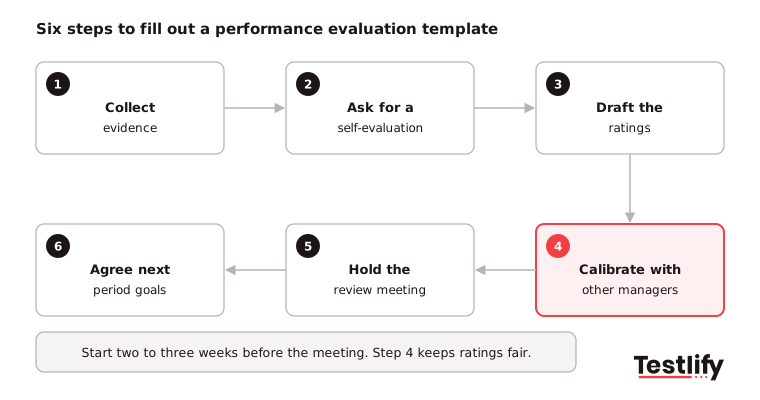
Filling out a performance evaluation template takes six steps: collect evidence, ask for a self-evaluation, draft the ratings, calibrate with other managers, hold the review meeting, and agree goals for the next period. Start two to three weeks before the meeting so nobody writes the review from memory the night before.
- Collect evidence. Pull goal results, work samples, customer or peer feedback and notes from one-on-ones for the whole period, not only the last month.
- Ask for a self-evaluation. Send the same form to the employee a week ahead. Gaps between the two views are the best topics for the meeting.
- Draft the ratings. Rate each goal and skill against the written scale, with one example per rating.
- Calibrate. Compare draft ratings with other managers for the same role so one team is not rated harder than another.
- Hold the meeting. Share the form, discuss the evidence, and let the employee add comments. Follow effective performance review practices.
- Agree next-period goals. Close with three to five goals and the support the employee will get.
What are good performance evaluation comments?
Good performance evaluation comments name a specific result or behavior, say what effect it had, and point to what comes next. Comments like "great team player" give the employee nothing to act on; a comment with an example and a next step does.
Rating | Example comment |
|---|---|
5 | "Rebuilt the onboarding checklist without being asked; new-hire setup time fell from five days to two. Ready to lead the Q3 hiring project." |
4 | "Hit all four quarterly goals and closed two ahead of time. Next step: present results to the leadership team directly." |
3 | "Delivered every report on time and to standard. To move up, own one process from start to finish next quarter." |
2 | "Met two of four goals; client updates were late three times. We will set weekly check-ins and a shared tracker for the next 60 days." |
1 | "Missed most goals and key deadlines this period. We will agree a written improvement plan with clear measures and a review date." |
Key takeaway: A rating without an example is an opinion. A rating with an example is evidence, and evidence is what holds up in a pay or promotion discussion.
How can a 90-day evaluation show whether a hire worked?
A 90-day evaluation shows whether a hire worked by rating the new employee on the same skills the hiring team assessed before the offer. If the people who scored well in hiring also score well at 90 days, the hiring process is picking the right people; if not, the team knows which stage to fix.
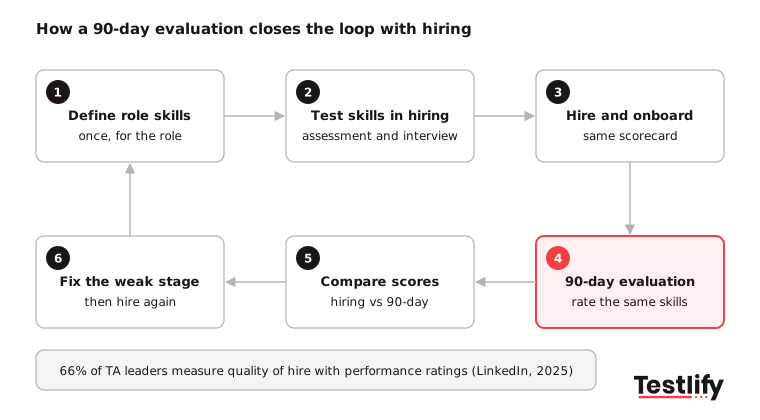
Hiring teams already lean on performance ratings. In LinkedIn's Future of Recruiting 2025, 66% of TA leaders said they measure quality of hire with job performance ratings, ahead of new-hire retention (60%) and hiring manager satisfaction (44%). Yet only 25% were highly confident in how their company measures quality of hire.
The gap usually comes from a mismatch: the hiring scorecard rates one set of skills, and the performance evaluation template rates a different, generic list. Across the teams we work with, the fix is simple. Write the role's skills once, use them in the job description, the skills assessment, the interview scorecard and the 90-day evaluation, and compare the scores.
The same LinkedIn report found 93% of TA professionals say accurately assessing skills is crucial to quality of hire. With Testlify, the skills you test in hiring come from a library of 3,500+ tests or a custom assessment built from your job description, and each candidate report breaks results down per skill. Those per-skill scores are what you line up against the 90-day ratings. To put a number on the result, try the quality of hire calculator.
What should you leave out of a performance evaluation?
A performance evaluation should leave out anything that is not about the employee's work: age, health, pregnancy, family plans, religion, race, national origin, rumors and personality labels. Ratings based on protected traits can turn a review into evidence in a discrimination claim.
The EEOC's guidance on prohibited practices makes it illegal to base employment decisions, including promotions and pay, on race, color, religion, sex (including pregnancy), national origin, age 40 or older, disability or genetic information. Evaluations often feed those decisions, so keep the form on results and observable behavior.
Also leave out:
- Medical leave and accommodations. Rate the work done, not the time someone was legally away.
- Comparisons with named colleagues. Compare the person with the rating scale, not with the colleague at the next desk.
- Personality labels. Write "missed three client deadlines", not "disorganized".
- Surprises. Nothing in the review should be news. Raise problems when they happen, not months later.
What makes performance evaluations unfair?
Performance evaluations become unfair when ratings depend on who the manager is rather than on the work: vague criteria, no written scale, recent events outweighing the whole period, and feedback used to settle scores. A template fixes some of this, and calibration fixes most of the rest.
Employees notice. A SHRM report from May 2025 on a LiveCareer survey of 1,000 workers found 79% would opt out of 360-degree feedback if they could, and 74% felt the results were unfair, biased or inaccurate. The stakes reach managers too: Gallup's State of the Global Workplace 2026 reports manager engagement fell to 22% in 2025, down nine points since 2022, while global employee engagement dropped to 20%.
Four fixes that work with any template:
- Written rating descriptions so every manager reads the scale the same way.
- Evidence for every rating, collected over the whole period.
- Calibration sessions where managers compare ratings for the same role.
- Employee comments on the form, so disagreement is recorded rather than lost.
Want evaluations that match how you hire?
Start with the skills that matter for each role. See how Testlify can help you assess those skills consistently before the offer and track performance after 90 days. Book a demo with Testlify to see how you can build a skills-based evaluation process that fits your hiring workflow.
Frequently asked questions

People and Talent Partner
Arushi Shah runs day-to-day talent acquisition and candidate experience at Testlify. She writes on interviewing, structured hiring, and giving candidates a fair, fast process.
LinkedInRelated resources
View all
HR Toolkit
ROI of using a structured HR toolkit in growing companies

HR Toolkit
HR toolkit compliance calendar templates

HR & recruitment
What Is Leadership Coaching? A 2026 Guide for HR Teams

Workplace culture
12 Best Employee Engagement Strategies That Work in 2026

Skill assessment
Skills Taxonomy vs Skills Ontology: A Guide for Hiring Teams

HR & recruitment
Methods of Job Analysis: 10 Methods and How to Choose (2026)
Get started.
Hire on proof, not resumes.
Run your first skills-based assessment free — no credit card required.