
90 day employee performance review template
A free 90 day employee performance review template for new hires, with a 1 to 5 scale, questions and example comments.

A 90 day employee performance review template is a form managers use to assess a new hire after three months. It records how the person is doing against the role's goals and core skills, what is going well, what needs work, and the goals for the next 90 days. Used the same way for every hire, it also gives the hiring team its first real signal of quality of hire.
 ChatGPT
 Gemini
 Claude
 Grok
 Perplexity
TL;DR
- A 90-day review is a formal check-in at the end of a new hire's first three months that rates performance, fit, and goals and agrees on the next steps.
- A good 90-day employee performance review template has eight parts: employee details, a 1 to 5 rating scale, rated performance factors, goal progress, strengths, development areas, comments from both sides, and next-quarter goals.
- Send a short self-assessment 3 to 5 days before the meeting, fill in your own ratings separately, and let the new hire speak first.
- Define what a 1, 3, and 5 look like before you score. A rating without a written example is an opinion.
- Every review ends with one of four outcomes: confirm, confirm with a development plan, extend the probation period, or part ways.
- Compare 90-day ratings with the candidate's pre-hire test and interview scores. That is the cheapest way to learn which hiring signals actually predict good hires.

What is a 90-day review?
A 90-day review is a formal performance conversation between a manager and a new employee at the end of the first three months in the role. The manager rates performance against the role's expectations, both sides discuss how onboarding went, and they agree on goals for the next quarter.
Many companies tie the 90-day review to the end of a probation period, so it doubles as the confirmation decision. Others run it as a lighter check-in inside a wider performance review cycle. The format is the same either way: a written form, a one-hour meeting, and a signed record.
The manager carries most of the weight in this meeting, and managers are stretched. Gallup's State of the Global Workplace 2026 found that manager engagement fell from 27% to 22% between 2024 and 2025, while global employee engagement sat at 20%. A template takes the guesswork out of the conversation, so a busy manager still covers everything that matters.
Why does the 90-day employee performance review matter?
The 90-day employee performance review matters for hiring teams because it is the first hard evidence of whether a hire is working out. Recruiters can use it to judge their own process: if new hires keep scoring low on the same skill, the screening for that skill is not working.
Quality of hire is the metric most teams want and few can measure. According to LinkedIn's Future of Recruiting 2025, 89% of talent acquisition professionals say measuring quality of hire will become more important, yet only 25% feel highly confident they can measure it. Among teams that do measure it, 66% use job performance ratings and 60% use new hire retention. A 90-day review captures both early.
- For the new hire: Clear feedback on what good looks like, before small gaps turn into habits.
- For the manager: A fixed point to fix onboarding gaps, reset goals, and decide on confirmation.
- For HR and TA: A consistent score per hire that can be compared across roles, teams, and sources.
Retention matters just as much. According to the BLS Job Openings and Labor Turnover Survey, 3.1 million employees quit their jobs in August 2026, representing a 1.9% quit rate. When a new hire leaves within four months, employers have to repeat the hiring process and absorb the cost all over again. A 90-day review can help identify early warning signs before that happens.
What should a 90-day employee performance review template include?
A 90-day employee performance review template should cover eight key areas: employee details, rating scale, performance factors, goal progress, strengths, areas for improvement, feedback, and goals for the next quarter. Include a space for signatures and the review date to complete the form.
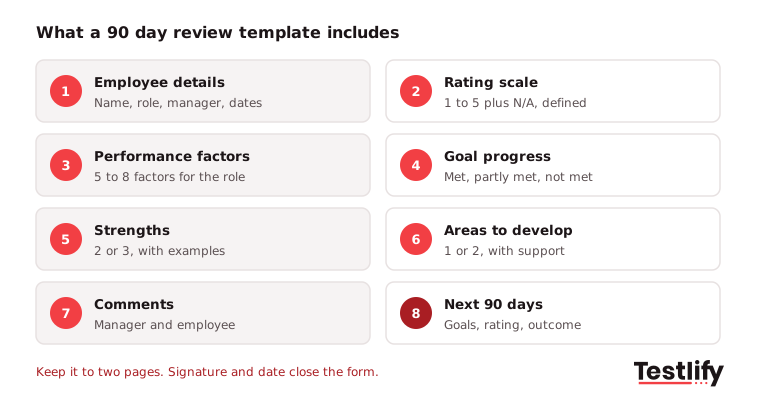
- Employee details: Name, job title, team, manager, start date, review date and review period.
- Rating scale: A 1 to 5 scale with a written meaning for each number, plus N/A for factors the person has not had a chance to show yet.
- Performance factors: Five to eight factors that fit the role, such as job knowledge, quality of work, reliability, communication, collaboration, initiative and learning speed.
- Goal progress: The two or three goals set on day one, each marked met, partly met or not met, with a line of evidence.
- Strengths: Two or three specific things the person does well, with examples.
- Areas to develop: One or two skills to work on, with the support the manager will give.
- Comments: One box for the manager and one for the employee, so both views are on record.
- Next 90 days: Two or three goals for days 91 to 180, an overall rating and the outcome of the review.
Keep the form to two pages. If the onboarding checklist already set day-one goals, copy them into the goal section so the review measures what was agreed.
What does a 90-day employee performance review template look like?
A 90-day employee performance review template looks like a short form with a header, a rating table and a few open text boxes. Copy the version below into a document or your HR system and replace the performance factors with the ones that matter most for the role.
Section 1, employee details:
- Employee name:
- Job title and team:
- Manager:
- Start date:
- Review date:
- Review period: day 1 to day 90
Section 2, performance factors (rate 1 to 5, or N/A):
Performance factor | What to look for | Rating (1 to 5) | Evidence or example |
|---|---|---|---|
Job knowledge | Understands the tools, processes and products the role needs | ||
Quality of work | Output is accurate and needs little rework | ||
Reliability | Meets deadlines and follows through on commitments | ||
Communication | Keeps the manager and team informed, asks for help early | ||
Collaboration | Works well with peers and other teams | ||
Initiative | Spots problems and suggests fixes without being asked | ||
Learning speed | Picks up new tasks and feedback quickly | ||
Role-specific skill | The one skill the role was hired for (for example, SQL, closing deals, ticket resolution) |
Section 3, goal progress:
- Goal 1: ___ | Met / Partly met / Not met | Evidence:
- Goal 2: ___ | Met / Partly met / Not met | Evidence:
- Goal 3: ___ | Met / Partly met / Not met | Evidence:
Section 4, strengths and areas to develop:
- Top strengths (with examples):
- Areas to develop (with the support the manager will give):
Section 5, comments:
- Manager comments:
- Employee comments:
Section 6, next 90 days and outcome:
- Goals for days 91 to 180:
- Overall rating (1 to 5):
- Outcome: Confirm / Confirm with development plan / Extend probation / Do not continue
- Manager signature and date:
- Employee signature and date:
For other formats, such as a self-assessment or a 360 review, see these employee evaluation forms.
How do you score a 90-day review?
A 90-day review is scored on a 1 to 5 scale where 3 means the person meets the bar for a new hire at three months, not the bar for a fully ramped employee. Writing down what each score means before the meeting keeps ratings consistent between managers.
Score | Label | What it means at day 90 |
|---|---|---|
5 | Well above expectations | Already performs like an experienced team member on this factor |
4 | Above expectations | Ahead of a typical new hire, needs little guidance |
3 | Meets expectations | On track for a new hire at three months, normal amount of support |
2 | Below expectations | Behind where a new hire should be, needs a clear plan |
1 | Well below expectations | Serious gap that puts the role at risk |
N/A | Not yet seen | The person has not had a fair chance to show this yet |
Pro tip: Ask every manager to write one example for any score of 1, 2 or 5. Extreme scores without examples are where bias and halo effects hide, and they are the scores you will most need to defend later.
How are a 30-, 60-, and 90-day reviews different?
A 30, 60 and 90-day review differ in what they ask: the 30-day check is about settling in, the 60-day check is about early output, and the 90-day review is the formal rating of performance and fit. Many teams run the first two as short check-ins and keep the full form for day 90.
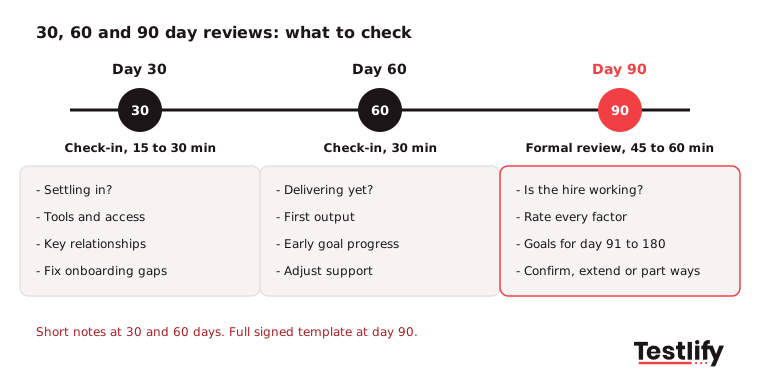
30-day check-in | 60-day check-in | 90-day review | |
|---|---|---|---|
Main question | Is the person settling in? | Is the person starting to deliver? | Is the hire working out? |
Focus | Onboarding, tools, relationships | First output, early goals, gaps | Performance, fit, goals, outcome |
Format | 15 to 30 minute chat | 30 minute check-in | 45 to 60 minute formal review |
Written form | Short notes | Short notes | Full template, signed |
Typical outcome | Fix onboarding gaps | Adjust goals and support | Confirm, extend or part ways |
If you only have time for one, run the 90-day review. If you can run all three, the 30-day check catches onboarding problems while they are still cheap to fix.
How do you run a 90-day review?
A 90-day review runs best in six steps: book it on day one, send a self-assessment a few days before, gather input from the people the new hire works with, fill in your ratings, hold the meeting, and file the signed form. Across the teams that run this well, the meeting itself takes 45 to 60 minutes.
- Book it on day one: Put the 90-day review in both calendars when the person starts, so it never slips.
- Send a self-assessment: Share the same form 3 to 5 days before and ask the new hire to rate themselves and list their wins.
- Gather input: Ask two or three peers or stakeholders for one strength and one thing to improve.
- Fill in your ratings: Score every factor with the rubric and write examples before the meeting. Do not share ratings in advance.
- Hold the meeting: Let the new hire go through their self-assessment first, then share yours. Spend most of the time where the two views differ.
- Agree and file: Set goals for days 91 to 180, record the outcome, get both signatures, and send the form to HR.
What questions should you ask in a 90-day review?
The best 90-day review questions cover four areas: the role, onboarding, goals, and support. Open questions work better than yes or no ones, because the aim is to hear what the new hire thinks, not to confirm what the manager already believes.
About the role:
- Is the role what you expected when you accepted the offer? What is different?
- Which parts of the job do you feel most confident about, and which least?
- What does a great week look like for you in this role?
About onboarding:
- What helped you most in your first three months?
- What do you wish you had known or been given earlier?
- Who has been most helpful, and is there anyone you have found hard to work with?
About goals:
- Which goals do you think you met, and what got in the way of the others?
- What would you like to achieve in the next 90 days?
About support:
- What tools, training or access do you still need?
- How can I support you better as your manager?
What are good 90-day review examples?
Good 90-day review examples are specific, tied to a goal or factor, and state what should happen next. The examples below show how a manager can write comments at different ratings, followed by sample goals for the next 90 days.
- Strong performance (rating 5): "Priya closed 14 support tickets a day by week ten, above the team target of 10, with a 96% customer rating. She also wrote two help articles nobody asked for. Next step: start mentoring the next new hire."
- On track (rating 3): "Dan knows the CRM and the sales process well and books meetings at the expected rate. He waits too long to ask for help on complex deals. Next step: weekly deal review with his manager for the next quarter."
- Below the bar (rating 2): "Reports are accurate but late on four of six deadlines. We agreed on a shared tracker and a mid-week check. Next step: review progress at day 120."
Sample goals for days 91 to 180:
- Handle the full ticket queue with no shadowing by day 120.
- Lead one customer onboarding from kickoff to go-live.
- Finish the advanced product training and pass the internal quiz.
- Cut average report turnaround from three days to two.
What happens after a 90-day review?
A 90-day review usually ends in one of four outcomes: confirm the hire, confirm with a development plan, extend the probation period, or part ways. Whichever outcome you choose, write it on the form, share it with the employee and keep a signed copy on file.
- Confirm: The person meets or beats the bar. Set next-quarter goals and move them into the normal review cycle.
- Confirm with a development plan: Overall on track, with one or two clear gaps. Write the plan with dates and support.
- Extend probation: Not yet clear either way. Set a short extension, usually 30 to 90 days, with specific goals. See how to manage employee probation periods.
- Part ways: Serious gaps that support has not closed. Involve HR and follow your local employment law and contract terms.
Keep the record. In the US, 29 CFR 1602.14 requires covered employers to keep personnel records for one year from the date of the record or the personnel action, whichever is later, and for one year after an involuntary termination. Rules differ by country, so check with HR or legal.
How does the 90-day review improve your hiring?
The 90-day review improves hiring when you compare its scores with how each person was assessed before the offer. If candidates who scored well on a skills test also score well at day 90, that test is worth keeping. If there is no link, the hiring signal needs changing.
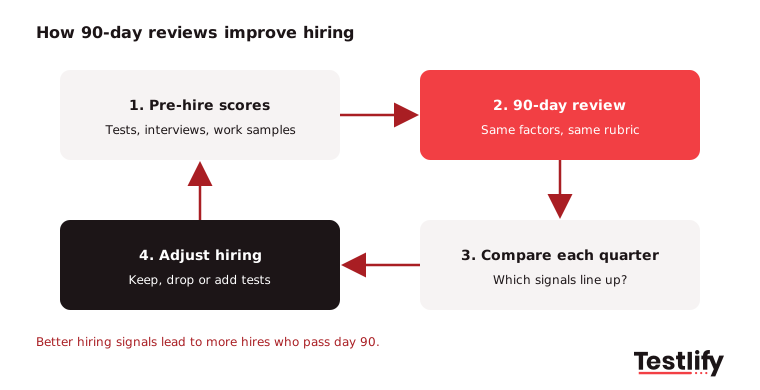
- Record pre-hire scores: Keep each hire's test, interview and work sample scores in one place.
- Use the same factors: Rate the 90-day review on factors that match the skills you tested for.
- Compare every quarter: Put pre-hire scores next to 90-day ratings for each role and look for the signals that line up.
- Adjust the process: Drop questions and tests that do not predict day-90 performance. Add ones for skills where new hires keep falling short.
Testlify supports the pre-hire half of this loop. Teams pick role-based tests from 3,500+ options in the Testlify test library, score every candidate the same way, and export results to compare with 90-day ratings. For more ways to measure the result, read the guide on how to improve quality of hire or try the quality of hire calculator.
Key takeaway: A 90-day review is only as useful as its consistency. Use the same template, the same rubric and the same factors for every hire in a role, and the reviews become hiring data, not just paperwork.
Ready to hire people who pass their 90-day review?
Start with skills you can see before the offer. Browse the Testlify test library or start a 7-day free trial, no credit card required, and build a role-based assessment from your own job description.
Frequently asked questions (FAQs)

Related resources
View all
HR Toolkit
How to handle difficult employees: A practical guide for managers

HR Toolkit
Employee termination checklist: a step-by-step guide for HR

HR Toolkit
Email marketing specialist job description: duties, skills and a sample

HR Toolkit
Performance Evaluation Template: Free Form, Rating Scale and Examples

Interview questions
30 Selenium interview questions to ask and what strong answers sound like

Hiring Guide
Startup hiring: a guide to your first 20 hires
Get started.
Hire on proof, not resumes.
Run your first skills-based assessment free — no credit card required.