
How to handle difficult employees: A practical guide for managers
A practical guide to handling difficult employees: spot the pattern, hold the first talk, document it, and know when to escalate.

Difficult employees are not simply people a manager finds annoying. They are people whose conduct or performance keeps falling short of a clear standard, and the gap repeats after the manager has already raised it. Getting that definition right matters, because it decides whether the fix is a conversation, a written plan or a legal process. Many managers wait too long, or react too fast, and both mistakes make things harder. This guide shows how to spot the real pattern, hold the first conversation, document each step and know when to bring in HR or legal counsel.
TL;DR / Key Takeaways
- A difficult employee has a repeating conduct or performance gap that continues after the manager has raised it. One bad week does not count.
- Check first whether the cause is the person or the system: unclear goals, poor feedback or an overloaded role.
- Common patterns include the exempt high performer, the entrenched veteran, the blame-shifter, the chronic complainer and the quiet underperformer.
- Hold the first conversation privately and promptly. Name one specific instance, state the impact, ask their side, agree on the change and set a follow-up date.
- Document every step with the date, the behavior, the conversation and what was agreed. The usual path runs from verbal talk to written warning to a PIP to a final decision.
- Bring in HR or legal counsel when a protected characteristic, harassment, accommodation or termination is involved.
 ChatGPT
 Gemini
 Claude
 Grok
 Perplexity
What makes an employee "difficult"?
An employee becomes difficult when a specific behavior or performance gap repeats after a manager has already named it and asked for a change. SHRM describes the pattern as performance or conduct problems that continually recur despite previous discussions and documented commitments, and recommends addressing them with renewed urgency, both verbally and in writing, once that pattern is clear. SHRM on how to deal with difficult employees
Two checks keep this definition from becoming a label for anyone a manager dislikes:
- Is it a pattern, or a bad week? One missed deadline or one sharp comment in a stressful meeting is not a pattern. A manager who raises it only once and already calls the person "difficult" is reacting, not managing.
- Is it the person, or the system? HR Magazine has reported cases where the "difficult" employee was not the real problem; the organization's culture, unclear expectations, or an overloaded role was. Before writing anyone up, check that goals, feedback and tools were actually clear.

What are the most common types of difficult employees?
Most difficult employees fall into a handful of repeating patterns: the high performer who thinks the rules do not apply to them, the long-tenured employee who refuses to change how they work, and the person who deflects every piece of accountability onto someone else. A 2026 guide from TriNet names these three as the archetypes managers run into most. TriNet's 2026 guide to difficult employees

Type | What it looks like | First move |
|---|---|---|
The exempt high performer | Misses process steps, talks over others, assumes results excuse behavior | Separate the praise for output from the conduct that has to change; name both in the same conversation |
The entrenched veteran | Resists new tools or process, "we've always done it this way" | Ask what specifically is hard about the change, then set one small, trackable adjustment |
The blame-shifter | Explains every miss as someone else's fault, rarely owns a mistake outright | Focus the conversation on the one task and its outcome, not on who else was involved |
The chronic complainer | Raises real and small issues constantly, drains team energy | Separate venting from an actual request; ask what outcome they want from each complaint |
The quiet underperformer | Technically competent, consistently behind on deadlines, avoids flagging it early | Set a short check-in cadence so problems surface before the deadline, not after |
Most of these people do their technical job acceptably or better. That is exactly why the conduct problem gets excused for too long, and why documentation matters once a manager does step in.
How do you start the first conversation with a difficult employee?
Start the first conversation privately, promptly, and focused on one specific, observable action rather than on the person's character. TriNet's guidance is to hold these talks as soon as the pattern is confirmed, not after it has built up for months, and to describe what happened rather than what kind of person the manager thinks they are dealing with.
A short structure that holds up in most of these conversations:
- Name the specific instance: "In yesterday's client call, you interrupted Priya twice while she was presenting the numbers." Not "you're always rude in meetings."
- State the impact: What it cost the team, the client relationship, or the deadline. Keep it factual, not framed as a personal failing.
- Ask their side: There may be context the manager is missing, including a system or workload problem rather than a conduct one.
- Agree on the change: One or two specific, checkable actions, not a vague "try to do better."
- Set a follow-up date: A fixed point to revisit, so the conversation does not quietly disappear.
Pro tip: Write a short note to yourself right after the conversation, even before any formal write-up: date, what was said, what was agreed. If the pattern continues, that note becomes the first entry in a documented timeline instead of a memory you have to reconstruct later.
How should you document a difficult employee's behavior?
Document every step with the same four details: the date, the specific behavior or result, the conversation that followed, and what was agreed next. Older SHRM guidance on discipline documentation, still followed by most HR teams, recommends that each step name the specific area for improvement, how it will be measured, a timeframe, and the consequence of not improving, and that write-ups confirm who was present and when the conversation took place.
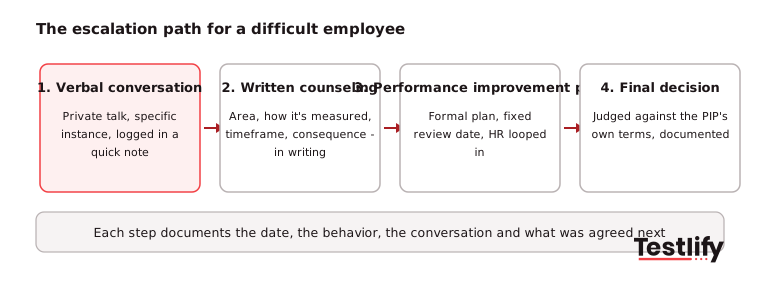
A typical path through documentation:
- Verbal conversation, logged in a private note (date, behavior, agreement).
- Written counseling or warning, if the behavior repeats: specific area, how it is measured, timeframe, and what happens if it does not change.
- Performance improvement plan (PIP), if the pattern continues: a formal, written plan naming the exact gap, the improvement expected, the timeframe, and the review date. A January 2025 HR consultant guide describes the PIP as generally the last step in this sequence, used when the employer still believes the person is capable of the change.
- Final decision, based on whether the PIP's own terms were met, documented against those terms rather than against a fresh set of complaints.
Each step should look back at the one before it. A PIP that raises a brand-new issue the employee was never warned about weakens the whole record if the case is ever challenged.
When should you bring in HR or legal counsel?
Bring in HR or legal counsel as soon as the behavior touches a protected characteristic, a harassment or safety complaint, a request for medical or disability accommodation, or a termination that is close to being decided. A manager who runs the first one or two conversations alone is usually fine; a manager who drafts a PIP, handles a harassment complaint, or decides on a termination without HR in the loop is taking on legal risk the organization has not agreed to.
Signs it is time to loop someone else in:
- The employee has raised, or you suspect, a discrimination, harassment or retaliation concern.
- A disability, medical condition or caregiving responsibility may be part of what is making the role hard for them right now.
- The next step under consideration is a final warning, a PIP, or termination.
- The employee has access to sensitive systems, client relationships or safety-critical work where the behavior creates risk beyond their own performance.
Why do difficult employees matter for the wider team, not just the manager?
A difficult employee that goes unmanaged affects everyone around them, not just the manager who is avoiding the conversation. Gallup's most recent State of the Global Workplace report puts U.S. employee engagement at around 31 to 32%, a figure that has been flat for several years, and links low engagement directly to the day-to-day experience people have with their managers and teammates. Gallup's State of the Global Workplace report
A team member who watches a colleague's conduct go unaddressed for months draws a conclusion about the standard the manager is actually willing to enforce. That is part of why the first conversation matters more than any later step: a prompt, specific, private talk settles far more cases than people expect, and it keeps the record honest if the case does not resolve there.
How can skills assessments help before conduct problems start?
Skills assessments reduce how often a conduct or performance pattern shows up after hire by testing for the specific skills and work style a role needs before the offer goes out, rather than relying on interview impressions alone. Testlify's test library covers role-specific, cognitive, situational judgment and personality assessments that surface how a candidate is likely to handle real work scenarios, including the kind of accountability and collaboration questions that come up in a "difficult employee" conversation later. Using the same structured criteria for every candidate, rather than gut feel in an interview, is one of the more reliable ways to lower how often this guide gets used in the first place.
FAQ
Is it ever right to terminate without a PIP? Yes, for serious misconduct such as harassment, safety violations, theft or similarly serious conduct, most organizations move straight to investigation and a decision rather than a performance improvement plan, which is designed for performance and conduct patterns that are correctable, not for a single severe incident.
How long should a PIP run? Most PIPs run 30 to 90 days, long enough to see a real change in a repeating pattern but short enough that the team is not left in limbo. The exact length should match how quickly the specific gap can realistically be fixed.
What if the employee says the problem is their manager, not them? Take it seriously and check it, ideally with HR involved, since HR Magazine has reported real cases where the culture or the manager's own behavior was the actual source of the problem. Checking does not mean dropping the documentation already gathered; it means confirming the standard being enforced is fair before enforcing it further.
Can one honest conversation really fix a difficult employee? Often, yes. Many cases resolve at the first specific, private conversation once the employee understands exactly what is expected and that it is being tracked, which is why skipping straight to a formal write-up is usually not the first move.
Should documentation happen even if the manager thinks it will not escalate? Yes. A short note after every relevant conversation costs a few minutes and protects everyone if the pattern does not improve the way the manager hopes it will.

Content Writer
Yashika Khandelwal is a Content Writer with 3+ years of experience creating research-backed content on hiring, talent assessment, and HR technology. She is a registered Organizational Psychologist and subject matter expert who combines behavioral science with practical recruitment insights to produce accurate, evidence-based content.
LinkedInRelated resources
View all
HR Toolkit
Employee termination checklist: a step-by-step guide for HR

HR Toolkit
Email marketing specialist job description: duties, skills and a sample

HR Toolkit
Performance Evaluation Template: Free Form, Rating Scale and Examples

Hiring Guide
Finance director job description: duties, skills and template

HR compliance
Employee monitoring policy template: free sample and guide

Workplace culture
What is an upskilling strategy? A practical guide for HR teams
Get started.
Hire on proof, not resumes.
Run your first skills-based assessment free — no credit card required.