
What Are Niche Skills? Meaning, Examples and How to Hire for Them (2026)
Niche skills are rare, specialized abilities that are hard to hire for. Examples by field, and how to find, test and hire people with them.

Niche skills are specialized abilities that only a small group of people have, usually tied to one technology, industry or type of problem. They take a long time to learn, they are hard to check on a resume, and the business often depends on them. That mix makes niche skills valuable to the people who have them and hard to hire for.
TL;DR: - Niche skills are rare, specialized abilities tied to one technology, industry or problem, and the business often depends on them. - Examples appear in tech, finance, healthcare, engineering and language work, not only in IT. - A skill is niche when few people have it, it takes long to learn, it is hard to verify and it matters to the business. - Niche roles are hard to fill in 2026 because pools are small and resumes do not prove depth. - Search by skills, test early with real tasks, and decide whether to hire, upskill or contract.
 ChatGPT
 Gemini
 Claude
 Grok
 Perplexity
What are niche skills?
Niche skills are narrow, deep abilities that few candidates in the market can show, such as securing cloud infrastructure, building AI models or running anti-money laundering checks. The meaning is relative: a skill is niche when demand for it is higher than the supply of people who can do it well.
Most job ads do not use the word "niche". Niche skills show up instead as very specific requirements: a named tool or platform, a regulation, a programming language few people use, or a mix of two fields, like a nurse who also understands clinical data systems.
Two things are worth keeping in mind:
- Niche is not the same as advanced. A senior accountant has advanced general skills. An accountant who knows transfer pricing rules for three countries has a niche skill.
- Niche depends on context. Python is a general skill for a data team. Python for a specific industrial control system is niche.
For the wider split between skill types, see hard skills vs soft skills.

Examples of niche skills
Niche skills examples appear in every field, not only in tech. The common thread is a small talent pool and a real business need. The table below groups common examples by field and shows where hiring teams usually meet them.
Field | Examples of niche skills | Where hiring teams meet them |
|---|---|---|
AI and data | AI model development, LLM fine-tuning, AI evaluation and testing, MLOps | AI product teams, data platforms |
Cybersecurity | Cloud security, penetration testing, identity and access management, incident response | Security, IT, compliance |
Software and IT | Rust or Scala development, mainframe and COBOL modernization, SAP S/4HANA migration, embedded and IoT engineering | Platform, ERP and device teams |
Finance and compliance | Anti-money laundering, transfer pricing, actuarial modeling, regulatory reporting | Banks, insurers, fintech |
Healthcare | Clinical informatics, medical coding for specialties, telehealth operations | Hospitals, health tech |
Engineering and industry | PLC programming, battery and energy storage design, supply chain risk modeling | Manufacturing, energy, logistics |
Language and communication | Technical writing, localization for a specific market, regulated medical translation | Product, regulatory, support |
A skill can also become niche because of the mix. A sales rep is easy to find. A sales rep who can demo a complex cybersecurity product to a technical buyer is not.
Niche soft skills pair a people skill with deep knowledge of one field. Negotiating clinical trial contracts or explaining security risks to a board are two cases. Test them with recorded answers or role plays judged on content.
Types of niche skills
Technical and field knowledge get most of the attention in niche hiring. People skills matter just as much when they are tied to one specialty. The groups below cover the niche soft skills that hiring teams most often need, and how to spot each one.
Language and communication niche skills
Hybrid niche skills come from mixing two fields that rarely meet in one person. A nurse who understands clinical data systems is one example. A sales rep who can demo a complex security product to a technical buyer is another.
Hybrid niche skills
Tool and platform niche skills mean deep, hands-on command of one system. SAP S/4HANA migration and PLC programming are typical examples. Certificates alone say little, so use a hands-on task or simulation in the tool.
Tool and platform niche skills
Regulatory and compliance niche skills cover rules that few people know well. Anti-money laundering, transfer pricing and regulatory reporting fall here. A wrong call carries legal risk, so scenario questions on real rules work better than memory quizzes.
Regulatory and compliance niche skills
Industry-specific niche skills depend on knowing how one sector works. Clinical informatics, actuarial modeling and battery storage design are examples. Candidates from nearby fields often lack the context, so ask for case work from the sector.
Industry-specific niche skills
Technical niche skills are deep abilities in a specific technology or method. Examples include LLM fine-tuning, MLOps, Rust development and mainframe modernization. Assess them with coding or data tasks in a live environment, not with theory questions.
Technical niche skills
Seven types of niche skills: technical, industry-specific, regulatory, tool and platform, hybrid, language and communication, and niche soft skills
Niche skills fall into a few clear types. Knowing the type helps you decide where to search and how to test. Most roles combine more than one type, so treat the groups below as a guide.
Specialist communication
Specialist communication means explaining complex ideas in plain terms to people outside the field. Examples include a data scientist briefing sales or an engineer walking a customer through a security incident. Ask candidates to explain a real topic to a non-expert and score clarity and accuracy.
Negotiation in a specialized market
Negotiation becomes niche when the deal depends on market knowledge few people hold. Clinical trial contracts, software licensing and energy supply agreements are typical cases. A role play built on a real deal shows how a candidate handles pressure and trade-offs.
Advisory and influence with senior stakeholders
Advisory skill is the ability to guide leaders who do not know the subject. A compliance specialist who persuades a board to change a process is a good example. Use a short scenario where the candidate must recommend an action and defend it.
Leadership in technical teams
Leading specialists calls for credibility with experts and the judgment to set priorities in work you may not do yourself. Engineering managers and lab leads need this mix. Structured interview questions on past decisions, plus a reference from a peer, give better evidence than a title.
Teaching and mentoring specialists
Teaching and mentoring matter when a skill is too rare to hire for at scale. A strong specialist who can train others spreads that skill across the team. Ask for a short walkthrough of how they would coach a junior colleague on one task.
Cross-field collaboration
Cross-field collaboration is the habit of working well with people from other specialties, such as clinicians and software developers on one product. Look for examples of shared projects and how conflicts were settled. A joint exercise with two interviewers from different fields tests this well.
How to choose which type matters for your role
- Start with the first 90 days: list who the person must talk to, persuade or teach.
- Pick one or two soft skill types as must-haves, and treat the rest as nice-to-have.
- Match each type to one exercise, such as a role play, a recorded answer or a short brief.
- Score content and judgment, not accent, style or polish.
- Ask your best current specialist which of these skills they use most each week.
Niche skills vs general skills
Niche skills and general skills differ in how many people have them, how long they take to learn and how widely they transfer. General skills, like communication or spreadsheet work, help in almost any role. Niche skills solve a narrow problem very well, and their value depends on demand in one area.
Niche skills | General skills | |
|---|---|---|
Talent pool | Small, often global | Large, local |
Time to learn | Months to years, often with hands-on work | Weeks to months |
Transfer across roles | Low to medium | High |
How to check them | Practical tasks, work samples, expert review | Interviews, general tests, references |
Pay | Often a premium | Market rate |
Risk | Can fade as tools change | Stable |
Most strong hires combine both. A security engineer still needs to explain a risk to a non-technical manager, so test the general skills alongside the niche one.
How do you know if a skill is niche?
A skill is niche when it passes four checks: few people have it, it takes a long time to learn, it is hard to verify from a resume, and the business depends on it. If a skill passes only one or two, it is probably a specialized general skill, and standard hiring will work.
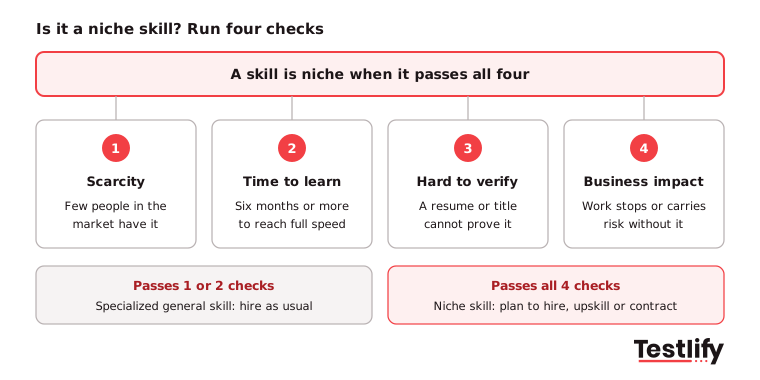
- Scarcity. Search your ATS and a job board. If only a handful of people match a skill-specific search in your region, the pool is small.
- Time to learn. Ask the hiring manager how long a strong general hire would need to get to full speed. Six months or more is a sign of a niche skill.
- Hard to verify. If a certificate or job title does not tell you whether someone can actually do the work, you will need a practical test.
- Business impact. If the work stops, slips or carries compliance risk without this person, the skill is critical as well as rare.
This check also tells you where to spend effort. A skill that is rare but low impact may be easier to contract. A skill that is rare and critical needs a planned hiring or upskilling route.
Why are niche skills in demand in 2026?
Niche skills are in demand because new technology and new rules keep creating work that few people are trained for. In 2026, AI skills overtook engineering and IT as the hardest skills for employers to find, and most employers still report trouble filling roles at all.
The numbers from the past year are clear:
- ManpowerGroup's 2026 Global Talent Shortage survey of 39,063 employers in 41 countries found that 72% report difficulty filling roles (69% in the US). AI model and application development (20%) and AI literacy (19%) are now the hardest skills to find, ahead of engineering (19%).
- SHRM's 2025 Talent Trends found that 69% of organizations struggle to fill full-time roles, 28% now require new skills for full-time roles, and 47% are updating existing roles to include them.
- CompTIA's State of Cybersecurity 2025 counted more than 514,000 US job postings for cybersecurity and closely related roles between May 2024 and April 2025, up 9%. Of the firms surveyed, 45% reported skills gaps in using AI tools.
- The US Bureau of Labor Statistics projects 21% growth for information security analysts from 2025 to 2035, with about 14,100 openings a year and a median pay of $129,180.
Niche skills also move. Skills that were niche five years ago, like general cloud administration, are now common. Skills that barely existed, like evaluating AI model output, are now in short supply. A skills plan for niche roles needs a yearly review, not a one-time list.
Why is hiring for niche skills so hard?
Hiring for niche skills is hard because the talent pool is small, resumes cannot prove depth, and many interviewers cannot judge the skill themselves. Roles stay open longer, cost more to fill, and a wrong hire is expensive because there are few people to replace them.
- Small pools. There are simply fewer people with the skill, and many of them are already employed and not looking.
- Resumes do not show depth. Two candidates can list the same tool. One used it daily for three years, the other did a short course. Keyword screening cannot tell them apart.
- Interviewers lack the expertise. A recruiter, or even a hiring manager from a nearby field, may not know which answers show real skill.
- Job titles vary. The same niche skill hides behind different titles across companies, so title-based searches miss good people.
- Pay expectations are high. Scarcity pushes salaries up, and slow processes lose candidates to faster offers.
- The target keeps moving. Tools and rules change, so last year's job description may already be out of date.
For sourcing tactics, see how to source candidates for hard-to-fill roles.
How do you hire for niche skills?
Hiring for niche skills works best when you define the exact skill, widen the search beyond job titles, test the skill early and move fast once you find a fit. The goal is to judge candidates on proof of the skill, not on where they worked or what their last title was.
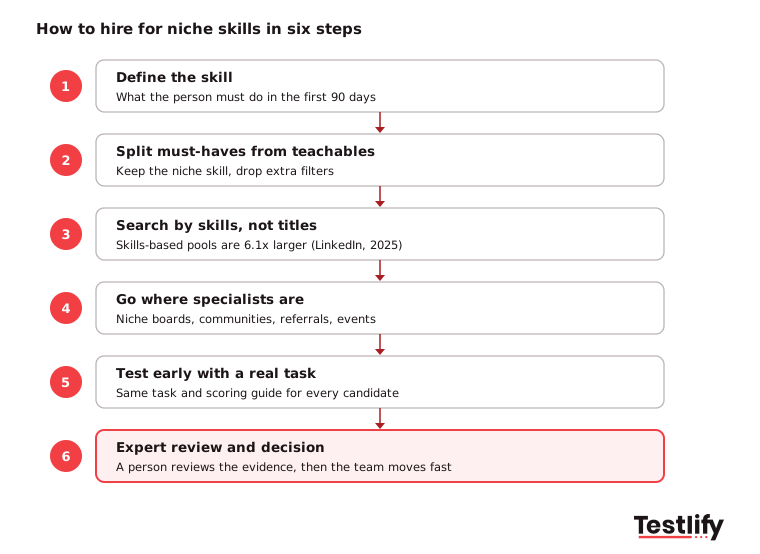
- Define the skill precisely. Write down what the person must do in the first 90 days, the tools involved, and the level needed. "Knows cloud security" is too vague. "Can design access controls for a multi-account cloud setup" is testable.
- Separate must-haves from teachables. Keep the niche skill as a must-have and move the rest to nice-to-have. Every extra requirement shrinks an already small pool.
- Search by skills, not titles. LinkedIn's 2025 skills-based hiring research found that looking for people with the right skills, instead of people who held the same job before, expands talent pools by 6.1x globally and by 8.2x for AI roles.
- Go where the specialists are. Niche job boards, professional communities, open source projects, conferences and employee referrals reach people a general job ad will not.
- Test early. Put a short, role-specific skills assessment or practical task before long interviews, so the team spends time only on candidates who can do the work.
- Move quickly. Niche candidates often have several offers. Agree on the process, the panel and the pay range before the role goes live.
Pro tip: Ask your best current specialist to review the test before you use it. Five minutes of expert review catches questions that are too easy, out of date or unclear.
For more on the skills-first approach, read what skills-based hiring is and why it matters.
How do you assess niche skills?
Niche skills are best assessed with tasks that mirror the real job, scored against clear criteria and reviewed by someone who knows the field. Certificates and interviews help, but a practical test is the most direct proof that a candidate can do the work today.
Type of niche skill | Best proof | Watch out for |
|---|---|---|
Coding and engineering | Coding task in a live environment, code review | Tasks copied from public sites |
Data and AI | Work with a real dataset, explain a model choice | Answers generated by AI tools |
Compliance and finance | Case questions on a real rule, scenario judgment | Questions that test memory only |
Tools and platforms (SAP, Salesforce, PLC) | Hands-on task or simulation in the tool | Certificates without recent use |
Creative and language | Portfolio plus a short brief or translation sample | Portfolio work done by a team |
Communication in a niche context | Recorded answer explaining a technical topic to a non-expert | Scoring on accent or polish instead of content |
A few rules keep the results fair:
- Use the same task and scoring guide for every candidate in the role.
- Keep tasks short. Under an hour for a first screen respects candidates who already have jobs.
- Check integrity in remote tests, since AI tools can produce plausible answers in seconds.
- Have a person review every rejection, and use the test as evidence, not the final decision.
For a deeper look at assessment methods, see how to evaluate niche skills.
Should you hire, upskill or contract for niche skills?
Hiring, upskilling and contracting each fit a different situation. Hire when the skill is critical and needed for years. Upskill when you have people with nearby skills and some time. Contract when the need is urgent, short or uncertain. Many teams use all three for the same skill.
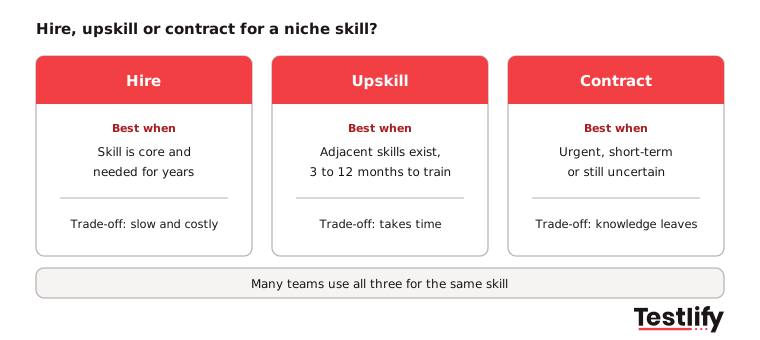
Option | Best when | Main trade-off |
|---|---|---|
Hire | The skill is core to the business and needed long term | Slow and costly in a small market |
Upskill current staff | People with adjacent skills exist and you have 3 to 12 months | Takes time, and trained staff may leave |
Contract or consult | The work is a project, urgent or you are not sure you need it full time | Knowledge leaves with the contractor |
Upskilling is now the most common response to shortages. ManpowerGroup's 2026 survey found that 27% of employers use upskilling and reskilling first, ahead of flexible schedules and higher pay, and SHRM found that over a third of organizations train existing employees for hard-to-fill roles. Testing your current team first shows who is closest to the niche skill. A skill gap analysis makes that comparison clear.
Key takeaway: Niche skills are a supply problem, so the fix is to widen the pool and prove the skill. Search by skills instead of titles, test early with real tasks, and decide case by case whether to hire, upskill or contract.
How does Testlify help teams test niche skills?
Testlify helps hiring teams test niche skills with role-specific tests, custom tests built by subject matter experts, and practical tasks scored the same way for every candidate. Teams can start from a job description and have a skills test ready before the first candidate applies.
- Ready-made and custom tests. A library of 3,500+ tests covers technical, software, language and role-specific skills, and Testlify's experts build custom skills tests on request for skills that are too narrow for any library.
- Real tasks, not only quizzes. 25+ question types include coding, file upload, practical tasks, audio and video answers, and Microsoft Office or Google Workspace work.
- Fair, checked results. Automated scoring with a per-skill breakdown, plus 20+ proctoring checks such as AI assistance detection and copy-paste tracking.
- Fits your hiring workflow. 100+ ATS integrations let results sit next to your candidate records.
Browse the Testlify test library to see the tests available for your roles.
Pick one hard-to-fill role and turn its job description into a skills test. Book a Testlify demo to see how it works with your roles, or check the pricing page and start a 7-day free trial, no credit card required.
Frequently asked questions (FAQs)

People and Talent Partner
Arushi Shah runs day-to-day talent acquisition and candidate experience at Testlify. She writes on interviewing, structured hiring, and giving candidates a fair, fast process.
LinkedInRelated resources
View all
Skill assessment
How do skills assessments correlate with on-the-job performance?

Skill assessment
How does skills mapping enable skills-based organizations?

Skill assessment
Skills mapping vs competency mapping
Skill assessment
Free skills mapping template

Skill assessment
Top skills mapping tools

Skill assessment
Best pre-hire assessments when hiring for top roles in the financial industry
Get started.
Hire on proof, not resumes.
Run your first skills-based assessment free — no credit card required.