
12 HR communication email templates for hiring managers
Losing great candidates due to poor emails? These ready-to-use HR communication email templates help you write faster and better emails that convert.

HR communication email templates are ready-to-use emails that recruiters and hiring managers send at each stage of hiring, from the first “we got your application” note to the final update, so every candidate hears back on time and in a consistent voice. Good templates cut the writing work and stop strong candidates from going quiet on you.
The stakes are bigger than they look. U.S. employers make roughly 5.2 million hires in a single month, and each one rides on a chain of emails. When those emails are slow, vague, or copy-pasted, candidates read it as disinterest and drift toward the company that replied faster. A good template fixes the slow part without making the message feel like a form letter.
This guide gives you 12 templates for active, passive, referred, silver-medalist, and niche candidates, plus two recruiter-to-hiring-manager updates. There is also a timing table and a short section on keeping the whole set on-brand. Copy one, swap the details, send.
 ChatGPT
 Gemini
 Claude
 Grok
Grok Perplexity
TL;DR
- HR communication email templates keep every candidate informed with less writing, so no one goes cold while you finish interviews.
- Match the message to the candidate: active seekers want speed, passive candidates want a reason to care, referred candidates want the connection named.
- Speed is a signal. Acknowledge an application within 24 hours and reply to an engaged candidate within 48 hours.
- Send hiring managers a short, numbers-first pipeline update, not a wall of text, so they can act in under a minute.
- Templates set the floor for tone and timing; personalization on top is what earns the reply.

Why do HR communication emails matter in hiring?
They set the tone for the entire hiring experience and decide whether a strong candidate stays engaged or walks. Every email is a small proof of how organized, respectful, and fast your team is. Silence, or a clumsy message, tells a candidate more than your careers page ever will.
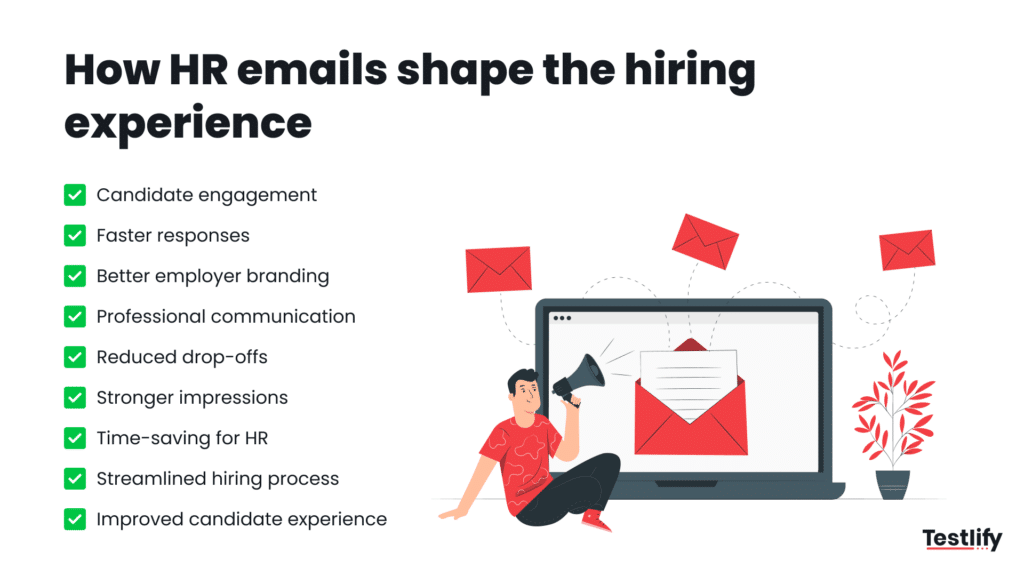
The money case is easy to make. SHRM benchmarks the average cost per hire at about $4,700, and the median role takes 44 days to fill (SHRM benchmarks). Lose a finalist to a competitor’s faster follow-up, and you restart that clock and that spend. Clear, on-time emails protect the investment you have already made in sourcing and screening.
The experience case is just as strong. Communication is most of what a candidate remembers about your process, and a quick “your application is in review, expect to hear back by Friday” does more for your employer brand than any tagline. The downside is expensive too: Gallup puts the cost of replacing an employee at one-half to two times their annual salary, and a candidate who ghosts you after a silent week is a hire you now have to make twice. Standardized emails also save your team from rewriting the same message 40 times a week.
What makes a hiring email candidates actually answer?
Three things: it is short, it is clearly for them, and it asks for one specific next step. A candidate should know within the first two lines who is writing, about which role, and what to do next. Everything else is optional.
- Keep it to three short paragraphs. Role, why them, next step. If a sentence does not move the candidate forward, cut it.
- Personalize the first line, not just the name. Reference their actual skill, project, or referral. A merge field alone reads as a blast.
- Give one call to action. “Are you free Tuesday at 2pm?” beats “let me know your availability sometime.” Make the reply a yes or no.
- Write a subject that says what it is. “Next steps for your [Job Title] application” gets opened; “An exciting opportunity” gets ignored.
- Send on time. A same-day acknowledgement and a 48-hour reply window signal a team that has its act together.
Pro tip: Build the templates once, then set a delay rule in your applicant tracking system so the acknowledgement fires automatically and the human-written follow-up goes out within 48 hours. Automate the timing, keep the words human.
Which HR email should you send, and when?
Different candidates need different timing and tone. Use this table as a quick reference before you pick a template, then adjust the window to your own pipeline speed.
Candidate type | Email goal | Send within | Follow-up window |
|---|---|---|---|
Active job seeker | Acknowledge and move fast | 24 hours | 48 hours |
Passive candidate | Spark interest, build a relationship | 72 hours | 10 days |
Referred candidate | Warm intro, name the referrer | 48 hours | 10 days |
Silver medalist | Re-engage for a new role | When a fit opens | 14 days |
Niche or specialized | Personalized, expertise-led outreach | 72 hours | 14 days |
Hiring manager update | Numbers-first pipeline status | Weekly | 21 days at longest |
12 HR communication email templates for hiring managers
Using one generic email for everyone lowers response rates. These 12 are grouped by candidate type, plus a set for updating your hiring manager. Swap the bracketed details, keep the structure, and send.
Active job seekers (quick response and high engagement)
Purpose: These candidates are looking right now. Be fast, direct, and easy to reply to.
Template 1: Acknowledging an active job seeker’s application
Subject: Next steps for your [Job Title] application
Hi [Candidate’s Name],
Thanks for applying for the [Job Title] role at [Company Name]. Your application is in review now, and you will hear back from us by [Date].
If anything changes on your end, or you have a question in the meantime, just reply to this email. Looking forward to the next step.
Best, [Your Name] [Your Position]
Template 2: Fast-track interview for a high-priority candidate
Subject: Quick chat about the [Job Title] role?
Hi [Candidate’s Name],
Your background for the [Job Title] role stood out, and since you are actively looking, we would like to fast-track your interview.
Are you free for a 20-minute call on [Date and Time]? If that does not work, send me two windows that do and I will make one fit.
Best, [Your Name] [Your Position]
Passive candidates (relationship building)
Purpose: Reach someone who is employed but open to the right move. Give them a reason to care.
Template 3: Initial outreach to a passive candidate
Subject: Your work in [Skill or Field] caught our eye
Hi [Candidate’s Name],
I came across your work in [specific skill or project] and was impressed. You may not be actively looking, but we are hiring for [Job Title], and your experience looks like a strong fit.
Would you be open to a short call to hear the details? No pressure either way, and I am happy to work around your schedule.
Best, [Your Name] [Your Position]
Template 4: Follow-up email for a passive candidate
Subject: Still worth a conversation?
Hi [Candidate’s Name],
Following up on my note about the [Job Title] role at [Company Name]. Timing is everything, and I get it if now is not the moment.
If you are even a little curious, a 15-minute call is all it takes. And if the timing is just off, tell me and I will check back later this year.
Best, [Your Name] [Your Position]
Referred candidates (engaging through employee referrals)
Purpose: Reach a candidate a current employee referred. Name the connection early. For the referrer side, see our referral and internal hiring emails.
Template 5: Reaching out to a referred candidate
Subject: [Referrer’s Name] thought we should talk
Hi [Candidate’s Name],
[Referrer’s Name] on our team mentioned you would be a great fit for our [Job Title] opening, and after a look at your background, I agree.
Would you be up for a quick chat this week about your goals and the role? Let me know a time that works and I will send an invite.
Best, [Your Name] [Your Position]
Template 6: Interview invitation after a referral
Subject: Interview invitation for the [Job Title] role
Hi [Candidate’s Name],
[Referrer’s Name] spoke highly of your work, and we would like to invite you to interview for the [Job Title] role at [Company Name]. Here are the details:
- Date and time: [Insert]
- Format or video link: [Insert]
- Interviewer: [Name and Position]
Does that time work? If not, reply with two options and I will adjust. For the full offer stage later, our job offer email templates can help.
Best, [Your Name] [Your Position]
Silver medalist candidates (strong, previously rejected)
Purpose: Keep talented near-misses warm for the next opening.
Template 7: Staying connected for future roles
Subject: Let’s stay in touch for what’s next
Hi [Candidate’s Name],
Thank you for the time you put into our process for the [Job Title] role. We went with another candidate this round, but your skills genuinely stood out.
I would like to keep you in mind for roles that fit even better. Connect with me on [LinkedIn Profile], and I will reach out when the right one opens.
Best, [Your Name] [Your Position]
Template 8: Reaching out about a new role
Subject: A new [Job Title] role that fits you
Hi [Candidate’s Name],
We connected during your application for [Previous Job Title], and a new [Job Title] role just opened that lines up well with your experience.
If you are open to it, I would love a quick call to see if this one is the right fit. What does your week look like?
Best, [Your Name] [Your Position]
Niche or specialized candidates (targeted outreach)
Purpose: Engage candidates with rare or in-demand skills. Lead with their expertise.
Template 9: Personalized outreach to a niche candidate
Subject: Your expertise in [Skill or Industry]
Hi [Candidate’s Name],
Your expertise in [specific skill] is exactly what we are looking for on the team at [Company Name], and that is rare enough that I wanted to reach out directly.
If you are open to exploring a [Job Title] role, I would love to find 20 minutes to talk. When suits you this week?
Best, [Your Name] [Your Position]
Template 10: Exclusive opportunity for a specialized role
Subject: A [Job Title] role built for your skill set
Hi [Candidate’s Name],
We are hiring for a [Job Title] role that maps closely to your expertise in [Skill or Industry], and we are being selective about who we approach.
Would a short call this week be worth your time? I can walk you through the role and how it fits your goals, then you decide.
Best, [Your Name] [Your Position]
Recruiter-to-hiring-manager updates
Purpose: Keep the hiring manager in the loop without a wall of text. Lead with the decision they need to make, back it with numbers.
Template 11: Weekly pipeline update to a hiring manager
Subject: [Job Title] pipeline update, week of [Date]
Hi [Hiring Manager’s Name],
Quick status on the [Job Title] search:
- Screened: [number] candidates this week
- Moving to interview: [number]
- Waiting on you: [number] profiles to review by [Date]
Can you review the shortlisted profiles by [Date] so we keep the strongest candidates moving? Reply here or grab 15 minutes on my calendar.
Best, [Your Name] [Your Position]
Template 12: Requesting an interview decision
Subject: Decision needed on [Candidate’s Name] for [Job Title]
Hi [Hiring Manager’s Name],
[Candidate’s Name] finished the [assessment or interview stage] with a score of [result]. Two other teams are moving on similar profiles, so a fast call helps us stay competitive.
Can you give a go or no-go by [Date]? If you want more context first, I will send the scorecard and set up 15 minutes.
Best, [Your Name] [Your Position]
How do these templates fit your hiring workflow?
Templates are the words. The workflow is what makes them fire at the right moment. The Testlify Hiring Workflow Method runs evidence-based hiring across the full journey, from assessment invitation and reviewer collaboration to structured decisions, so each email maps to a real step instead of a scramble.
In practice, the acknowledgement goes out the moment an application lands, the assessment invite follows for candidates who pass screening, and the hiring-manager update carries the scores that decide who advances. When you pair these emails with skills-based hiring, the pipeline update writes itself, because the shortlist is already scored before the first call. That is the difference between chasing candidates and running a process. For rejections handled with the same care, use our candidate rejection emails.
Key takeaways
- Templates buy speed, not personality. They remove the blank-page delay so replies go out on time. The insight that earns a response, the candidate’s actual skill or the referrer’s name, still has to be added by hand. Treat the template as the floor, not the finished email.
- Match the message to the candidate’s situation. Active seekers reward speed, passive candidates need a reason to care, and silver medalists respond to being remembered. Sending the same email to all three is why response rates fall. Segment first, then write.
- Timing is a trust signal. A 24-hour acknowledgement and a 48-hour reply tell candidates your team is organized, which matters when a competitor is courting the same person. Slow, silent pipelines lose finalists you already paid to source.
- Write hiring-manager updates numbers-first. Lead with the decision and the counts, use bullets, and name the deadline. A manager who can act in under a minute keeps your strongest candidates moving instead of stalling in a busy inbox.
- Let evidence do the sorting. When candidates are scored on skills before outreach, every email targets a real fit, so you send fewer messages and waste less of everyone’s time. Communication and assessment are one system, not two chores.
Frequently asked questions (FAQs)

B2B SaaS Content Writer
Rishav Kumar is a B2B SaaS content writer with 4 years of experience. He loves crafting engaging content. Always exploring fresh ideas, he's passionate about helping businesses grow through impactful writing.
LinkedInRelated resources
View all
HR & recruitment
Discriminant validity: Definition, examples & formula

HR & recruitment
18 best candidate rejection email templates

HR & recruitment
Interview Invitation Email Templates: 17 Free Samples for 2026
HR & recruitment
Interview Questions Bank: 30+ HR Questions to Ask

HR & recruitment
AI vs human-led hiring assessments: Which is better?

HR & recruitment
What makes a hiring test legally compliant?
Get started.
Hire on proof, not resumes.
Run your first skills-based assessment free — no credit card required.