
Resilience test: what it measures and how to use it in hiring
What a resilience test measures, which test types suit hiring, the questions to ask and how to add one to your process fairly and well.

A resilience test is an assessment that shows how a person handles stress, setbacks and change: whether they stay composed, adapt and keep working toward the goal. Hiring teams use a workplace resilience test to see how a candidate is likely to cope with the pressure of a specific role before they make an offer.
TL;DR:
- A resilience test measures how someone copes with pressure, recovers from setbacks and adapts to change. For hiring, use a workplace version built around job scenarios, not a personal wellbeing quiz.
- Resilience matters more now: Gallup's 2026 report puts global employee engagement at 20%, and SHRM found 31% of US workers say their job causes frequent stress.
- The traits that matter at work are stress management, adaptability, problem-solving under pressure, emotional control, persistence and willingness to ask for help.
- Situational judgment tests fit early screening best. Behavioral interviews and role plays confirm the result for finalists.
- Free self-report scales like the Brief Resilience Scale (6 items) are easy to fake in a hiring context and were not built for selection.
- Use the result as one input next to skills tests and interviews, keep it tied to the job, and never use it to screen for mental health.
 ChatGPT
 Gemini
 Claude
 Grok
 Perplexity
What is a resilience test?
A resilience test is a short assessment that measures a person's ability to stay effective under pressure, bounce back from setbacks and adapt when plans change. Most versions take 3 to 15 minutes and give a score or profile across a few traits, such as stress management, adaptability and persistence.
The term covers three different things, and the search results mix them up:
- Personal resilience quizzes: Self-scored questionnaires for individuals. Psychology Today's version, for example, has 20 statements rated from "strongly disagree" to "strongly agree" and takes about 3 minutes.
- Workplace resilience tests: Assessments built for hiring and development. They put candidates in work situations, like an angry customer or a moved deadline, and score how they respond.
- Software resilience testing: A QA practice that checks how an application behaves under failure. It shares the name and nothing else.
This guide is about the second kind: the resilience test you give candidates as part of a hiring process.

Why does a resilience test matter in hiring?
A resilience test matters because most roles now involve constant change, heavy workloads and setbacks, and a CV shows none of how someone handles them. According to Gallup's 2026 report, global employee engagement has dropped to 20% from its 2022 peak of 23%, and only 34% of employees are thriving. The same report found leaders are 7 points more likely than individual contributors to report a lot of daily stress. Gallup's State of the Global Workplace tracks these numbers every year.
Adding a resilience test to your recruitment strategy helps in three ways:
- Lower hiring risk: You spot candidates who are likely to struggle in a high-pressure role before you hire them, which saves the cost of a bad hire and a second search.
- Better retention: People who cope with the real demands of the job are less likely to burn out and leave in the first months. Psychometric tests are one of the levers that reduce employee turnover.
- A steadier team: Teams built from people who handle change well keep delivering through reorganizations, peak seasons and new systems.
What does a resilience test measure?
A resilience test measures the habits a person falls back on when work gets hard. Different tests use different labels, but most cover the same six traits.
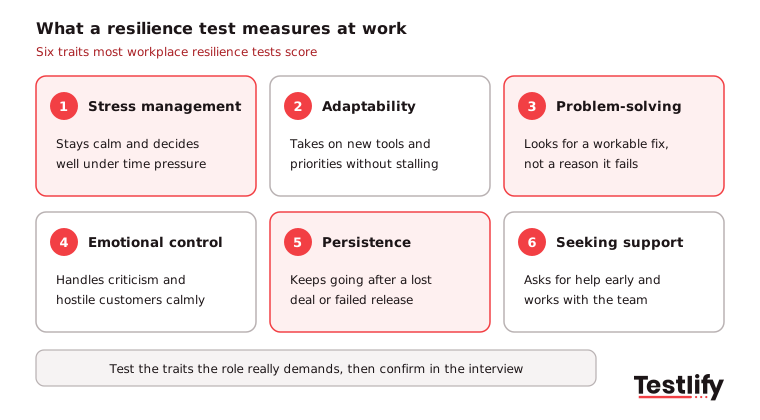
Trait | What it looks like at work | What a low score can mean |
|---|---|---|
Stress management | Stays calm and makes sound calls under time pressure | Rushed or frozen decisions when the queue spikes |
Adaptability | Accepts new tools, processes and priorities without stalling | Pushback or long ramp-up after every change |
Problem-solving under pressure | Looks for a workable fix instead of a reason it cannot be done | Escalates every obstacle |
Emotional control | Takes criticism or a hostile customer without reacting badly | Conflict with customers or colleagues |
Persistence | Keeps going after a lost deal or a failed release | Drops effort after the first setback |
Seeking support | Asks for help and works with the team when stuck | Struggles alone until the deadline is missed |
Stress management is often the trait hiring teams care about most; see how to assess stress management skills in recruitment. Problem-solving overlaps with resilience too, and you can evaluate problem-solving skills with their own test.
What types of resilience tests can employers use?
Employers can choose from four types of resilience test: self-report scales, situational judgment tests, behavioral interviews and role-play exercises. Each one shows a different slice of resilience, and they work best in combination.
Type | Format | What it shows | Best hiring stage | Watch out for |
|---|---|---|---|---|
Self-report scale | Agree/disagree statements, 6 to 50 items | How the person sees their own resilience | Development, not selection | Easy to fake when a job is at stake |
Situational judgment test (SJT) | Work scenarios with response options | What the candidate would do in realistic situations | Early screening | Must match the role's real pressures |
Behavioral interview | Questions about past setbacks | What the candidate actually did before | Shortlist | Needs a scoring guide to stay consistent |
Role-play exercise | Live simulation (complaint, deadline change, conflict) | How the candidate reacts in the moment | Finalists | Time-heavy; keep scenarios the same for everyone |
Pro tip: If you want a quick, fair first screen, use a situational judgment test. The scenarios are based on the job, every candidate gets the same ones, and there is no obvious "good" answer to pick.
How do you add a resilience test to your hiring process?
You add a resilience test to your hiring process by tying it to the pressures of the role, placing it early as a screen, and confirming the result later with an interview. Six steps cover it.
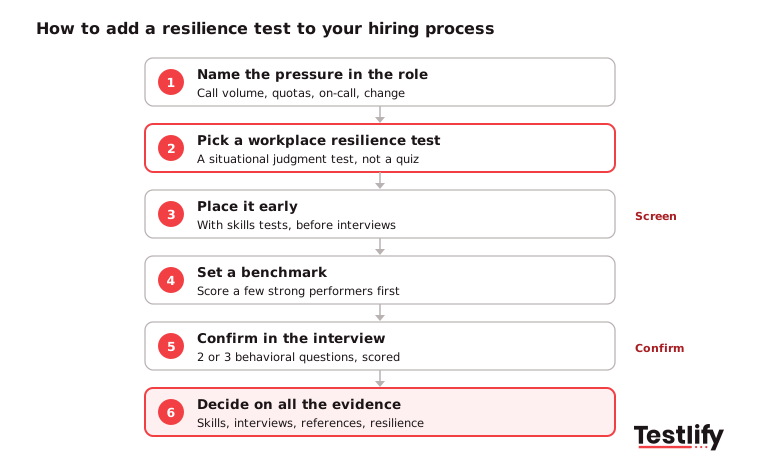
- Name the pressure in the role: List the situations that test people in this job: call volume, quotas, on-call shifts, difficult patients, shifting priorities. Say so in the job description, so candidates know resilience is part of the role.
- Pick the right test: Choose a workplace resilience test, ideally a situational judgment test, over a free self-report quiz.
- Place it early: Send it with your skills tests right after application review, so it filters before interviews take up your team's time.
- Set a benchmark: Agree on what a good score looks like, for example by testing a few of your strong performers in the same role, and compare candidates against that profile.
- Confirm in the interview: Ask two or three behavioral questions about real setbacks and score the answers with a guide.
- Decide on all the evidence: Weigh the resilience score next to skills test results, interviews and references. It is never the only reason to hire or reject.
Key takeaway: A resilience test is most useful as an early, consistent screen that you confirm later with structured interview questions.
Which roles need a resilience test most?
Roles that face constant pressure, change or difficult people need a resilience test most. Testlify's resilience test page lists project managers, sales executives, healthcare professionals, financial analysts, customer service representatives, IT support specialists, marketing managers, supply chain managers and HR specialists among the roles it suits.
In practice, the strongest cases are:
- Contact center and BPO roles: High call volumes, angry customers and tight handling-time targets.
- Sales roles: Frequent rejection and monthly quota pressure.
- Healthcare roles: Long shifts, emotional situations and high stakes.
- IT support and engineering on-call roles: Outages that need calm problem-solving at odd hours.
- Managers and team leads: They carry their own stress and their team's, and their reaction sets the tone for everyone.
For volume roles, a resilience test saves the most time, because it screens hundreds of applicants the same way before anyone books an interview.
What questions reveal resilience in an interview?
Resilience interview questions ask candidates to describe a real setback and what they did next. A good starting question is: "Describe a challenging situation you faced at work. How did you cope with it, and what did you learn from it?"
A strong answer has three parts:
- The situation: A clear description of the challenge and what was at stake.
- The actions: The specific steps the candidate took to cope, including who they asked for help.
- The lesson: What they learned and what they now do differently.
Other questions that work well:
- "Tell me about a time a project you owned failed. What happened next?"
- "Describe a time your priorities changed overnight. How did you reorganize your work?"
- "Tell me about the most difficult customer or colleague you have dealt with. How did you handle it?"
- "When was the last time you asked for help at work? What made you decide to ask?"
For finalists, a short role play adds evidence an interview cannot. Give the candidate a realistic scenario, such as a customer complaint, a technical issue, a deadline change or a conflict with a colleague, and watch how they respond: tone of voice, whether they stay on the problem, and how they recover if the scenario turns against them. Score every candidate on the same scenario and the same scale. For more on assessing resilience during recruitment, see why assessing resilience helps you overcome hiring challenges.
How do you use resilience test results fairly?
Resilience test results are fair to use when the test is tied to the job, given the same way to every candidate, and treated as one input among several. US employment rules apply to resilience tests like any other selection tool.
- Keep it job-related: The EEOC says a test that screens out a protected group more often must be "job-related and consistent with business necessity". Link the traits you test to real demands of the role.
- Offer accommodations: Employers must provide reasonable accommodations in how tests are given, and a test should measure the skill, not a candidate's disability. The EEOC guidance on employment tests covers both rules.
- Do not screen for mental health: A resilience test for hiring should ask about work behavior, not diagnose anxiety or depression. Psychological tests that assess mental health count as medical inquiries, which are restricted before a job offer.
- Tell candidates what to expect: Explain why you use the test and how it fits the process. It lowers anxiety and drop-off.
- Check your own data: Review pass rates by group from time to time, and adjust the benchmark if one group is screened out more than others.
Can a resilience test help develop current employees?
A resilience test can also help develop current employees, because the same profile that informs a hiring decision shows each person where to grow. SHRM's May 2025 research found 31% of US workers say their job causes frequent stress, and only 25% of organizations focus more on preventing mental health issues than reacting to them. The same SHRM findings name workloads (47%), pay (42%) and poor leadership (40%) as the top causes.
Four ways to use resilience results with your existing team:
- Feedback: Share each person's profile privately, with the traits that are strong and the ones to work on.
- Coaching: Set one or two specific goals with the employee's manager, such as asking for help earlier or planning for known peak weeks.
- Training: Run sessions on stress techniques, problem-solving and handling change, and let people share how they handled real situations.
- Support: Point people to mentoring, peer support or an employee assistance program, and fix the workload or leadership problems that cause stress in the first place.
Hiring for resilience and developing it go together; see how to build a resilient workforce.
How does Testlify help you run a resilience test?
Testlify gives you a ready-made workplace resilience test and the tools to run it at scale. The Testlify resilience test is a situational judgment test with 12 questions that takes 10 minutes. It covers creative problem-solving, stress management, emotional intelligence and flexibility in change.
- Combine it with other tests: Add role-specific, cognitive ability and personality tests from a library of 3,500+ tests into one assessment, or build one from a job description with the AI test builder.
- Confirm with interviews: Use one-way video interviews or AI interviews to ask your resilience questions in the same way to every candidate.
- Keep results honest: Over 20 proctoring checks, such as tab tracking and webcam snapshots, run during the test; see anti-cheating and proctoring.
- Work inside your ATS: Testlify connects with 100+ ATS and HRIS tools, including Greenhouse, Lever and Workday, through its integrations.
You can try the resilience test with real candidates on a 7-day free trial, no credit card needed, or book a demo to see it set up for your roles.
Frequently asked questions (FAQs)

Wordpress Developer
Yash Patel is a Wordpress and SEO Specialist at Testlify with 3+ years of experience in technical SEO, on-page optimization, and content strategy. He works on improving Testlify's organic presence and produces content focused on hiring, talent assessment, and HR technology.
LinkedInRelated resources
View all
HR & recruitment
How to hire top talent using project manager test
HR & recruitment
How to hire with a deductive reasoning test: a 2026 guide

HR & recruitment
How to assess HTML5 developer skills for hiring
HR & recruitment
How to hire top talent using sales test

HR & recruitment
How to hire top talent using electrical engineering test

HR & recruitment
How to hire top talent using analytical ability test
Get started.
Hire on proof, not resumes.
Run your first skills-based assessment free — no credit card required.