
How to hire a cloud engineer: skills, tests and interview questions
A practical guide to hiring cloud engineers: the right profile, a job description, skills tests, interview questions, pay and red flags.

To hire a cloud engineer, decide which kind of cloud engineer you need, write a job description that names your cloud platform and tooling, test hands-on skills before the first interview, and interview on a real scenario from your own environment. Cloud engineers design, build and run the infrastructure your products depend on, so a wrong hire shows up fast in outages, security gaps and cloud bills.
TL;DR / Key Takeaways
- Hire a cloud engineer in seven steps: pick the variant, write a specific job description, source, run a skills test, review infrastructure code, hold a scenario interview, then offer within about three weeks.
- Decide first whether you need a cloud infrastructure, platform, security or reliability (SRE) engineer. They need different tests, sources and pay.
- The core skills to test are one major cloud platform, infrastructure as code (Terraform or CloudFormation), containers, networking and security, and cost awareness.
- A 30 to 45 minute skills test before any live interview, plus a review of a deliberately flawed Terraform file, filters out most weak candidates.
- Certifications are a supporting signal, not a hard filter. Hands-on infrastructure code beats a stack of associate-level badges.
- US pay benchmark: the closest federal occupation (computer network architects, which includes cloud architects) had a median of $134,050 in May 2025, with 8% growth expected to 2035.
 ChatGPT
 Gemini
 Claude
 Grok
 Perplexity
What does a cloud engineer do?
A cloud engineer is an IT professional who designs, builds, secures and maintains a company's cloud infrastructure on platforms such as Amazon Web Services (AWS), Microsoft Azure or Google Cloud Platform (GCP). The role sits between software engineering and operations: cloud engineers write code that creates infrastructure, then keep it running, secure and affordable.
Day-to-day tasks vary by company, but most cloud engineers spend their week on a mix of these:
- Migrating systems and applications from on-premises servers to the cloud
- Configuring cloud services such as networking, identity and access, and storage
- Writing infrastructure as code so environments can be rebuilt and reviewed like software
- Building and maintaining CI/CD pipelines that deploy applications to the cloud
- Monitoring and tuning the performance, availability and cost of cloud systems
- Managing cloud data, storage and backup and disaster recovery plans
- Choosing the right cloud services for a workload, based on cost, reliability and reach
- Working with developers, security, data and finance teams on shared goals
- Keeping documentation of cloud systems and configurations up to date
For more on the platform side, see the Testlify glossary entries on cloud computing and Google Cloud Platform.

Why is it hard to hire a cloud engineer right now?
Hiring a cloud engineer is hard because demand keeps growing while the skills behind the role keep changing. Cloud computing is one of the reasons the US Bureau of Labor Statistics expects computer network architect jobs, the federal category that includes cloud architects, to grow 8% between 2025 and 2035, with about 9,600 openings a year.
Cost pressure has also changed what companies want from a cloud hire. According to Flexera's 2025 State of the Cloud Report, a survey of more than 750 technical leaders, 84% of organizations say managing cloud spend is their top cloud challenge, cloud budgets run 17% over their limits, and 59% are expanding their FinOps (cloud cost) teams. The same report found that 72% of organizations now use generative AI cloud services, up from 47% a year earlier.
For hiring teams this means two things:
- Skills go stale fast: Containers, serverless, multi-cloud setups and AI workloads mean a certification from three years ago may not match today's work.
- Cost is now a core skill: A cloud engineer who cannot read a cloud bill or right-size resources costs you money every month.
For wider context, read the Testlify roundup of cloud computing trends.
Which type of cloud engineer do you need?
Cloud engineer is an umbrella title for at least four distinct profiles, and picking the wrong one is the most common and costly mistake in cloud hiring. In my work with hiring teams, most failed cloud searches start with a job post that mixes all four. Decide which one you need before you write a word of the job description.
Profile | What they own | Hire when |
|---|---|---|
Cloud infrastructure engineer | Networks, compute, storage and identity, built with infrastructure as code | You are migrating to the cloud or building a new environment |
Cloud platform engineer | Internal tools, templates and pipelines that other developers use | Many teams deploy to the cloud and need a paved road |
Cloud security engineer | Access policies, encryption, monitoring, compliance controls | You handle sensitive data or face audits (SOC 2, ISO 27001) |
Site reliability engineer (SRE) with cloud focus | Uptime, incident response, monitoring and capacity | Downtime directly costs revenue |
Then tie the profile to the business driver behind the hire. A migration needs someone who has moved stateful workloads safely. A greenfield build needs design judgment. A cost problem needs someone fluent in tagging, reserved capacity and right-sizing. These are three different candidates, even when the title is the same.
Pro tip: Write one sentence that starts "In the first six months, this person will..." and finish it with a concrete outcome, such as "move our billing service to AWS with no downtime". If the team cannot agree on that sentence, you are not ready to open the role.
How is a cloud engineer different from a cloud architect, DevOps engineer or data engineer?
A cloud engineer builds and runs the cloud environment, a cloud architect designs it, a DevOps engineer owns the path from code commit to production, and a data engineer moves and prepares data. The roles overlap, especially in smaller teams, which is why candidates and hiring managers often confuse them.
Cloud engineer | Cloud architect | DevOps engineer | Data engineer | |
|---|---|---|---|---|
Main focus | Building and running cloud infrastructure | Designing the overall cloud strategy and architecture | Software delivery: CI/CD, release, operations | Data pipelines, storage and quality |
Typical work | Provisioning, migration, security config, cost tuning | Reference designs, platform choices, migration plans | Pipelines, automation, deployment tooling | Collecting, cleaning and modelling data for analytics |
Key tools | AWS/Azure/GCP, Terraform, Kubernetes, Linux | Same platforms, plus architecture frameworks | Git, Jenkins or GitHub Actions, Docker, Kubernetes | SQL, Spark, data warehouses, orchestration tools |
Seniority | Junior to senior | Usually senior | Junior to senior | Junior to senior |
Reports to | Infrastructure or platform lead | CTO or head of engineering | Engineering or platform lead | Data or analytics lead |
If you need someone to design the target architecture across many teams, start from the Testlify cloud architect job description. If the pain is slow or broken releases, read how to hire DevOps engineers instead.
What skills should a cloud engineer have?
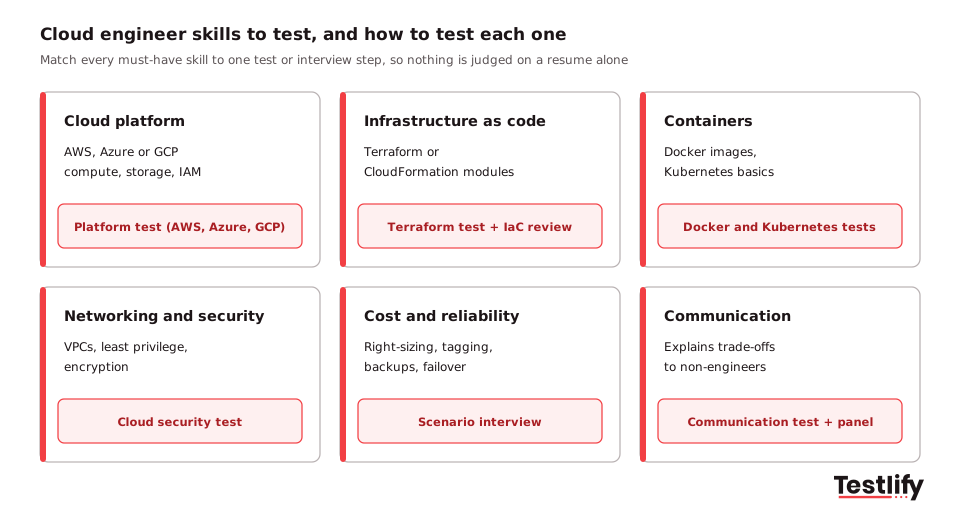
A cloud engineer needs deep skill in one major cloud platform, infrastructure as code, containers, networking and security, and at least one scripting language, plus the soft skills to work across teams. Platform demand is spread out: in the Stack Overflow Developer Survey 2025, 45.9% of professional developers used AWS, 27.2% Azure and 24.3% Google Cloud, while 73.8% used Docker and 30.1% Kubernetes.
Hard skills
- Cloud platforms: Working depth in AWS, Azure or GCP: compute, storage, identity and access management, and managed databases. Match the candidate's main platform to yours.
- Cloud storage: Object, block and archive storage (for example S3 and Glacier on AWS, Blob storage and Data Lake on Azure), plus public, private and hybrid setups.
- Infrastructure as code: Writing reusable Terraform modules or CloudFormation templates, with state and code review handled properly.
- Networking: Virtual networks, subnets, load balancers, DNS, VPNs and autoscaling rules.
- Security and disaster recovery: Least-privilege access, encryption in transit and at rest, logging, backups and tested failover.
- Containers and orchestration: Docker images and Kubernetes deployments, which also make it easier to move workloads between clouds.
- Programming and scripting: Python is the most common, with Bash, Go, Java, .NET or SQL depending on your stack.
- DevOps and CI/CD: Building pipelines that test and deploy code and infrastructure automatically.
- Web services and APIs: Cloud services are driven by APIs, so engineers need to read docs and automate against them.
- Linux and Windows server administration: Most cloud workloads still run on Linux, with Microsoft services common in enterprise estates.
- Cost management (FinOps): Tagging, budgets, right-sizing and reserved or spot capacity.
Soft skills
- Collaboration: Cloud engineers work with software, security, data, business analysis and finance teams at the same time.
- Attention to detail: One wrong security group rule or IAM policy can expose data. See why attention to detail matters in hiring.
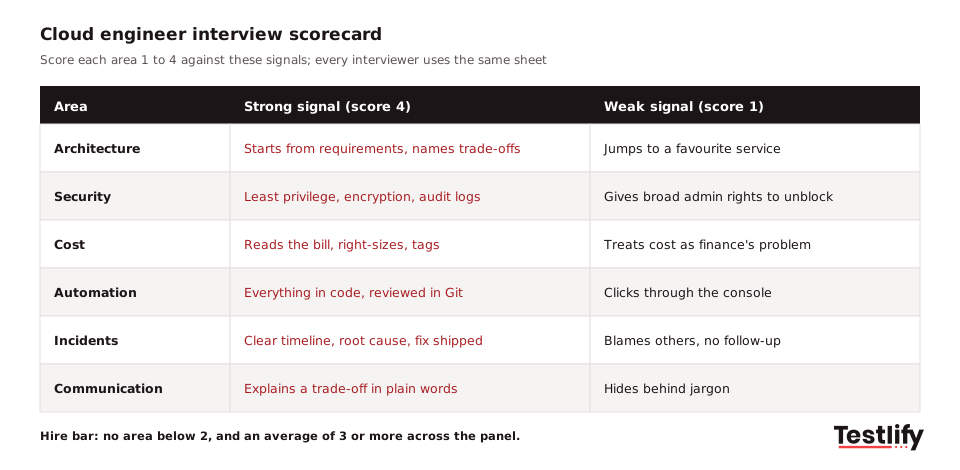
- Clear communication: Explaining an architecture trade-off to a CFO, or a security requirement to a product team, in plain words.
- Learning speed: Cloud services change every quarter, so a track record of picking up new tools matters as much as today's stack.
Testlify's guide to the soft skills to assess when hiring developers covers how to test these, and the skills map for an AWS cloud engineer breaks the AWS skill set down further.
How do you hire a cloud engineer, step by step?
To hire a cloud engineer, follow seven steps: pick the variant, write a specific job description, source in the right places, run a short skills test, review infrastructure code, hold a scenario interview, and make a fast offer with a real onboarding plan. Most teams can run this in about three weeks from the first screen to an offer.
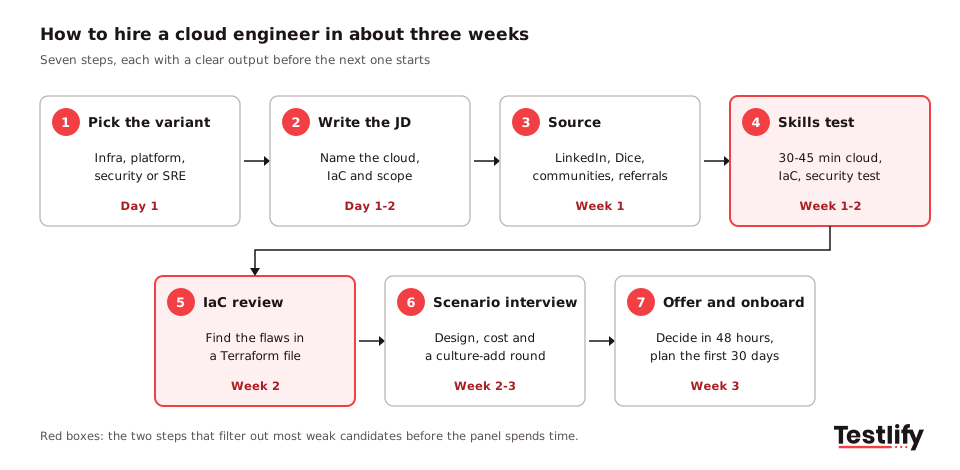
- Pick the variant and the driver: Decide between infrastructure, platform, security and SRE, and write down the business outcome the hire must deliver.
- Write a specific job description: Name your primary cloud (AWS, Azure or GCP), your infrastructure as code tooling (Terraform, CloudFormation or Pulumi), the scale of the environment, and whether the work is a new build or running an existing estate. Specific details let experienced engineers judge their own fit and give you sharper screening criteria.
- Source where cloud engineers already are: Post on LinkedIn and Dice, ask your engineers for referrals, and reach into cloud communities. A referral from a trusted cloud engineer pre-checks technical credibility before the first call.
- Run a skills test before any live interview: A 30 to 45 minute assessment covering cloud architecture basics, infrastructure as code and security means every panelist meets a candidate who has already passed a verified baseline.
- Review infrastructure code: Ask shortlisted candidates to review a deliberately flawed Terraform or CloudFormation file. Spotting security misconfigurations, waste and scaling problems in real code shows applied skill far better than verbal questions.
- Hold a scenario interview: Present an anonymized problem from your own environment, such as cutting cloud spend by 30% without breaking service levels, and ask the candidate to talk through their approach. Add a round on collaboration and communication with the teams they will support.
- Offer fast and onboard properly: Give feedback within 48 hours of each stage and keep the offer competitive. Plan the first 30 days around your account structure, tagging and cost rules, pipelines, security baseline and incident runbooks.
Key takeaway: Steps 4 and 5 do most of the filtering. Put them before the panel interviews and your engineers spend their time only on candidates who can already do the work.
What should a cloud engineer job description include?
A cloud engineer job description should state the cloud platform, tooling, scope and outcomes of the role, so candidates can judge their fit in one read. Copy and adapt this template.
Title: Cloud Engineer (state the variant if it matters, for example Cloud Infrastructure Engineer, AWS)
Location: [City, State] or remote, with time zone
Overview: As our Cloud Engineer you will design, build and run the cloud infrastructure that every product and service we offer depends on. You will design for reliability, security and cost from the start, and build the automation and monitoring that let engineering teams ship quickly without losing stability.
Responsibilities:
- Design and build reliable, secure cloud infrastructure on [AWS / Azure / GCP]
- Write and review infrastructure as code with [Terraform / CloudFormation]
- Automate provisioning, deployment and monitoring
- Keep cloud systems highly available, backed up and secure
- Track and reduce cloud costs with tagging, budgets and right-sizing
- Work with development, security and finance teams to turn business needs into technical plans
Requirements:
- [X]+ years in IT or engineering, with [Y] years focused on cloud (set by seniority)
- Hands-on experience with at least one major cloud provider: AWS, Azure or GCP
- Strong understanding of IaaS, PaaS and SaaS models
- Infrastructure as code with Terraform or CloudFormation, including modules and remote state in a GitOps workflow
- Docker and an orchestration tool such as Kubernetes
- Networking fundamentals, cloud security principles and compliance standards
- Troubleshooting skills in cloud environments, and clear written and spoken communication
- A degree in computer science, engineering or IT, or equivalent hands-on experience
Benefits:
- Paid certification exams and cloud training budget
- Conference attendance, such as AWS re:Invent, KubeCon or Google Cloud Next
- Competitive salary and benefits, with remote or flexible working
- Real ownership of a cloud platform, and a part in the company's move to the cloud
Naming specific tooling in the requirements signals engineering maturity, and certification sponsorship often matters as much as base pay to engineers who are building their skills.
Where can you find cloud engineer candidates?
Cloud engineer candidates are easiest to find on LinkedIn, specialist tech boards such as Dice, startup boards such as Wellfound, and in cloud practitioner communities. Use a mix: boards bring volume, while communities and referrals bring passive senior engineers.
Channel | Best for | How to use it |
|---|---|---|
Passive and senior candidates | Filter by platform (AWS, Azure, GCP), tools (Terraform, Kubernetes) and certifications | |
Indeed | Volume, mid-market roles, locations outside tech hubs | Sponsored posts keep applications steady |
Dice | Tech-only audience | Search the resume database for certification mixes or GovCloud and Azure Government experience |
Glassdoor | Candidates who research employers | Keep your profile current and mention your cloud stack and engineering culture |
Wellfound (formerly AngelList) | Engineers who want startup scope | Stress ownership of a young cloud platform |
Cloud communities | Self-identified practitioners | AWS Community Builders, HashiCorp Discuss, CNCF Slack and local AWS User Groups |
Employee referrals | Pre-vetted talent | Ask your own cloud engineers first; reward good referrals |
Active community members show the two traits you most want in a cloud engineer: real technical depth and continuous learning.
Which skills assessments work best for cloud engineers?
The best skills assessments for cloud engineers combine one platform test, one infrastructure or container test, and one security test, taken before the first live interview. This gives every candidate in the pipeline an objective, comparable score and protects your engineers' time.
A good starting stack for most roles is the AWS Cloud Engineer test (or the Azure or Google Cloud Platform equivalent), plus the Docker test and the Cloud Security test. Add these where the role needs them:
- Infrastructure as code roles: Terraform test and the Complete Automation test
- Hybrid or multi-cloud networking: Cisco Networking Fundamentals test and the Network Security Engineer test
- Provider-specific depth: AWS DevOps test, AWS SysOps test, AWS EMR test, Azure Machine Learning test and the SAP Cloud Platform test
- Scripting: Python test or the .NET test
- Troubleshooting: Testing and Debugging Skills test
- Soft skills: Collaboration test and Communication test
The Testlify test library has 3,500+ tests, and the AI test builder can turn your cloud engineer job description into a custom assessment in under a minute. For remote hiring, 20+ proctoring checks, including webcam snapshots, tab monitoring and copy-paste blocking, keep results trustworthy. See how anti-cheating and proctoring works. Scores sync to your ATS through 100+ integrations, so recruiters do not copy results by hand.
Skills tests also help with skill gap analysis: set the difficulty to the seniority you need and you see exactly where each candidate falls short.
What interview questions should you ask a cloud engineer?
Cloud engineer interview questions should test real decisions: how the candidate designs, secures, automates and fixes cloud systems. Ask the same questions in the same order for every candidate, and score each answer against a shared scorecard, as in a structured interview.
General questions
- Tell me about a challenging cloud infrastructure project and how you got past the obstacles: Listen for a specific project, the candidate's own part in it, and a measurable result.
- How do you design a cloud architecture that scales and recovers from failure for a new project? Strong answers start from requirements (traffic, data, uptime targets) before naming services.
- What has infrastructure as code given you in past roles? Look for code review, repeatable environments and drift detection, not just "it is faster".
- How do you protect sensitive data in a cloud environment? Expect least privilege, encryption, key management, logging and regular access reviews.
- Describe a time you fixed a performance problem in a cloud application: Good answers walk through metrics, logs, a hypothesis, the fix and how they confirmed it.
Technical questions
- What are the main differences between on-premises and cloud infrastructure? Listen for elasticity, shared responsibility, pay-per-use cost and the operational changes that follow.
- How would you design a highly available web application on a cloud platform? Expect multiple availability zones, load balancing, autoscaling, managed databases with failover, and backups. The AWS Well-Architected Framework is a good reference for what a complete answer covers.
- When would you recommend serverless computing, and when not? Strong candidates name trade-offs: cold starts, vendor lock-in and cost at high volume.
- How do you secure data in transit and at rest? Look for TLS, managed keys, encryption by default and access policies tied to roles.
- How would you build a CI/CD pipeline that deploys to the cloud? Expect source control, automated tests, infrastructure plans reviewed before apply, staged rollouts and rollback.
Also ask about open-source cloud databases, the data types and service models (IaaS, PaaS, SaaS) the candidate has worked with, and how cloud computing has helped past employers. For a longer bank with sample answers, use the Testlify list of cloud engineer interview questions.
Do cloud certifications matter when you hire a cloud engineer?
Cloud certifications matter as a supporting signal, not as a hard filter. Professional-level credentials such as AWS Certified Solutions Architect Professional, Google Professional Cloud Architect and Microsoft's Azure Solutions Architect Expert show serious study of a platform. Associate-level badges show the basics.
What certifications cannot show is production judgment. We have seen candidates with several certificates struggle to review a simple Terraform file, and engineers with none run large estates well. Use certifications to shortlist when you have many applicants, then let the skills test and code review decide. Certifications across more than one provider are worth noting if you run production workloads on several clouds.
How much does it cost to hire a cloud engineer?
The cost to hire a cloud engineer in the US starts with a salary benchmark of about $134,050, the May 2025 median for computer network architects according to the US Bureau of Labor Statistics, the federal category that includes cloud architects. Entry-level cloud engineers earn below that median, while senior, security-focused and multi-cloud engineers earn above it.
Pay moves with four factors:
- Seniority and scope: Owning a platform pays more than supporting one.
- Specialism: Cloud security, Kubernetes and reliability skills usually command a premium.
- Location: Major tech hubs pay more; remote roles often pay to a national band.
- Platform: Pay differences between AWS, Azure and GCP are small next to the factors above.
Outside the US, benchmark against live postings and local salary surveys in each market you hire in. Beyond salary, budget for recruiter time, assessment tools, certification sponsorship and onboarding. Cloud engineers also weigh remote work, flexible hours and the chance to work on modern technology, so say clearly what you offer on each.
What are the red flags when hiring a cloud engineer?
The biggest red flags when hiring a cloud engineer are habits that create security risk, waste money or make systems fragile. Watch for these in tests, code reviews and interviews:
- Console-only experience: Built everything by clicking in the web console, with no infrastructure as code.
- Broad access as a fix: Grants admin rights to solve permission problems quickly.
- No cost awareness: Treats the cloud bill as finance's problem.
- Provider defaults everywhere: Accepts default network and identity settings without review.
- Big-bang migrations: Plans one cutover with no tested rollback.
- Certificates instead of examples: Leads with badges rather than environments they designed or ran.
- Vague incident stories: Cannot explain what failed, why, and what changed afterwards.
What recruiting templates can you use to hire a cloud engineer?
Cloud engineer recruiting templates cover the posts, emails and rejections you need to hire a cloud engineer. Personalize each one: experienced cloud engineers read your messages with the same care they give a code review.
Social media post templates
Posts that name your cloud platform, your tooling, or a concrete challenge attract better-matched candidates than generic hiring posts. A scale metric, such as millions of requests a day, helps too.
- Template 1: We are hiring a Cloud Engineer to run our AWS platform. You will own our Terraform codebase, our Kubernetes clusters and our cloud costs as we grow to [scale metric]. If that sounds like your kind of problem, apply here: [link] #CloudEngineer #AWS #Hiring
- Template 2: Calling all Cloud Engineers who know AWS, Azure or GCP and enjoy hard infrastructure problems. Join us to help shape our cloud strategy with infrastructure as code, containers and solid networking. Apply today: [link] #CloudEngineering #NowHiring
- Template 3: Our team is growing and we need a Cloud Engineer to help build and maintain modern cloud infrastructure. Bring your experience with networking, infrastructure as code and containers. Apply now: [link] #CloudComputing #TechJobs
Outreach email templates
Reference something specific from the candidate's profile, such as an open-source contribution, a certification or a public talk.
Outreach: Subject: Cloud Engineer role at [Company Name]
Hi [Candidate's Name], I came across your [specific project or contribution] and was impressed by your work with [technology]. We are hiring a Cloud Engineer to design, build and run our cloud infrastructure on [platform]. You would own cost optimization, deployment automation and security, working closely with our product teams. Would you be open to a 20-minute call this week? Best regards, [Your Name], [Your Title], [Company Name]
Follow-up: Subject: Following up: Cloud Engineer at [Company Name]
Hi [Candidate's Name], I wanted to follow up on my note about our Cloud Engineer role. Your experience with [AWS / Azure / GCP] and with solving hard infrastructure problems stood out to us. If you have questions about the team, the stack or the role, I am happy to answer them. Best regards, [Your Name]
Interview invitation: Subject: Interview invitation: Cloud Engineer at [Company Name]
Hi [Candidate's Name], we would like to invite you to interview for the Cloud Engineer role. The interview will take place [via video / in person] on [date] at [time] and will include [an architecture walkthrough / an infrastructure code review / a cloud cost scenario]. Let me know if this time works or suggest another. Best regards, [Your Name]
Describing the technical format in the invitation lowers candidate anxiety and no-show rates, and shows that you run an organized process.
Rejection email template
Send rejections within 48 hours of a decision. The cloud community is small and well connected, so a respectful rejection protects your employer brand and can even lead to a referral.
Dear [Candidate], thank you for applying for the Cloud Engineer role at [Company] and for the time you put into the process. After careful review, we have decided to move forward with candidates who more closely match the needs of this role. We were impressed by your skills, and we encourage you to watch our careers page for future openings. We wish you the best in your search. Sincerely, [Your Name]
Ready to hire a cloud engineer with Testlify?
Testlify helps you hire a cloud engineer on proof of skill, not on resumes. Pick a ready-made cloud test from Testlify's test library or build one from your job description, invite candidates from your ATS, and get a ranked shortlist with per-skill scores. Plans are credit-based, so you pay only when a candidate starts an assessment, and you can start a 7-day free trial with no credit card. For enterprise hiring, book a demo.
Hiring for related roles? See the Testlify machine learning engineer hiring guide and network security engineer hiring guide.
FAQ: what else do teams ask before they hire a cloud engineer?

Director of Marketing
Akash Patange is the Director of Marketing at Testlify, where he works closely with HR leaders and recruiters to help organizations improve hiring outcomes. He writes about talent assessment, recruitment technology, and data-driven hiring practices.
LinkedInRelated resources
View all
Tech recruitment
Top 10 technical skills you must assess while hiring in 2026

Tech recruitment
How to hire Bash developers: Skills, tests and questions

Tech recruitment
How do coding challenge platforms compare for developer hiring?

Tech recruitment
Online coding assessment tools: how to choose and run them

Tech recruitment
How to use coding assessments to create a talent pipeline

Tech recruitment
Interview question to hire a marketing strategist
Get started.
Hire on proof, not resumes.
Run your first skills-based assessment free — no credit card required.