
How to hire Bash developers: Skills, tests and questions
A practical guide to hiring Bash developers: the roles that use Bash, skills by level, where to find people and how to test them fairly.

To hire Bash developers well, start with the job the scripts have to do, then test that work directly. A Bash developer writes the shell scripts that automate builds, deployments, backups and server tasks on Linux and Unix systems. Resumes rarely show how well someone writes those scripts, so a short practical test tells you more than a keyword match.
 ChatGPT
 Gemini
 Claude
 Grok
 Perplexity
TL;DR / Key takeaways
- A Bash developer writes and maintains shell scripts that automate deployments, backups, log handling and server tasks on Linux and Unix.
- "Bash developer" is rarely a job title. Most hires are DevOps engineers, SREs, Linux administrators, build and release engineers or data engineers who script in Bash.
- Bash is everywhere: 48.7% of developers in the 2025 Stack Overflow survey use Bash or shell.
- Screen with a 30 to 45 minute practical task, such as a log parser with error handling, scored on correctness, safety and readability.
- The biggest red flags are unquoted variables, no error handling, hardcoded passwords and code the candidate cannot explain line by line.
- Use pay data for the actual role family. BLS puts the median for systems administrators at $99,130 and for software developers at $135,980 (May 2025).

What does a Bash developer do?
A Bash developer writes, tests and maintains scripts in the Bash shell to automate repetitive work on Linux and Unix systems. Typical scripts deploy code, provision servers, rotate logs, run backups, schedule maintenance with cron and glue tools such as Git, Docker and cloud command-line tools into one repeatable workflow.
Bash is the default shell on most Linux servers, so almost every infrastructure team depends on it. The Stack Overflow Developer Survey 2025 found that 48.7% of all respondents and 48.8% of professional developers use Bash or shell, which puts it among the most used languages in the survey.
Day to day, the work usually includes:
- Automation: turning manual runbooks into scripts that run the same way every time.
- Glue code: connecting build tools, CI/CD pipelines, monitoring and cloud CLIs.
- Troubleshooting: reading logs, fixing failed jobs and making scripts fail safely.
- Maintenance: keeping older scripts readable, documented and under version control.
Which roles need Bash skills?
Bash skills are needed in DevOps, site reliability, Linux administration, build and release, and data engineering roles. Very few companies post a job called "Bash developer". Most hiring teams that search for one actually need one of these roles, with Bash as a core skill, so define the role first and test Bash inside it.
Role family | What Bash is used for | What else to test |
|---|---|---|
DevOps engineer | CI/CD steps, deployment scripts, environment setup | Docker, Kubernetes, Terraform, a cloud platform |
Site reliability engineer | Incident tooling, health checks, alert handlers | Monitoring, Linux internals, Python or Go |
Linux or systems administrator | Backups, user management, cron jobs, log rotation | Networking, permissions, security hardening |
Build and release engineer | Build wrappers, packaging, release automation | Git, build tools, artifact repositories |
Data engineer | File moves, ETL steps, scheduled data pulls | SQL, Python, a workflow scheduler |
Demand stays steady because these systems need people to run them. The US Bureau of Labor Statistics projects about 13,400 openings a year for network and computer systems administrators over the decade, mostly to replace people who change roles or retire.
For a broader view of the DevOps role, see the DevOps engineer hiring guide.
What skills should a Bash developer have?
A Bash developer should have strong shell scripting fundamentals, Linux command-line fluency, text processing with grep, sed and awk, safe error handling, and working knowledge of Git and the tools the scripts automate. Senior people also write scripts that are secure, testable and easy for others to maintain.
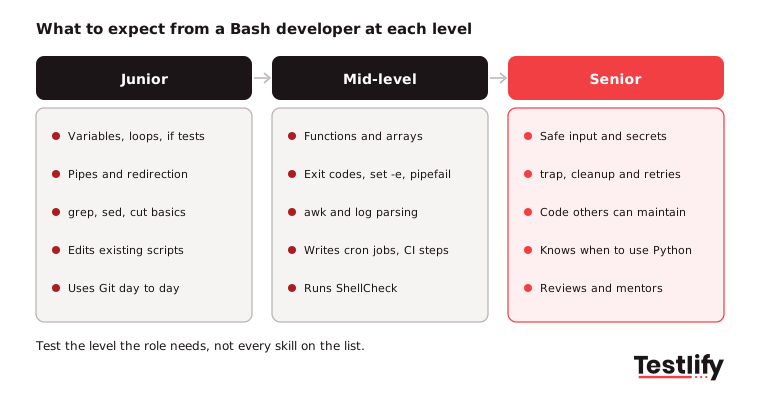
- Scripting fundamentals: variables, quoting, conditionals, loops, functions, arrays and exit codes.
- Linux fluency: file permissions, processes, signals, pipes, redirection and environment variables. The Linux glossary entry covers the basics.
- Text processing: grep, sed, awk, cut, sort and xargs to parse logs and command output.
- Error handling: checking exit codes, using set -euo pipefail where it fits, cleaning up with trap, and logging failures clearly.
- Security: never passing untrusted input straight to a shell, keeping secrets out of scripts, and using least privilege. OWASP's command injection page shows what goes wrong when scripts trust input.
- Tooling: Git, cron or systemd timers, SSH, and linters such as ShellCheck.
- Judgment: knowing when a task has outgrown Bash and belongs in Python or Go.
Pro tip: Write down which of these skills the role really needs before you open the req. A Linux administrator and a data engineer both use Bash, but they need very different tests.
How do you hire Bash developers step by step?
To hire Bash developers, define the role family and the scripts the person will own, write a skills-based job description, source in the right channels, screen with a short practical test, run a structured technical interview, and make the offer on evidence. The test comes before the interview so engineers only meet people who can already script.
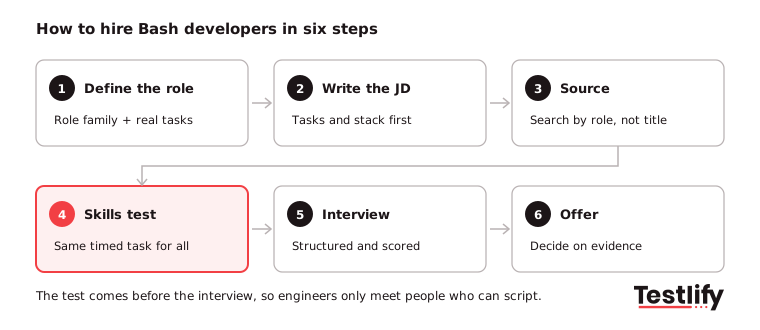
- Define the role: Name the role family and list three to five real tasks, such as "rewrite our deployment script" or "automate nightly database backups".
- Write the job description: Lead with those tasks and the stack. Skip "5+ years of Bash", which says nothing about skill.
- Source candidates: Use the channels in the next section. Ask for a script sample or a link to public code where it is relevant.
- Screen with a skills test: Send every applicant the same timed Bash test before any interview.
- Interview with structure: Use the same questions and a scoring sheet for every candidate. A structured interview keeps engineers consistent.
- Decide and offer: Compare test scores, interview scores and references side by side.
Screening on skills also widens the pool. LinkedIn Economic Graph's Skills-Based Hiring report (March 2025) found that hiring on skills instead of job titles or degrees expands talent pools by a median 6.1 times globally, and by 15.9 times for non-AI roles in the United States.
Where can you find Bash developers?
Bash developers are easiest to find in DevOps and Linux communities, on LinkedIn under DevOps, SRE and systems administration titles, through employee referrals, and on freelance marketplaces for short projects. Searching for the title "Bash developer" alone misses most qualified people, so search by role family and skill instead.
- LinkedIn and job boards: Search for DevOps, SRE and Linux administrator titles with "Bash" or "shell scripting" as a skill.
- Referrals: Your own engineers know who writes clean scripts. Referrals work well for senior infrastructure roles.
- Open-source communities: Contributors to shell tools, dotfiles and infrastructure projects show their scripting in public.
- Freelance marketplaces: Good for a single migration or automation project. Test freelancers the same way as full-time hires.
- Staffing and remote hiring platforms: Useful when you need a dedicated or remote Bash developer fast, but still run your own skills test.
How do you test Bash skills?
The best way to test Bash skills is a short, timed practical task that mirrors real work, scored against a fixed rubric. A 30 to 45 minute task, such as parsing a log file and reporting errors safely, shows more than trivia questions, because it tests correctness, safety and readability together.
A good task has three parts: a script to write, a broken script to fix, and two or three questions about why the candidate made certain choices. Ready-made options include the Bash test, the Shell Script test and a Bash and Python coding test for roles that use both.
What to score | What good looks like | Weight |
|---|---|---|
Correctness | Script gives the right output on normal and edge-case input | 35% |
Safety | Quotes variables, checks exit codes, handles missing files, no secrets in code | 25% |
Readability | Clear names, functions, comments where logic is not obvious | 20% |
Efficiency | Uses the right tool (awk, sort, xargs) instead of slow loops | 10% |
Explanation | Can explain each line and the trade-offs made | 10% |
Keep the test the same for every candidate and decide the pass mark before you see results. Add proctoring for remote tests so the score reflects the candidate's own work.
What should you ask in a Bash developer interview?
A Bash developer interview should ask candidates to explain choices in real scripts, not recite definitions. Good questions cover quoting, exit codes, error handling, text processing, debugging and security, and each one should be answered with an example from the candidate's own work.
- Walk me through a script you wrote that runs in production. What breaks it?
- What is the difference between $@ and $*, and when does quoting them matter?
- How do you make a script stop on the first error, and when would you not want that?
- How would you find the ten most frequent IP addresses in a large access log?
- How do you debug a cron job that works when you run it by hand but fails on schedule?
- How do you keep passwords and API keys out of your scripts?
- When would you rewrite a Bash script in Python?
For a longer list with sample answers, see these shell scripting interview questions and Linux interview questions.
What red flags should you watch for?
The main red flags when hiring Bash developers are scripts with unquoted variables, no error handling, hardcoded credentials, parsing the output of ls, and code the candidate cannot explain. Each one causes real outages or security issues later, and each one is easy to spot in a test or code sample.
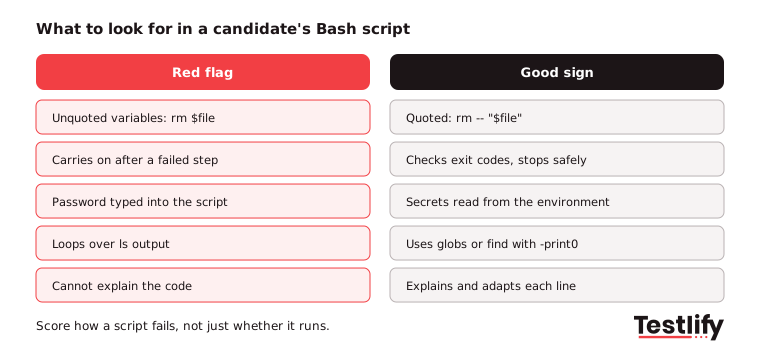
- Unquoted variables: A filename with a space can make the script delete or skip the wrong files.
- No error handling: The script carries on after a failed step and leaves systems half updated.
- Hardcoded secrets: Passwords and tokens in scripts end up in version control.
- Fragile parsing: Looping over ls output or using fixed column numbers breaks on real data.
- Copy-paste code: Candidates can now generate a working script with an AI assistant. Ask them to explain two or three lines and change one requirement live. People who wrote the script can adapt it. People who pasted it usually cannot.
Key takeaway: A clean, safe 20-line script tells you more about a Bash developer than a 200-line one. Score how the script fails, not just whether it runs.
How much does it cost to hire a Bash developer?
The cost to hire a Bash developer depends on the role family, seniority, location and whether you hire full-time or freelance. Pay for a full-time hire follows the role, not the Bash skill, so benchmark against DevOps, SRE, systems administrator or software developer pay in your market.
As a reference point for the US, the BLS software developer profile lists a median pay of $135,980 in May 2025 and projects 10% growth from 2025 to 2035. The same BLS data puts the median for network and computer systems administrators at $99,130. DevOps and SRE roles usually sit nearer the developer figure.
Beyond salary, count the hidden costs: engineer hours spent on interviews, time the role stays open, and the cost of a bad hire who breaks production scripts. Testing skills before interviews cuts the first two and lowers the risk of the third.
How can Testlify help you hire Bash developers?
Testlify helps hiring teams hire Bash developers by testing scripting skill before the first interview. Teams pick a ready-made Bash or shell scripting test, or build a role-specific assessment from the job description, and every candidate gets the same timed test with automatic scoring.
- Ready-made tests: 3,500+ tests, including Bash, shell scripting, Linux and DevOps tests, plus a coding environment for hands-on tasks. Browse coding tests.
- Fair, comparable results: Every candidate is scored on the same questions, and teams can mix skills tests with 25+ question types, including coding tasks and video answers.
- Integrity checks: 20+ proctoring checks, including copy and paste tracking and AI assistance detection, so scores reflect the candidate's own work. See anti-cheating and proctoring.
- Fits your stack: Results sync with 100+ ATS and HRIS tools, so recruiters do not copy scores by hand.
Ready to test Bash skills before the interview?
Pick the Bash test from the test library, send it to your next batch of applicants, and bring only the strongest scripters to your engineers. Start a 7-day free trial of Testlify, no credit card required.
Frequently asked questions

Content Writer
Yashika Khandelwal is a Content Writer with 3+ years of experience creating research-backed content on hiring, talent assessment, and HR technology. She is a registered Organizational Psychologist and subject matter expert who combines behavioral science with practical recruitment insights to produce accurate, evidence-based content.
LinkedInRelated resources
View all
Tech recruitment
How do coding challenge platforms compare for developer hiring?

Tech recruitment
Online coding assessment tools: how to choose and run them

Tech recruitment
How to use coding assessments to create a talent pipeline

Tech recruitment
Interview question to hire a marketing strategist

Tech recruitment
How to hire PHP developers: skills, cost, interview questions and process

Tech recruitment
How to Hire Cybersecurity Experts in 2026: A Complete Guide
Get started.
Hire on proof, not resumes.
Run your first skills-based assessment free — no credit card required.