
50 content strategist interview questions with sample answers
Interview questions, model answers, a 1 to 5 scorecard and paid work-sample ideas to hire a content strategist who plans and proves results.

Hiring a content strategist and getting a content writer is a costly mistake. The calendar fills up, but nobody can say what the content was meant to achieve.
Content strategist interview questions fix this when they make candidates show a goal, an audience and a measured result. Polished answers about writing do not prove a candidate can plan, prioritize or prove impact.
Below are 50 questions across six themes (10 general, 10 behavioral, 10 situational, 8 strategy and measurement, 6 AI and search, 6 culture fit), each with sample answers and what to listen for. You also get a scorecard, work-sample tasks and the red flags that should end a process, so you hire a strategist, not a writer.
TL;DR:
- Good content strategist interview questions make candidates show a plan, a goal and a measured result. Score the reasoning, not the polish.
- Use six themes: general, behavioral, situational, strategy and measurement, AI and search, and culture fit. Each one surfaces evidence the others miss.
- Put a short content strategy test before the interviews and a paid, time-boxed work sample (audit, brief or analytics read) after them.
- Score every answer on the same 1 to 5 scale for five competencies: strategy, audience, SEO and AI search, data, and stakeholders.
- The clearest red flag is a candidate who talks about content without ever naming a goal, an audience or a number.
- A content writer produces the words; a content strategist decides what to produce, for whom and why, then proves it worked.
 ChatGPT
 Gemini
 Claude
 Grok
 Perplexity
What does a content strategist do?
A content strategist plans, manages and measures content so it supports business goals and meets audience needs. Every piece gets a clear purpose, a defined reader and a metric.
Day to day, the strategist audits existing content, sets the editorial calendar, briefs writers and reports on what moved traffic, pipeline and revenue.
Typical responsibilities include:
- Build a content strategy tied to business and marketing goals.
- Research audiences, customer journeys and content gaps.
- Plan editorial calendars and prioritize what gets made.
- Run keyword and topic research and build search-led content plans.
- Define brand voice, messaging and content guidelines.
- Work with writers, designers, SEO specialists, product and sales.
- Review content for quality, accuracy and consistency.
- Track performance (traffic, engagement, conversions) and update, merge or retire content based on it.
The role overlaps with search work. The US occupational database lists tracking and reporting search activity, analyzing web metrics and shaping online marketing strategy among the top tasks for search marketing strategists on O*NET, which is why many content strategist job posts ask for SEO skills too.
Area | Content strategist | Content writer | SEO strategist |
|---|---|---|---|
Owns | The plan, priorities and outcomes | The words and the draft | Search visibility |
Main question | What should we publish, for whom, and why? | How do we say this well? | How do people find us? |
Typical metrics | Pipeline influence, conversions, engagement, organic growth | On-time delivery, quality, edits needed | Rankings, organic traffic, technical health |
Interview focus | Planning, prioritizing, measuring, stakeholders | Writing samples, editing, research | Keyword research, technical SEO, analytics |
If writing is the job you are filling, use our content writer interview questions. For a search-first hire, see the SEO specialist interview questions.

What skills should content strategist interview questions test?
Content strategist interview questions should test five skills: strategy and planning, audience research, SEO and AI search, data and measurement, and stakeholder management, with editorial judgment running through all five. Writing helps, but content strategy is the job.
Map each skill to the evidence that proves it, then pick the question or task that surfaces that evidence.
Competency | What good looks like | How to test it |
|---|---|---|
Strategy and planning | Builds a topic plan tied to goals and the buyer journey | Questions 2, 31 and 38; skills test |
Audience and research | Defines who the content serves and what they need | Question 27; content audit task |
SEO and AI search | Picks topics by search demand and business value, plans for AI answers | Questions 9 and 39 to 44 |
Data and measurement | Reads analytics and reports against targets set up front | Questions 12, 33 and 36; analytics read task |
Editorial judgment | Sets the quality bar, briefs writers, edits for the reader | Content brief task; portfolio walkthrough |
Stakeholder management | Aligns marketing, design, product and leadership on one plan | Questions 14, 23 and 25 |
What general questions should you ask a content strategist?
General questions set the baseline: how the candidate defines the role, structures a strategy and picks tools. Ask them early to hear how someone frames content strategy in their own words.
Weak candidates describe tasks. Strong ones describe a system with a goal attached.
- Walk us through your experience as a content strategist. What kinds of programs have you owned?
- Walk us through how you build a content strategy from scratch.
- How would you explain content strategy to someone outside marketing?
- How do you decide which topics to prioritize on a content calendar?
- What tools do you use for research, planning and measurement, and why?
- How do you keep brand voice consistent across writers and channels?
- What does a content audit involve, and how often should one happen?
- How do you map content to the stages of the buyer journey?
- How do you balance search demand with readability and brand voice?
- How do you decide when to update, merge or retire an existing piece?
Sample answers to general questions
Question 2: Walk us through how you build a content strategy from scratch.
Look for: A clear order (audience, goals, audit, plan, measurement) and a link back to the business goal.
Example answer: "I start with the business goal and the audience: who buys, what they need at each stage, and what competitors already cover. Then I audit what we have, set two or three goals with KPIs, and build personas and a calendar mapped to the buyer journey, with topics, formats, and channels."
"I review results monthly and change the plan when the data says so."
Question 1: Walk us through your experience as a content strategist.
Look for: Programs owned end to end, across channels or industries, with a result attached.
Example answer: "At my last agency I built the content strategy for a software company selling to IT teams: audience research, a content calendar, and blog posts, whitepapers and case studies. Over a year organic traffic grew about 30% and content-sourced leads rose."
"I owned the plan and the reporting; writers and designers owned production."
Which behavioral questions reveal real experience?
Behavioral questions ask for real events, not opinions, so they expose whether a candidate has actually run a strategy or only read about one. Push for specifics: the situation, what they did and the measured result.
Vague answers that never reach a number are the tell.
- Tell us about a content strategy you built and the results it delivered.
- Describe a piece of content that underperformed. What did you do next?
- Give an example of a time data changed your content plan.
- Tell us about a disagreement with a stakeholder over content direction.
- Describe a time you had to cut scope because of limited resources.
- Tell us about a time you aligned a content strategy with a brand voice that did not fit the target audience.
- Tell us about a content program you inherited and improved.
- Describe a project where you managed external writers, vendors or an agency.
- Describe how you handled a content crisis or public negative feedback.
- Give an example of a content experiment that did not go as planned.
Sample answers to behavioral questions
Question 13: Give an example of a time data changed your content plan.
Look for: Analytical skill, a specific insight from the data, and a change that moved a metric.
Example answer: "Our blog drove plenty of traffic but converted badly. I pulled conversion data by page and saw readers left without a next step."
"We tested different call-to-action placements and messages on the top 20 posts, kept the winners, and conversions from those pages rose about 20% in a quarter. After that, every brief included the next step for the reader."
Question 16: Tell us about a time you aligned a content strategy with a brand voice that did not fit the target audience.
Look for: Problem-solving, research before opinion, and how they won stakeholder buy-in.
Example answer: "A client had a traditional voice but wanted a younger audience. I researched how that audience talked about the category, then proposed a tone that kept the brand's core traits but used plainer, more direct language."
What situational questions test decision-making?
Situational questions drop the candidate into scenarios they will face on the job: no budget, a hostile stakeholder, a channel that stops working. There is rarely one right answer, so score the reasoning, the tradeoffs and whether they ask for data before deciding.
- You join, and there is no documented content strategy. What do you do in your first 30, 60 and 90 days?
- Organic traffic drops 25% in a quarter. How do you diagnose it?
- Leadership wants a topic with no search demand. How do you respond?
- You get half the budget you asked for. What do you cut and what do you protect?
- Two teams want conflicting content from the same limited resources. What do you do?
- A top-performing article is now outdated. Do you update it or replace it, and why?
- You need to reach an audience you do not know well. Where do you start?
- A competitor outranks you on your core topics. What is your plan?
- A writer keeps missing the brief. How do you handle it?
- A campaign is underperforming halfway through. Do you kill it or fix it, and how?
Sample answer to a situational question
Question 21: You join, and there is no documented content strategy. What do you do in your first 30, 60 and 90 days?
Look for: Listening and auditing before publishing, quick wins in the second month, and a written plan with targets by day 90.
Example answer: "In the first 30 days, I meet sales, product, and support, audit our content and analytics, and agree on what success means. By day 60 I fix the biggest gaps, such as outdated top pages and missing bottom-funnel content, and test a brief template with writers."
"By day 90 I present a written strategy with goals, a calendar and the three metrics I will report every month."
Which content strategy and measurement questions separate strategists from writers?
Content strategy and measurement questions test the core of the role: turning goals into a plan, setting priorities and proving impact. They separate a content strategist from a strong writer who wants a bigger title.
Measurement matters more than ever: Orbit Media's 2026 survey of 1,042 content marketers found that the share reporting "strong results" fell from 26% to 14% between 2022 and 2026.
- How do you connect a content strategy to revenue or pipeline, not just traffic?
- How do you build a topic cluster or pillar strategy around a core theme?
- How do you set and track KPIs for a content program?
- How do you decide the right publishing cadence for a team?
- How do you split effort between new content and refreshing old content?
- How do you prove content ROI to a skeptical CFO?
- What is the most important part of a content brief, and why?
- How would you build a 90-day content roadmap for our company?
Sample answer to a measurement question
Question 33: How do you set and track KPIs for a content program?
Look for: KPIs agreed before publishing, a mix of leading and business metrics, and a reporting rhythm.
Example answer: "I agree on KPIs with leadership before we publish anything. For each goal I pick one business metric, such as demo requests or pipeline influenced, and one or two leading metrics, such as rankings for target topics or engaged time."
"I report monthly, and I add qualitative signals like sales feedback and comments to explain why the numbers moved."
Which questions test AI and search skills?
AI and search questions test whether a candidate can use AI tools without losing quality, and plan content for search engines and AI answers. AI use is now near universal: the same Orbit Media survey found that AI use among content marketers went from virtually zero to 93% in three years.
The question is no longer whether candidates use AI, but how they control it.
- Where do you use AI in your content workflow, and where do you never use it?
- AI drafts are flooding your queue. How do you keep quality and accuracy high?
- How do you plan content so it is cited in AI answers as well as ranked in search results?
- How do you show experience and expertise in content when anyone can generate text?
- Search traffic to your top pages drops after a search engine update. What do you check first?
- How would you set guidelines for AI use across a team of writers?
Sample answer to an AI question
Question 40: AI drafts are flooding your queue. How do you keep quality and accuracy high?
Look for: Clear rules on where AI helps, human fact-checking, and original input that AI cannot supply.
Example answer: "I use AI for research summaries, outlines, and first-pass edits, never for facts we have not checked. Every brief asks for something only we have, such as product data, customer quotes, or an expert's view."
"Editors check every claim against a source, and we track which pieces perform so we stop producing content that only adds volume."
Which personality questions show culture fit?
Personality and culture-fit questions check how a candidate works, not just what they know. Content strategists sit between many teams, so collaboration, curiosity, and resilience matter.
Keep these open and listen for self-awareness. The goal is fit with how your team works, not a hunt for one personality type.
- What piece of content best shows how you think, and why?
- How do you handle critical feedback on work you cared about?
- How do you balance creativity with strategic discipline?
- What steps do you take to make content inclusive for diverse audiences?
- What is a content trend you disagree with, and why?
- What does success in this role look like to you after one year?
Sample answer to a culture-fit question
Question 46: How do you handle critical feedback on work you cared about?
Look for: Openness, a specific example, and a change they made because of the feedback.
Example answer: "I ask questions until I understand the problem behind the feedback, then decide what to change. On a recent launch plan, sales said our content ignored their most common objection."
"I disagreed at first, checked call notes, saw they were right, and added two pieces that became our best converters that quarter."
Which work-sample tasks should you add to the interview?
Work-sample tasks show how a candidate actually works, which a strong interview alone rarely does for strategy roles. Keep each task short, relevant to your business, and paid if it takes more than an hour.
Score it with the same scorecard as the interview. Three tasks cover most of the role:
- Content strategy case study: Give a realistic scenario and ask for a short strategy: audience, goals, messages, formats, channels, and metrics. Shows strategic thinking and alignment with business goals.
- Content audit or brief: Share five to ten of your own pages and ask what to keep, update, merge or retire, or ask for one content brief. Shows audience thinking and editorial judgment. Our content strategy interview template gives you a ready structure.
- Analytics read: Hand over a sample analytics export and ask for three findings and three actions. Shows data literacy and the ability to turn numbers into decisions.
Add a writing or editing check only if the role includes hands-on writing; an SEO copywriting test covers that without a separate take-home.
Skills evidence widens the pool as well as sharpening the pick. LinkedIn's 2025 skills-based hiring research found that a skills-based approach gives a median 6.1x larger talent pool globally and 15.9x in the US.
That makes a skills test a fair first filter as part of skills-based hiring.
Pro tip: Give every finalist the same task, the same time limit and the same data. A task that changes per candidate cannot be compared, and an unpaid multi-day project mostly filters out good people with full-time jobs.
How should you run the content strategist interview process?
A good content strategist interview process runs in five stages: a recruiter screen, a short skills test, a hiring manager interview, a paid work sample, and a panel with a scored debrief. Evidence stages come early, so you spend interview time only on candidates who can do the work.
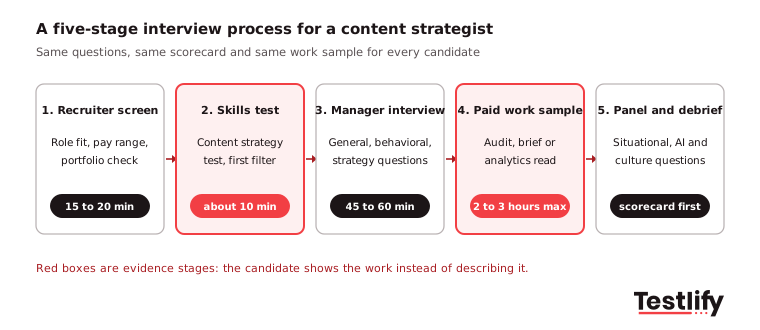
- Recruiter screen: Confirm role fit, pay range and a portfolio with measured results. 15 to 20 minutes.
- Skills test: Send a content strategy assessment before any interview. Testlify's Content Strategy test is 10 questions in about 10 minutes and covers using content for conversion, findability and distribution, and measuring performance.
- Hiring manager interview: Use the general, behavioral and strategy questions above, the same core set for everyone.
- Paid work sample: One task from the previous section, capped at two to three hours.
- Panel and debrief: Situational, AI and culture questions with cross-functional peers, then a debrief where everyone submits scores before discussion.
Speed matters. The US Bureau of Labor Statistics projects marketing manager jobs will grow 6% from 2025 to 2035, faster than average, so strong content leaders often weigh several offers.
A structured interview with fixed stages lets you move fast without skipping evidence.
How do you score answers to content strategist interview questions?
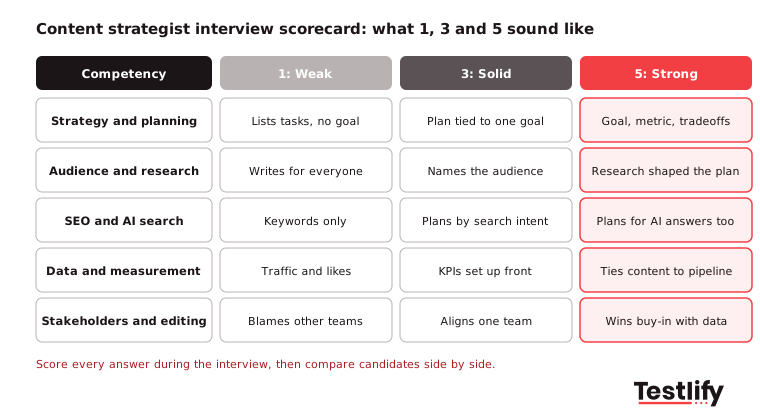
Score answers to content strategist interview questions for judgment, evidence and results, not confident delivery. A strong answer names a real situation, a decision and a measured outcome, and shows the candidate asked for data before acting.
Rate each competency on the same 1 to 5 scale during the interview, never from memory afterward.
How to tell answers apart:
- Strong answers tie every choice to a goal and a metric. Weak ones list tasks with no outcome.
- Strong candidates ask clarifying questions before answering a scenario. Weak ones jump to a template answer.
- Strong candidates talk about audience and data. Weak ones talk only about output volume.
- Strong candidates own a failure and what they changed. Weak ones have never seen a piece underperform.
Key takeaway: Give every candidate the same core questions, the same skills test and the same work sample, then compare scores side by side. An interview scorecard filled in during the interview reduces bias and makes the debrief about evidence, not impressions.
What are the red flags in content strategist interviews?
The biggest red flag in a content strategist interview is a candidate who talks about content without ever mentioning a goal, an audience, or a number. Watch for strategy that lives only in slides, a portfolio with no measured results, and answers that blame teams or tools for every past failure.
- No metrics appear anywhere in their answers, or only vanity metrics like likes and page views.
- They cannot say how they would measure success in your role.
- They treat content strategy as a publishing calendar and nothing more.
- They have never updated, merged or retired underperforming content.
- They describe SEO as keyword stuffing or a one-time checklist.
- They have no rules for AI use, or use it for facts nobody checks.
- They dismiss data, sales or other stakeholders as someone else's job.
For red flags that apply to any role, see our guide to interview red flags.
Hire content strategists based on proven skills
See how candidates audit content, plan topics and read data before you spend hours interviewing. Combine the content strategy test with SEO, writing and marketing tests from the Testlify test library of 3,500+ tests.
Try it free for 7 days with no credit card. Book a demo to see how it fits your hiring workflow.
Frequently asked questions (FAQs)

Director of Marketing
Akash Patange is the Director of Marketing at Testlify, where he works closely with HR leaders and recruiters to help organizations improve hiring outcomes. He writes about talent assessment, recruitment technology, and data-driven hiring practices.
LinkedInRelated resources
View all
HR & recruitment
45 Graphic Designer interview questions to ask job applicants

HR & recruitment
45 Operations Manager interview questions to ask job applicants

HR & recruitment
40 social media management interview questions for 2027

HR & recruitment
50 financial analyst interview questions

HR & recruitment
40 account management interview questions and answers

HR & recruitment
45 Content Writer interview questions to ask job applicants
Get started.
Hire on proof, not resumes.
Run your first skills-based assessment free — no credit card required.