
40 social media management interview questions for 2027
Forty interview questions for social media manager hires, grouped by skill, with listen-fors, red flags, a scorecard and a work sample.

Social media management interview questions test whether a candidate can run a brand's channels as a business function: set goals, plan content, manage a community, handle a crisis, read the data and report results to leaders. The best ones ask for real examples and numbers, not opinions about favorite platforms.
This list gives your hiring panel 40 questions grouped by skill, what a strong answer includes, the red flags to note, a 1 to 5 scorecard and a short work sample task. Use it alongside a clear social media manager job description so every interviewer tests the same things.
TL;DR:
- The best social media management interview questions ask for a real example, the goal behind it, the action taken and a measured result.
- Test six areas: strategy, content and platforms, community and crisis, analytics, paid social and influencers, and leadership.
- Strong candidates tie social metrics to revenue, pipeline or retention. Weak ones stop at followers and likes.
- Ask about AI tools, social search and FTC disclosure rules. Most question lists online still skip all three.
- Score each answer alone on a 1 to 5 scale before the debrief, so the loudest interviewer does not set the result.
- Run a skills test before the interview and a short work sample after it. Use interview time for judgment, not facts a test can check.
 ChatGPT
 Gemini
 Claude
 Grok
 Perplexity
What should social media management interview questions test?
Social media management interview questions should test six skill areas: strategy, content and platform knowledge, community and crisis handling, analytics and reporting, paid social and influencer work, and leadership. A manager-level hire needs all six. A coordinator needs mostly content and community, so trim the list for junior roles.
Skill area | What good looks like | Questions | Best tested by |
|---|---|---|---|
Strategy and planning | Goals linked to business results, clear audience and channel choices | 1 to 6 | Interview |
Content and platforms | Platform-native formats, steady brand voice, sensible use of AI tools | 7 to 12 | Portfolio and work sample |
Community and crisis | Calm written replies, clear escalation path, account security | 13 to 18 | Interview and role play |
Analytics and reporting | Picks the right metrics, explains what changed and why | 19 to 24 | Skills test and work sample |
Paid social and influencers | Budget control, testing, disclosure rules | 25 to 29 | Interview |
Experience and leadership | Real results, team and agency management, stakeholder trust | 30 to 40 | Interview and references |
Key takeaway: Facts and tool knowledge are cheaper to check with a skills test. Keep interview time for judgment, trade-offs and past results.

Which strategy and planning questions should you ask?
Strategy and planning questions show whether the candidate starts from a business goal or from a posting calendar. Listen for goals, audiences and channel choices that connect to revenue, pipeline, retention or hiring, not just reach.
1. How would you audit our social channels in your first 30 days?
Listen for: a review of past performance, audience data, competitor accounts and brand guidelines, followed by a short list of priorities.
2. Walk me through a social strategy you built from scratch. What was the business goal?
Listen for: a goal stated in business terms, the audience, the chosen channels and how progress was measured.
3. How do you decide which platforms a brand should be on, and which to leave?
Listen for: audience fit and resource limits. Strong candidates are willing to drop a channel that does not earn its time.
4. How do you balance organic and paid social in a plan?
Listen for: organic for community and trust, paid for reach and testing, with budget tied to goals.
5. How do you set targets for a new channel with no history?
Listen for: benchmarks from similar accounts, a short test period, then targets that are realistic but still stretch.
6. What would you stop doing on our current accounts, and why?
Listen for: specific, respectful critique that shows they studied your channels before the interview.
These social media management questions are also useful for a social media strategist hire, where strategy carries more weight than daily posting.
Which content and platform questions should you ask?
Content and platform questions check whether the candidate can make content that fits each platform and still sounds like one brand. In 2026 they should also cover AI writing and design tools and social search, because many people now search on TikTok, Instagram and YouTube before they search on Google.
Platform choice matters because audiences differ. According to the Pew Research Center's 2026 social media fact sheet, 84% of US adults use YouTube, 70% use Facebook, 51% use Instagram, 37% use TikTok and 31% use LinkedIn. A B2B brand and a consumer brand should not run the same mix.
1. How do you keep one brand voice across LinkedIn, Instagram and TikTok?
Listen for: a written voice guide, examples of the same message adapted per platform, and a review step.
2. Which content formats are working best on each platform right now?
Listen for: current, platform-specific detail such as short video, carousels or live sessions, backed by their own results.
3. How do you use AI tools in your content process, and where do you draw the line?
Listen for: AI for drafts, ideas and resizing, with human editing, fact checks and brand review before anything goes live.
4. How do you write posts so people find them through search on social platforms?
Listen for: keywords in captions and on-screen text, clear titles, alt text and hashtags used for discovery, not decoration.
5. How do you plan a content calendar, and how much room do you leave for trends?
Listen for: planned pillars with space for reactive posts, plus a rule for which trends fit the brand.
Show me a post you made that underperformed. What did you change? Listen for: honest diagnosis, a test and a measured fix.
Pro tip: Ask candidates to bring two or three posts they made and the numbers behind them. A portfolio without results tells you about design taste, not management skill.
Which community and crisis management questions should you ask?
Community and crisis management questions show how the candidate behaves in public, in writing and under pressure. Every reply is on record and can be screenshotted, so the panel should listen for calm tone, a clear escalation path and a habit of moving complaints to private messages.
1. A customer posts an angry complaint that starts to spread. What do you do in the first hour?
Listen for: acknowledge quickly, move details to private messages, loop in support and legal where needed, and avoid deleting criticism.
2. When should a comment be hidden or deleted, and when should it stay?
Listen for: clear rules for spam, abuse and personal data, and a default of leaving fair criticism visible.
3. Who signs off on a public statement during a crisis?
Listen for: a pre-agreed approval chain with communications, legal and leadership, and holding replies ready to go.
4. How do you protect brand accounts from being hacked or misused?
Listen for: two-factor authentication, shared password managers, role-based access and a plan for regaining a locked account.
5. How do you turn community feedback into product or service changes?
Listen for: tagging and summarizing themes, sharing them with the right teams and closing the loop publicly.
6. Tell me about a post that went wrong. What did you learn?
Listen for: ownership, a fix and a process change, not blame.
The crisis management test can check crisis judgment before the interview, so the panel can spend this section on the candidate's own examples.
Which analytics and reporting questions should you ask?
Analytics and reporting questions separate managers who report activity from managers who report impact. A strong candidate picks a few metrics per goal, explains what moved them and turns the data into a decision leadership can act on.
1. Which metrics do you report to leadership, and which do you keep for the team?
Listen for: business metrics such as leads, sales or sign-ups for leaders, with engagement and reach used inside the team.
2. How do you show the return on social media spend?
Listen for: UTM links, platform and web analytics, CRM data and an honest view of what attribution can and cannot prove.
3. Engagement dropped 30% last month. How would you find out why?
Listen for: checking platform changes, content mix, posting times and audience shifts before changing anything.
4. Which analytics and listening tools have you used, and what did you use them for?
Listen for: real use cases, not a list of tool names.
5. Describe an A/B test you ran on social. What did you test and what happened?
Listen for: one variable at a time, a sample big enough to read and a decision made from the result.
6. How do you build a monthly report that leaders actually read?
Listen for: one page, the three numbers that matter, what changed and what happens next.
Which paid social and influencer questions should you ask?
Paid social and influencer questions test budget control, testing discipline and legal awareness. A manager who runs creator partnerships should know that the FTC expects a clear disclosure of any paid or free-product relationship, placed where people will see it.
1. How do you split a paid social budget across platforms and campaigns?
Listen for: allocation by goal and past cost per result, a test budget, and weekly checks.
2. What do you look at when a paid campaign is not hitting its cost per lead target?
Listen for: audience, creative, offer and landing page checked in order, with one change at a time.
3. How do you vet an influencer or creator before you sign them?
Listen for: audience location and quality, fake follower checks, past brand work and values fit.
4. What disclosure rules do creators need to follow on sponsored posts?
Listen for: clear words such as "ad" or "sponsored" placed with the post itself, not buried in hashtags or the profile.
5. How do you measure whether an influencer partnership was worth it?
Listen for: unique codes or links, reach in the right audience and cost compared with paid social.
Which behavioral questions reveal real experience?
Behavioral questions ask the candidate to describe what they actually did in a past situation. Ask for the situation, the task, the action and the result (the STAR method), and press for numbers. These social media management questions work for any level and expose candidates who only talk in general terms.
1. Tell me about your most successful campaign. What was the goal and the result?
Listen for: clear campaign objectives, audience targeting, platform selection, content strategy, engagement metrics, and measurable results. Strong candidates explain what made the campaign successful and how their contribution influenced the outcome.
2. Describe a time you had to win a stakeholder over to a new platform or idea.
Listen for: persuasive communication, data-backed recommendations, understanding stakeholder concerns, handling resistance, and the ability to demonstrate the business value of a proposed strategy.
3. Tell me about a time you missed a target. What did you do next?
Listen for: accountability, honest reflection, root-cause analysis, willingness to experiment, and corrective action. Look for candidates who explain what they learned and how they improved subsequent campaign performance.
4. Describe a time you managed several brands or accounts at once. How did you prioritize?
Listen for: time management, organizational skills, content calendar management, prioritization frameworks, and the ability to balance competing deadlines without compromising content quality.
5. Tell me about a time you worked with design, product or sales on a launch.
Listen for: cross-functional collaboration, clear communication, understanding of brand messaging, coordination across teams, and the ability to align social media content with broader launch objectives.
6. Describe a time you had to deliver under a very tight deadline. What did you cut?
Listen for: decision-making under pressure, prioritization, adaptability, and resource management. Strong candidates explain what they prioritized, what they deprioritized, and how they maintained quality while meeting the deadline.
Which leadership questions fit a manager-level hire?
Leadership questions matter when the role owns a budget, a team or an agency. A social media manager at a mid-market or enterprise company spends as much time on planning, approvals and reporting as on posting, so test those skills directly.
1. How have you managed an agency or freelancers? How did you hold them to results?
Listen for: clear briefs, agreed metrics and regular reviews.
2. How do you build an approval process that is fast but safe?
Listen for: tiers of approval by risk, with routine posts approved by the team and sensitive posts escalated.
3. How do you coach a junior team member whose content is not landing?
Listen for: specific feedback, examples and a short plan with check-ins.
4. How do you protect your team from burnout in an always-on role?
Listen for: scheduling tools, rotas for out-of-hours monitoring and clear rules on what needs a reply after hours.
5. What would you need from us in your first 90 days to succeed?
Listen for: access, budget, brand guidelines and a named sponsor. The answer also tells you what support the candidate expects.
What does a strong answer sound like?
A strong answer to a social media management interview question names a goal, explains the action and gives a measured result. Here are three examples for the panel to compare against.
Question 2, a strategy built from scratch: "Our goal was demo requests from mid-size retailers. I moved most effort from Instagram to LinkedIn, posted three customer stories a week and added a lead form. Demo requests from social went from about 10 to 35 a month in two quarters." Look for: the business goal first, a channel decision and a number.
Question 13, a spreading complaint: "I replied publicly within 20 minutes, said we were looking into it and asked the customer to message us. Support fixed the order that day and the customer posted an update. I then wrote a short guide so the team could reply the same way next time." Look for: speed, a private follow-up and a process change.
Question 20, return on spend: "I tag every link with UTMs, track sign-ups in our CRM and compare paid cost per sign-up with other channels. I also tell leaders what we cannot track, such as dark social sharing." Look for: real tracking, a comparison and honesty about limits.
What red flags should the panel watch for?
Red flags are patterns that show a candidate will struggle in a manager-level role, even if their content looks good. Note them on the scorecard as evidence, not as a gut feeling. The LinkedIn Talent Solutions interview guide for the role makes a similar point: look for measurable results and calm, written de-escalation.
- Followers as the only measure of success: Growth without leads, sales or retention is not a business result.
- No numbers in any example: Every manager should know the results of their own campaigns.
- Deleting criticism by default: Screenshots last forever, and deleting fair complaints often makes a crisis worse.
- "We" with no "I": The candidate cannot say what they personally did.
- Plans to automate everything: Scheduling helps, but replies and community work need a person.
- No account security habits: One hacked brand account can cost more than a year of content.
How do you score social media management interview questions fairly?
Score social media management interview questions with a shared 1 to 5 scale and written anchors for 1, 3 and 5. Each interviewer scores every answer alone, with a note of the evidence, before the debrief. A structured interview like this makes candidates easier to compare and keeps one strong opinion from deciding the hire.
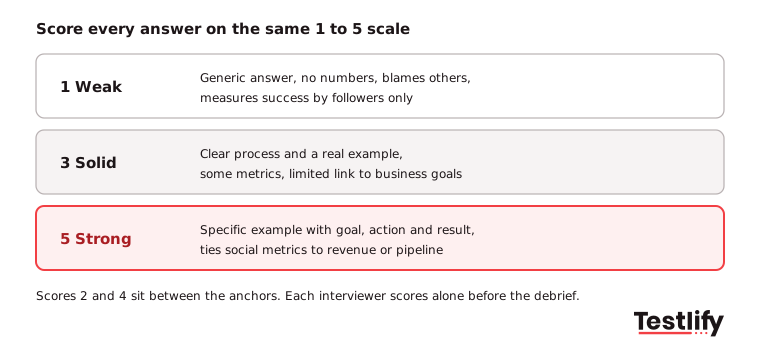
We have seen panels agree far more often when they score alone first and then discuss the gaps, rather than starting with an open conversation. Weight the skill areas by role: for a manager, give strategy and analytics more weight than daily content work.
Which work sample task should you add?
A work sample task asks the candidate to do a small piece of the real job, such as planning a week of posts for a product launch or replying to three sample comments. Keep it under 90 minutes, or pay for anything longer, and score it with the same 1 to 5 scale.
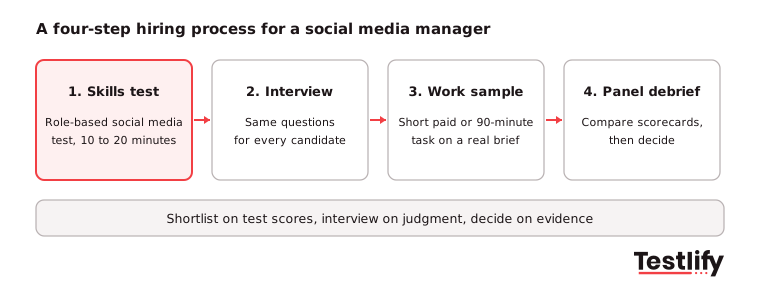
Put a skills test before the interviews so the panel only meets people who already have the basics. Skills-first screening also widens the pool. According to LinkedIn Economic Graph research published in March 2025, a skills-based approach expands talent pools by a median 6.1x globally and 15.9x in the United States.
Good work sample tasks for this role:
- Launch plan: One week of posts across two platforms for a real or sample product, with goals and metrics.
- Reply drill: Draft replies to three comments: a fair complaint, a troll and a sales question.
- Report review: Read a one-page analytics export and write three findings and one recommendation.
- Creator brief: Write a brief for an influencer, including the disclosure wording.
How does Testlify help you hire a social media manager?
Testlify helps hiring teams shortlist social media managers on proof of skill before anyone books an interview. Candidates take a role-based test, the platform scores every answer, and the panel gets a ranked shortlist with a per-skill breakdown.
- Ready-made tests: The social media management test and the social media manager test are short intermediate-level tests (about 10 and 20 minutes) covering strategy, content, campaign management, analytics, media planning and customer interactions. Combine them with any of the 3,500+ tests in the library, such as communication or Canva.
- Custom questions: Add your own work sample with 25+ question types, including file upload, video answers and open-ended tasks.
- AI interviews: Run a structured first round by video, voice or chat, with every answer scored against the same criteria.
- Fair and secure: 20+ proctoring checks, including AI assistance detection, keep results honest. Explore Testlify's anti-cheating and proctoring features in detail.
- Fits your stack: Results sync to 100+ ATS and HRIS tools through Testlify integrations.
For the full hiring process, from sourcing to offer, read the social media manager hiring guide. Hiring for a junior role instead? Use the social media coordinator questions.
Ready to hire your next social media manager?
Send the social media management test to your next applicants and interview only the people who pass. Start a 7-day free trial of Testlify, no credit card required, or book a demo to see the test and scorecard on your own role.
Frequently asked questions

Director of Marketing
Akash Patange is the Director of Marketing at Testlify, where he works closely with HR leaders and recruiters to help organizations improve hiring outcomes. He writes about talent assessment, recruitment technology, and data-driven hiring practices.
LinkedInRelated resources
View all
HR & recruitment
50 financial analyst interview questions

HR & recruitment
40 account management interview questions and answers

HR & recruitment
45 Content Writer interview questions to ask job applicants

HR & recruitment
45 Talent Acquisition Specialist interview questions to ask job applicants

HR & recruitment
45 UI/UX Designer interview questions to ask job applicants.

HR & recruitment
Customer Success Representative Interview Questions (2026 Guide)
Get started.
Hire on proof, not resumes.
Run your first skills-based assessment free — no credit card required.