
Testlify vs BryQ: A detailed comparison
Discover the perfect solution for evaluating your candidates’ skills with Testlify. Dive into our comprehensive Testlify vs Bryq comparison…
 ChatGPT
 Gemini
 Claude
 Grok
Grok Perplexity
Bryq alternatives: which software fits your hiring?
Testlify and Bryq both score candidates before anyone books an interview, but they are built on opposite ideas. Testlify hands you a library of 3,500+ tests to assemble per role, each scored separately. Bryq runs one sitting of about 30 minutes and returns a single match score against a profile it builds for the job. Depth in a named skill points to Testlify. One tidy number per candidate points to Bryq.
Trusted by 1,500+ hiring teams from fast-scaling startups to enterprise TA functions
TL;DR
- Testlify is a modular test library. You choose which tests a role needs, and you read the results test by test.
- Bryq is a single integrated assessment. It scores cognitive ability, behaviour and role skills in one session and ranks candidates by fit.
- Both cover cognitive and personality testing. The real split is coding and video interviews (Testlify) against one blended fit score and AI fluency (Bryq).
- Pricing works in opposite directions: Testlify bills per candidate credit, Bryq bills a flat subscription with unlimited assessments.
- High-volume screening on a fixed budget favours a flat plan. Deep technical hiring favours the bigger library.

How does Testlify compare to Bryq?
The honest answer is that these two products barely compete on the same axis. One is a catalogue. The other is a verdict.
Testlify works like a toolkit. A hiring team picks a coding test, adds a situational judgement test, maybe a typing test for a support role, and reads each score on its own. That granularity is the point: you can see that a candidate is strong on SQL and weak on written communication, and decide what matters for the job.
Bryq compresses that into one measurement. It builds what it calls an Ideal Candidate Profile from the job requirements, then scores every applicant against it and hands back a ranked list. Cognitive ability, behavioural traits and role skills all fold into one composite. Less to interpret, less to argue about in a debrief, and less to inspect when a hiring manager asks why a candidate placed where they did.
Neither approach is automatically better. They fail differently. A catalogue lets a team assemble a battery that quietly tests the same trait three times. A single blended score makes it hard to tell whether a candidate landed at 72 because they reason well and communicate poorly, or the reverse.
What makes Testlify different from Bryq?
Four differences actually change how a hiring week runs.
Library depth. Testlify carries 3,500+ tests mapped to 4,500+ roles, including coding assessments across 45+ programming languages. Bryq runs a core cognitive and personality assessment plus a library of 140+ skill tests. If the role is a backend engineer and the question is whether they can actually write Go, that gap decides it.
Interview and proctoring surface. Testlify includes one-way video interview questions and about 20 anti-cheat measures spanning identity checks, browser lockdown, session recording and AI monitoring. Bryq keeps the assessment short and self-contained and does not position itself as a video interviewing product.
Scoring philosophy. Covered above, and it is the difference most teams underrate until their first calibration meeting.
AI fluency. Bryq measures how candidates work with AI tools as a scored dimension. Testlify tests AI and technical skills through its library rather than as one named fluency score. For a team hiring people who will spend all day alongside AI tooling, that is a genuine point in Bryq's favour, and pretending otherwise would not help anyone choose.
Both platforms hold SOC 2 and ISO 27001 certification and operate under GDPR.
This is where the Testlify Multi-Signal Talent Evaluation Model comes in. The model combines multiple role-relevant signals, including assessments, interviews, simulations, references and reviewer feedback, to help teams make more confident hiring decisions. One signal is fragile. Several pointing the same way is confidence. The practical read: a single composite score is one signal wearing the costume of many, and it is worth knowing which one you bought.
The research backs the multi-signal instinct. In a 2022 reanalysis of decades of selection data, published in the Journal of Applied Psychology and summarised by the Society for Industrial and Organizational Psychology, structured interviews came out at an operational validity of .42, job knowledge tests at .40, work samples at .33 and cognitive ability at .31. No single method dominates. Cognitive ability, long treated as the anchor, sits fourth.
Pro Tip: before comparing feature lists, write down the two skills that actually sink your bad hires. If they are technical and specific, buy library depth. If they are judgement and fit, buy the integrated profile. Most teams shop the other way round and then blame the tool.
Feature-wise comparison for Testlify vs Bryq
Feature grids in this category are usually written to make the host look good. The table below only lists capabilities both vendors describe publicly, and it marks Bryq present where Bryq is genuinely present, including on cognitive and psychometric testing, which older versions of this comparison got wrong.
Capability | Testlify | Bryq |
|---|---|---|
Core model | Modular library, tests scored separately | One integrated session, single composite match score |
Test library size | 3,500+ tests across 4,500+ roles | 140+ skill tests plus core cognitive and personality |
Cognitive ability testing | Yes | Yes, covering attention to detail, logical, numerical and verbal reasoning |
Personality and psychometric testing | Yes | Yes, built on the 16PF and OCEAN models |
Coding and technical tests | Yes, 45+ programming languages | Not a coding assessment platform |
One-way video interview questions | Yes | Not offered |
Scored AI fluency dimension | Tested through the skills library | Yes, as a named scored dimension |
Proctoring and anti-cheat | About 20 measures across identity, environment, lockdown and AI monitoring | Standard assessment controls |
Typical candidate time | 40 to 60 minutes for an assembled battery | About 30 minutes in one sitting |
ATS integrations | 100+ integrations | 25+ ATS platforms including Greenhouse, Lever, Workday and iCIMS |
Pricing model | Per candidate credit, plan based | Flat subscription, unlimited assessments |
Security and compliance | SOC 2 Type II, ISO 27001, GDPR | SOC 2, ISO 27001, GDPR |
Two rows deserve a caveat. Proctoring depth is hard to compare like for like, because vendors count measures differently. And "not offered" means the vendor does not market the capability, not that it is impossible to work around with another tool in the stack.
How Bryq works?
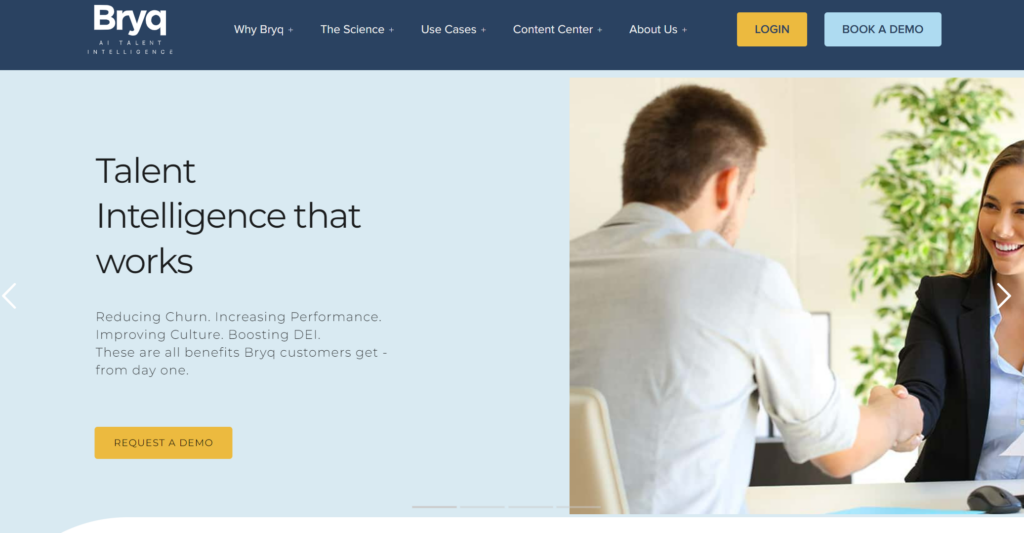
Bryq asks candidates to complete a short multiple-choice assessment, usually inside 30 minutes, presented in an interface that resembles a workplace chat tool rather than an exam. Questions arrive as messages from colleagues asking for input on a project.
Behind that, the platform scores four cognitive dimensions (attention to detail, logical reasoning, numerical reasoning and verbal reasoning), personality traits drawn from the 16PF and OCEAN frameworks, role skills from its test library, and practical AI fluency. Those feed the Ideal Candidate Profile match, and recruiters get a ranked shortlist with detail available underneath.
The design goal is speed and consistency: every candidate takes the same assessment, so comparisons are clean. The trade-off is configurability. A team that wants to test one narrow competency and nothing else is buying a lot of assessment it did not ask for.
Testlify vs Bryq: Pricing
This section used to say Bryq does not publish pricing. That is out of date, and the correction matters because the two billing models push budgets in opposite directions.
Bryq pricing
Bryq publishes a flat-rate subscription starting around $69 per month with unlimited assessments. Cost per candidate falls as volume rises, because the subscription does not move. A team screening 2,000 people pays what a team screening 200 pays.
Testlify pricing
Testlify bills per candidate credit. The Standard plan runs $139 per month billed annually, which is $1,668 per year and includes 100 credits, with additional credits at $21 and extra seats at $15 per seat per month. A credit is consumed when a candidate starts, not when you invite them. There is a 7 day free trial with no card required and a 30 day money-back guarantee, and a Custom plan covers teams assessing 25,000+ candidates a year. Current figures live on the Testlify pricing plans page.
The maths is not subtle. Credit pricing is cheaper when hiring is spiky and you assess a few hundred people a year, and it rewards you for screening precisely. Flat pricing is cheaper at volume and easier to defend in a budget meeting, because the number does not move when a req count doubles. Work out your realistic annual assessed-candidate count first, then compare. Doing it in the other order is how teams end up surprised in month four.
Which platform should you choose?
Choose Testlify when the roles are technical or specialised, when you need to see individual skill scores rather than a blended one, when video responses matter, or when proctoring rigour has to survive scrutiny. The breadth of the test library is the reason to be here.
Choose Bryq when you screen high volumes of similar roles, when a fixed annual number beats variable cost, when you want one ranked list instead of a scoring debate, and when AI fluency is a hiring criterion you want measured directly. If neither shape fits, the wider field of talent assessment tools worth shortlisting is a reasonable next stop.
There is a third answer that vendors rarely give: if the thing sinking your hires is an unstructured interview loop, neither purchase fixes it. Assessment quality feeds a decision that still gets made by people in a room. Gallup put global employee engagement at 20% in 2025 and estimated the cost of low engagement to the world economy at about $10 trillion, roughly 9% of GDP, in its State of the Global Workplace research. Screening tools are upstream of that, not a cure for it.
Skill requirements are also moving under both platforms. The World Economic Forum's Future of Jobs Report 2025 found employers expect 39% of workers' core skills to change by 2030, down from 44% in 2023. Whichever platform you pick, the tests you configure this year will need revisiting. A library you can edit and a profile you can retune are both fine answers, as long as somebody owns the job of doing it. Worth checking, too, how each vendor handles a role definition changing mid-quarter, because that is the real maintenance cost and it never appears on a feature grid.
Hire on proof, not resumes
Run a real assessment on a live role and compare the shortlist to the one your current process produced. That comparison settles the question faster than any feature table. Start free with a 7 day trial, no card required, or book a demo and bring a job description you are struggling to fill.
Key takeaways
- The scoring model is the decision, not the feature count. Testlify reports each test separately and Bryq blends everything into one match score. That single choice shapes every debrief you run for the next two years, because a team can only argue about evidence it can see. Decide which shape of evidence your hiring managers will actually trust before you compare anything else.
- Both platforms test cognitive ability and personality. Older comparisons on this page marked Bryq absent on both, which was wrong. Bryq scores four cognitive dimensions and uses the 16PF and OCEAN personality models, so a team choosing between them is not trading psychometric rigour for anything.
- Coding and video are the honest dividing line. Testlify covers 45+ programming languages and one-way video interview questions. Bryq does not market either. If you hire engineers, that alone likely settles the shortlist, and no amount of scoring elegance compensates for not being able to test the skill.
- Pricing models reward opposite behaviour. Credit billing rewards precise, selective screening. Flat subscription billing rewards volume. Model your realistic annual assessed-candidate count against both before you talk to either sales team, because the cheaper option flips somewhere in the middle and the crossover is specific to you.
- No single assessment method carries a hire. The 2022 validity reanalysis put structured interviews at .42 and cognitive ability at .31, which means the platform is one input among several. Pair whichever you buy with a structured interview and a reference step, or you have bought precision at the top of a funnel that still leaks at the bottom.
- Plan for the tests going stale. With 39% of core skills expected to change by 2030, whichever configuration you ship this quarter needs an owner and a review date. Tools do not maintain their own relevance, and a role profile nobody has touched in eighteen months quietly stops predicting anything.
FAQs
Related resources
View all
Competitor Comparisons
Testlify vs Crystal: A detailed comparison
Competitor Comparisons
Testlify vs Equalture: A detailed comparison
Competitor Comparisons
Testlify vs Moodle: A detailed comparison
Competitor Comparisons
Testlify vs SuccessFinder: A detailed comparison
Competitor Comparisons
Testlify vs Reveal: A detailed comparison
Competitor Comparisons
Testlify vs AssessFirst: A detailed comparison
Get started.
Hire on proof, not resumes.
Run your first skills-based assessment free — no credit card required.