
Testlify vs Crystal: A detailed comparison
Discover the perfect solution for evaluating your candidates’ skills with Testlify. Dive into our comprehensive Testlify vs Crystal Knows…
Testlify and Crystal look like competitors on a search results page, but they answer two different questions. Crystal predicts how a person probably communicates so you can adapt your pitch or your interview style. Testlify measures whether that person can actually do the job. If you are choosing one to decide who gets hired, Testlify is the tool built for that decision.
That distinction matters more than any feature checklist, because buying the wrong category is the expensive mistake here. A team that swaps a skills assessment for a personality profile ends up with a shortlist it cannot defend. A team that expects Testlify to write a tailored sales email will be disappointed too.
 ChatGPT
 Gemini
 Claude
 Grok
Grok Perplexity
TL;DR
- Crystal reads public data and questionnaires to estimate personality style, then coaches you on how to talk to that person. It is a communication tool, not a hiring filter.
- Testlify measures job-relevant skills with role-based tests, cognitive and coding assessments, and structured interviews, then scores candidates against the same bar.
- Personality style is a poor basis for a hire or no-hire call. Skills evidence and structured interviews predict on-the-job performance far better.
- Crystal does not publish pricing. Testlify publishes plans and bills monthly or annually.
- Plenty of teams run both: Testlify decides who advances, Crystal helps the interviewer or the account manager prepare for the conversation.

What is Crystal and who is it for?
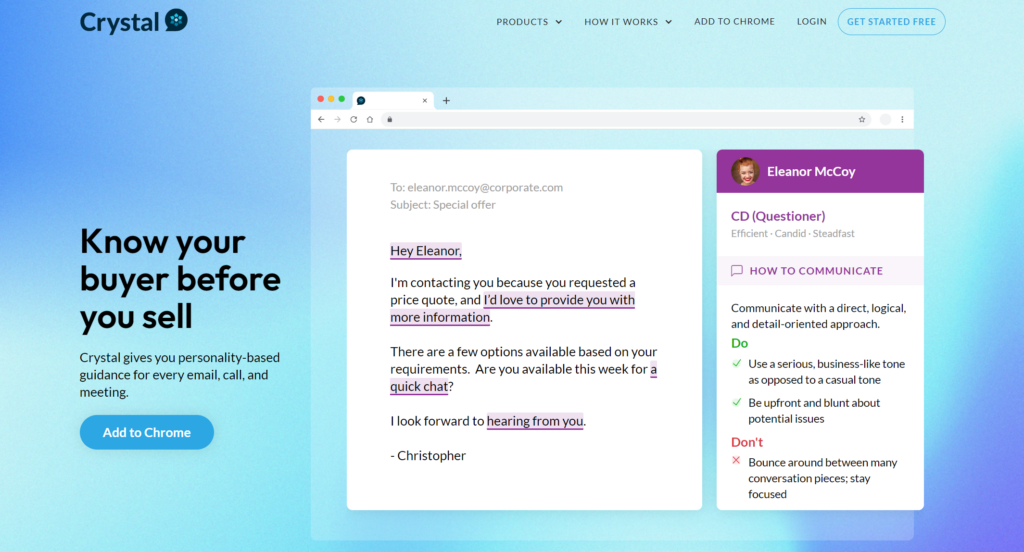
Crystal is a personality platform that estimates someone's communication style, usually along DISC lines, from public profiles and questionnaires. It then suggests how to email, pitch, negotiate, or run a meeting with that person. Sales teams, recruiters preparing outreach, and managers preparing a difficult conversation are its core users.
Its strength is preparation. Before a first call with a stranger, a one-page read on whether they want the detail or the summary is genuinely useful. Crystal is built around that moment, and it is good at it.
The limits are worth naming just as plainly. Crystal infers traits rather than measuring performance, so it cannot tell you whether a candidate can write SQL, handle an angry customer, or size a project. It also does not run proctored tests, so nothing it produces is evidence you could show a regulator or a hiring committee.
What is Testlify and who is it for?
Testlify is a pre-hire talent assessment platform. Hiring teams use it to screen candidates on job-relevant skills before the first interview, using more than 1,000 ready-made tests plus custom ones, cognitive and personality assessments, coding and live-coding tasks, language and software tests, AI interviews, and proctoring controls.
The buyer is usually a talent acquisition lead or a hiring manager with too many applicants and no reliable way to rank them. Resume screening does not scale honestly at that volume, and neither does a gut-feel phone screen.
Testlify sits in one slice of the stack and stays there. It is not an applicant tracking system, an HRIS, or a background-check vendor. It integrates with those and handles the screening and assessment step.
Testlify vs Crystal: feature comparison
The table below compares what each platform actually does. Blank cells are not criticism, they reflect that these products were designed for different jobs.
Capability | Testlify | Crystal |
|---|---|---|
Primary job | Measure job-relevant skills | Estimate communication style |
Role-specific skills tests | Yes, 1,000+ templates | No |
Cognitive ability tests | Yes | No |
Coding and live coding | Yes | No |
Personality and behavioral assessment | Yes, candidate-completed | Yes, largely inferred |
Language and software skills tests | Yes | No |
AI interviews and video responses | Yes | No |
Proctoring and anti-cheating | Yes | No |
Candidate scoring and benchmarks | Yes | No |
Multiple reviewer scoring | Yes | No |
Communication and pitch coaching | No | Yes |
Personality insight from public profiles | No | Yes |
Email and meeting playbooks | No | Yes |
ATS integrations | Yes | Limited |
White-label and custom branding | Yes | No |
Public pricing | Yes | No |
Built for hire or no-hire decisions | Yes | Not recommended |
Read the last row twice. It is the only one that changes a buying decision.
Which tool should you use, and when?
Use Testlify when the output has to survive scrutiny: ranking 300 applicants, defending a shortlist to a hiring committee, or proving that two candidates were measured the same way. Use Crystal when the output is a conversation: preparing for a call, adapting a pitch, or coaching a manager before a review.
If the job to be done is | Reach for | Why |
|---|---|---|
Screening 50 or more applicants for one role | Testlify | Scores everyone against the same bar before anyone spends interview time |
Proving a shortlist was built consistently | Testlify | Produces scored, reviewable evidence per candidate |
Testing a specific technical skill | Testlify | Role tests, coding tasks, and live coding measure the work itself |
Preparing for a first sales call | Crystal | Style estimate from public data helps tailor the opening |
Coaching a manager before a review | Crystal | Communication guidance is the product, not a by-product |
Deciding who gets the offer | Testlify | Skills evidence is defensible, inferred personality is not |
The pattern behind that table is simple enough to apply without it: if the answer changes who advances, it needs measured evidence. If the answer changes how you talk to someone, a style read is fine. This is the same logic behind skills-first screening, which ranks people on demonstrated ability rather than on proxies.
The reason to keep personality inference away from the hire or no-hire call is not squeamishness, it is accuracy. A 2022 review of selection research in Industrial and Organizational Psychology recalculated the predictive validity of widely used hiring methods and put structured interviews and job-relevant work samples at the top, while revising general mental ability down to about r = .31 under stricter corrections. Broad personality style did not come out ahead of either. The Society for Industrial and Organizational Psychology walked through what those revised numbers mean for practitioners.
Testlify's own read on the underlying question is in this breakdown of whether DISC belongs in hiring, and the short version is that style tells you how someone prefers to work, not whether they can do the work.
Pro Tip: if a personality profile is already in your process, move it after the skills assessment and label it as interview preparation, not as a screening filter. The ranking stays defensible, and the interviewer still gets the context they wanted.
How do the pricing models compare?
Crystal does not publish pricing. You contact them for a quote, which makes budgeting harder and makes a like-for-like cost comparison impossible from the outside.
Testlify publishes its plans, and they bill monthly or annually with a free trial to start. For a hiring team, the practical difference is that one cost can be modelled against expected hiring volume before a single call, and the other cannot.
Cost per assessment is the wrong number to optimise anyway. SHRM research on skills assessments in hiring found that 54% of organizations use pre-employment assessments, and 78% of those say the assessments improved quality of hire, while 36% report a longer time to fill. Those three figures together are the real trade: better hires, slightly slower process, and the slower part is usually fixable by running the test before the first interview instead of after it. The same research reports that a further 25% of employers plan to expand pre-hire assessment use.
Set against a bad hire, the arithmetic is not close. Replacing someone who was screened on impressions rather than evidence costs weeks of recruiter time, a second interview loop, and the ramp that never paid back. A single avoided mis-hire usually covers a year of assessment tooling, which is why the case for pre-employment testing tends to be made on quality rather than on licence cost.
Can you use both together?
Yes, and it is a sensible setup for teams that sell as well as hire. Testlify handles screening and scoring so the shortlist is built on evidence. Crystal then helps whoever runs the final interview or the client handover prepare for the human on the other side.
The rule that keeps this clean: only one of them is allowed to affect who advances. The moment a personality read starts filtering candidates, the process loses the consistency that made it defensible in the first place.
This maps onto the Testlify Multi-Signal Talent Evaluation Model, which combines several role-relevant signals such as assessments, interviews, simulations, references, and reviewer feedback rather than resting a decision on any single one. One signal is fragile. Several pointing the same way is confidence. A communication-style estimate can be context around that evidence, but it is not one of the signals a decision should rest on.
The pressure to get this right is growing. The World Economic Forum's Future of Jobs Report 2025 found employers expect 39% of workers' core skills to change by 2030, and that 59% of the workforce will need training in that window. When the skills themselves keep moving, a static read on someone's personality ages badly, while a current, role-specific skills measurement does not. Their skills outlook chapter has the full breakdown.
Ready to assess real job skills?
If the goal is a shortlist you can defend, start with the skills. Testlify offers a free trial, so a role-specific assessment can be built and sent to candidates in an afternoon. To see how it would fit an existing hiring process, book a demo with the team.
Key Takeaways
- These are different categories, not rivals. Crystal estimates communication style, Testlify measures job-relevant ability. Treating them as substitutes is how teams end up with a shortlist they cannot justify, so pick based on the decision you are trying to make rather than on feature counts.
- Keep personality out of the hire or no-hire call. The 2022 revision of selection-method validity put structured interviews and work samples ahead of broad trait measures. Style tells you how someone prefers to work, which is useful for the interviewer and misleading as a filter.
- Order matters more than tooling. Running the skills assessment before the first interview is what recovers the 36% of teams who report assessments slowing time to fill. The test does the screening the phone screen was doing badly.
- Public pricing is a real differentiator here. Testlify publishes plans and bills monthly or annually. Crystal quotes on request, so hiring volume cannot be modelled against cost before a sales conversation.
- Running both is fine, with one rule. Only the skills evidence decides who advances. Personality context is for preparing the conversation, and the moment it starts filtering people, consistency is gone.
- Skills keep moving, so measure them fresh. With 39% of core skills expected to change by 2030, a role-specific assessment run this quarter says more than a trait profile captured once and reused for years.
FAQs
Related resources
View all
Competitor Comparisons
Testlify vs Equalture: A detailed comparison
Competitor Comparisons
Testlify vs Moodle: A detailed comparison
Competitor Comparisons
Testlify vs SuccessFinder: A detailed comparison
Competitor Comparisons
Testlify vs Reveal: A detailed comparison
Competitor Comparisons
Testlify vs AssessFirst: A detailed comparison
Competitor Comparisons
Testlify vs HR Avatar: A detailed comparison
Get started.
Hire on proof, not resumes.
Run your first skills-based assessment free — no credit card required.