
Testlify vs SuccessFinder: A detailed comparison
Discover the perfect solution for evaluating your candidates’ skills with Testlify. Dive into our comprehensive Testlify vs SuccessFinder…
The short answer: SuccessFinder is a behavioral assessment built to profile personality and career interests, and Testlify is a multi-skill assessment platform that measures behavior alongside coding, cognitive ability, software skills and situational judgment. If you need one behavioral profile, SuccessFinder fits. If you need to test what a candidate can actually do, you need a wider library.
Trusted by hiring teams from fast-scaling startups to enterprise talent acquisition functions. GDPR compliant. No credit card required to start.
 ChatGPT
 Gemini
 Claude
 Grok
Grok Perplexity
TL;DR
- SuccessFinder measures 26 behavioral competencies and 29 career interests through a single 300-question assessment that takes about 30 minutes.
- It does not offer coding tests, aptitude tests, software-skills tests or situational judgment tests, so technical and role-specific screening has to happen somewhere else.
- Testlify covers behavioral testing plus more than 1,000 role-specific tests, 45+ programming languages, proctoring and ATS integrations in one platform.
- SuccessFinder does not publish pricing and offers no free trial. Testlify publishes its plans openly.
- Pick SuccessFinder if a deep behavioral profile is the whole job. Pick a multi-signal platform if a hiring decision rests on more than personality.

What does SuccessFinder actually measure?
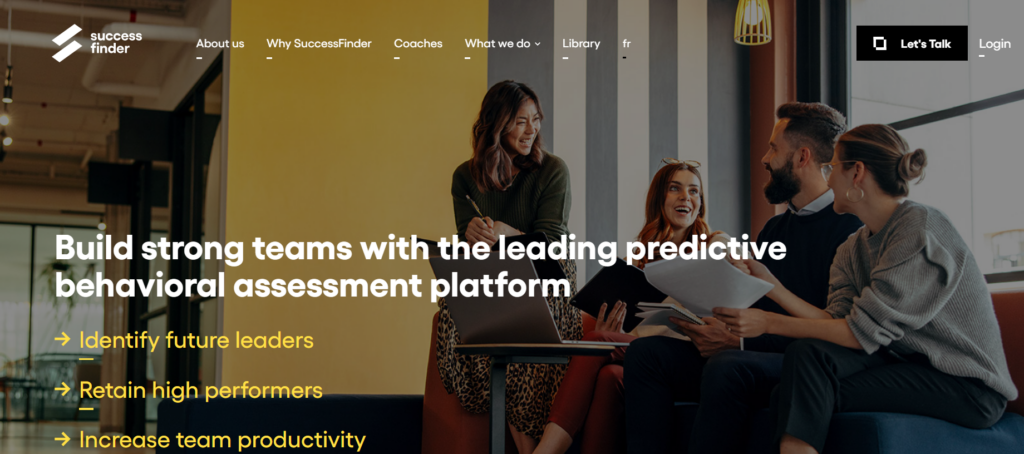
SuccessFinder builds psychometric assessments around a single behavioral profile. Its personality test scores 26 distinct behavioral competencies and maps 29 career interests, which gives a recruiter a readable picture of how someone prefers to work and what kind of role tends to hold their attention.
The assessment runs to 300 questions and takes roughly 30 minutes on any device. Candidates answer all of them, and employers get a report that ranks candidates against each other on collaboration, cultural fit, empathy and similar traits. The company's client base leans toward education and finance.
That is a real strength, and it is worth being precise about it. A behavioral profile answers "how will this person work with our team?" quite well. It does not answer "can this person do the job on day one?" Those are different questions, and only one of them is settled by a personality inventory.
Testlify vs SuccessFinder: feature comparison
Comparing the two side by side is mostly an exercise in library breadth. The behavioral overlap is genuine. Everything past that diverges quickly.
Features | Testlify | SuccessFinder |
|---|---|---|
Test Library | ||
Role-specific tests | Yes | No |
Cognitive ability tests | Yes | No |
Programming Tests | Yes | No |
No. of programming languages supported | 45+ | No |
Situational judgment tests | Yes | No |
Typing test | Yes | No |
Software skills tests | Yes | No |
Non-technical tests | Yes | No |
Psychometric tests | Yes | No |
Personality tests | Yes | Yes |
Motivation test | Yes | Tested within the main assessment |
Assessment templates | Yes | No |
Custom assessments creation | Yes | Not stated |
Test recommendations for different job roles | Yes | Yes |
Coding tests | Yes | No |
Assessments | ||
Custom assessment builder | Yes | No |
Custom coding questions | Yes | No |
Multiple-choice questions | Yes | Yes |
Descriptive questions | Yes | No |
Video interview questions | Yes | No |
Assessments curated by I/O psychologists | Yes | Not stated |
Google doc | Yes | No |
Google sheets | Yes | No |
Google slides | Yes | No |
Audio questions | Yes | No |
Qualifier questions | Yes | Yes |
File upload questions | Yes | No |
Quality check | Peer reviews, sample testing and psychometrician review | Not stated |
Video interview questions | ||
One-way video interview | Yes | No |
Custom video questions creation | Yes | No |
Candidate recording attempts per question | Yes | No |
Live video interview | No | No |
Candidate experience | ||
Fully customizable email templates | Yes | No |
Custom invitation and rejection email | Yes | Not stated |
Mobile-friendly | Yes | Yes |
Candidate support | Yes | Yes |
Instructions before assessment | Yes | Yes |
Average assessment length | 40-60 minutes | 30 minutes |
Anti-cheating features | ||
Session recording | Yes | No |
Snapshot capturing | Yes | No |
Mouse tracking | Yes | No |
Copy-paste disabled | Yes | No |
Microphone and camera access | Yes | No |
Location access | Yes | No |
IP address tracking | Yes | No |
Randomization of question sequence | Yes | Not stated |
Time limit on tests | Yes, typically 10 minutes | Yes |
Reporting and analytics | ||
Detailed reports | Yes | Yes |
Easy to share reports and scorecards | Yes | Not stated |
Exportable/downloadable reports | Yes | Not stated |
Recruiting analytics | Yes | Yes |
Candidate benchmarking | Yes | Yes |
Completion rate and response insights | Yes | No |
Enterprise friendly | ||
White label feature | Yes | No |
Custom branding | Yes | No |
ATS integration | Yes | No |
User, role, and access management | Yes | No |
Bulk candidate invite | Yes | Yes |
Share public link invite to candidates | Yes | Yes |
Candidate pipeline management | Yes | Yes |
Internationalization | Yes | Yes |
Campus hiring support | Yes | Not stated |
Dedicated account manager | Yes | No |
GDPR compliant | Yes | Yes |
Multilingual abilities | Yes | Not stated |
Customer support | ||
24/7 support | Yes | No |
On-call support | Yes | Yes |
Email support | Yes | Yes |
Product demo | Yes | Yes |
Training and onboarding tour | Yes | Not stated |
What makes Testlify different from SuccessFinder?
One signal, however well measured, is still one signal. That is the core difference. Testlify is built around the Testlify Multi-Signal Talent Evaluation Model, which combines several role-relevant signals (assessments, interviews, simulations, references and reviewer feedback) so a decision rests on more than one reading of a candidate.
There is decent evidence behind that preference. A 2022 reanalysis of decades of selection research in the Journal of Applied Psychology found that structured evaluation methods outrank years of education and general years of experience as predictors of job performance. Structure beats credentials. Separately, a meta-analysis of mechanical versus clinical data combination found that combining assessment data by rule predicts outcomes at least as well as experts recombining the same information by judgment. Both findings point the same direction: gather more than one structured signal, then combine them consistently.
Practically, that shows up as library breadth. Testlify's library of role-based assessments covers more than 1,000 tests, including coding across 45+ programming languages, aptitude and reasoning assessments, software-skills tests, situational judgment and personality. A hiring team can run behavioral screening and a coding test inside one workflow rather than buying two tools and reconciling two reports.
The skills side of this keeps getting heavier. The World Economic Forum's Future of Jobs Report 2025, drawn from over 1,000 companies across 22 industries and 55 economies, projects that nearly 40% of skills required on the job are set to change by 2030. A tool that only profiles personality cannot tell a team whether a candidate holds the skills that are actually shifting.
Pro Tip: run the behavioral assessment second, not first. Screening on job-relevant skills first shrinks the pool to people who can do the work, and the behavioral profile then does the job it is genuinely good at: sorting fit among candidates who are already qualified. Teams that reverse the order tend to spend 30 minutes of candidate time on people they were never going to hire.
How much does SuccessFinder cost?
SuccessFinder does not publish pricing. Buyers contact the company for a quote, and there is no free version and no free trial, though a demo can be requested. Independent software-review listings put it at the premium end of the assessment market.
That matters more than it looks. An opaque quote makes it hard to model cost per candidate before committing, and it slows procurement in exactly the organizations that need a defensible paper trail. Testlify takes the other approach and publishes plans and what each one includes so a team can work out the cost of a hiring cycle before a sales call.
Which SuccessFinder alternative fits your hiring?
Honest answer: it depends on how many questions the hire actually turns on. Here is the decision rule worth applying.
- Behavioral profiling is the whole job. Succession planning, leadership development, internal mobility, coaching. SuccessFinder is built for this and does it in depth across 26 competencies. A broader platform is not automatically better here.
- The role needs proof of skill. Engineering, finance, operations, support, anything where the work is demonstrable. A personality inventory cannot answer it, so a platform with coding, cognitive and software-skills tests earns its place.
- High-volume hiring with integrity risk. Campus intakes and remote screening need proctoring, randomized question order and session recording. Behavioral-only tools generally do not carry that layer.
- Procurement needs a predictable number. Published pricing beats a quote cycle when finance wants cost per candidate up front.
The tradeoff cuts both ways, and pretending otherwise would be dishonest. A 30-minute single assessment is a lighter ask of a candidate than a 40-to-60-minute multi-test battery. If the pipeline is small, senior and relationship-led, that shorter experience has real value. Breadth costs candidate time, and candidate time is not free.
Churn is the reason most teams end up wanting more than one signal anyway. The U.S. Bureau of Labor Statistics reported 3.2 million quits in June 2026, a rate of 2.0 percent. At that level of movement, a screening process that only reads personality leaves the skill question to the interview, which is the least standardized part of most pipelines. Skills-based hiring practices exist to close exactly that gap.
Ready to assess real skills?
Pick the two competencies the role genuinely turns on, build an assessment around them, and send it to your next five candidates before the first interview. If a walkthrough would help, book a demo with the Testlify team and bring a live role to map against the library.
Key takeaways
- Behavioral depth and skills breadth are different products. SuccessFinder profiles 26 behavioral competencies and 29 career interests well. It carries no coding, aptitude, software-skills or situational judgment tests, so a team hiring for demonstrable work will need a second tool. Decide which question the hire turns on before shortlisting vendors, because that single choice settles most of the comparison.
- One signal is fragile. The selection research is consistent that structured methods beat credentials, and that combining evidence by rule beats recombining it by intuition. A single personality profile is one input, not a decision. Build the process so at least two independent, role-relevant signals point the same way before an offer.
- Skills are the moving target. With nearly 40% of job skills set to change by 2030, a profile of how someone prefers to work ages better than a snapshot of what they know, but neither substitutes for the other. Reassess the skill requirements of a role roughly every year rather than reusing a two-year-old assessment.
- Pricing transparency is a procurement feature. An unpublished quote makes cost per candidate hard to model and lengthens the buying cycle. If finance needs a number before a pilot, that alone can decide the vendor.
- Order the funnel deliberately. Screen on job-relevant skills first, then run behavioral assessment on the survivors. It respects candidate time and puts the behavioral read where it is most useful, which is choosing among people who can already do the work.
- Candidate time is a real cost. A 30-minute assessment asks less than a 40-to-60-minute battery. For small, senior pipelines the shorter route may genuinely be the better one, and a wider library is not automatically the right answer.
FAQs
Related resources
View all
Competitor Comparisons
Testlify vs Reveal: A detailed comparison
Competitor Comparisons
Testlify vs AssessFirst: A detailed comparison
Competitor Comparisons
Testlify vs HR Avatar: A detailed comparison
Competitor Comparisons
Testlify vs ModernHire: A detailed comparison
Competitor Comparisons
Testlify vs Wonderlic: A detailed comparison
Competitor Comparisons
Testlify vs Thomas International: A detailed comparison
Get started.
Hire on proof, not resumes.
Run your first skills-based assessment free — no credit card required.