
Testlify vs Reveal: A detailed comparison
Discover the perfect solution for evaluating your candidates’ skills with Testlify. Dive into our comprehensive Testlify vs Reveal…
Testlify and Reveal both score candidates before anyone books an interview, but they are not measuring the same thing. Reveal by Hiring Indicators runs a fixed medley of three to six psychometric tests and returns a competency profile with a job fit score. Testlify runs whatever evidence a role actually needs: skills tests, coding work samples, AI interviews, proctoring and reference checks, scored in one place.
So the honest question is not which grid has more ticks. It's whether a hiring decision at your company needs a personality and cognitive read, or needs proof that someone can do the work. This comparison uses both vendors' published material, with Reveal's own pricing page as the source for Reveal's numbers.
 ChatGPT
 Gemini
 Claude
 Grok
Grok Perplexity
TL;DR: Testlify vs Reveal in short
- Reveal is a psychometric job-fit battery. It measures personality traits, stylistic tendencies, cognitive style and problem solving, then turns them into competency ratings and one job fit score.
- Testlify is a multi-signal assessment and interviewing platform: 3,500+ tests, 25+ question types, coding and work samples, AI video, voice and phone interviews, and 20+ proctoring measures.
- Reveal publishes no skills testing, no coding, no interviewing and no proctoring. Its own FAQ says it is not an applicant tracking system and that ATS integration goes through an API at extra development cost.
- On price, Reveal's Scale Up plan is $2,750 a year for up to 50 assessments, about $55 each. Testlify's Basic plan is $279 a month billed at $3,348 a year for 300 credits, about $11.16 each.
- Pick Reveal if you hire a handful of people a year, want a benchmarked job profile built for you, and value the 120-day turnover guarantee. Pick Testlify if you hire across mixed roles and need to see work, not just traits.

What is Reveal by Hiring Indicators?
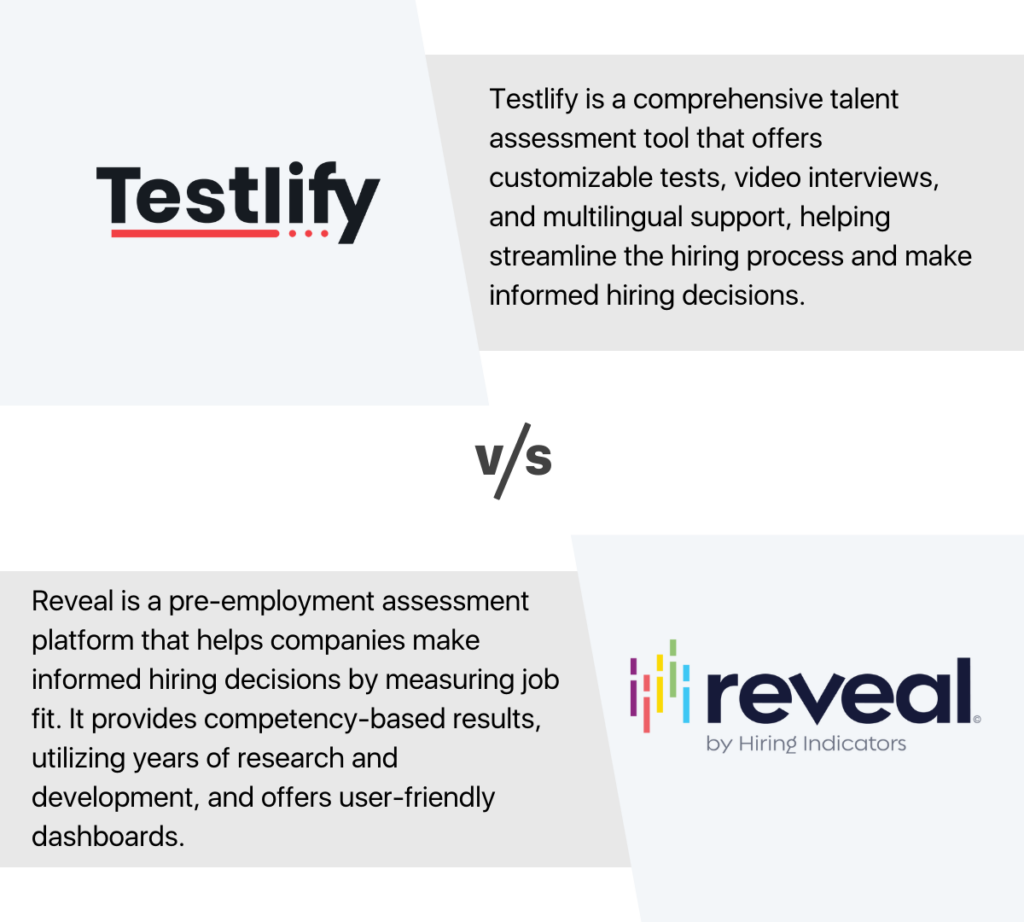
Reveal is a competency and job-fit assessment from Hiring Indicators. Candidates take a strategic medley of up to six tests, and the report returns job-specific competency results, candidate strengths and areas for growth. The scoring engine is called C-fit, and it measures personality traits, stylistic tendencies, cognitive style and ability, and problem solving and decision making.
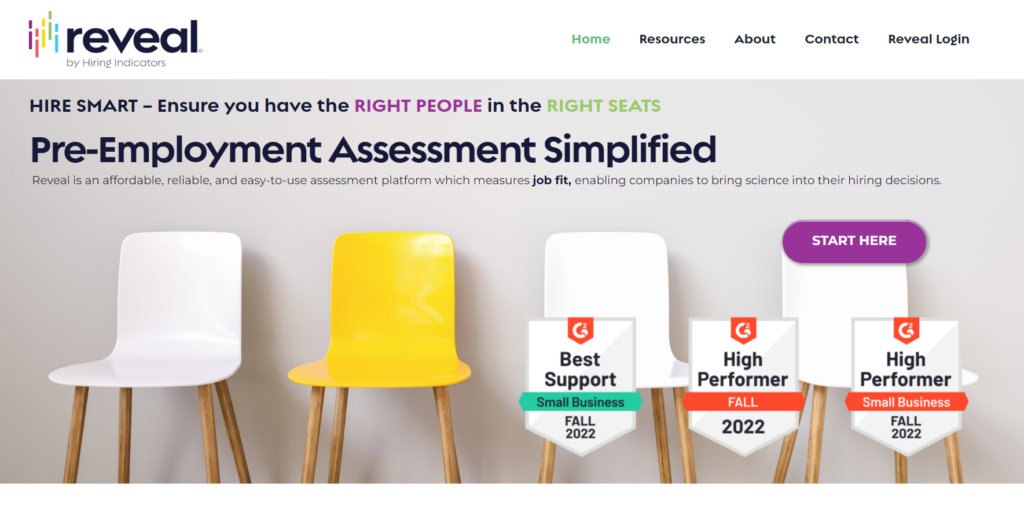
The job fit score averages the competencies for a role, so a recruiter can rank a shortlist with one number. Hiring Indicators says the assessments rest on more than 50 years of research and development, and that Reveal does not report raw cognitive scores, using a combination of scales to score each competency instead. No certification is needed to read a report, which matters for a small team with no in-house psychologist.
Two things are worth knowing before you buy. First, custom job profiles are not self-serve: building one needs a benchmark study and consulting fees on top of the subscription. Second, Reveal's own FAQ states it "does not offer a method to accept and track applications and resumes", and that connecting it to an existing ATS runs through an API with additional development cost.
What is Testlify and who is it for?
Testlify is a pre-hire assessment and interviewing platform. It carries 3,500+ tests across 4,500+ roles, 25+ question types, 45+ programming languages and a UI in 16+ languages. Test categories run from cognitive ability and psychometric assessments through coding, software skills, situational judgement, simulations and blue-collar work samples.
It fits a team hiring across mixed roles: a marketing agency filling a designer, an account manager and a developer in the same quarter cannot run all three through one personality battery and learn much. Testlify's answer is the Testlify Multi-Signal Talent Evaluation Model, which combines several role-relevant signals (assessments, interviews, simulations, references and reviewer feedback) rather than advancing a candidate on one strong score. One signal is fragile. Several pointing the same way are not.
For teams that already run Greenhouse, Workday or Lever, Testlify sits in front of them as the screening layer through 100+ ATS integrations and leaves the ATS as the system of record. Teams with no ATS get a simple built-in pipeline instead: job requisitions, an application form, job-board publishing and an applied to reviewed to shortlisted to rejected flow. It is deliberately basic, and it is not a substitute for a dedicated system of record.
How do Testlify and Reveal compare?
Rows below are drawn from each vendor's published material. Where a vendor publishes nothing on a capability, the table says so rather than asserting an absence.
Capability | Testlify | Reveal by Hiring Indicators |
|---|---|---|
Core method | Configurable multi-signal assessment | Fixed medley of 3 to 6 psychometric tests |
Test library | 3,500+ tests, 4,500+ roles, 50+ industries | Job profiles built from a shared assessment set |
Question types | 25+, including coding, typing, file upload and Office apps | Not published |
Coding assessment | Embedded VS Code editor, up to 20 test cases, 45+ languages | Not published |
Personality and cognitive | Personality, culture, psychometric and cognitive categories | C-fit: personality, stylistic tendencies, cognitive style, problem solving |
Video and voice interviews | One-way, two-way conversational AI, voice and outbound phone | Not published |
Proctoring | 20+ measures, three presets, dual-device monitoring | Not published |
AI scoring | Auto-scoring with human override and advisory-only mode | Scored against normative data, no raw scores reported |
Item-level psychometrics | Difficulty index, discrimination index, quality risk per question | Not published |
Applicant tracking | 100+ ATS integrations, plus a simple built-in pipeline | Not an ATS per vendor FAQ; API integration at extra cost |
Custom job profiles | Self-serve assessment builder and AI assessment creation | Benchmark study plus consulting fees |
Guarantee | 7-day trial, 30-day money-back, price locked 24 months | 120-day turnover guarantee, assessments credited back |
Which one measures job skills better?
Testlify measures job skills; Reveal measures the person. Reveal's published scope is personality, stylistic tendencies, cognitive style and problem solving, which predicts how someone tends to work. It does not ask them to write a query, fix a spreadsheet or handle an angry customer. Testlify does, and that gap is the whole reason to look past a job-fit battery.
Work-sample questions in Testlify include coding in an embedded VS Code editor with up to 20 test cases (visible or hidden, with per-test-case scoring), practical tasks submitted by file or URL, and Office-app questions bound to the real products: Google Docs, Sheets and Slides, plus Microsoft Word, Excel and PowerPoint. The typing test scores 60% accuracy and 40% speed by default, and the weighting is configurable.
One 2026-specific option has no equivalent in a psychometric battery. Vibe coding lets candidates direct AI tools to reach a working solution instead of writing syntax by hand, which is closer to how a lot of engineering now happens. That matters because the skills themselves keep moving: the World Economic Forum's Future of Jobs Report 2025 found employers expect 39% of workers' core skills to change by 2030. A trait profile does not go stale that fast. A skills test does, which is an argument for a library you can re-cut per role rather than a fixed battery.
There is a defensibility angle too. The U.S. Equal Employment Opportunity Commission's guidance on employment tests and selection procedures is clear that a selection procedure which screens out a protected group must be job-related and consistent with business necessity. A work sample tied to the actual job is easier to defend on that ground than a personality inventory, and Testlify's item-level analytics (difficulty index, discrimination index and a quality-risk flag per question) give a team the evidence to show a question is doing real work.
Pro Tip: run the psychometric read and the work sample in the same assessment rather than choosing between them. Testlify lets you weight each test from x0 to x5, so a customer-service role can score the situational judgement section five times heavier than the typing section without anyone doing arithmetic by hand.
Can either platform run AI interviews?
Testlify can. Reveal publishes no interviewing capability at all, so a team that buys Reveal still needs somewhere to run screening interviews.
Testlify supports one-way asynchronous video, two-way conversational AI video, audio and voice questions, and outbound AI phone interviews billed at $0.18 per minute, with 150+ interview templates. The AI interviewer is configurable rather than a canned recording: selectable avatar, selectable voice, an AI persona and context, and custom prompts. Recording controls cover the number of attempts (including no limit), recording time, completion time, and auto-start with preparation time so a nervous candidate can read the question first.
Transcripts are automatic and multilingual, generated for recordings of at least 30 seconds, with the spoken language auto-detected. Reviewers can watch or download the video, download the audio and transcript, replay the screen, and regenerate the interview report. Scoring is AI-assisted with human override, and the product ships the disclaimer in the interface: AI scores and insights are for guidance only, use human judgment for final decisions.
That last point is not a nicety. New York City's Local Law 144 requires an annual independent bias audit for automated employment decision tools used to screen candidates in the city, plus notice to candidates. A platform where AI scoring can be turned off, kept advisory, or excluded from the final average is far easier to run inside that rule than a black box. The one thing Testlify does not do is schedule live human interview panels. If you need calendar coordination for a four-person loop, that stays with your ATS or your scheduling tool.
How does each platform stop cheating?
Reveal does not publish anti-cheating controls. Testlify ships 20+ measures across three presets: Standard for balanced flexibility, Strict for maximum enforcement, and Custom.
The measures cover full-screen enforcement, tab-switch detection, face detection and single-presence checks, photo ID verification with a face match against the ID, periodic webcam snapshots, session and screen recording, copy-paste tracking, multi-monitor restriction, IP proctoring and AI-tool and browser-extension detection.
The standout is dual-device proctoring, and few platforms of any size offer it. The candidate's phone becomes a second camera positioned to capture both the candidate and the laptop screen, and it is a hard gate: the assessment will not start until mobile monitoring is active. Disconnecting ends the session and the action is reported to the administrator.
What the recruiter sees is deliberately evidence-first rather than automatic. A green flag means no suspicious behavior was observed. Yellow means some behavior was not ideal and a quick manual review is recommended. Red means cheating was confirmed. Auto-termination exists but is a separate, opt-in setting with a recruiter-set violation threshold, so flags on their own never reject anyone. Face verification data is deleted after 30 days and candidates can withdraw consent at any time. That combination (evidence, a human review step, a stated retention window) is the Testlify Assessment Integrity Framework in practice.
Testlify vs Reveal: pricing compared
Both vendors publish list prices, which is rarer than it should be in this category. Reveal's figures below come from the Hiring Indicators pricing page as published on September 9, 2026; Testlify's come from its own pricing page on annual billing.
Plan | Price | Assessment allowance | Cost per assessment |
|---|---|---|---|
Reveal Small Business / Startup | $850 per year | 10 assessments, 1 job position review | $85.00 |
Reveal Scale Up | $2,750 per year | Up to 50 assessments, 10 job position reviews | $55.00 |
Reveal Enterprise | $5,500 per year | Up to 100 assessments, unlimited job position reviews | $55.00 |
Testlify Starter | $139 per month, billed $1,668 per year | 100 credits | $16.68 |
Testlify Basic | $279 per month, billed $3,348 per year | 300 credits | $11.16 |
Testlify Business | $699 per month, billed $8,388 per year | 1,000 credits | $8.39 |
Read the per-assessment column carefully, because it is not a like-for-like number. Reveal's price bundles job-position benchmark reviews and a 120-day turnover guarantee that credits back assessments used on a hire who leaves inside four months. Testlify's credit is cheaper because it buys a test, not a consulting relationship: one credit per started assessment by a qualified candidate, credits do not roll over, and seats beyond the plan allowance are $15 each per month.
Two Testlify caveats belong here rather than in a footnote. White labeling and the 100+ ATS integrations are $2,388 a year each on the self-serve tiers, included only on the Custom plan, so a team that needs both should price them in from the start. And the trial is 7 days with no card, backed by a 30-day money-back guarantee and a price locked for 24 months.
At 10 hires a year, Reveal's entry plan costs $850 and Testlify's Starter costs $1,668, so Reveal is cheaper on paper. At 50 assessments the gap closes to $2,750 against $1,668. Past roughly 100 assessments a year, Testlify is cheaper by a wide margin, and the U.S. Bureau of Labor Statistics counted 5.1 million hires in July 2026 alone, so volume hiring is not a niche case.
Which one should you pick?
Pick Reveal if hiring is occasional and behavioral. A construction firm hiring two site supervisors a year, or an accounting practice filling one senior role, gets a benchmarked job profile, a readable report nobody needs training to interpret, and a turnover guarantee that carries real money behind it. The consulting-led setup is a feature when you have no one internally who wants to design an assessment.
Pick Testlify if you hire across different kinds of work, or if you need to see output. A marketing agency screening a paid-media analyst, a copywriter and a front-end developer in the same month needs three different tests, not three runs of the same battery. So does a retail group hiring 200 seasonal staff who need a situational judgement screen and proctoring, not a consulting engagement.
The case for adding Testlify alongside Reveal is thinner than it looks, because the overlap is small and the budget is not. If the traits read is the part you trust, keep it and add work samples for the roles where output is the risk. If you are replacing Reveal outright, the thing to check first is whether anyone actually uses the job fit score to rank, or whether the hiring managers quietly ignore it and interview everyone anyway.
Hire on evidence, not one score
See what a multi-signal assessment looks like for one of your open roles. Browse the Testlify test library to find the tests that match the job, or book a walkthrough and have someone build the assessment with you. A 7-day trial needs no card.
Key takeaways
- Reveal and Testlify solve different problems. Reveal scores who a candidate tends to be; Testlify scores what a candidate can do. If your hiring risk is fit and retention, that first answer may be enough. If your risk is capability, a trait profile will not catch it, and no amount of tuning the job fit score will change that.
- Coverage is the sharpest difference. Reveal publishes no skills testing, coding, interviewing or proctoring, so a team buying it still needs somewhere to run interviews and somewhere to stop cheating. Budget for those tools before comparing the subscription prices, or the comparison is not honest.
- Price per assessment inverts with volume. Reveal is cheaper below about 20 assessments a year and Testlify is cheaper above roughly 100, so the right answer depends on your hiring plan for the next 12 months, not on the headline plan price.
- Defensibility favours job-related evidence. EEOC guidance requires a selection procedure that screens people out to be job-related and consistent with business necessity, and a work sample tied to the role is easier to defend than an inventory of traits. Keep the evidence a rejected candidate's lawyer would ask for.
- AI scoring needs a human override to be safe, not just accurate. NYC Local Law 144 requires an annual bias audit and candidate notice for automated screening tools, so the ability to keep AI scores advisory, exclude them from the final average, or route an answer to a named human reviewer is a compliance control, not a nice-to-have.
- Configurability is what survives skill churn. With 39% of core skills expected to change by 2030, a fixed battery ages faster than a library you can re-cut per role. Prefer the option that lets you change what you measure without a new benchmark study and a new invoice.
- Whichever you choose, decide who owns the decision. Both tools produce a number. The number should shorten a shortlist, not make the offer, and the hiring team should be able to say out loud what evidence moved a candidate forward.
FAQs
Related resources
View all
Competitor Comparisons
Testlify vs AssessFirst: A detailed comparison
Competitor Comparisons
Testlify vs HR Avatar: A detailed comparison
Competitor Comparisons
Testlify vs ModernHire: A detailed comparison
Competitor Comparisons
Testlify vs Wonderlic: A detailed comparison
Competitor Comparisons
Testlify vs Thomas International: A detailed comparison
Competitor Comparisons
Testlify vs Indeed Hiring Platform: A detailed comparison
Get started.
Hire on proof, not resumes.
Run your first skills-based assessment free — no credit card required.