
Testlify vs AssessFirst: A detailed comparison
Discover the perfect solution for evaluating your candidates’ skills with Testlify. Dive into our comprehensive Testlify vs AssessFirst…
 ChatGPT
 Gemini
 Claude
 Grok
Grok Perplexity
TL;DR: Testlify vs AssessFirst
- AssessFirst predicts fit from personality, motivation and reasoning. Testlify tests whether someone can actually do the job, then adds personality and cognitive data on top.
- AssessFirst runs three core questionnaires (SWIPE, DRIVE and BRAIN) plus a voice tool. Testlify runs a library of 3,500+ tests across coding, software, cognitive, psychometric and role-specific skills.
- Published AssessFirst pricing starts at 590 euros a month for the Web plan, with the Predict and Automate tiers quoted on request. Testlify publishes one Standard plan at 139 dollars a month.
- Testlify covers technical hiring (45+ programming languages, coding tests, work simulations); AssessFirst does not test technical skill at all.
- Pick AssessFirst for pure behavioural prediction. Pick Testlify when the shortlist has to survive a hiring manager asking "can they do the work?"
Testlify and AssessFirst both score candidates before anyone books an interview, but they measure different things. AssessFirst is a psychometric platform: it profiles personality, drivers and reasoning speed, then predicts fit against a role model. Testlify is a skills assessment platform: it puts the actual work in front of the candidate, scores it, and layers personality and cognitive results alongside that evidence. That difference decides which one belongs in your process.

What makes Testlify different from AssessFirst?
Testlify measures demonstrated skill first and personality second. AssessFirst reverses that order. Testlify's library spans coding, software tools, cognitive ability, psychometrics and role simulations, so one assessment can cover a Python developer and a customer support lead. AssessFirst delivers behavioural prediction only, with no technical or software skills testing anywhere in the product.
That single design choice ripples through everything else. Because AssessFirst never sees a candidate do the work, it has no need for coding sandboxes, question banks per language, or the anti-cheating machinery that comes with timed skills tests. Testlify needs all of it, which is why the Testlify test library carries 45+ programming languages, 25+ question types and 20+ proctoring measures.
There is a real tradeoff here, and it cuts both ways. Personality data ages well. A candidate's drivers at 28 look a lot like their drivers at 33, so an AssessFirst profile stays useful long after the hire. A skills score is a snapshot: it tells you what someone could do on a Tuesday in March, and skills move. Teams that want both usually run a skills assessment to build the shortlist and a personality read to inform the final conversation.
This is the Testlify Multi-Signal Talent Evaluation Model in practice: one signal is fragile, several independent signals pointing the same way are not. A meta-analysis by Kuncel and colleagues in the Journal of Applied Psychology found that combining assessment scores mechanically predicts outcomes at least as well as experts re-weighing the same information by instinct. Collect the signals, then let the scoring do the combining.
How do Testlify and AssessFirst compare on features?
Testlify covers a wider surface: coding tests, software skills, situational judgment, typing, video questions and psychometrics, with white-label branding and 24/7 support. AssessFirst matches Testlify on personality, cognitive ability, ATS integration and candidate benchmarking, but has no coding, software, situational-judgment or typing assessments. The table below is the row-by-row picture.
Features | Testlify | AssessFirst |
|---|---|---|
Test Library | ||
Role-specific tests | ✓ | ✗ |
Cognitive ability tests | ✓ | ✓ |
Programming Tests | ✓ | ✗ |
No. of programming languages supported | 45+ | ✗ |
Situational judgment tests | ✓ | ✗ |
Typing test | ✓ | ✗ |
Software skills tests | ✓ | ✗ |
Non-technical tests | ✓ | ✗ |
Psychometric tests | ✓ | ✗ |
Personality tests | ✓ | ✓ |
Motivation test | ✓ | ✗ |
Assessment templates | ✓ | ✗ |
Custom assessments creation | ✓ | Partial |
Test recommendations for different job roles | ✓ | ✓ |
Coding tests | ✓ | ✗ |
Assessments | ||
Custom assessment builder | ✓ | ✗ |
Custom coding questions | ✓ | ✗ |
Multiple-choice questions | ✓ | ✓ |
Descriptive questions | ✓ | ✗ |
Video interview questions | ✓ | ✓ |
Assessments curated by I/O psychologists | ✓ | Partial |
Google doc | ✓ | ✗ |
Google sheets | ✓ | ✗ |
Google slides | ✓ | ✗ |
Audio questions | ✓ | ✗ |
Qualifier questions | ✓ | ✗ |
File upload questions | ✓ | ✗ |
Quality check | Extensive process incl. peer reviews, sample testing, review by psychometrician & more | Partial |
Video interview questions | ||
One-way video interview | ✓ | ✗ |
Custom video questions creation | ✓ | ✗ |
Candidate's recording attempts per question | ✓ | ✗ |
Live video interview | ✗ | ✗ |
Candidate experience | ||
Fully customizable email templates | ✓ | Partial |
Custom invitation and rejection email | ✓ | ✓ |
Mobile-friendly | ✓ | ✓ |
Candidate support | ✓ | ✓ |
Instructions before assessment | ✓ | ✓ |
Average assessment length | 40-60 minutes | 10 minutes |
Anti-cheating features | ||
Session recording | ✓ | ✗ |
Snapshot capturing | ✓ | ✗ |
Mouse tracking | ✓ | ✗ |
Copy-paste disabled | ✓ | ✗ |
Microphone and camera access | ✓ | ✗ |
Location access | ✓ | ✗ |
IP address tracking | ✓ | ✗ |
Randomization of question sequence | ✓ | ✓ |
Time limit on tests | Yes, set per test | ✓ |
Reporting and analytics | ||
Detailed reports | ✓ | ✓ |
Easy to share reports and scorecards | ✓ | ✓ |
Exportable/downloadable reports | ✓ | ✓ |
Recruiting analytics | ✓ | Partial |
Candidate benchmarking | ✓ | ✓ |
Completion rate and response insights | ✓ | ✗ |
Enterprise friendly | ||
White label feature | ✓ | ✗ |
Custom branding | ✓ | ✓ |
ATS integration | ✓ | ✓ |
User, role, and access management | ✓ | ✓ |
Bulk candidate invite | ✓ | ✓ |
Share public link invite to candidates | ✓ | ✓ |
Candidate pipeline management | ✓ | ✓ |
Internationalization | ✓ | ✓ |
Campus hiring support | ✓ | Partial |
Dedicated account manager | ✓ | ✗ |
GDPR compliant | ✓ | ✓ |
Multilingual abilities | ✓ | Partial |
Customer support | ||
24/7 support | ✓ | ✗ |
On-call support | ✓ | ✗ |
Email support | ✓ | ✓ |
Product demo | ✓ | ✓ |
Training & onboarding tour | ✓ | Partial |
How does AssessFirst work?
AssessFirst asks a candidate to complete three short questionnaires, then scores them against a target profile for the role. SWIPE reads personality from image-based choices, DRIVE maps the 20 needs that motivate someone, and BRAIN measures learning speed with a timed reasoning game. A match score comes out the other end.
The interesting part is where the target profile comes from. Rather than asking a hiring manager to guess, AssessFirst can model the people already succeeding in similar roles and set the benchmark from them. For a company with a long tenure history and low turnover, that is genuinely useful. For a role nobody has held before, it has nothing to learn from.
AssessFirst has grown past the original three tests. VOICE now runs a short spoken technical interview simulation, and SCAN handles CV screening. Anything older that describes AssessFirst as a three-test product is out of date.
The limit is what the questionnaires cannot see. None of them ask a candidate to write a SQL query, build a spreadsheet model, or handle an angry customer. Reasoning speed and motivation predict how someone will approach work; they do not tell you whether the person can do it today. Sackett and colleagues, in the 2022 reanalysis of selection-method validity, put structured job-relevant evidence among the strongest predictors and proxies like years of education and general experience among the weakest. Personality belongs in the mix. It just should not be the whole mix.
How much do Testlify and AssessFirst cost?
Testlify publishes one Standard plan at 139 dollars a month, billed at 1,668 dollars a year, with a 7-day free trial and no card required. AssessFirst publishes one entry price, 590 euros a month for the Web plan, and quotes the rest on request. Both bill annually; only one lets you check the number before a sales call.
AssessFirst pricing
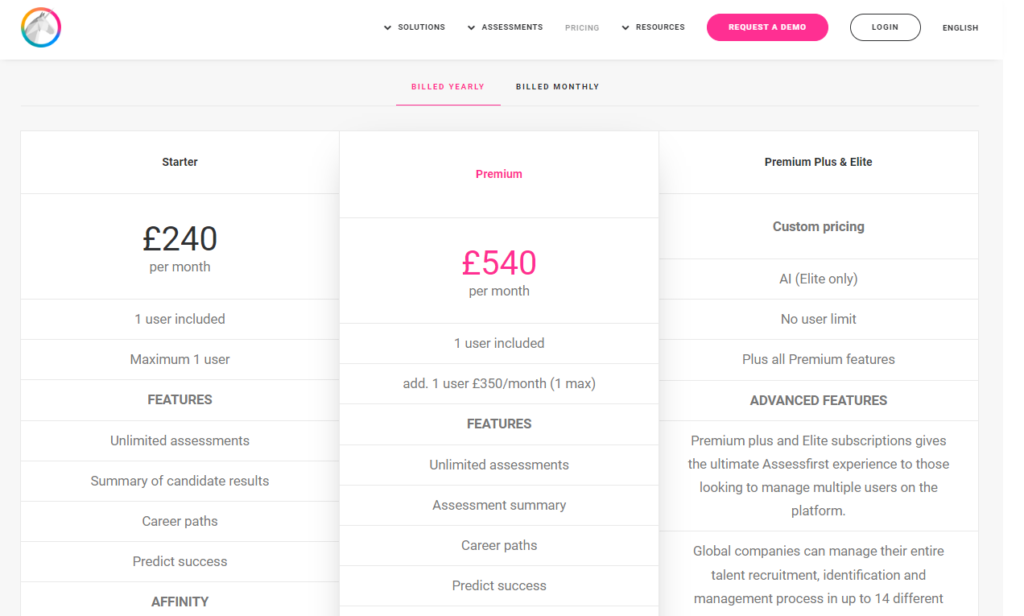
AssessFirst lists four tiers on its published pricing page. Web starts at 590 euros a month and caps you at 100 candidates a month. Predict covers up to 50 users and adds match scores, 2500+ predefined job profiles and API access, at a price you have to ask for. Automate lifts the user cap entirely and adds internal mobility and talent-rediscovery features. VOICE is sold separately.
Older comparisons still quote a 240 pound Starter plan and a 540 pound Premium plan. Those tiers are gone. If a vendor comparison you are reading still shows them, it has not been checked in a while.
Testlify pricing
The Testlify Standard plan is 139 dollars a month, billed at 1,668 dollars a year, and includes 3 user seats, unlimited assessments, the full 3,500+ test library, AI interviews and proctoring. That works out at about 16.68 dollars per candidate across the 100 annual credits. Extra seats are 15 dollars a month. White label and the 100+ ATS integrations are add-ons at 2,388 dollars a year each. Above roughly 25,000 candidates a year, pricing moves to a Custom plan with SSO, regional data storage and an uptime SLA.
Straight comparison is harder than it looks, because the two price different units. AssessFirst charges by candidates screened per month; Testlify charges by annual credits and seats. A team hiring in bursts (30 roles in Q1, almost nothing in Q3) will find an annual credit pool easier to live with than a monthly cap that resets whether or not it was used.
Pro tip: before comparing sticker prices, count how many candidates you actually assessed last year, not how many you plan to. Most teams overestimate by a third, buy a tier up, and never touch the ceiling.
Which platform should you choose?
Choose on what your shortlist is missing. If interviews keep surfacing people who can clearly do the work but flame out on the team, you have a fit problem and AssessFirst is built for it. If interviews keep surfacing people who present well and then cannot ship, you have an evidence problem, and a personality profile will not fix it.
AssessFirst fits better when
- The roles are non-technical and high-volume, where 10-minute questionnaires beat 45-minute skills tests on completion rate.
- You have enough tenure data to model what "good" looks like from your own high performers.
- Internal mobility matters as much as hiring, and you want the same profile to serve both.
Testlify fits better when
- You hire engineers, analysts, or anyone whose output can be tested directly. AssessFirst has no coding or software assessments.
- You need one platform across mixed roles instead of a psychometric tool plus a separate technical screen.
- Assessment integrity is a live concern, and session recording, browser lockdown and IP tracking need to be there.
- Procurement wants a published price rather than a quote.
The honest answer for a lot of enterprise teams is both, in sequence. Use skills evidence to decide who advances, since that is the decision with the most candidates riding on it, and use a behavioural read on the final two or three, where fit actually gets decided. What does not work is running either one as the only gate. The U.S. Bureau of Labor Statistics counted 5.3 million hires in June 2026, a hires rate of 3.4 percent. At that volume, a single-signal screen is a lot of decisions resting on one number.
Hire on evidence, not on a personality profile
Put both approaches in front of your next shortlist and see which one your hiring managers argue with less. Testlify's 7-day free trial needs no credit card, and the full 3,500+ test library is open from the first day. If you would rather have someone map it to your roles first, book a demo and bring your two hardest reqs.
Key Takeaways
- The two tools measure different things, so "which is better" is the wrong question. AssessFirst predicts behaviour and fit; Testlify measures demonstrated skill. Decide which gap is costing you hires this quarter, then buy for that gap rather than for the longer feature list.
- Technical hiring rules AssessFirst out on its own. There is no coding test, no software skills test and no work simulation in the product. If engineers, analysts or ops specialists are in your pipeline, a psychometric-only platform cannot build the shortlist, and you will end up paying for a second tool anyway.
- Published pricing is a real difference, not a detail. Testlify lists 139 dollars a month; AssessFirst lists 590 euros a month for Web and quotes Predict and Automate on request. Budget approval moves faster when the number is on a page, and comparison pages still quoting 240 pound tiers are working from retired plans.
- Match the billing shape to your hiring shape. A monthly 100-candidate cap suits steady volume. An annual credit pool suits burst hiring. Teams that hire 30 people in one quarter and almost none the next lose money on a monthly cap that resets unused.
- Personality data ages better than skills data. A motivation profile stays useful for years; a skills score describes one moment. That argues for skills evidence at the shortlist stage, where volume is highest, and behavioural data at the final stage, where fit decides.
- Combine signals mechanically, not by gut feel. The Kuncel meta-analysis found that scoring assessment data by formula beats experts re-weighing the same inputs by instinct. Whichever platform you pick, let the scores build the shortlist before opinion enters the room.
FAQs
Related resources
View all
Competitor Comparisons
Testlify vs HR Avatar: A detailed comparison
Competitor Comparisons
Testlify vs ModernHire: A detailed comparison
Competitor Comparisons
Testlify vs Wonderlic: A detailed comparison
Competitor Comparisons
Testlify vs Thomas International: A detailed comparison
Competitor Comparisons
Testlify vs Indeed Hiring Platform: A detailed comparison
Competitor Comparisons
Testlify vs HireQuotient: A detailed comparison
Get started.
Hire on proof, not resumes.
Run your first skills-based assessment free — no credit card required.