
Benefits of building a talent pool in 2026
Talent pools improve hiring efficiency, reduce time-to-hire, and ensure quick access to pre-qualified candidates for future roles.

The benefits of building a talent pool come down to one thing: you stop starting from zero every time a role opens. A talent pool gives recruiters a ready group of pre-qualified, skills-validated, already-engaged candidates, which cuts time-to-hire, lowers sourcing cost, lifts quality of hire, and turns hiring from a scramble into a plan. In 2026, that readiness is the difference between filling a role in days and losing a strong candidate to a faster competitor.
A talent pool is not a dusty database of old applicants. Think of it as a living shortlist you build before you need it: people you have sourced, assessed, and stayed in touch with, mapped to the roles you know are coming. When the requisition lands, you are choosing from warm, evaluated candidates instead of writing a job ad and hoping.
 ChatGPT
 Gemini
 Claude
 Grok
Grok Perplexity
TL;DR: the benefits of a talent pool at a glance
- Speed: Sourcing is already done, so you move straight to evaluation and shorten the whole hiring cycle.
- Cost: Fewer roles need paid ads or agency fees, which pulls down cost per hire.
- Quality: Candidates are assessed on skills over time, not judged on a resume in a rush.
- Reach: A pool holds passive candidates who would never answer a job post but will take a warm, relevant call.
- Stability: Planned pipelines make headcount predictable and protect recruiters from constant firefighting.

Why do talent pools matter more than ever in 2026?
Because the talent you want is getting harder to find, waiting for applications no longer works. The World Economic Forum’s Future of Jobs Report 2025 found that 63% of employers cite skills gaps as the biggest barrier to transforming their businesses, and nearly 40% of the skills a job requires are set to change by 2030. The same report projects 78 million net new jobs by 2030, so the people who match tomorrow’s roles are scarce, and they are rarely sitting in an inbox waiting to be discovered.
The scale is hard to ignore. Korn Ferry estimates a global human talent shortage of more than 85 million people by 2030, worth about $8.5 trillion in unrealized annual revenue if left unaddressed. When demand outstrips supply that badly, the recruiters who win are the ones who built relationships early, not the ones who posted fastest.
Recruiting in 2026 is shaped by three realities that a talent pool answers directly:
- The best candidates are usually employed and passive, not actively job hunting.
- Hiring timelines keep shrinking while the bar for quality keeps rising.
- Recruiting teams are asked to deliver more with fewer resources.
Instead of restarting the funnel for every opening, recruiters with a mature pool already have candidates who are skills-validated, previously engaged, familiar with the employer brand, and aligned to likely future roles. That head start is the whole point.
What is a talent pool?
A talent pool is a structured, maintained group of candidates a company has already identified, assessed, and engaged for current or future roles. It usually includes past applicants worth revisiting, silver-medalist candidates who just missed out, sourced passive prospects, referrals, and internal employees ready for a move. What separates a real pool from a spreadsheet of names is upkeep: skills are validated, notes are current, and engagement is ongoing. If you want the step-by-step version, here is how to build a talent pool from scratch.
What are the top 10 talent pool benefits?
Here are the ten benefits that matter most to recruiters, ranked by how directly they help you hire faster, cheaper, and with more confidence.
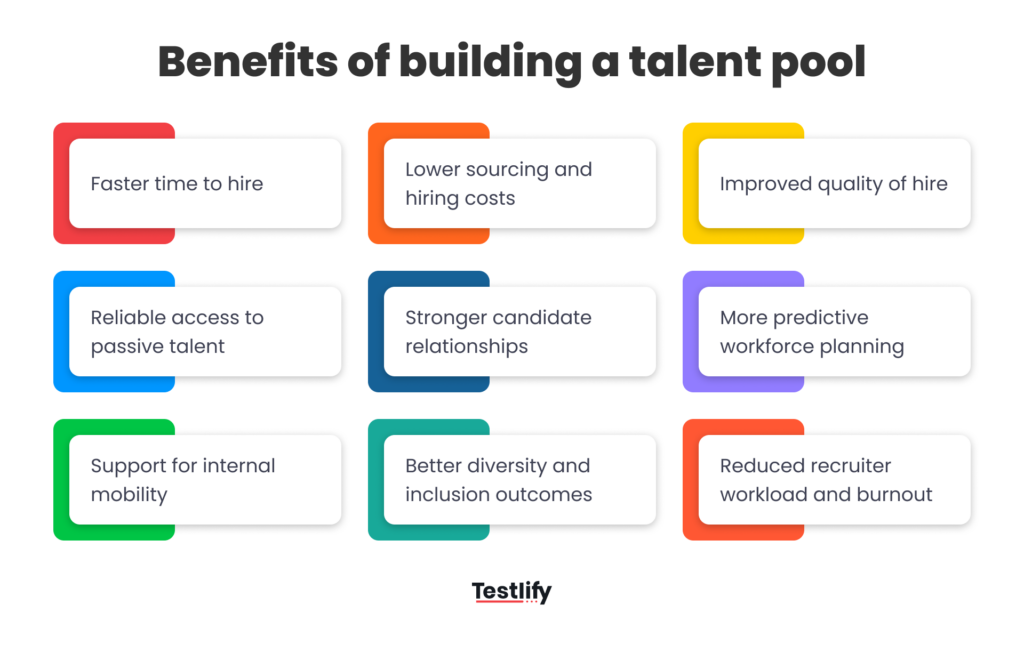
1. Faster time-to-hire
Speed is not just an efficiency metric anymore. It decides whether a strong candidate stays interested or takes a competing offer. A slow cycle has predictable costs: qualified people drop out, critical teams stay short-staffed, and hiring managers lose faith in the process.
A talent pool removes the slowest part of hiring, which is building a funnel from nothing. With candidates already identified and assessed, recruiters skip weeks of sourcing and go straight to evaluation and decision. Sourcing cycles shrink because the people are already known, early screening drops because skills were validated before the role opened, and hiring managers see relevant profiles days sooner. Fewer handoffs, fewer delays, a more predictable process.
2. Lower sourcing and hiring costs
Recruiting costs climb every year as teams compete for the same scarce talent across pricier channels: rising job-board fees, heavy agency reliance for niche roles, and steeper paid-advertising competition. SHRM benchmarking puts the average cost per hire near $4,700 and the median time to fill a role at 44 days, and both climb when every requisition restarts from scratch.
A pool shifts hiring from one-off sourcing to reusable talent infrastructure. Job-ad spend falls because fewer roles need external promotion, agency dependence drops for hard-to-fill positions, and the same nurtured candidates get considered for several roles over time. You are paying to build an asset once instead of renting attention again and again.
3. Improved quality of hire
Rushed hiring rewards whoever looks good on paper. A pool lets you judge people on evidence gathered over weeks or months, not a 20-minute read of a resume. That matters because skills predict performance far better than credentials do: McKinsey found that hiring for skills is five times more predictive of job performance than hiring for education. If you want to go deeper on the metric itself, here is how to improve quality of hire with structured evidence.
This is where a pool earns its keep only if the candidates in it are actually validated, not just collected. The Testlify Competency-to-Evidence Matrix is a simple way to keep that discipline: map each target role to the competencies that matter, then tie every competency to real evidence through a skills assessment, a work simulation, or structured interview feedback before the candidate enters the pool. Done that way, the pool is not a list of names, it is a ranked set of people you already have proof on.
4. Reliable access to passive talent
Most of the strongest candidates are not applying anywhere. They are employed, doing good work, and open to the right move only if it comes to them well-framed. A talent pool is how you keep a relationship warm with these passive candidates so that when a fitting role opens, you are making a relevant call to someone who already knows you, not cold-messaging a stranger.
The payoff compounds. Every conversation, assessment, and piece of feedback you log makes the next outreach sharper and more personal. Cold sourcing resets to zero each time. A pool remembers.
5. Stronger candidate relationships
Transactional hiring treats candidates like tickets to close. A pool treats them like people you will likely work with someday, which changes how they experience your brand even when there is no open role. Consistent, useful contact (a relevant article, a genuine check-in, an honest update on timing) builds trust that pays off the moment you have something to offer.
Here is the quiet advantage: candidates who feel respected during the wait say yes faster and negotiate less adversarially when the offer comes. A relationship you build in advance is an edge that pays off at offer time.
6. More predictable workforce planning
When you can see who is available and ready across critical roles, headcount planning stops being guesswork. A well-mapped pool gives leaders a real view of internal and external supply for the skills the business will need next quarter, which makes hiring forecasts something you can actually stand behind. It ties directly into broader workforce planning, turning “we hope we can hire” into “here is who we can hire.”
That visibility also surfaces gaps early. If the pool is thin for a role you know is coming, you find out with months to spare, not the week the requisition opens.
7. Support for internal mobility and retention
A talent pool should include the people already on your payroll. When employees can see and reach the next role internally, they stay, and that matters financially. Gallup estimates the cost of replacing an employee runs from one-half to two times their annual salary, and closer to 200% for senior leaders and managers, so every internal move you enable instead of an external hire avoids a real bill.
Internal candidates ramp faster, already fit the culture, and carry institutional knowledge out the door if you ignore them. Treating your own people as a first-class part of the pool is one of the cheapest retention levers available.
8. Better diversity and inclusion outcomes
Reactive hiring narrows the field to whoever happens to apply this week, which quietly reinforces whatever bias already exists in your channels. Building a pool on purpose lets you widen sourcing over time, reach underrepresented talent through deliberate outreach, and evaluate everyone against the same skills-based criteria rather than gut feel under deadline.
The catch is that a pool only improves diversity if you measure and manage it. Track the makeup of your pool the way you track any pipeline metric, and use structured assessments so the evaluation stays consistent across every candidate.
9. Greater hiring agility
Business needs change fast: a new product line, a sudden resignation, a seasonal spike. A ready pool means you can respond to any of these without a standing start, which is exactly what makes seasonal and project-based hiring manageable instead of chaotic. When the plan changes, you already have candidates to call.
Agility here is not about moving recklessly. It is about having enough prepared options that a change in demand does not force a panic hire or a long vacancy.
10. Reduced recruiter workload and burnout
Constant cold sourcing is exhausting, repetitive work, and it is a leading driver of recruiter burnout. A pool front-loads the hard part so that day-to-day hiring becomes evaluation and relationship work rather than an endless search for net-new candidates.
Lighter, more strategic workloads keep good recruiters in their seats and let them spend energy on the parts of the job that actually need judgment. A team that is not firefighting every requisition can finally give strategic hiring the sustained attention it needs.
Reactive hiring vs a talent pool: what changes?
The clearest way to see the benefits is to compare how the same hire plays out with and without a pool.
Dimension | Reactive, requisition-by-requisition hiring | Talent-pool-led hiring |
|---|---|---|
Starting point | Write a job ad and build a funnel from zero | Shortlist from candidates already sourced and assessed |
Time to shortlist | Weeks of sourcing before the first real conversation | Days, because evaluation starts immediately |
Cost drivers | Job-board fees, agency fees, paid ads per role | One-time investment in a reusable pipeline |
Quality signal | A resume read under deadline pressure | Skills evidence gathered over time |
Workforce planning | Reactive and hard to forecast | Visible supply mapped to future roles |
Recruiter experience | Repetitive cold sourcing, high burnout risk | Relationship and evaluation work, steadier load |
Turn your talent pool into a decision-ready pipeline
Building a talent pool is only the first step. The real value comes from knowing that every candidate has already been assessed and is ready to move the moment a role opens.
With Testlify, recruiters can validate candidates using role-specific skills assessments, cognitive and personality tests, coding challenges, and AI-assisted interviews—all in one platform. Instead of storing resumes, you build a talent pool backed by structured evidence, making it easier to identify the right candidates faster and hire with confidence.
This approach reflects Testlify’s Human& AI Evidence-Based Hiring Framework: AI helps automate screening and surface insights, while hiring decisions remain in human hands, supported by objective evidence.
Book a demo. See how Testlify helps you build, validate, and activate a future-ready talent pool before your next hiring need arises.
Key takeaways
- Readiness beats reaction. A talent pool moves hiring from starting cold on every role to choosing from warm, assessed candidates, which is why it compresses time-to-hire so sharply. The practical implication: start building the pool for your predictable roles now, before the requisition lands.
- A pool is an asset, not a list. Cost per hire drops because you invest once in a reusable pipeline instead of renting ads and agencies for every opening. Treat pool-building as infrastructure spend with a payback, not a nice-to-have.
- Validation is what makes quality real. Skills predict performance about five times better than education does, so a pool only lifts quality if candidates are assessed on evidence before they enter it. Bake a skills check into your intake, or the pool is just names.
- Passive talent is the real prize. The best candidates are not applying, and a pool is the only way to keep those relationships warm at scale. Log every interaction so each future outreach is more personal than the last.
- Your own people belong in the pool. Internal mobility avoids replacement costs that run from one-half to two times salary and keeps institutional knowledge in-house. Map internal candidates alongside external ones for every critical role.
- Pools protect the recruiters too. Front-loading sourcing cuts the repetitive cold-search work that burns people out, letting the team spend judgment where it counts. A steadier workload is a retention lever for your recruiters, not just your candidates.
FAQs

Content Writer
Yashika Khandelwal is a Content Writer with 3+ years of experience creating research-backed content on hiring, talent assessment, and HR technology. She is a registered Organizational Psychologist and subject matter expert who combines behavioral science with practical recruitment insights to produce accurate, evidence-based content.
LinkedInRelated resources
View all
HR & recruitment
Enhance candidate experience without additional costs

HR & recruitment
Scale recruiting efforts without expanding your team

HR & recruitment
Achieve unbiased recruitment without complex algorithms with Testlify

HR & recruitment
What are the different elements of new hire orientations?

HR & recruitment
What is the importance of new hire orientations?

HR & recruitment
How to Use Technology to Support Staffing: 7 Ways That Actually Cut Time-to-Fill
Get started.
Hire on proof, not resumes.
Run your first skills-based assessment free — no credit card required.