
How to hire business analysts: a skills-first guide for 2026
A 7-step guide to hiring business analysts: define the BA variant, write the job, screen on skills early and run structured interviews.

Knowing how to hire business analysts starts with one fact: "business analyst" is not one job. A BA on a data team writes SQL all day, a BA on a systems migration lives in process maps and requirements, a BA in banking builds financial models, and a BA in a product team runs stakeholder workshops. The hiring process works when it is built for the variant you need and tests the skills that variant uses, before anyone reads a resume closely.
TL;DR:
- To hire a business analyst, pick the BA variant, write an outcome-based job description, source widely, give every applicant a short skills assessment, run a structured interview, check references, then make the offer.
- Four skills carry most BA roles: requirements elicitation, data reasoning, process modeling and written stakeholder communication. Weight them to the variant you are hiring.
- Set the passing score before candidates sit the assessment, and use pass, review and fail bands instead of one cutoff.
- Send the assessment to everyone who clears the knockout questions. Testing only resume survivors just confirms the resume screen.
- Keep the screening assessment to 30 to 45 minutes. Longer tests lose employed, senior candidates first.
- Two quarters after the hire, compare assessment scores with performance. If they do not line up, change the test.
 ChatGPT
 Gemini
 Claude
 Grok
 Perplexity
How to hire business analysts in 7 steps
The fastest way to hire business analysts well is a seven-step process: define the BA variant, write the job description, source candidates, assess every applicant, run a structured interview, check references, then make the offer and onboard. Each step answers a different question about the candidate, so no stage repeats another.
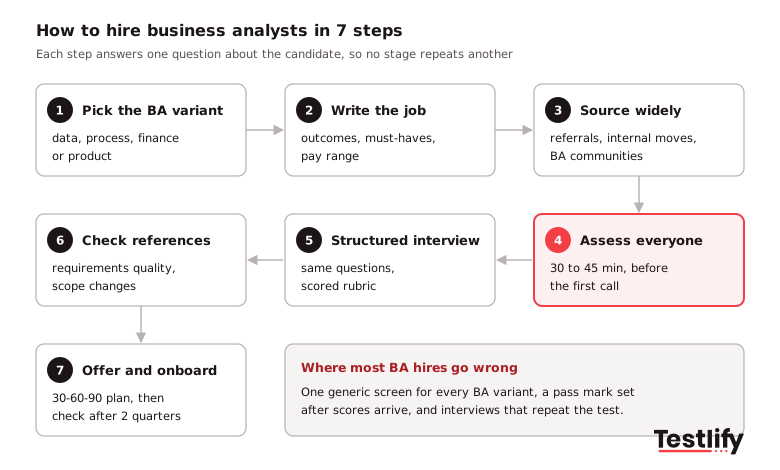
Follow these steps in order, and every decision along the way rests on evidence, not instinct.
- Pick the BA variant: Sit with the hiring manager for 30 minutes and list what this analyst will do in the first quarter. The work, not the job title.
- Write the job description: Lead with outcomes, split must-haves from nice-to-haves, and publish a pay range.
- Source widely: Combine job boards with referrals, internal moves and BA communities.
- Assess every applicant: Send a 30 to 45 minute skills assessment to everyone who clears the knockout questions.
- Run a structured interview: Same questions for every candidate, scored against a written rubric.
- Check references: Ask about the quality of requirements and how the candidate handled scope changes.
- Offer and onboard: Agree a 30-60-90 day plan, then check the hire against the assessment after two quarters.

What does a business analyst do?
A business analyst finds out what a business needs, turns that need into clear, testable requirements, and checks that the solution delivered actually solves the problem. The occupation database O*NET lists Business Analyst as a job title under management analysts, with core tasks such as gathering information on problems or procedures, analyzing data to develop solutions, and documenting findings as recommendations.
In practice, the title covers at least four jobs. Screen all four with the same generic test and the process is consistent, but consistently wrong.
BA variant | What the work looks like | Skills that carry the role |
|---|---|---|
Data or BI business analyst | Queries data to check business rules, builds reports and dashboards | Data reasoning, SQL or spreadsheets, written communication |
Process or systems business analyst | Maps current processes, writes requirements for system changes and migrations | Requirements elicitation, process modeling |
Finance or banking business analyst | Builds models, analyzes products and regulation in banking, capital markets or insurance | Domain knowledge, financial modeling |
Product business analyst | Runs stakeholder workshops, writes user stories, sets priorities with product managers | Elicitation, written and spoken communication |
Key takeaway: Decide which variant you are hiring before you write a single line of the job description. Everything that follows depends on it.
Why is hiring business analysts hard right now?
Hiring business analysts is hard mainly because of volume. Business analysts sit inside one of the larger and faster-growing occupations the U.S. government tracks, so every posting attracts a deep pile of applications that look alike on paper.
Occupation (BLS category) | Jobs, 2025 | Median pay, May 2025 | Projected growth, 2025 to 2035 | Openings per year |
|---|---|---|---|---|
Management analysts | 1,077,100 | $101,860 | 10% | About 94,100 |
Operations research analysts | 113,100 | $88,940 | 12% | About 7,500 |
The US Bureau of Labor Statistics projects about 94,100 management analyst openings a year, and its operations research analyst data shows 12% growth through 2035. Most business analyst postings fall into one of these two groups.
The skill being screened for is also the one employers want most. According to the World Economic Forum's Future of Jobs Report 2025, analytical thinking is the top core skill, rated essential by nearly 70% of employers. Everyone is hiring for it, yet many teams never measure it directly.
In the Skills-First Talent Report 2026 from Testlify and SHRM Labs, 32.8% of HR and talent leaders said they use no skills assessment at any hiring stage, and only 8.4% were very confident their process selects the best candidate.
When does your team need a business analyst?
A team needs a business analyst when the gap is between what the business asks for and what gets built or changed. Common signs are projects that ship the wrong thing, requirements that change late, reports nobody acts on, and process problems everyone can see, but nobody owns.
A business analyst is also easy to confuse with nearby roles. Hiring the wrong one is a common and expensive mistake.
Role | Main question they answer | Typical output |
|---|---|---|
Business analyst | What does the business need, and does the solution meet it? | Requirements, process maps, recommendations |
Project manager | Will we deliver on time and on budget? | Plans, timelines, status reports |
Data analyst | What do the numbers say? | Analyses, dashboards, models |
Product manager | What should we build next, and why? | Roadmaps, priorities, product decisions |
If the problem is late delivery, you need a project manager. If the problem is that nobody can read the data, you may need a data analyst. If the problem is that teams build the wrong thing, you need a business analyst.
What skills should you look for in a business analyst?
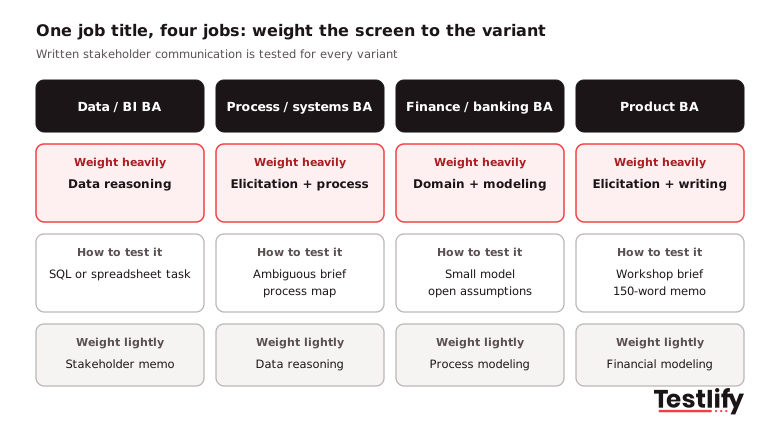
Business analyst hiring should focus on four competencies: requirements elicitation, data reasoning, process modeling and written stakeholder communication. Add domain and financial modeling for banking and finance roles. Weight each one by how much of the actual job it represents, rather than testing all of them equally.
Competency | What good looks like on the job | How to test it | Weight it heavily for |
|---|---|---|---|
Requirements elicitation | Turns a vague ask into specific, testable requirements and finds the constraint nobody mentioned | Give an ambiguous one-paragraph brief, ask for the five questions they would ask first and why | Product and systems BAs |
Data reasoning | Checks a business rule in the data instead of assuming it, spots a misleading chart | A short SQL or spreadsheet task on a small dataset, plus one interpretation question | Data and BI BAs |
Process modeling | Maps a current process, finds where work stalls, proposes a change and names the tradeoff | Give a written process description, ask for the failure point and one change | Operations and migration BAs |
Stakeholder communication | Writes a summary an executive can act on without a follow-up meeting | A 150-word recommendation memo based on the data task | Every variant |
Domain and financial modeling | Builds a model and states its assumptions plainly | A small modeling exercise with the assumptions left open | Banking and finance BAs |
The stakeholder communication row is the one teams skip most often, and the one that causes the most day-to-day friction. A business analyst who can model a process but cannot write a clear paragraph about it will create meetings for the rest of their tenure. Test the writing.
Certifications are useful supporting evidence, not a substitute for a work sample. The IIBA certification ladder runs from the ECBA for people starting out, to the CCBA for practitioners with 2 to 3 years of business analysis work, to the CBAP for those with more than 5 years. PMI's PMI-PBA is common in project-heavy environments.
Treat any of them as a reason to look closer, never as a reason to skip the assessment.
How do you write a business analyst job description?
A business analyst job description works when it leads with the outcomes the analyst will own in the first year, lists only the skills that are truly required, and states the pay range. Candidates with a current job decide in seconds whether a posting is worth their time.
- Lead with outcomes: "Rewrite the claims intake requirements for the new platform by Q3" tells a candidate more than "gather requirements from stakeholders".
- Keep must-haves short: Three to five real requirements. Long lists put off strong candidates from non-traditional backgrounds, such as QA, operations or support.
- Name the variant: Say whether the role is data, process, finance or product-heavy, and which tools matter (SQL, Excel, Jira, Visio, Power BI).
- Publish the pay range: It filters out mismatched applicants before they apply.
- Explain the process: Say there is a short skills assessment and roughly how long it takes. Candidates are more likely to finish a step they expected.
Start from the business analyst job description template and adjust it to the variant.
Where do you find business analyst candidates?
Business analyst candidates come from four main channels: job boards, employee referrals, internal moves and BA communities. The best hires often come from the last three, because they bring proof of work that a resume cannot show.
- Referrals: Ask project managers, engineering leads and operations managers. They work with analysts every day and know who writes requirements people can build from.
- Internal moves: QA testers, operations specialists and support leads often already do half the job. Assess them the same way as external candidates.
- BA communities: Local IIBA chapters, business analysis meetups and conferences reach practitioners who are not actively applying.
- Job boards and LinkedIn: Necessary for reach, but expect high volume and near-identical resumes, which is why the next step matters.
How do you screen business analysts with a skills assessment?
Screening business analysts with a skills assessment works only when the assessment is built backwards from the role. A generic one does the opposite: it adds a stage, annoys strong candidates and produces a score nobody on the panel trusts. Build it from the variant, then place it before the first human conversation.
- List the real tasks: Use the first-quarter task list from step 1 of the hiring process.
- Turn tasks into competencies: "Rewrite the claims intake requirements" becomes requirements elicitation plus process modeling. Three or four competencies is the right number. Seven means nobody has decided.
- Pick evidence for each one: A short work sample for the competencies that carry the role, and situational or multiple-choice questions for the rest.
- Weight to the job: Give each competency the share of the score that matches its share of the work.
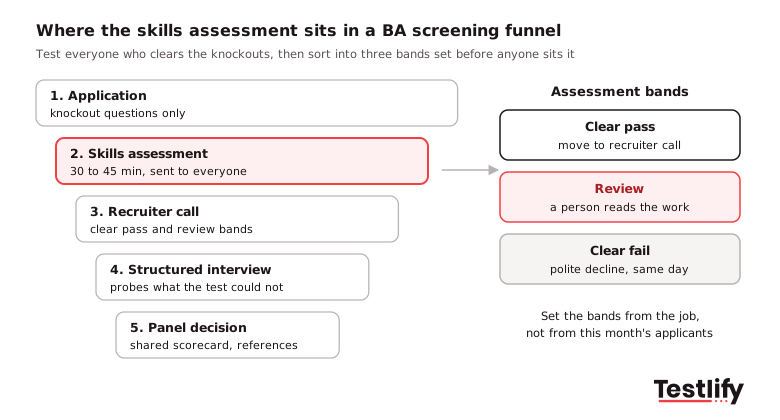
- Send it to everyone: Every applicant who clears the knockout questions gets the assessment, 30 to 45 minutes long.
Consider a hypothetical mid-size insurance company replacing its claims platform. The BA on that project spends most of their time interviewing adjusters, mapping the intake process and writing requirements the vendor can build against. SQL is nice to have and financial modeling is irrelevant.
A screen built from those tasks weights requirements elicitation at 40%, process modeling at 35% and written communication at 25%, and drops the data-query section. The off-the-shelf test the company almost bought weighted SQL at a third of the score, which would have filtered on a skill the job barely uses.
A ready-made business analyst test is the quickest starting point. The Testlify business analysis test covers analytical proficiency, stakeholder management, requirement elicitation and process modeling in a 10-minute situational judgment format, and you can add a business process mapping test, a stakeholder management test or your own written task to match the variant.
Pro tip: Before you buy or build anything, write down the single decision the assessment has to inform. "Can this person turn a messy request into a testable requirement?" is a test you can design. "Is this person good?" is not.
How do you set a fair passing score?
A fair passing score comes from the job, set before anyone sits the assessment. Ask experienced people in the role what a minimally competent new hire could do on each task, and set the bar there. Taking the top 20% of whoever applied this month means the standard moves with the applicant pool instead of the job.
- Write down the reasoning first: Record why the bar sits where it does. It forces the panel to agree on what competent means, and it gives you an answer if the process is ever questioned.
- Use bands, not one line: A 68 and a 71 are not meaningfully different. Sort candidates into clear pass, review and clear fail, and have a person read the work in the review band.
- Score work samples with a rubric and two reviewers: A written task graded by one person is a subjective interview in another format.
The review band is where the value hides. It holds candidates a resume screen would have rejected, and they are often people with unconventional backgrounds who can do the work.
What should you ask in a business analyst interview?
A business analyst interview should be structured: the same questions for every candidate, each tied to a competency, each scored against a written rubric. Use it to probe what the assessment could not reach, such as how a candidate handles conflicting stakeholders, rather than testing the same skills twice.
- Behavioral questions: "Tell me about a time a stakeholder changed requirements late. What did you do?" Score answers on situation, task, action and result.
- Situational questions: "Two department heads want opposite things from the same system. How do you decide what goes in the requirements?"
- A walkthrough of the assessment: Ask the candidate to explain one choice they made in the work sample. It shows reasoning and confirms the work is theirs.
- A cross-functional panel: Include someone from engineering or operations who will work with the analyst. They test whether the candidate can explain technical points to business people and the reverse.
Use an interview scorecard so every interviewer scores the same competencies, and pick questions from this list of business analyst interview questions. For the method itself, see how to run a structured interview.
Watch for these red flags:
- Vague results: "Improved processes" with no numbers, no scope and no example.
- Never pushing back: A business analyst who agrees with every stakeholder will write requirements that contradict each other.
- Tools over judgment: Long lists of tools and no clear account of a decision they influenced.
How do you make the final hiring decision?
The final hiring decision should combine three signals: the assessment result, the scored work sample and the structured interview. One score is fragile evidence. Three signals pointing the same way is a decision you can defend to the hiring manager, to a candidate who asks why, and to an auditor.
- Check references on specifics: Ask former managers how accurate the candidate's requirements were, how they turned stakeholder needs into specifications, and how they handled scope changes. See these best practices for reference checks.
- Make the offer quickly: Strong business analysts usually have more than one process running. Keep the whole process to three interview rounds at most.
- Onboard with a 30-60-90 day plan: Pair the new analyst with a stakeholder from day one and give them one real requirement to own in the first month.
- Check the test after two quarters: Compare assessment scores with performance reviews. If there is no relationship, the assessment is measuring something the job does not need. In the Testlify and SHRM Labs report, 44.5% of leaders said nobody formally validates their assessments, so this check alone puts you ahead. It is also the loop that improves quality of hire, not just time to hire.
What mistakes should you avoid when hiring business analysts?
The most common mistakes when hiring business analysts are using one generic screen for every variant, setting the pass mark after scores arrive, and testing only candidates who already passed a resume screen. Each one makes the process look objective while it filters on the wrong thing.
- Testing recall instead of analysis: Questions that ask for the phases of a waterfall project or the meaning of an acronym reward recent exam study, not the ability to do the work.
- Testing the wrong variant: A heavy SQL screen for a role that is 80% stakeholder workshops filters out the person who would have been excellent.
- A test that is too long: Past roughly 45 minutes, a screening assessment selects for who had a free evening, not who can do the job.
- Interviews that repeat the test: Whatever the assessment proved, the interview should probe for depth instead.
- Confusing BA with PM or data analyst: Write the job for the problem you have, using the role table above.
Hire your next business analyst with Testlify
Testlify gives you a role-based screen for each BA variant without building one from scratch. Start with the business analysis test, add SQL, Excel, process mapping or a written task from a library of 3,500+ tests, and send it to every applicant from your ATS. Results come back scored and ranked, with 20+ proctoring checks, so the interview can focus on depth.
If you are working out how to hire business analysts with a skills-based screen, pick one open BA role, write down the three or four competencies it needs, and build the assessment against those. Start a 7-day free trial with no credit card, or book a demo to map the process to your own roles.
Frequently asked questions (FAQs)

Human Resources Lead
Snehi Parmar leads People at Testlify, owning hiring, culture, performance, and retention for a 90-person team. She writes on practical HR strategy and building people processes that scale.
Related resources
View all
HR & recruitment
How can you ensure an engaging candidate experience from start to finish

HR & recruitment
How to simplify candidate screening with PostgreSQL test

HR & recruitment
How to reduce recruitment costs without sacrificing quality in 2026

HR & recruitment
How to hire top talent using postgresql test

HR & recruitment
How to incorporate Git test into your recruitment strategy

HR & recruitment
How to simplify candidate screening with git test
Get started.
Hire on proof, not resumes.
Run your first skills-based assessment free — no credit card required.